
Biofuels Market Outlook: Size, Share, Trends, Growth Analysis, Competitive Landscape & Forecast, 2026-2033

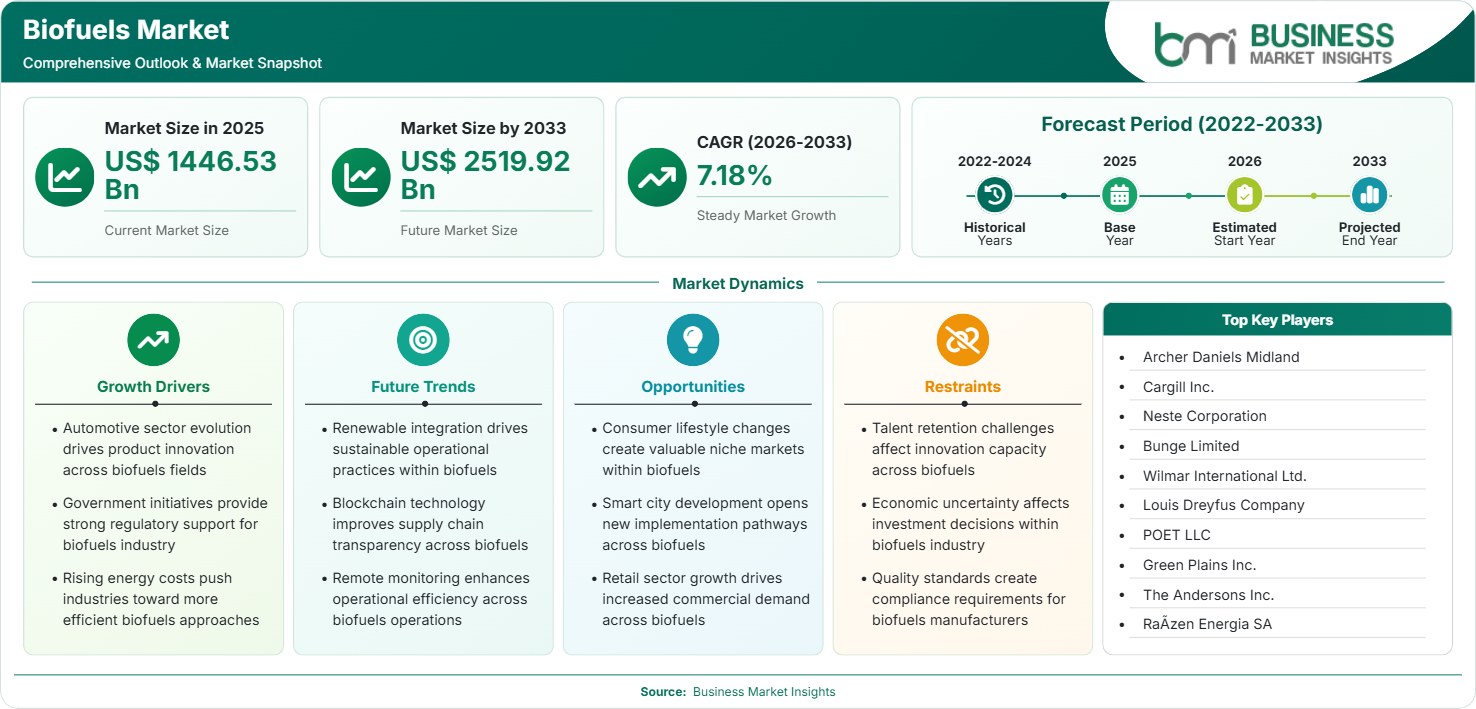
The Biofuels Market size was valued at US$ 1446.53 Billion in 2025 and is projected to reach US$ 2519.92 Billion by 2033, growing at a CAGR of 7.18% during 2026–2033. Expanding renewable fuel mandates, rising demand for low-carbon transportation fuels, supportive decarbonization policies, and investments in advanced biofuel technologies continue driving adoption, while sustainable feedstock innovation and aviation biofuels create significant long-term growth opportunities.

Report Coverage
  • Type: Solid , Liquid , Gaseous
  • Category: First-Generation, Second-Generation, Others
  • Application: Transport, Power Generation, Residential, Commercial & Industrial Heating, Others
US$ 1446.53 Bn Market size in 2025
US$ 2519.92 Bn Market Size by 2033
7.18% CAGR, 2026 - 2033
2026-2033 Forecast Period

AI Overview

Biofuels Market Summary

  • North America Region: North America holds 34%–37% market share in 2025, expanding at a 6.8%–7.4% CAGR during 2026–2033. Renewable fuel standards, abundant agricultural feedstocks, advanced refining infrastructure, increasing sustainable aviation fuel investments, and supportive tax incentives continue strengthening regional production and commercialization. The U.S. market benefits from robust renewable fuel policies and sustainable aviation fuel investments, advancing at a CAGR of 6.9%–7.5% through 2033.
  • Fastest Growing Region: Asia Pacific accounts for 27%–30% market share in 2025 and is projected to register a 8.2%–8.8% CAGR during 2026–2033. Expanding energy demand, government blending mandates, agricultural residue utilization, and investment in advanced bio-refineries continue accelerating regional development.
  • Leading Segment: Liquid biofuels represent 61%–65% market share in 2025 and are expected to grow at a 7.0%–7.6% CAGR during 2026–2033. Rising consumption of ethanol, biodiesel, and renewable diesel across transportation applications supports sustained segment leadership.
  • High Growth Segment: Second-Generation biofuels account for 27%–31% market share in 2025 while expanding at a 8.6%–9.2% CAGR through 2033. Technological advancements, non-food biomass utilization, and increasing sustainability regulations continue accelerating commercial deployment worldwide.
  • Key Market Opportunity: Expanding commercialization of sustainable aviation fuel, renewable diesel, and lignocellulosic biofuels presents substantial opportunities for producers, technology developers, and investors seeking scalable low-carbon energy solutions globally.
  • Major Market Players: Archer Daniels Midland Company, Cargill, Incorporated, Neste Oyj, Bunge Global SA, Wilmar International Limited, Louis Dreyfus Company B.V., POET, LLC, Green Plains Inc., The Andersons, Inc., Raízen S.A., CropEnergies AG, and Algenol.
Strategic Insights

Biofuels Market: Strategic Insights

Biofuels Market Strategic Framework
FREE PDF
Request your free sample
Request free sample
Stakeholder View

Key Takeaways

  • The market ecosystem is becoming increasingly integrated as feedstock suppliers, agricultural producers, biotechnology companies, refiners, distributors, and fuel retailers collaborate to establish resilient renewable fuel supply chains with improved production efficiency.
  • Second-generation biofuels present the strongest long-term growth opportunity because they utilize agricultural residues, forestry waste, and non-food biomass while addressing sustainability concerns associated with conventional feedstocks.
  • Innovation is accelerating through advanced biorefineries, enzyme optimization, gasification technologies, renewable diesel processing, and sustainable aviation fuel development that improve conversion efficiency and reduce carbon intensity.
  • Asia Pacific offers the most attractive regional investment opportunity owing to expanding fuel blending mandates, abundant biomass availability, supportive renewable energy policies, and increasing investment in commercial-scale production facilities.
  • Strategic partnerships, production capacity expansions, feedstock integration agreements, and investments in sustainable aviation fuel continue reshaping the competitive landscape while strengthening long-term industry profitability.
  • Rising demand for certified low-carbon fuels across transportation, industrial, and aviation sectors is encouraging continuous innovation in feedstock utilization, process optimization, and lifecycle emissions reduction technologies.
Geographic Outlook

Biofuels Market Regional Highlights

North America Biofuels Market

North America represented 34%–37% of global revenue in 2025 and is projected to expand at a 6.8%–7.4% CAGR during 2026–2033. Strong renewable fuel mandates, abundant corn and soybean feedstocks, advanced refining infrastructure, and increasing investments in sustainable aviation fuel continue supporting regional production. The United States dominates regional consumption and production, while Canada strengthens demand through clean fuel regulations and renewable diesel capacity expansion. The Biofuels Market share remains highest in North America because of well-established supply chains and supportive policy frameworks.

  • Renewable Fuel Standard programs continue encouraging higher ethanol and biodiesel blending rates, creating stable demand across transportation fuels while stimulating investment in advanced biofuel technologies and production facilities.
  • Growing commercialization of sustainable aviation fuel encourages refiners and airlines to establish long-term supply agreements, accelerating investment in renewable diesel and advanced biomass conversion technologies.
  • Agricultural abundance supports reliable feedstock availability, enabling cost-efficient production while encouraging innovation in waste-based and non-food biomass utilization for next-generation biofuel manufacturing.
  • Public and private investments in carbon reduction initiatives strengthen commercialization of renewable fuels, supporting industrial decarbonization and enhancing regional competitiveness within global clean energy markets.
  • Digital process optimization and integrated biorefineries improve production efficiency, reduce lifecycle emissions, and strengthen profitability for established producers operating across diversified renewable fuel portfolios.

US Biofuels Market

The United States accounted for approximately 82%–85% of North American revenue in 2025 and is expected to register a 6.9%–7.5% CAGR during 2026–2033. Extensive corn ethanol production, renewable diesel investments, federal tax incentives, and increasing sustainable aviation fuel deployment continue reinforcing the country's leadership across global renewable fuel production.

  • Strong agricultural infrastructure ensures reliable feedstock supply while supporting cost-effective expansion of ethanol, biodiesel, renewable diesel, and advanced biofuel manufacturing capacity.
  • Major energy companies continue investing in renewable fuel conversion facilities to meet growing demand from transportation, aviation, and industrial customers pursuing lower-carbon energy alternatives.
  • Government incentives and clean energy funding encourage commercialization of advanced conversion technologies utilizing agricultural residues, municipal waste, and lignocellulosic biomass.
  • Strategic partnerships between biotechnology firms, agricultural cooperatives, and refiners accelerate innovation while strengthening domestic renewable fuel supply chains.

Europe Biofuels Market

Europe accounted for 25%–28% of global revenue in 2025 and is anticipated to grow at a 7.2%–7.8% CAGR through 2033. Ambitious decarbonization targets, renewable energy directives, and sustainable transport initiatives continue driving regional demand. Germany remains the largest producer and consumer, while Finland records the strongest growth because of renewable diesel innovation and advanced biofuel technology investments.

  • Renewable Energy Directive implementation continues increasing renewable fuel consumption across transportation sectors while encouraging investment in sustainable feedstock development and advanced refining technologies.
  • Aviation and maritime decarbonization policies strengthen demand for sustainable aviation fuel and renewable diesel throughout commercial transportation networks.
  • Circular economy initiatives promote greater utilization of agricultural residues, forestry by-products, and organic waste streams as renewable biofuel feedstocks.
  • Advanced biorefinery investments enhance production efficiency while supporting commercialization of second-generation biofuels with lower lifecycle greenhouse gas emissions.
  • Cross-border collaboration strengthens renewable fuel supply chains and encourages innovation through research partnerships between industry participants and academic institutions.

Asia Pacific Biofuels Market

Asia Pacific held 27%–30% of global revenue in 2025 and is projected to register the fastest regional expansion with a 8.2%–8.8% CAGR during 2026–2033. China leads regional production through expanding renewable fuel capacity, while India demonstrates the highest growth supported by ethanol blending targets, agricultural residue utilization, and government incentives promoting domestic biofuel manufacturing.

  • National blending mandates continue stimulating ethanol and biodiesel demand while encouraging long-term investments in renewable fuel production infrastructure across emerging economies.
  • Large agricultural sectors provide abundant biomass resources supporting cost-effective production of first-generation and advanced biofuels throughout the region.
  • Increasing energy security initiatives encourage governments to reduce dependence on imported fossil fuels through domestic renewable fuel production.
  • Investments in advanced biorefineries improve conversion efficiency and promote commercialization of second-generation technologies utilizing agricultural waste and forestry residues.
  • Growing industrialization and transportation demand create sustained opportunities for renewable fuel adoption across commercial and public sectors.

Rest of World Biofuels Market

Rest of World represented 10%–13% of global revenue in 2025 and is forecast to expand at a 7.4%–8.0% CAGR during 2026–2033. South & Central America remains a major production hub led by Brazil's sugarcane ethanol industry, while the Middle East and Africa continue increasing renewable fuel investments through national energy diversification strategies and agricultural development programs.

  • Brazil maintains leadership through large-scale sugarcane ethanol production, advanced processing technologies, and expanding export opportunities supporting regional renewable fuel growth.
  • Argentina continues strengthening biodiesel production by leveraging abundant soybean feedstocks and export-oriented processing infrastructure.
  • Gulf countries increasingly evaluate renewable fuels to complement broader energy transition strategies and reduce transportation-related emissions.
  • African economies expand pilot biofuel initiatives utilizing locally available biomass resources while supporting rural economic development and energy access.
  • International investment and technology transfer continue improving commercial production capabilities, encouraging wider adoption of sustainable renewable fuels across emerging markets.

Global Market Geography
FREE PDF
Request your free sample
Request free sample
Segment Analysis

Biofuels Market Segmentation

Type

The Type segment represents the largest revenue contribution within the Biofuels Market scope, with Liquid biofuels accounting for 61%–65% market share in 2025 and projected to grow at a 7.0%–7.6% CAGR during 2026–2033. Expanding transportation fuel blending mandates, increasing renewable diesel production, and technological advancements in ethanol manufacturing continue supporting segment dominance. Solid and gaseous biofuels also benefit from growing industrial decarbonization initiatives and sustainable waste utilization across multiple end-use sectors.

  • Solid: Primarily utilized for heat and power generation, solid biofuels continue gaining importance through improved biomass processing technologies and increasing utilization of agricultural residues, forestry resources, and waste-derived feedstocks.
    • Woody Materials: Forest residues, wood pellets, and wood chips remain widely adopted for industrial heating and biomass power generation because of established supply chains and reliable combustion performance.
    • Crops: Dedicated energy crops support biomass fuel production by providing renewable feedstock sources for thermal energy generation while improving rural agricultural income opportunities.
    • Municipal Solid Waste (MSW): Waste-to-energy projects increasingly convert municipal waste into usable bioenergy, supporting landfill reduction objectives while improving circular economy implementation and sustainable resource management.
  • Liquid: Ethanol, biodiesel, and renewable diesel continue dominating renewable transportation fuels because of established blending infrastructure, expanding regulatory support, and increasing demand for lower-carbon mobility solutions.
    • Fuel Ethanol: Ethanol remains the most widely consumed liquid biofuel, supported by gasoline blending mandates, mature production infrastructure, and abundant agricultural feedstock availability across major producing countries.
    • Biodiesel: Biodiesel continues supporting commercial transportation, agricultural equipment, and heavy-duty vehicle decarbonization through compatibility with existing diesel engines and renewable feedstock utilization.
    • Renewable Diesel: Renewable diesel experiences accelerating adoption because of superior fuel characteristics, compatibility with conventional diesel infrastructure, and increasing investment in advanced hydrotreated fuel production technologies.
  • Gaseous: Biogas and biomethane production continue expanding through anaerobic digestion of agricultural residues, food waste, and wastewater, supporting renewable electricity generation and cleaner industrial fuel applications.

Category

The By Category segment demonstrates increasing diversification as advanced technologies improve commercial viability. First-Generation biofuels maintained 58%–62% Biofuels Market share in 2025 and are expected to expand at a 6.8%–7.4% CAGR through 2033. Meanwhile, continuous innovation in non-food biomass conversion and sustainability policies accelerates adoption of advanced alternatives, strengthening long-term industry competitiveness while reducing dependence on food-based feedstocks.

  • First-Generation: Produced primarily from sugar, starch, and vegetable oils, these biofuels continue serving transportation markets because of mature technologies, extensive production capacity, and established distribution infrastructure.
  • Second-Generation: Agricultural residues, forestry biomass, and lignocellulosic materials enable sustainable fuel production while minimizing competition with food resources and supporting lower lifecycle greenhouse gas emissions.

Application

The Application segment reflects broad adoption across transportation and energy sectors. Transport accounted for 54%–58% market share in 2025 and is anticipated to register a 7.4%–8.0% CAGR during 2026–2033. Growing renewable fuel blending mandates, commercial fleet decarbonization, and sustainable aviation initiatives continue driving demand. The Biofuels Market trends increasingly emphasize diversified applications beyond transportation, including power generation and industrial heating.

  • Transport: Passenger vehicles, commercial fleets, aviation, marine transport, and rail systems increasingly utilize renewable fuels to reduce greenhouse gas emissions while complying with national renewable energy regulations.
  • Power Generation: Biomass-fired power plants and biogas facilities continue supporting renewable electricity generation by utilizing agricultural waste, forestry residues, and organic municipal resources.
  • Residential: Households increasingly adopt biomass pellets, biogas, and renewable heating fuels to improve energy efficiency while reducing dependence on conventional fossil fuel sources.
  • Commercial & Industrial Heating: Manufacturing facilities, commercial buildings, and district heating networks continue incorporating renewable biomass fuels to reduce operational emissions and improve long-term energy sustainability.
Market Forces

Biofuels Market Dynamics

Key Market Drivers

Government Renewable Fuel Policies Accelerate Biofuel Adoption

Renewable fuel standards, ethanol blend requirements, and low-carbon fuels policies still provide the most compelling drivers for growth in the industry. Regulations in the United States, Brazil, Europe, India, and Indonesia will continue to push for greater use of renewable fuels to cut greenhouse gas emissions and enhance energy security. As per the International Energy Agency (IEA), biofuels will continue to form an important part of decarbonizing the transport sector, especially in aviation and heavy-duty transport modes. The Biofuels Market growth is further supported by increasing investments in advanced production facilities, stable feedstock supply chains, and fiscal incentives encouraging commercial deployment of renewable diesel, ethanol, and sustainable aviation fuel technologies across developed and emerging economies.

Growing Demand for Sustainable Aviation Fuel and Renewable Diesel

The aviation and heavy transportation industries are rapidly increasing the adoption of renewable fuels to achieve long-term decarbonization objectives. Airlines, logistics firms, and freight forwarders are signing up for long-term supply contracts for sustainable aviation fuel (SAF) and renewable diesel as emission standards are tightened by governments. For airlines to cut their carbon footprint, SAF is still very critical in air transport, as stated by the International Air Transport Association (IATA). Increased refining capabilities, better processing techniques, and more readily available waste materials are contributing to making it commercially viable. The increased involvement of oil refineries in this process adds to the development of supply and new business avenues for renewable fuels.

Advancements in Second-Generation Feedstock Technologies

Continuous innovation in biomass conversion technologies is improving production efficiency while reducing dependence on food-based feedstocks. Development of advanced enzyme hydrolysis, gasification, pyrolysis, and fermentation techniques can help in the production of biofuels from agricultural waste, wood industry byproducts, solid municipal waste, and lignocellulosic biomass with low emissions. Efforts are being made at research organizations and biotechnology firms to develop better feedstock and process integration. The Biofuels Market trends increasingly reflect a transition toward circular economy principles, where waste materials become valuable renewable energy resources. These innovations strengthen environmental performance while improving feedstock diversification and long-term industry resilience against agricultural commodity price fluctuations.

Key Market Opportunities

Commercial Expansion of Sustainable Aviation Fuel Production

Sustainable aviation fuel represents one of the most attractive long-term investment opportunities as airlines pursue net-zero emissions commitments and governments introduce SAF blending requirements. Refineries are constantly increasing production capacity, while airlines are setting up long-term purchasing contracts to ensure the supply of renewable fuels. Investments in waste oils, agri-waste, and man-made biofuels keep enhancing feedstock availability and production scalability. The Biofuels Market Forecasts indicate increasing commercial demand for aviation fuels with substantially lower lifecycle emissions, creating opportunities for technology providers, feedstock suppliers, and integrated energy companies seeking participation in rapidly expanding low-carbon aviation value chains.

Development of Waste-Based and Circular Economy Biofuels

Growing emphasis on waste valorization creates substantial opportunities for producers utilizing municipal solid waste, food waste, agricultural residues, and industrial by-products as renewable feedstocks. Governments continue to advance the concept of a circular economy to reduce reliance on landfills and, at the same time, create renewable fuels and power for transportation. The development of advanced biochemical and thermochemical conversion systems allows for improved economics and increased flexibility with respect to raw materials used. It is a direction that is being pursued by utilities, cities, waste management firms, and renewable energy developers.

Emerging Markets Investing in Advanced Biorefineries

There is an upsurge of investments in commercial-scale biorefineries in the emerging economies of the Asia Pacific, Latin America, Africa, and the Middle East in order to achieve energy security by reducing their dependency on imported fossil fuels. Favorable government policies, abundant agricultural resources, and growing demand for transport are some factors driving the growth of renewable fuel production capacities. These investments create opportunities for engineering companies, biotechnology developers, and equipment manufacturers while strengthening regional renewable energy ecosystems and improving long-term Biofuels Market competitiveness.

Market Restraints and Challenges

Feedstock Price Volatility and Supply Chain Constraints

Factor: Agricultural commodity prices, seasonal harvest variability, weather conditions, and competing demand from food and industrial sectors significantly influence feedstock availability and production costs.

Impact: The manufacturers of biofuels encounter volatile operating margins, decreased flexibility in their production schedules, and greater procurement risks during times of disruption in supply chains. The use of traditional feedstocks like corn, sugarcane, soybean oil, and vegetable oils exposes them to costs that decrease their competitiveness with fossil fuels. Expanding utilization of waste biomass, agricultural residues, and second-generation feedstocks will remain essential for improving long-term supply resilience and reducing exposure to commodity Biofuels Market volatility.

Infrastructure Limitations and Regulatory Inconsistencies

Factor: Differences in renewable fuel standards, blending mandates, sustainability certification requirements, and distribution infrastructure across countries create operational complexity for producers and fuel distributors.

Impact: For businesses operating internationally, there are increased costs of complying with regulations, delayed implementation of projects, and increased uncertainty of investments. The lack of storage and transportation infrastructures and refueling stations for advanced renewable fuels also hinders further commercialization in some areas. More international cooperation on the issue of sustainability standards, certifications, and fuel quality will facilitate easier trade across borders and promote investments in renewable fuels.

Company Analysis

Competitive Landscape

The competitive landscape is characterized by vertically integrated agribusiness companies, renewable fuel producers, biotechnology innovators, and advanced biorefinery operators expanding global production capacity. The Biofuels Market analysis indicates increasing investments in second-generation biofuels, renewable diesel, sustainable aviation fuel (SAF), and feedstock diversification. Strategic collaborations between agricultural suppliers, refiners, airlines, and technology developers continue strengthening commercialization while supporting compliance with evolving low-carbon fuel regulations.

Company Name

Overview

Products and Services Relevant to this Market

Archer Daniels Midland Company

Global agricultural processing and nutrition company with extensive biofuel manufacturing operations and integrated grain procurement supporting renewable fuel production worldwide.

Fuel ethanol, renewable feedstock processing, grain sourcing, corn processing, carbon reduction solutions, and sustainable agricultural supply chain services.

Cargill, Incorporated

Diversified agribusiness company leveraging global agricultural assets to support renewable energy production and sustainable feedstock supply for biofuel manufacturers.

Biodiesel feedstocks, vegetable oils, agricultural commodities, supply chain management, sustainability consulting, and renewable fuel raw material solutions.

Neste Oyj

Global leader in renewable fuels recognized for advanced renewable diesel and sustainable aviation fuel technologies supported by waste and residue feedstocks.

Renewable diesel, sustainable aviation fuel, renewable feedstock processing, emission reduction solutions, and advanced refining technologies.

Bunge Global SA

International agribusiness company integrating oilseed processing with renewable fuel supply chains to support global biofuel production and sustainability initiatives.

Vegetable oils, oilseed processing, biodiesel feedstocks, renewable fuel supply, grain merchandising, and sustainable sourcing solutions.

Wilmar International Limited

Leading agribusiness company operating integrated agricultural processing and renewable energy businesses across Asia and global commodity markets.

Biodiesel production, vegetable oil processing, renewable feedstocks, agricultural supply chain management, and sustainable sourcing programs.

Louis Dreyfus Company B.V.

Global merchant and processor of agricultural commodities supporting renewable fuel production through integrated logistics and feedstock procurement operations.

Oilseed processing, biofuel feedstocks, agricultural trading, logistics services, renewable commodity sourcing, and sustainability solutions.

POET, LLC

One of the world's largest bioethanol producers focused on innovation, sustainable agriculture, and advanced renewable fuel technologies.

Fuel ethanol, bioproducts, carbon capture initiatives, renewable fuel technologies, and agricultural co-product commercialization.

Green Plains Inc.

Renewable fuels company investing in high-efficiency ethanol production, carbon reduction technologies, and value-added agricultural processing capabilities.

Fuel ethanol, renewable corn oil, protein ingredients, carbon capture technologies, and sustainable biofuel production solutions.

The Andersons, Inc.

Agricultural company supporting grain merchandising, renewable fuel supply chains, and feedstock logistics serving North American biofuel producers.

Grain merchandising, ethanol services, feedstock logistics, renewable fuel distribution, and agricultural supply chain management.

Raízen S.A.

Brazilian energy company integrating sugarcane cultivation with large-scale ethanol production and renewable energy operations supporting transportation decarbonization.

Sugarcane ethanol, bioelectricity, renewable fuels, biomass energy production, and integrated agricultural energy solutions.

CropEnergies AG

European renewable fuel producer specializing in sustainable ethanol manufacturing using diversified agricultural feedstocks and efficient processing technologies.

Fuel ethanol, renewable alcohol products, feedstock processing, co-products, and sustainable fuel manufacturing solutions.

Algenol

Biotechnology company developing algae-based renewable fuel technologies and advanced low-carbon biofuel production processes.

Algae-derived biofuels, biotechnology research, carbon utilization technologies, renewable energy innovation, and advanced biofuel development.

Trust & Transparency

Research Methodology

The market analysis combines proprietary research with secondary data from government agencies, company disclosures, regulatory filings, industry databases and expert interviews. Market estimates are validated through data triangulation, cross-market benchmarking and analyst review.

View Full Research Methodology

Questions Answered

Frequently Asked Questions

What insights does this Biofuels Market Report provide?

The report delivers detailed analysis of market size, competitive positioning, regional outlook, segment performance, technology developments, investment opportunities, regulatory trends, and strategic business recommendations supporting informed decision-making.

Which application dominates global biofuel consumption?

Transportation remains the leading application due to widespread ethanol and biodiesel blending programs, increasing renewable diesel demand, and growing commercialization of sustainable aviation fuel across global mobility sectors.

Why is Asia Pacific considered a high-growth region?

Rapid industrialization, expanding transportation demand, supportive blending mandates, abundant agricultural biomass, and increasing government investment in commercial biorefineries continue accelerating renewable fuel production throughout the region.

Which biofuel category is expected to experience the fastest growth?

Second-generation biofuels are projected to grow the fastest because they utilize non-food biomass, agricultural residues, forestry waste, and municipal waste while offering improved sustainability and lower lifecycle greenhouse gas emissions.

What are the primary factors driving the Biofuels Market?

The market is driven by renewable fuel blending mandates, decarbonization targets, sustainable aviation fuel adoption, energy security initiatives, and increasing investments in advanced biomass conversion technologies utilizing agricultural residues and waste feedstocks.

Access the Full Biofuels Market Report

Get segment-level forecasts, regional estimates, competitive benchmarking, company profiles and downloadable Excel datasets.

Access the full Biofuels Market Report
350 pages PDF & Excel | 2026-08-18
Similar Research

Related Market Reports