
Algae Biofuel Market Outlook: Size, Share, Trends, Growth Analysis, Competitive Landscape & Forecast, 2026-2033

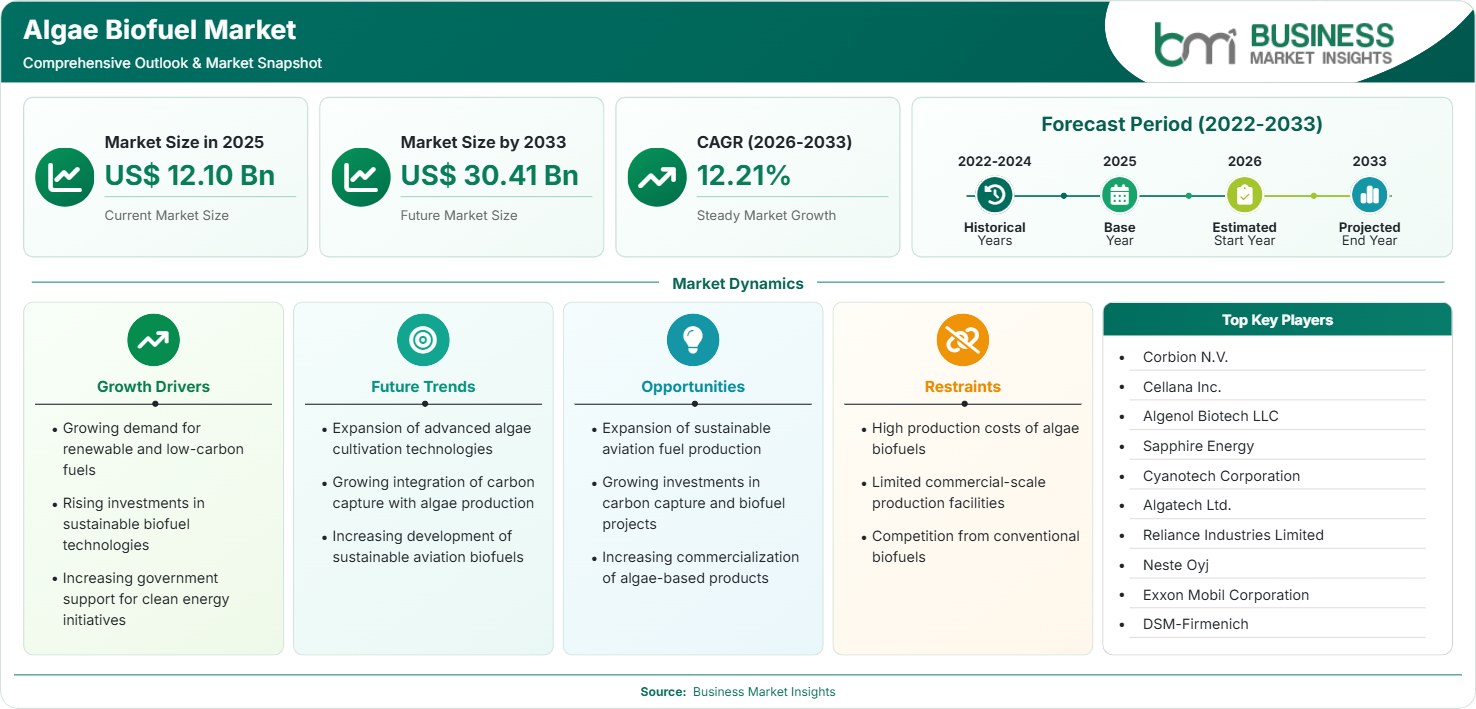
The Algae Biofuel Market size was valued at US$ 12.10 Billion in 2025 and is projected to reach US$ 30.41 Billion by 2033, growing at a CAGR of 12.21% from 2026 to 2033, driven by renewable fuel adoption, decarbonization initiatives, sustainable aviation fuel demand, carbon reduction investments, and advancements in algae cultivation technologies.

Report Coverage
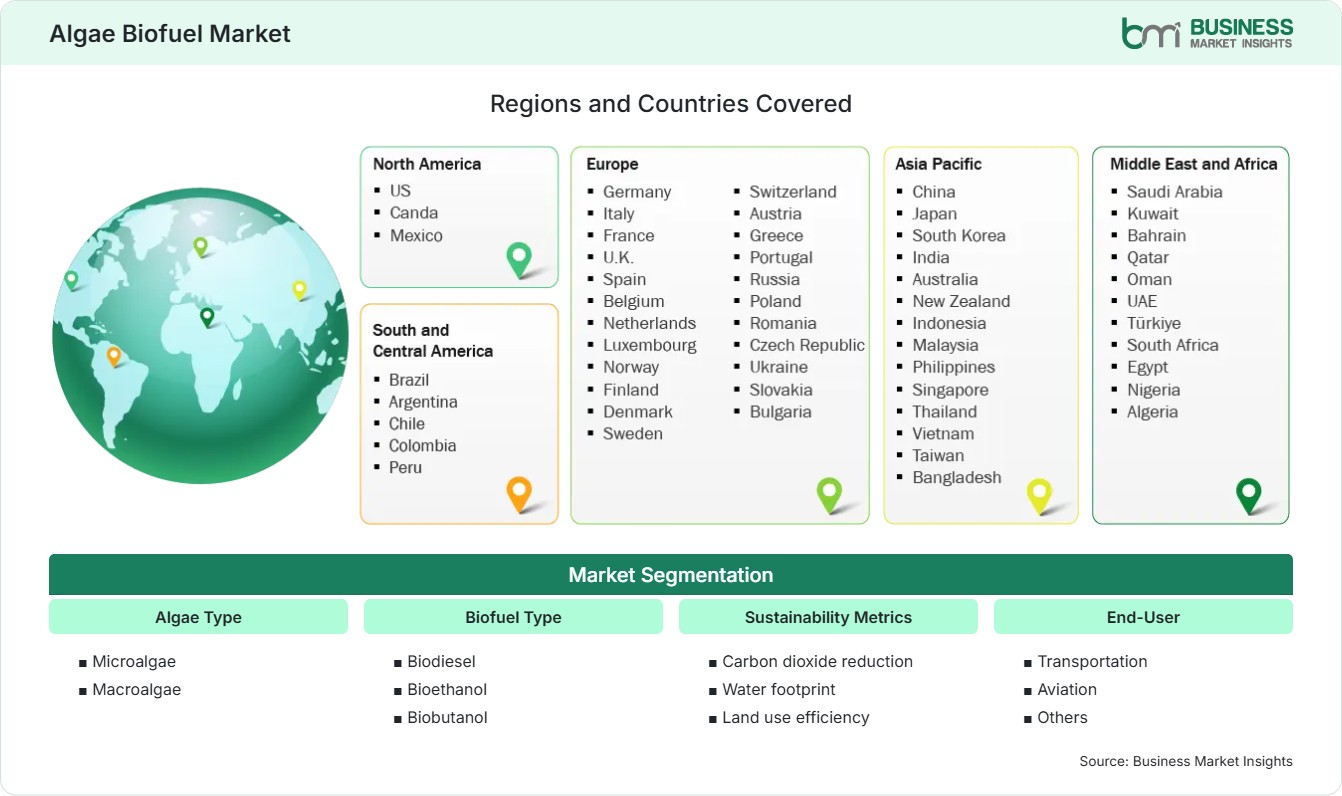
  • Algae Type: Microalgae, Macroalgae
  • Biofuel Type: Biodiesel, Bioethanol, Biobutanol
  • Sustainability Metrics: Carbon dioxide reduction, Water footprint, Land use efficiency
  • End-User: Transportation, Aviation, Others
US$ 12.10 Bn Market size in 2025
US$ 30.41 Bn Market Size by 2033
12.21% CAGR, 2026 - 2033
2026-2033 Forecast Period

AI Overview

Algae Biofuel Market Summary

  • North America Region: North America holds 34%–37% share in 2025, growing at a CAGR of 11.80%–12.40% during 2026–2033, supported by clean energy investments, biofuel innovation, carbon reduction programs, and research activities. The US market is expanding at a CAGR of 12.00%–12.60% due to renewable fuel policies, biotechnology investments, and sustainable aviation fuel development.
  • Fastest Growing Region: Asia Pacific accounts for 30%–33% share in 2025 and is growing at a CAGR of 12.80%–13.50% from 2026–2033 due to increasing renewable energy investments, industrial biotechnology development, government clean energy programs, and rising demand for sustainable fuel alternatives.
  • Leading Segment: Microalgae represents 62%–65% share in 2025 and is growing at a CAGR of 12.40%–13.00% during 2026–2033 due to higher productivity, greater lipid content, biotechnology advancements, and suitability for large-scale biofuel applications.
  • High Growth Segment: Aviation represents 27%–30% share in 2025 and is projected to grow at a CAGR of 13.20%–13.90% through 2033 due to sustainable aviation fuel initiatives, airline decarbonization targets, and increasing demand for low-carbon alternatives.
  • Key Market Opportunity: Sustainable aviation fuel expansion, carbon capture integration, and commercialization of algae-based products are creating opportunities for companies developing scalable and environmentally efficient biofuel technologies.
  • Major Market Players: Corbion N.V., Cellana Inc., Algenol Biotech LLC, Sapphire Energy, Cyanotech Corporation, Algatech Ltd., Reliance Industries Limited, Neste Oyj, Exxon Mobil Corporation, and DSM-Firmenich.
Strategic Insights

Algae Biofuel Market: Strategic Insights

Algae Biofuel Market Strategic Framework
FREE PDF
Request your free sample
Request free sample
Stakeholder View

Key Takeaways

  • The market ecosystem is developing through collaboration among biotechnology companies, energy producers, research institutions, and government organizations focused on renewable fuel innovation.
  • Sustainable aviation fuel, transportation applications, and carbon reduction projects represent major growth opportunities as industries seek alternatives to conventional fossil fuels.
  • Technology advancement is focused on improving algae cultivation efficiency, biomass processing, carbon capture integration, and cost reduction strategies.
  • North America and Asia Pacific provide attractive investment opportunities due to clean energy policies, biotechnology capabilities, and renewable fuel development initiatives.
  • Partnerships between energy companies and algae technology providers are increasing to accelerate commercialization and overcome production challenges.
  • Sustainability measurement factors such as carbon reduction, water efficiency, and land utilization are becoming important evaluation criteria for biofuel projects.
Geographic Outlook

Algae Biofuel Market Regional Highlights

North America Algae Biofuel Market

North America accounted for 34%–37% share in 2025 and is expected to grow at a CAGR of 11.80%–12.40% during 2026–2033. The region benefits from advanced biotechnology research, renewable fuel policies, and strong investment in sustainable energy solutions. The Algae Biofuel Market share is supported by government initiatives, private sector funding, and increasing interest in low-carbon fuel technologies across transportation and aviation sectors.

  • The US remains a major contributor due to renewable fuel development programs and biotechnology investments.
  • Companies are investing in algae cultivation systems and sustainable aviation fuel research.
  • Carbon reduction initiatives are supporting demand for alternative fuel technologies.
  • Research institutions are developing improved algae production and processing methods.

US Algae Biofuel Market

The US represents 28%–31% share of North America in 2025 and is projected to grow at a CAGR of 12.00%–12.60% during 2026–2033. The country benefits from clean energy investments, biotechnology expertise, and increasing demand for sustainable fuel solutions. Government support for renewable fuels and private sector research activities are encouraging development of algae-based fuel technologies for transportation and aviation applications in Algae Biofuel Market forcasts.

  • Renewable fuel programs are encouraging investments in alternative fuel technologies.
  • Aviation companies are exploring algae-based solutions for sustainable fuel development.
  • Biotechnology firms are improving algae production efficiency through research and innovation.

Europe Algae Biofuel Market

Europe accounted for 24%–27% share in 2025 and is forecast to grow at a CAGR of 11.50%–12.20% between 2026–2033. The region benefits from strong climate policies, renewable energy targets, and sustainability-focused investments. Germany, France, the United Kingdom, and the Netherlands are major contributors in Algae Biofuel Market. The United Kingdom demonstrates a CAGR of 11.80%–12.50% due to sustainable aviation fuel initiatives and clean energy innovation programs.

  • European regulations supporting carbon reduction are encouraging alternative fuel development.
  • Aviation decarbonization targets are increasing interest in algae-based fuel pathways.
  • Energy companies are investing in sustainable biotechnology projects.
  • Research collaborations are improving algae cultivation and processing technologies.

Asia Pacific Algae Biofuel Market

Asia Pacific accounted for 30%–33% share in 2025 and is projected to grow at a CAGR of 12.80%–13.50% during 2026–2033. The region represents the fastest-growing market due to increasing renewable energy investments, industrial biotechnology development, and government support for clean energy transitions. China, Japan, India, and Southeast Asian countries are key contributors in Algae Biofuel Market. China demonstrates a CAGR of 13.00%–13.70% due to renewable energy expansion and biotechnology investments.

  • China is increasing investment in alternative fuel research and renewable energy technologies.
  • India is developing biofuel initiatives to improve energy security and reduce emissions.
  • Southeast Asian countries are exploring algae cultivation opportunities due to favorable conditions.
  • Industrial partnerships are supporting commercialization of algae-based products.

Rest of World Algae Biofuel Market

Rest of World accounted for 7%–10% share in 2025 and is expected to grow at a CAGR of 10.80%–11.50% during 2026–2033. South America is developing through renewable energy investments and biofuel expansion programs, while the Middle East and Africa are exploring algae technologies for carbon reduction and energy diversification in Algae Biofuel Market. Increasing interest in sustainable fuel production and resource-efficient technologies is supporting gradual market development across emerging regions.

  • Brazil and other South American countries are exploring renewable fuel opportunities through existing bioenergy infrastructure.
  • Middle Eastern nations are investing in carbon reduction technologies and alternative energy solutions.
  • African markets are evaluating algae cultivation opportunities to support sustainable fuel development.
  • International collaborations are helping emerging regions access algae production technologies.
Global Market Geography
FREE PDF
Request your free sample
Request free sample
Segment Analysis

Algae Biofuel Market Segmentation

Algae Type

The Algae Type segment includes Microalgae and Macroalgae. Microalgae maintains a leading position due to higher biomass productivity, strong lipid content, and suitability for biofuel conversion processes. Macroalgae is gaining attention due to cultivation advantages and potential applications in sustainable fuel production. The segment is projected to grow at a CAGR of 12.50%–13.10% during 2026–2033, supported by biotechnology advancements, improved cultivation systems, and increasing renewable fuel investments in Algae Biofuel Market.

  • Microalgae: Microalgae offers high productivity and efficient oil extraction capabilities, supporting biodiesel and sustainable fuel production applications.
  • Macroalgae: Macroalgae provides cultivation flexibility and supports research into alternative biomass sources for renewable fuel development.

Biofuel Type

The Biofuel Type segment includes Biodiesel, Bioethanol, and Biobutanol. Biodiesel represents a significant application due to compatibility with existing diesel infrastructure and established conversion processes. Bioethanol and Biobutanol are gaining interest through advancements in biochemical processing and renewable fuel research. The segment is projected to expand at a CAGR of 12.30%–12.90% during 2026–2033 as companies improve algae conversion efficiency and commercial scalability in Algae Biofuel Market.

  • Biodiesel: Biodiesel production from algae is gaining attention due to high oil content and potential for renewable diesel alternatives.
  • Bioethanol: Bioethanol applications are supported by research into algae-based carbohydrate conversion and sustainable fuel pathways.
  • Biobutanol: Biobutanol development is increasing due to higher energy density and potential transportation fuel applications.

Sustainability Metrics

The Sustainability Metrics segment includes Carbon dioxide reduction, Water footprint, and Land use efficiency. These metrics are becoming important factors for evaluating algae biofuel projects as industries focus on environmental performance. Carbon dioxide reduction remains a key consideration due to decarbonization objectives. Improved cultivation methods are helping optimize water consumption and land utilization. The segment is projected to grow at a CAGR of 12.60%–13.20% during 2026–2033.

  • Carbon dioxide reduction: Carbon reduction capabilities are supporting algae biofuel adoption in industries seeking lower-emission energy alternatives.
  • Water footprint: Water efficiency improvements are influencing algae cultivation methods and sustainable production strategies.
  • Land use efficiency: Efficient land utilization advantages are encouraging research into algae-based fuel systems.

End-User

The End-User segment includes Transportation, Aviation, and Others. Transportation applications maintain strong adoption in Algae Biofuel Market due to demand for renewable fuel alternatives and emission reduction strategies. Aviation represents a high-growth area because airlines and fuel producers are exploring sustainable aviation fuel solutions. The segment is projected to grow at a CAGR of 12.70%–13.40% during 2026–2033, supported by clean energy initiatives and increasing commercial interest.

  • Transportation: Transportation applications are adopting algae biofuels to support emission reduction goals and renewable fuel integration.
  • Aviation: Aviation demand is increasing due to sustainable aviation fuel development and industry decarbonization targets.
Market Forces

Algae Biofuel Market Dynamics

Key Market Drivers

Growing demand for renewable and low-carbon fuels

Growing demand for renewable and low-carbon fuels is accelerating interest in algae-based alternatives as industries seek solutions to reduce greenhouse gas emissions and dependence on fossil fuels. Algae biofuels offer potential advantages through carbon utilization, efficient biomass production, and compatibility with sustainability objectives. The growth is influenced by global decarbonization commitments, renewable energy investments, and increasing demand from transportation sectors. The Algae Biofuel Market trends indicate stronger focus on developing scalable production systems, improving conversion efficiency, and integrating algae technologies into broader clean energy strategies.

Rising investments in sustainable biofuel technologies

Increases in investments on the development of technologies for sustainable biofuels have led to advances in algae growth, extraction processes, and commercialization approaches. Investments by energy and biotechnology firms along with research institutions are geared towards improving strains, harvesting processes, and production technologies to enhance the commercial viability of algae fuels. Companies are pursuing collaborations that will integrate biotechnological knowledge with the energy industry's capabilities. Advancements in carbon capture systems and renewable fuel research provide algae technologies an opportunity to become a part of future energy systems with lower carbon emissions.

Increasing government support for clean energy initiatives

Increasing government support for clean energy initiatives is encouraging the development of algae biofuel technologies through renewable energy policies, research funding, and sustainability programs. Governments are adopting strategies to cut carbon emissions and enhance energy security, making it easier to develop alternative fuels. Government financing and favorable regulations are ensuring that research and development are hastened for businesses. Algae-based fuels are being considered as part of the renewable energy strategy, as they can help meet carbon emissions reduction targets.

Key Market Opportunities

Expansion of sustainable aviation fuel production

The expansion of sustainable aviation fuel production is creating significant opportunities for algae biofuel companies as airlines and fuel producers focus on reducing aviation-related emissions. Algae-based feedstocks are gaining attention due to their renewable characteristics, carbon reduction potential, and compatibility with advanced fuel conversion pathways. Aviation companies are investing in alternative fuel strategies to meet long-term sustainability targets, creating demand for scalable biofuel solutions. Technology providers developing efficient algae cultivation, extraction, and refining processes can benefit from partnerships with aviation stakeholders. Increasing regulatory focus on cleaner aviation operations is supporting research activities and commercial development of algae-derived sustainable aviation fuel solutions.

Growing investments in carbon capture and biofuel projects

Growing investments in carbon capture and biofuel projects are creating opportunities for algae technology providers by combining emissions reduction strategies with renewable fuel production. Algae cultivation can utilize carbon dioxide sources, supporting integrated approaches for reducing industrial emissions while generating valuable biomass. Energy companies and industrial organizations are exploring projects that connect carbon capture technologies with algae production systems. These initiatives are encouraging development of large-scale facilities focused on improving sustainability outcomes and resource efficiency. Companies offering integrated solutions involving carbon utilization, biomass processing, and fuel conversion are positioned to benefit from increasing investment in low-carbon energy infrastructure.

Increasing commercialization of algae-based products

Increasing commercialization of algae-based products is expanding opportunities beyond traditional biofuel applications as companies explore multiple revenue streams from algae biomass. Algae-derived products are being developed for fuel, chemicals, nutrition, and industrial applications, improving the economic potential of cultivation projects. Diversification strategies can support commercial viability by allowing producers to utilize different components of algae biomass. Biotechnology companies are investing in scalable production methods and downstream processing capabilities to improve market adoption. Growing interest in sustainable materials and circular economy approaches is encouraging broader commercialization of algae-based solutions across energy and industrial sectors.

Market Restraints and Challenges

High production costs of algae biofuels

Factor: High production costs of algae biofuels remain a major challenge due to expensive cultivation systems, harvesting processes, nutrient requirements, and downstream processing technologies. Commercial algae production requires specialized infrastructure, controlled growth environments, and advanced extraction methods that increase operational expenses. Scaling production while maintaining economic efficiency remains a significant technical and financial challenge for industry participants.

Impact: High production costs can limit large-scale commercialization and reduce competitiveness compared with conventional fuels and established biofuel alternatives. Companies may face difficulties achieving cost parity without technological improvements and operational optimization. The financial burden associated with cultivation facilities and processing systems can delay investment decisions and restrict market expansion in cost-sensitive regions.

Limited commercial-scale production facilities

Factor: Limited commercial-scale production facilities create challenges because algae biofuel technologies require extensive infrastructure development before achieving widespread market availability. Many projects remain at pilot or demonstration stages due to difficulties associated with scaling cultivation systems, maintaining productivity, and managing operational complexity. Limited industrial experience also creates challenges for establishing standardized production approaches.

Impact: Limited production capacity restricts supply availability and slows adoption among large fuel consumers seeking reliable renewable alternatives. Insufficient commercial infrastructure can increase uncertainty for investors and delay broader industry development. Expanding large-scale facilities and improving operational reliability will be necessary to support future commercialization and market growth.

Company Analysis

Competitive Landscape

The Algae Biofuel Market analysis highlights a competitive environment involving biotechnology companies, energy corporations, renewable fuel developers, and sustainability-focused organizations. Market participants are focusing on cultivation improvements, carbon utilization technologies, strategic partnerships, and commercialization strategies to strengthen their position in the evolving renewable fuel ecosystem.

Company Name

Overview

Products and Services relevant to this market

Corbion N.V.

Biotechnology company developing sustainable solutions based on fermentation and algae-related technologies.

Provides algae-based ingredients, biotechnology solutions, and sustainable production technologies.

Cellana Inc.

Renewable biotechnology company specializing in algae cultivation and commercialization.

Develops algae biomass solutions, cultivation technologies, and renewable product applications.

Algenol Biotech LLC

Biotechnology company focused on algae-based fuel and chemical production technologies.

Offers algae cultivation platforms and technologies for renewable fuel development.

Sapphire Energy

Renewable energy company developing algae-based crude oil alternatives.

Provides algae-based fuel technologies and renewable energy solutions.

Cyanotech Corporation

Algae biotechnology company producing commercial algae-based products.

Develops algae cultivation technologies and specialty algae products.

Algatech Ltd.

Biotechnology company specializing in microalgae cultivation and sustainable applications.

Provides microalgae-based products, cultivation expertise, and biotechnology solutions.

Reliance Industries Limited

Diversified energy company investing in renewable energy and sustainability initiatives.

Develops clean energy solutions, biofuel research, and renewable technology investments.

Neste Oyj

Renewable fuels company focused on sustainable energy solutions and low-carbon products.

Provides renewable fuels, sustainable aviation fuel, and renewable energy technologies.

Exxon Mobil Corporation

Global energy company investing in lower-emission technologies and energy innovation.

Conducts research into algae-based biofuels and advanced low-carbon energy solutions.

DSM-Firmenich

Science-based company developing sustainable solutions through biotechnology and innovation.

Provides biotechnology expertise, sustainable materials, and algae-related solutions.

Trust & Transparency

Research Methodology

The market analysis combines proprietary research with secondary data from government agencies, company disclosures, regulatory filings, industry databases and expert interviews. Market estimates are validated through data triangulation, cross-market benchmarking and analyst review.

View Full Research Methodology

Questions Answered

Frequently Asked Questions

How can stakeholders evaluate the Algae Biofuel Market Report?

The Algae Biofuel Report provides insights into market trends, technology developments, segment opportunities, competitive strategies, and regional growth factors. Stakeholders can use the analysis to assess investment opportunities, understand industry challenges, and identify future applications within the renewable fuel ecosystem.

What challenges affect large-scale algae biofuel commercialization?

Large-scale commercialization is affected by production costs, cultivation complexity, limited infrastructure, and challenges associated with scaling from pilot projects to commercial facilities. Companies are focusing on technology improvements, process optimization, and strategic partnerships to address these barriers.

Why is sustainable aviation fuel an important opportunity for Algae Biofuel Market?

Sustainable aviation fuel is an important opportunity because aviation requires lower-carbon alternatives that can support emission reduction targets. Algae-based feedstocks are being explored due to their renewable characteristics and potential integration into advanced fuel production pathways for the aviation sector.

How does algae biofuel contribute to sustainability goals?

Algae biofuel contributes to sustainability goals through potential carbon dioxide utilization, efficient biomass production, and reduced dependence on conventional fossil resources. Algae cultivation can support cleaner fuel development while offering opportunities to improve resource efficiency through optimized water usage and land utilization approaches.

What factors are supporting the adoption of algae biofuels?

The increasing focus on renewable energy, carbon reduction targets, sustainable aviation fuel development, and advancements in algae cultivation technologies are supporting adoption. Energy companies and research organizations are investing in algae-based solutions to develop alternatives that reduce dependence on fossil fuels and improve environmental performance.

Access the Full Algae Biofuel Market Report

Get segment-level forecasts, regional estimates, competitive benchmarking, company profiles and downloadable Excel datasets.

Access the full Algae Biofuel Market Report
350 pages PDF & Excel | 2026-08-25
Similar Research

Related Market Reports