
Liquid Biofuels Market Outlook: Size, Share, Trends, Growth Analysis, Competitive Landscape & Forecast, 2026-2033

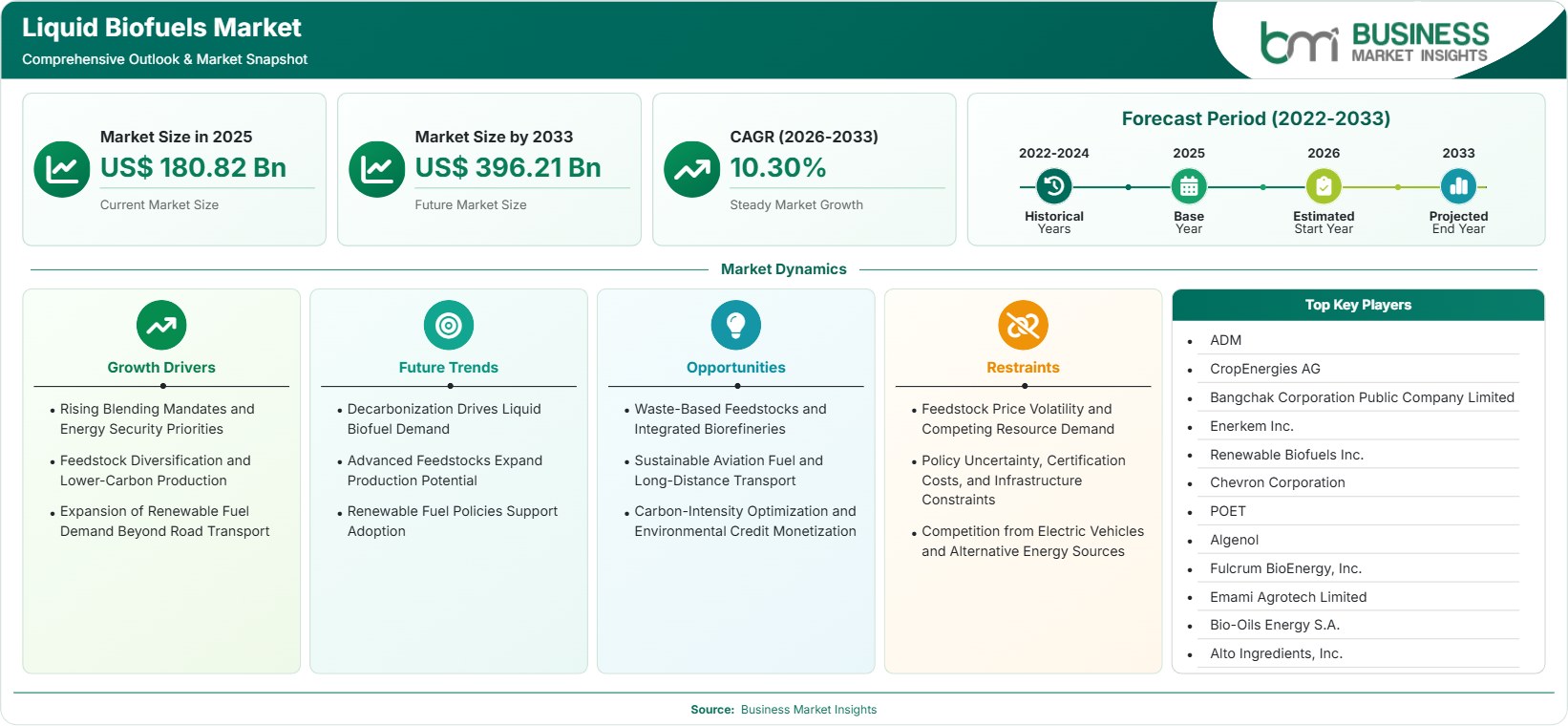
The Liquid Biofuels Market size was valued at US$ 180.82 Billion in 2025 and is projected to reach US$ 396.21 Billion by 2033, growing at a CAGR of 10.30% during 2026–2033, driven by blending mandates, energy security, decarbonization targets, feedstock diversification, and aviation fuel opportunities.

Report Coverage
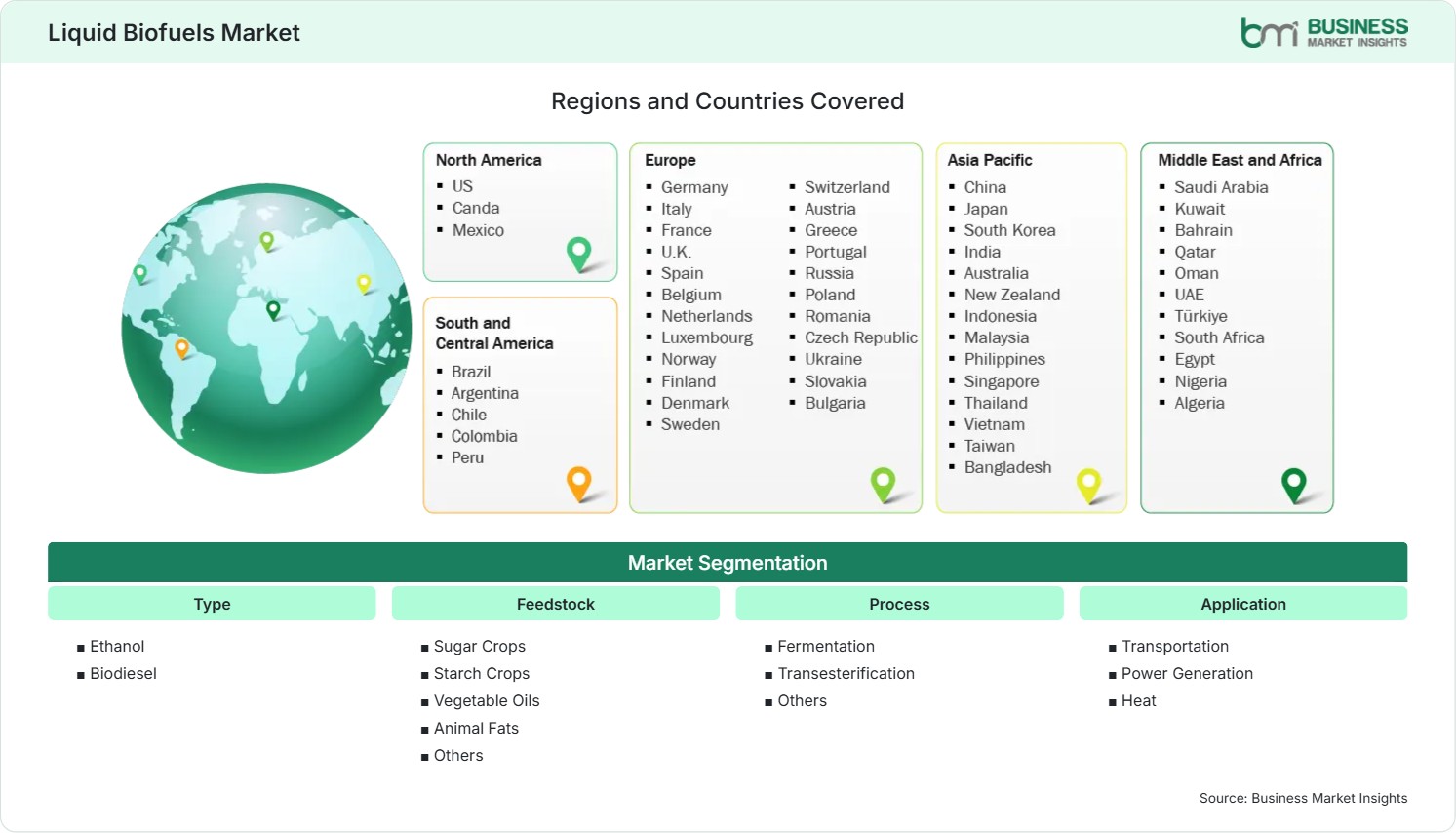
  • Type: Ethanol, Biodiesel
  • Feedstock: Sugar Crops, Starch Crops, Vegetable Oils, Animal Fats, Others
  • Process: Fermentation, Transesterification, Others
  • Application: Transportation, Power Generation, Heat
US$ 180.82 Bn Market size in 2025
US$ 396.21 Bn Market Size by 2033
10.30% CAGR, 2026 - 2033
2026-2033 Forecast Period

AI Overview

Liquid Biofuels Market Summary

  • North America Region: North America holds a 31%–34% share in 2025, growing at a CAGR of 8.8%–9.6%, influenced by renewable fuel standards, low-carbon fuel policies, ethanol infrastructure, and advanced feedstock projects. US demand remains supported by established ethanol production, renewable diesel capacity, and transportation decarbonization policies, with a modeled 8.9%–9.7% CAGR through 2033.
  • Fastest Growing Region: Asia Pacific holds a 27%–30% share in 2025, expanding at a CAGR of 11.4%–12.2%, supported by biodiesel mandates, rising transport demand, domestic feedstock availability, import substitution, refinery integration, and expanding ethanol programs across India, Indonesia, Thailand, and Malaysia.
  • Leading Segment: Ethanol holds a 62%–66% share in 2025, expanding at a CAGR of 9.8%–10.6%, supported by gasoline blending mandates, established production assets, agricultural feedstock availability, flexible distribution infrastructure, and increasing demand for lower-carbon transportation fuels.
  • High Growth Segment: Biodiesel holds a 34%–38% share in 2025, advancing at a CAGR of 11.2%–12.0%, driven by higher blend requirements, renewable diesel integration, waste oils, animal fats, energy security strategies, and commercial fleet decarbonization initiatives.
  • Key Market Opportunity: Waste-derived feedstocks, sustainable aviation fuel, advanced ethanol, carbon-intensity optimization, and refinery integration create investable pathways as governments tighten emissions standards and diversify transportation fuel supply.
  • Major Market Players: ADM, CropEnergies AG, Bangchak Corporation Public Company Limited, Enerkem Inc., Renewable Biofuels Inc., Chevron Corporation, POET, Algenol, Fulcrum BioEnergy, Inc., Emami Agrotech Limited, Bio-Oils Energy S.A., Alto Ingredients, Inc., and Gevo, Inc.
Strategic Insights

Liquid Biofuels Market: Strategic Insights

Liquid Biofuels Market Strategic Framework
FREE PDF
Request your free sample
Request free sample
Stakeholder View

Key Takeaways

  • The value chain is evolving from feedstock suppliers and conventional producers toward integrated ecosystems combining agriculture, waste collection, fermentation, refining, carbon management, logistics, certification, and fuel distribution.
  • Biodiesel provides the strongest near-term upside where mandatory blending ratios are rising, while ethanol remains the dominant volume platform because gasoline blending infrastructure is already widely established.
  • Producers are prioritizing cellulosic feedstocks, waste oils, low-carbon ethanol, carbon capture, advanced fermentation, and process-efficiency improvements to lower lifecycle emissions without abandoning existing liquid-fuel infrastructure.
  • Asia Pacific presents the strongest expansion case because India, Indonesia, Thailand, and Malaysia combine increasing fuel consumption with government-led blending policies and substantial agricultural or waste-derived feedstock availability.
  • Capital is increasingly directed toward assets capable of monetizing both fuel and environmental attributes, including clean-fuel credits, carbon reductions, renewable identification mechanisms, and low-carbon fuel standards.
  • Aviation and maritime applications could become increasingly important because electrification options remain constrained for long-distance transport, creating demand for scalable liquid renewable fuels and certified low-carbon feedstocks.
Geographic Outlook

Liquid Biofuels Market Regional Highlights

North America Liquid Biofuels Market

North America accounts for a 31%–34% share in 2025 and is modeled to expand at a CAGR of 8.8%–9.6% through 2033. The area is advantaged with ethanol infrastructure maturity, investments in renewable diesel, agricultural feedstocks, and environmental credits. Canada creates additional demand through clean fuel policies while the US is the largest producer and consumer in the region. The Liquid Biofuels Market share for the region is sustained by the presence of extensive blending facilities and distribution channels. According to IEA, the US is the largest producer and consumer of biofuels until 2030.

  • US ethanol and renewable diesel infrastructure provides scale advantages, allowing producers to optimize existing assets while introducing lower-carbon feedstocks and carbon-management technologies across established supply chains.
  • Canada contributes incremental demand through clean-fuel requirements and lower-carbon transportation policies, creating opportunities for producers capable of meeting lifecycle emissions thresholds and certification requirements.
  • Corn, soybean oil, animal fats, and recycled oils remain strategically important feedstocks, while logistics networks and established blending terminals reduce distribution barriers for large producers.
  • Advanced ethanol and renewable diesel projects increasingly integrate carbon capture, process optimization, and coproduct monetization to improve project economics under changing clean-fuel credit structures.

US Liquid Biofuels Market

The US represents 74%–78% of North American demand in 2025 and is modeled to grow at 8.9%–9.7% annually through 2033. The location is an indication of high ethanol capacity, abundant supply of corn, blending facilities, renewable diesel, and carbon credits. The US will still be the world's leading producer and user of biofuels up until 2030, according to the projections by IEA. Policy uncertainty may affect the timing of investments, but the already existing infrastructure makes the country resistant.

  • The Renewable Fuel Standard supports established ethanol demand, while low-carbon fuel programs encourage producers to reduce lifecycle emissions through improved process efficiency and alternative feedstocks.
  • Renewable diesel and biodiesel investment expands the addressable feedstock base, particularly for soybean oil, animal fats, used cooking oil, and other waste-derived lipid resources.
  • Carbon capture at ethanol facilities can improve lifecycle performance and create additional environmental value, encouraging producers to combine fuel production with carbon-management infrastructure.

Europe Liquid Biofuels Market

Europe holds a 24%–27% share in 2025 and is modeled to expand at a CAGR of 9.7%–10.5%. Germany, France, Spain, Italy, and the Netherlands are the key areas for both demand and supply, whereas Spain and Italy offer favorable growth conditions. The renewable transport targets of the European Union encourage demand for such products, though the feedstock sustainability criteria have their effect on producers' profit margins. The new transport GHG intensity target in Spain is one of the examples.

  • Germany remains a major European production hub, supported by established agricultural processing, biodiesel infrastructure, and demand for fuels meeting increasingly stringent greenhouse-gas performance criteria.
  • Spain provides strong growth potential, with transport decarbonization policy and renewable-fuel requirements supporting additional demand for ethanol, biodiesel, and advanced feedstock pathways.
  • Italy and France benefit from extensive fuel-distribution infrastructure and agricultural resources, although sustainability certification and feedstock competition remain important investment considerations.
  • European aviation provides an emerging opportunity as SAF mandates increase demand for certified renewable feedstocks, although IATA highlights capacity limitations and elevated SAF costs.

Asia Pacific Liquid Biofuels Market

Asia Pacific represents 27%–30% of 2025 demand and is modeled to record the fastest regional CAGR of 11.4%–12.2% through 2033. These countries constitute the main markets, with India and Indonesia being some of the best growth generators. The IEA expects biofuels’ demand to surge significantly in Brazil, Indonesia, and India up to 2030 due to increased mandates and higher transport fuel use.

  • Indonesia's B40 biodiesel mandate from January 2025 substantially expands domestic biodiesel requirements and strengthens palm-based and alternative lipid feedstock demand.
  • India's ethanol program supports domestic production expansion, agricultural diversification, and petroleum import reduction, while additional feedstocks broaden opportunities beyond conventional sugar-based production.
  • Thailand combines established ethanol and biodiesel industries with emerging SAF development, supported by used cooking oil collection and refinery integration initiatives.
  • Malaysia benefits from palm-oil availability and established biodiesel infrastructure, while policy implementation and export economics influence investment decisions across producers and refiners.

Rest of World Liquid Biofuels Market

South and Central America account for a substantial portion of the Rest of World market potential due to the presence of Brazil and Argentina, with Mexico offering extra fuel demand for transport needs. The large Brazilian sugarcane ethanol network and biodiesel obligation contribute to local demand. IEA data suggests an increase in Brazilian biodiesel demand to 15%.

Middle East and Africa offer smaller but expanding opportunities, particularly in countries seeking energy diversification, agricultural value creation, and lower petroleum import dependence. The regional share is modeled at 14%–17% in 2025, with a CAGR of 10.1%–10.9% through 2033.

  • Brazil remains the leading market, combining sugarcane availability, flexible ethanol use, established distribution, and policy support that reduces exposure to imported petroleum products.
  • Argentina provides opportunities in biodiesel and agricultural feedstock processing, while Mexico's fuel-blending policies support incremental ethanol and biodiesel demand.
  • South Africa offers a developing pathway for renewable transport fuels through agricultural resources, industrial infrastructure, and decarbonization initiatives, although scale remains below leading global markets.
  • Saudi Arabia and the United Arab Emirates represent emerging investment opportunities where renewable fuels can complement broader energy-transition strategies and support lower-carbon aviation and maritime ecosystems.
Global Market Geography
FREE PDF
Request your free sample
Request free sample
Segment Analysis

Liquid Biofuels Market Segmentation

Type

Ethanol represents a 62%–66% share in 2025 and is modeled to grow at a CAGR of 9.8%–10.6% through 2034. Established gasoline blending, agricultural feedstocks, mature fermentation technology, and extensive distribution infrastructure support continued leadership. Biodiesel is expanding faster as mandates rise across Asia and Latin America, strengthening demand for lipid feedstocks, renewable diesel integration, and lower-carbon fleet fuels.

  • Ethanol: Ethanol remains the dominant fuel type because gasoline blending programs, established fermentation assets, agricultural feedstocks, and mature distribution networks support reliable demand across major transportation markets.
  • Biodiesel: Biodiesel demand benefits from mandatory blending increases, vegetable oils, animal fats, used cooking oils, fleet decarbonization programs, and growing energy-security priorities across emerging economies.

Feedstock

Sugar Crops, Starch Crops, Vegetable Oils, Animal Fats, and Others collectively determine production economics through availability, pricing, sustainability requirements, and conversion efficiency. Feedstock diversification is becoming central to Liquid Biofuels Market scope because producers seek resilience against agricultural price volatility and competition for food and industrial resources. Waste-derived inputs increasingly attract investment because they can lower lifecycle emissions while improving compliance with environmental fuel standards.

  • Sugar Crops: Sugarcane and sugar beet provide established ethanol feedstocks, supported by high conversion efficiency, integrated agricultural processing, and mature regional supply chains in major producing countries.
  • Starch Crops: Corn and other starch crops support large-scale ethanol production, particularly in North America, where established farming, storage, fermentation, and distribution infrastructure enables high-volume manufacturing.
  • Vegetable Oils: Soybean, palm, rapeseed, and other vegetable oils support biodiesel production, with demand influenced by crop yields, food competition, sustainability certification, and regional blending mandates.
  • Animal Fats: Tallow, poultry fat, and other rendered fats provide renewable lipid feedstocks, increasingly valued for lower-carbon fuel production and diversification away from food-grade vegetable oils.

Process

Fermentation remains the primary process for ethanol, while transesterification is established for biodiesel. The process segment is influenced by conversion efficiency, feedstock quality, energy consumption, coproduct generation, and lifecycle emissions. Producers are investing in process optimization, pretreatment, advanced fermentation, and integrated carbon management to improve profitability. These Liquid Biofuels Market trends support technology upgrades at existing facilities rather than relying solely on greenfield construction.

  • Fermentation: Fermentation converts sugars and starch-derived intermediates into ethanol, with efficiency improvements, enzyme optimization, water management, and energy integration improving production economics.
  • Transesterification: Transesterification converts oils and fats into biodiesel, with catalyst selection, feedstock quality, pretreatment, and glycerol recovery influencing operating performance and product economics.

Application

Transportation accounts for a 70%–74% share in 2025 and is modeled to grow at a CAGR of 10.8%–11.6% through 2034. Power generation and heat applications provide additional demand where renewable liquid fuels can support backup generation, industrial thermal requirements, and decentralized energy systems. Transportation remains dominant because blending mandates create predictable offtake while decarbonization policies increase demand for lower-carbon fuels.

  • Transportation: Transportation remains the principal application because ethanol and biodiesel can enter established vehicle-fuel systems, supporting emissions reduction without requiring complete replacement of existing liquid-fuel infrastructure.
  • Power Generation: Liquid biofuels support distributed and backup generation where fuel flexibility, energy security, and lower lifecycle emissions provide advantages over conventional petroleum-based generator fuels.
  • Heat: Industrial and commercial heat applications create incremental demand for renewable liquid fuels, particularly where existing combustion systems can be adapted without extensive infrastructure replacement.
Market Forces

Liquid Biofuels Market Dynamics

Key Market Drivers

Rising Blending Mandates and Energy Security Priorities

Blending mandates are strengthening demand because governments increasingly use renewable fuels to reduce petroleum dependence while supporting domestic agriculture and energy security. As per IEA statistics, B40 mandate of Indonesia has been initiated from January 2025 whereas the regulatory framework of Brazil is focused on the increment in the biodiesel blend ratio. In the case of India, ethanol blending ratio has been increased to E20. Such policies lower the sensitivity of fuel demand to consumer discretionary choices due to obligations regarding mandatory blending rates. The growth in demand for Liquid Biofuels is most pronounced where there is an increase in transport fuel consumption and mandatory blend policies exist.

Feedstock Diversification and Lower-Carbon Production

Feedstock diversification is becoming a competitive necessity as producers face volatility in crop prices, sustainability requirements, and competition with food and industrial applications. The ethanol producers are considering agricultural residues and advanced routes, whereas the biodiesel and renewable diesel producers are using used cooking oil, animal fats, and other wastes as the sources. According to Chevron, some of the sources of renewable diesel and biodiesel are vegetable oils, animal fats, and restaurant grease. Liquid Biofuels market trends clearly show a trend toward multi-feedstock plants and lower lifecycle carbon intensity. Carbon capture from ethanol operations is yet another means of emission reduction. For example, the Gevo North Dakota assets utilize both low-carbon ethanol and carbon capture and storage.

Expansion of Renewable Fuel Demand Beyond Road Transport

The next phase of demand is increasingly linked to sectors where direct electrification is difficult. IEA expects aviation and maritime applications to account for more than 75% of new biofuel demand by 2030 in its renewable-fuels outlook. Aviation is especially critical in this case because airlines need liquid fuels that have a high energy density and thereby serve as a potential route to SAF based on bio-resources. According to IATA's forecasts, worldwide SAF production was estimated at around 1.9 million tonnes in 2025 and may increase up to 2.4 million tonnes in 2026, whereas the demand in the long run may grow up to 500 million tonnes per year by 2050.

Key Market Opportunities

Waste-Based Feedstocks and Integrated Biorefineries

Waste-derived feedstocks provide an opportunity to improve lifecycle emissions while reducing dependence on food-linked commodities. The utilization of used cooking oil, animal fats, agricultural waste, municipal waste, and industrial waste streams is possible to provide for differentiated renewable fuels where the waste streams can be collected reliably. The approach that Bangchak takes towards production of SAF is an illustration of this approach. Monetization of various products like fuels, chemicals, animal feeds, and environmental benefits through integrated biorefineries can enhance the resilience to changes in fuel prices. As far as minimizing risks is concerned, investment should be made in projects that have secured supply, logistics, certification capability, and synergy in infrastructure for the following reasons.

Sustainable Aviation Fuel and Long-Distance Transport

Aviation represents one of the most attractive opportunities because electrification cannot readily replace liquid jet fuel for long-distance commercial operations. IATA estimates that SAF production represented only around 0.6% of global jet-fuel consumption in 2025, despite production doubling from 2024. According to IATA, 500 million tons of SAF will have to be supplied annually in order for aviation to be able to achieve its net-zero pathway by 2050. Thus, the forecasts of the Liquid Biofuels Market must include not only aviation feedstock competition, but also refinery conversion capability, certification, and airline offtake agreements as well. The projects that will allow the production of certified SAF from waste oil and sustainable feedstocks may become strategically attractive for various players.

Carbon-Intensity Optimization and Environmental Credit Monetization

Carbon-intensity optimization creates an opportunity to generate value beyond fuel sales. Producers can combine renewable electricity, process heat optimization, carbon capture, low-carbon feedstocks, efficient logistics, and renewable energy certificates to reduce lifecycle emissions. Decreased carbon intensity may enhance opportunities to access environmental credits and become competitive in markets that value fuel according to its emissions performance. The importance of such an approach in financial terms was proven by Alto Ingredients through its monetization of the Section 45Z clean-fuel production tax credits earned in 2025, amounting to about $8.9 million in cash during June 2026. Such approaches may help projects economically if there is enough transparency in the markets for credits and credible incentives for reducing emissions.

Market Restraints and Challenges

Feedstock Price Volatility and Competing Resource Demand

Factor: Agricultural commodities, vegetable oils, animal fats, and waste oils face price volatility caused by crop yields, weather, food demand, livestock cycles, trade flows, and competing renewable-fuel buyers.

Impact: Higher costs of the input material could lead to reduced producer margins and diminished economic benefits of blending policies when the increase in input costs cannot be entirely transferred into higher fuel prices. The biodiesel producers are more vulnerable to fluctuations in the market of lipids, whereas ethanol producers could be exposed to fluctuations in corn, sugar, and energy prices. Competition for the input material could also limit sustainability efforts by diverting the use of low-carbon material to other purposes.

Policy Uncertainty, Certification Costs, and Infrastructure Constraints

Factor: Renewable-fuel economics depend heavily on blending mandates, tax credits, carbon-intensity rules, sustainability certification, and market-access requirements that can change across jurisdictions.

Impact: Volatility in the policy environment will lead to delays in investments, increased financial risks, and economic inequalities among the producers in terms of the regulations they fall under. According to IATA, the SAF costs can be quite high compared to the cost of regular jet fuel, and it pointed out the impact of policy design and compliance issues in fuel markets. The certification process becomes an additional hurdle for the producers, as the producers have to demonstrate the origin of their feedstocks, emissions over the lifecycle, traceability, and sustainability.

Company Analysis

Competitive Landscape

The Liquid Biofuels Market analysis indicates competition is increasingly based on feedstock access, production scale, carbon intensity, technology flexibility, geographic reach, certification capabilities, and environmental-credit monetization. Established ethanol producers compete alongside integrated energy companies and emerging technology developers.

Company Name

Overview

Products and Services relevant to this market

ADM

ADM is a major global agricultural processor with extensive grain handling, oilseed processing, ethanol production, and renewable-fuel infrastructure.

Ethanol, biodiesel feedstocks, agricultural processing, oilseed products, renewable fuels, feedstock logistics, and coproduct solutions.

CropEnergies AG

CropEnergies AG is a European renewable-ethanol producer focused on low-carbon transportation fuels and agricultural feedstock conversion.

Renewable ethanol, protein-rich animal feed, liquefied CO2, alcohol products, and integrated bioethanol production services.

Bangchak Corporation Public Company Limited

Bangchak is a Thailand-based energy company expanding renewable fuels and SAF while leveraging refinery infrastructure and waste-oil collection.

Biodiesel, sustainable aviation fuel, renewable-energy products, used cooking oil collection, refining, and low-carbon fuel solutions.

Enerkem Inc.

Enerkem develops technology for converting non-recyclable waste and renewable carbon into transportation fuels and chemical products.

Advanced ethanol, waste-to-fuels technology, biomass conversion, gasification, synthesis, and renewable chemical production platforms.

Renewable Biofuels Inc.

Renewable Biofuels Inc. operates in renewable fuel production, focusing on converting renewable feedstocks into transportation fuel products.

Biodiesel and renewable fuel production, feedstock processing, fuel blending, and related renewable-fuel supply capabilities.

Chevron Corporation

Chevron operates a large global energy platform and has expanded renewable-fuel activities involving bio-based diesel and lower-carbon transportation fuels.

Renewable diesel, biodiesel blends, sustainable aviation fuel, renewable gasoline blends, feedstock utilization, and fuel distribution.

POET

POET is a major US bioethanol producer focused on agricultural feedstock conversion and technology-enabled renewable fuel production.

Bioethanol, renewable chemicals, coproducts, animal feed, agricultural processing, and ethanol production technologies.

Algenol

Algenol develops biological technologies aimed at producing renewable fuels and chemicals using algae-based carbon conversion pathways.

Renewable fuels, ethanol-related technologies, algae-derived products, carbon utilization, and sustainable chemical development.

Fulcrum BioEnergy, Inc.

Fulcrum BioEnergy develops waste-to-fuel technologies designed to convert municipal solid waste into low-carbon transportation fuels.

Waste-derived fuels, synthetic crude, sustainable aviation fuel pathways, waste conversion, and advanced gasification technology.

Emami Agrotech Limited

Emami Agrotech operates across agricultural processing and edible oils, providing feedstock capabilities relevant to biodiesel value chains.

Vegetable oils, oilseed processing, agricultural products, edible oils, feedstock supply, and renewable-fuel ecosystem participation.

Bio-Oils Energy S.A.

Bio-Oils Energy focuses on renewable fuels and bioenergy solutions, with capabilities connected to biodiesel and renewable feedstock processing.

Biodiesel, vegetable-oil feedstocks, renewable fuel production, blending solutions, and bioenergy-related processing capabilities.

Alto Ingredients, Inc.

Alto Ingredients is a US producer of renewable fuels and specialty alcohols, with multiple ethanol production facilities and low-carbon initiatives.

Low-carbon ethanol, renewable fuels, specialty alcohols, corn processing, distillers grains, corn oil, and clean-fuel credit monetization.

Gevo, Inc.

Gevo develops renewable fuels, chemicals, carbon-management solutions, and low-carbon ethanol platforms with emphasis on lifecycle emissions reduction.

Renewable hydrocarbons, sustainable aviation fuel, low-carbon ethanol, carbon capture, renewable chemicals, and carbon-management technologies.

Trust & Transparency

Research Methodology

The market analysis combines proprietary research with secondary data from government agencies, company disclosures, regulatory filings, industry databases and expert interviews. Market estimates are validated through data triangulation, cross-market benchmarking and analyst review.

View Full Research Methodology

Questions Answered

Frequently Asked Questions

How should investors evaluate a renewable-fuel project?

Investors should assess secured feedstock supply, conversion efficiency, infrastructure access, policy durability, certification capability, carbon intensity, coproduct revenues, offtake agreements, and environmental-credit economics rather than relying only on headline fuel capacity.

Which countries provide the strongest expansion opportunities?

The Liquid Biofuels Market Report highlights that India, Indonesia, Brazil, Thailand, and other emerging markets provide compelling opportunities because fuel demand, blending requirements, domestic feedstocks, and energy-security objectives reinforce one another. IEA identifies Brazil, Indonesia, India, Europe, and the US among major demand centers through 2030.

How does carbon intensity affect producer competitiveness?

Lower carbon intensity can improve access to clean-fuel credits, strengthen regulatory compliance, and increase customer appeal. Producers can reduce intensity through renewable energy, efficient processing, alternative feedstocks, carbon capture, and improved logistics.

What role will aviation play in future renewable-fuel demand?

Aviation is likely to become a major source of incremental demand because commercial aircraft require energy-dense liquid fuels. IATA estimates that SAF production remains a small fraction of jet-fuel consumption, leaving substantial room for capacity expansion and technology deployment.

Which feedstocks will become more important for renewable liquid fuels?

Waste oils, animal fats, agricultural residues, and other low-carbon feedstocks are likely to gain strategic importance because producers face sustainability requirements and competition for conventional food-linked commodities. Their value increases when certification systems reward lower lifecycle emissions.

Access the Full Liquid Biofuels Market Report

Get segment-level forecasts, regional estimates, competitive benchmarking, company profiles and downloadable Excel datasets.

Access the full Liquid Biofuels Market Report
350 pages PDF & Excel | 2026-09-22
Similar Research

Related Market Reports