
Gas To Liquid Market Outlook: Size, Share, Trends, Growth Analysis, Competitive Landscape & Forecast, 2026-2033

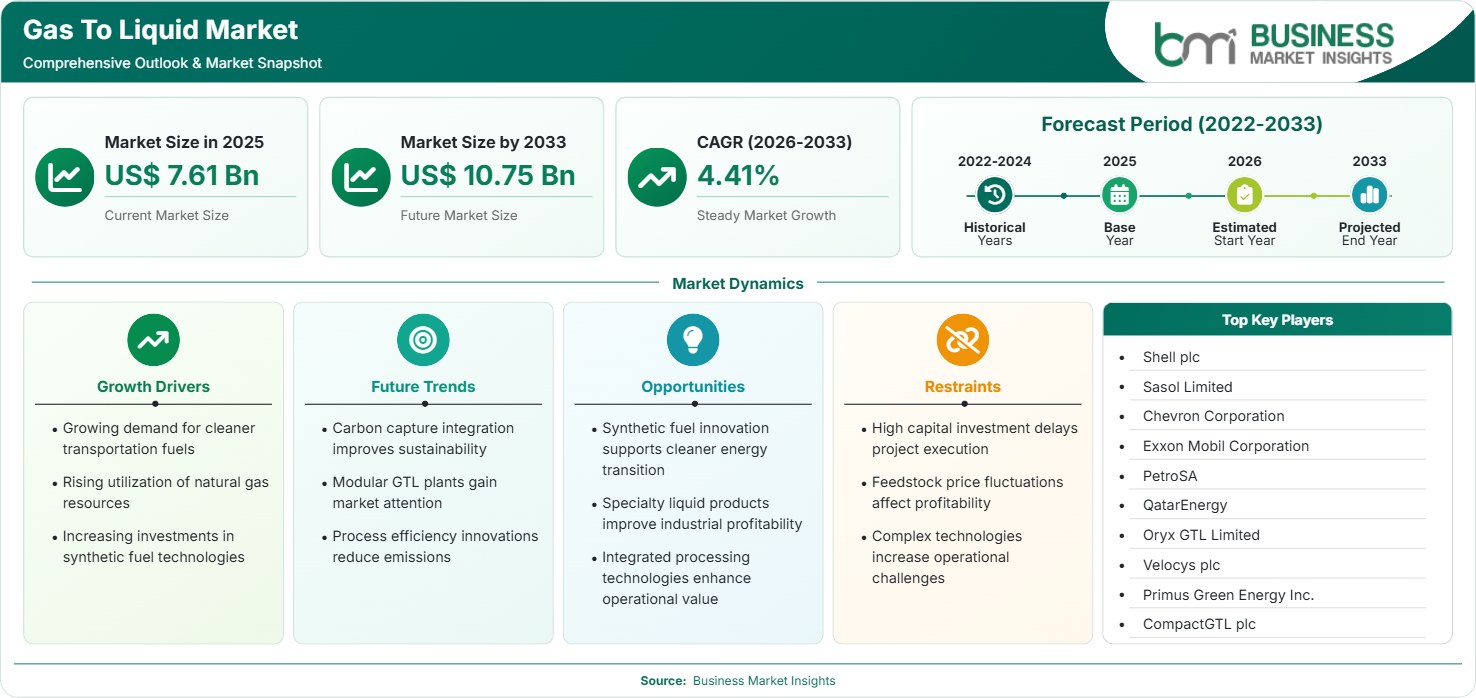
The Gas To Liquid Market size was valued at US$ 7.61 billion in 2025 and is projected to reach US$ 10.75 billion by 2033, growing at a CAGR of 4.41% during 2026–2033. Growing demand for cleaner transportation fuels, rising utilization of natural gas resources, and increasing investments in synthetic fuel technologies continue supporting steady market expansion.

Report Coverage
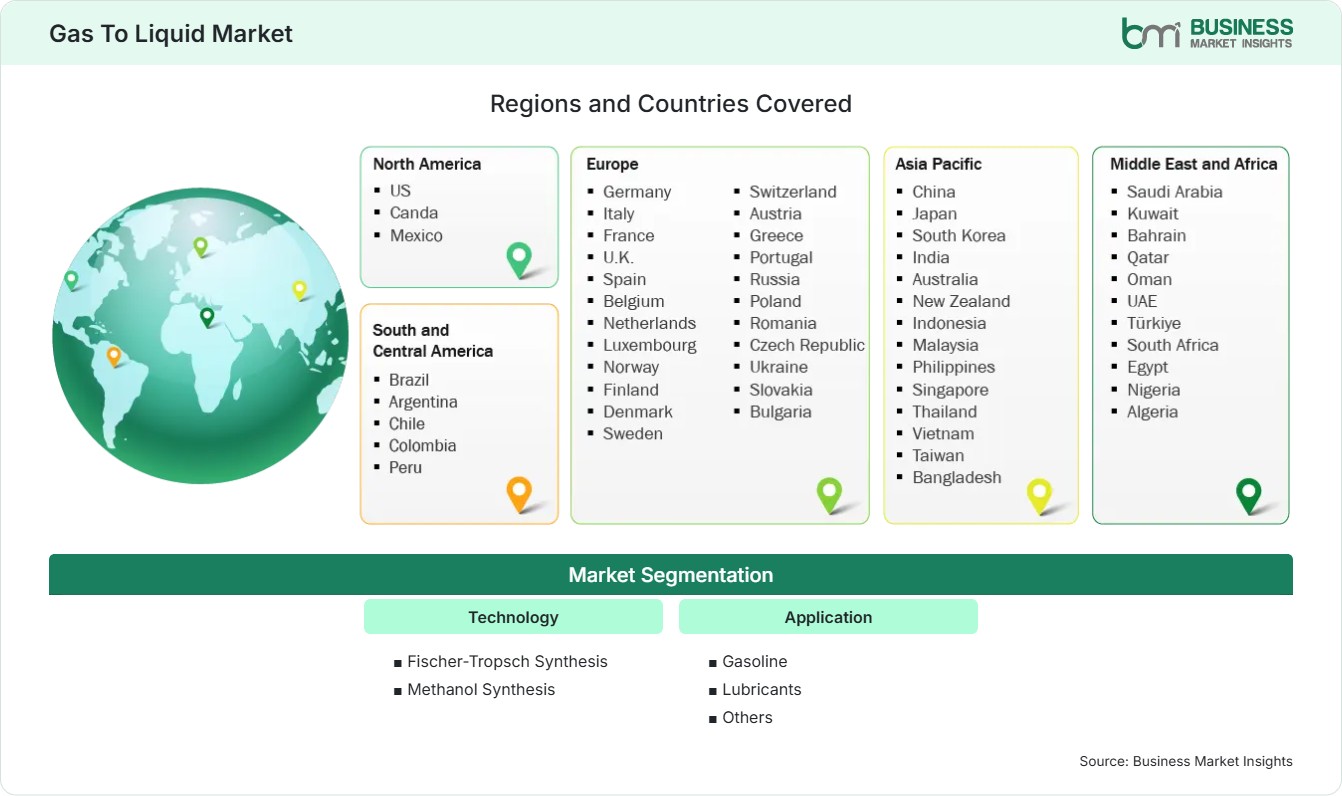
  • Technology: Fischer-Tropsch Synthesis, Methanol Synthesis
  • Application: Gasoline, Lubricants, Others
US$ 7.61 Bn Market size in 2025
US$ 10.75 Bn Market Size by 2033
4.41% CAGR, 2026 - 2033
2026-2033 Forecast Period

01 AI Overview

Gas To Liquid Market Summary

  • North America Region: North America accounts for 28%–31% market share in 2025 and is projected to expand at a CAGR of 4.1%–4.5% during 2026–2033. Abundant natural gas reserves, technological advancements, and investments in cleaner fuel production continue driving regional growth. The U.S. remains the largest market, advancing at a CAGR of 4.2%–4.6% through continued investment in energy infrastructure and low-emission fuel technologies.
  • Fastest Growing Region: Middle East & Africa represents 34%–37% market share in 2025 and is expected to register a CAGR of 4.8%–5.3%, supported by abundant gas reserves, integrated energy projects, and increasing investments in value-added hydrocarbon processing.
  • Leading Segment: Fischer-Tropsch Synthesis accounts for 76%–79% market share in 2025 and is projected to grow at a CAGR of 4.4%–4.8%, owing to its commercial maturity, high conversion efficiency, and ability to produce premium synthetic fuels.
  • High Growth Segment: Lubricants capture 29%–32% market share in 2025 and are anticipated to expand at a CAGR of 4.9%–5.4%, driven by increasing demand for high-performance synthetic base oils across industrial and automotive applications.
  • Key Market Opportunity: Investments in integrated gas processing, premium synthetic lubricants, and low-emission fuel technologies continue creating opportunities for technology providers and energy companies.
  • Major Market Players: Shell plc, Sasol Limited, Chevron Corporation, Exxon Mobil Corporation, PetroSA, QatarEnergy, Oryx GTL Limited, Velocys plc, Primus Green Energy Inc., and CompactGTL plc.
02 Strategic Insights

Gas To Liquid Market: Strategic Insights

Gas To Liquid Market Strategic Framework
FREE PDF
Request your free sample
Request free sample
03 Stakeholder View

Key Takeaways

  • Commercial-scale GTL projects continue to focus on regions with abundant natural gas reserves and established energy infrastructure, creating long-term supply advantages.
  • Premium synthetic diesel and lubricant production remains an attractive investment area because these products command higher margins than conventional transportation fuels.
  • Continuous improvements in catalyst technology and process integration are enhancing conversion efficiency while reducing operating costs across modern GTL facilities.
  • Middle East & Africa continues offering the strongest investment potential due to large gas reserves, government-backed energy diversification initiatives, and integrated downstream development.
  • Strategic collaboration between technology providers, engineering firms, and national energy companies continues accelerating commercialization of next-generation GTL projects.
  • Demand for cleaner-burning fuels and specialty liquid products is encouraging operators to expand production portfolios beyond conventional transportation fuels.
04 Geographic Outlook

Gas To Liquid Market Regional Highlights

North America Gas To Liquid Market

North America accounts for 28%–31% Gas To Liquid Market share in 2025 and is projected to register a CAGR of 4.1%–4.5% during 2026–2033. Strong natural gas production, technological innovation, and investments in cleaner fuel solutions continue supporting regional development. Energy companies are focusing on efficient gas conversion technologies while expanding production of premium synthetic fuels and specialty lubricants.

  • Abundant shale gas production strengthens feedstock availability for future GTL investments.
  • Energy companies continue investing in advanced conversion technologies that improve operational efficiency.
  • Growing industrial demand supports increased consumption of premium synthetic lubricants.
  • Technological innovation continues improving catalyst performance and plant productivity.

US Gas To Liquid Market

The United States contributes 82%–85% of North American revenue and is projected to grow at a CAGR of 4.2%–4.6% during 2026–2033. Expanding natural gas production, advanced engineering capabilities, and ongoing investments in cleaner fuel technologies continue supporting long-term market development.

  • Strong shale gas production improves long-term feedstock availability.
  • Research investments continue enhancing synthetic fuel production efficiency.
  • Industrial users increasingly adopt premium synthetic lubricant products.
  • Energy infrastructure modernization supports future GTL investments.

Europe Gas To Liquid Market

Europe represents 20%–23% market share in 2025 and is expected to expand at a CAGR of 3.9%–4.3% throughout the forecast period. Regional demand is supported by cleaner fuel initiatives, industrial lubricant consumption, and investments in low-carbon energy technologies. The Netherlands remains the leading market, while Norway records the fastest growth due to its strong natural gas industry and energy innovation programs.

  • Cleaner fuel regulations encourage interest in synthetic fuel technologies.
  • Industrial applications continue supporting demand for premium lubricants.
  • Energy transition strategies increase investment in low-emission fuel production.
  • Technology partnerships strengthen regional research and commercialization activities.

Asia Pacific Gas To Liquid Market

Asia Pacific accounts for 18%–21% market share in 2025 and is anticipated to register a CAGR of 4.4%–4.9% during 2026–2033. Expanding industrialization, rising energy demand, and increasing investments in cleaner transportation fuels continue supporting market growth. China leads regional consumption, while India records the fastest expansion through growing energy infrastructure and industrial development.

  • Expanding manufacturing activity increases demand for synthetic fuel products.
  • Governments continue promoting cleaner fuel technologies for industrial applications.
  • Rising natural gas utilization supports future GTL investment opportunities.
  • Industrial lubricant demand strengthens regional consumption of specialty products.

Rest of World Gas To Liquid Market

The Rest of World region accounts for 34%–37% market share in 2025 and is expected to record a CAGR of 4.8%–5.3% during 2026–2033. Growth is supported by abundant gas reserves, integrated energy developments, and increasing investments across the Middle East, Africa, and selected Latin American countries.

  • Qatar continues leading commercial GTL production through integrated energy infrastructure.
  • South Africa remains an important producer supported by established synthetic fuel expertise.
  • Government-backed gas monetization strategies encourage long-term investment.
  • Expansion of downstream processing strengthens regional value creation from natural gas resources.
Global Market Geography
FREE PDF
Request your free sample
Request free sample
05 Segment Analysis

Gas To Liquid Market Segmentation

Technology

Technology remains the defining factor influencing production efficiency, conversion economics, and product quality in the gas-to-liquid industry. This segment accounted for 76%–79% market share in 2025 and is projected to register a CAGR of 4.4%–4.8% during 2026–2033. Continuous catalyst improvements, better process integration, and commercial-scale deployment continue expanding the Gas To Liquid Market scope, enabling producers to manufacture cleaner transportation fuels and specialty liquid products with higher operational efficiency.

  • Fischer-Tropsch Synthesis: Continues dominating commercial production because of its proven capability to convert synthesis gas into premium-quality diesel, naphtha, waxes, and specialty base oils with high conversion efficiency.
  • Methanol Synthesis: Gains increasing attention as producers diversify synthetic fuel pathways and improve downstream processing flexibility for chemicals, transportation fuels, and industrial feedstock applications.

Application

Application diversity continues expanding as synthetic liquid products gain acceptance across transportation and industrial sectors. The segment represented 46%–49% market share in 2025 and is anticipated to register a CAGR of 4.5%–4.9% through 2026–2033. Ongoing Gas To Liquid Market trends indicate increasing utilization of premium synthetic fuels and specialty lubricants as industries seek cleaner, longer-lasting, and high-performance petroleum alternatives.

  • Gasoline: Synthetic gasoline is increasingly utilized for cleaner combustion characteristics, improved fuel quality, and compatibility with existing transportation infrastructure while supporting emission reduction initiatives.
  • Lubricants: Premium synthetic lubricants continue experiencing higher adoption because they provide excellent thermal stability, oxidation resistance, longer service life, and superior performance across demanding industrial and automotive operating environments.
06 Market Forces

Gas To Liquid Market Dynamics

Key Market Drivers

Growing demand for cleaner transportation fuels

Governments and the transport industry continue stressing on the need for cleaner fuels to minimize the emissions of sulfur and particulates and environmental impacts. Gas-to-liquid fuels offer very clean fuels with lower levels of sulfur compared to many traditional petroleum fuels, thus they fit into the increasingly strict fuel quality requirements. These developments continue supporting Gas To Liquid Market growth, particularly among energy companies seeking premium fuel products capable of meeting evolving environmental requirements while maintaining high engine performance.

Rising utilization of natural gas resources

Many gas-producing countries are focusing on converting abundant natural gas reserves into higher-value liquid products rather than relying solely on direct exports. Gas monetization technologies play an important role in ensuring that resources are optimally used, in addition to curbing the practice of gas flaring. The use of integrated processing plants enables manufacturers to produce quality fuels, lubricants, and other products using natural gas. Investment in resource optimization and processing ensures continued demand for the technology.

Increasing investments in synthetic fuel technologies

Investments from both the public and private sectors are still making contributions towards studies aimed at enhancing catalyst efficiency, conversion rates, and overall economics. The technology providers are endeavoring to keep down the costs of operations and increase the flexibility of the process regarding varied feedstock and products. These innovations continue shaping Gas To Liquid Market trends, allowing producers to improve productivity while expanding the commercial applications of synthetic liquid fuels and specialty products.

Key Market Opportunities

Synthetic fuel innovation supports cleaner energy transition

The rising concern over environmental protection has been fostering new possibilities for synthetic fuels that can be used in combination with current transport networks. GTL fuels have low sulfur levels and clean burning properties without needing substantial changes in the engine. Further technological advancement and an appropriate energy diversification strategy will enhance their commercial viability. Gas To Liquid Market Forecasts indicate that ongoing innovation in catalyst development and integrated processing technologies will continue expanding opportunities across transportation and industrial energy markets.

Specialty liquid products improve industrial profitability

Manufacturers are increasingly focusing on producing higher-value specialty products, including premium lubricants, synthetic waxes, process oils, base oils, specialty fluids, and high-performance process chemicals that deliver stronger profit margins than conventional transportation fuels. Industrial customers continue demanding products with higher purity, superior performance, greater thermal stability, and longer service life for applications across automotive, manufacturing, chemical processing, cosmetics, and industrial sectors. This strategic shift enables GTL operators to diversify revenue streams, reduce dependence on volatile commodity fuel pricing, and improve overall business resilience. Additionally, continuous innovation in specialty product formulations, advanced refining technologies, and customer-specific solutions is enhancing product differentiation and expanding commercial opportunities. The ongoing expansion of specialty product portfolios is expected to strengthen long-term profitability, improve value creation, and support sustainable growth across integrated gas-to-liquids operations.

Integrated processing technologies enhance operational value

Modern GTL facilities are increasingly integrating upstream natural gas production with downstream fuel and chemical manufacturing to improve operational efficiency, maximize resource utilization, and reduce overall production costs. The technologies associated with automation, digital monitoring, artificial intelligence, and process optimization contribute to greater plant efficiency, higher energy efficiency, operational reliability, and consistency in the production of synthetic fuels and specialty chemicals of very high quality. The integrated approach in the implementation of projects also helps in cutting down transportation and logistics costs, as well as contributes to the optimization of the entire gas-to-liquids value chain. There is a continuous improvement in the technologies used in catalytic conversion processes, process controls, and plant engineering, which help improve production and reduce the negative impact on the environment. This creates good opportunities for investments in the future.

Market Restraints and Challenges

High capital investment delays project execution

Large-scale GTL facilities require substantial investment in processing plants, specialized equipment, supporting infrastructure, and advanced engineering capabilities. Factor: High upfront capital requirements create financial barriers for project developers while increasing investment risk, particularly during periods of uncertain energy prices. Impact: Project approvals may be delayed, construction timelines extended, and investment decisions postponed, limiting the pace of new commercial capacity additions despite favorable long-term demand for synthetic fuels.

Feedstock price fluctuations affect profitability

Although natural gas remains the primary feedstock, its pricing can vary considerably depending on regional supply conditions, geopolitical developments, and seasonal demand. Factor: Volatile feedstock costs directly influence production economics and operating margins across GTL facilities. Impact: Profitability becomes more difficult to maintain during periods of unfavorable price movements, encouraging producers to prioritize operational efficiency, long-term supply agreements, and integrated gas sourcing strategies to reduce financial uncertainty.

07 Company Analysis

Competitive Landscape

Competition remains concentrated among integrated energy companies, specialized technology developers, engineering firms, and catalyst manufacturers focused on commercial-scale gas-to-liquids conversion projects. Gas To Liquid Market analysis indicates that leading participants are investing heavily in catalyst innovation, advanced process optimization, modular GTL technologies, digital plant automation, and integrated gas monetization projects to improve production efficiency, reduce operating costs, and enhance overall project economics. Companies are also expanding their portfolios of premium synthetic fuels, high-performance lubricants, specialty waxes, process oils, and value-added chemicals to diversify revenue streams and strengthen competitive positioning. Additionally, strategic partnerships, technology licensing agreements, and investments in low-carbon production technologies are enabling market participants to accelerate commercialization, improve operational sustainability, and capitalize on the growing demand for cleaner, high-quality synthetic fuel products across global energy and industrial markets.

Company Name

Overview

Products and Services Relevant to this Market

Shell plc

Global energy company and pioneer in commercial GTL technology with integrated upstream and downstream operations across multiple regions.

GTL diesel, GTL base oils, synthetic lubricants, process technologies, engineering expertise, and integrated energy solutions.

Sasol Limited

South African energy and chemical company with decades of experience in synthetic fuel production and Fischer-Tropsch technologies.

Synthetic fuels, GTL technologies, specialty chemicals, waxes, premium base oils, and catalyst development.

Chevron Corporation

International integrated energy producer investing in natural gas development and advanced fuel technologies.

Natural gas production, synthetic fuel research, downstream processing, energy infrastructure, and integrated fuel solutions.

Exxon Mobil Corporation

Global energy company focused on advanced refining technologies, natural gas production, and cleaner fuel development.

Natural gas processing, premium lubricants, synthetic fuel technologies, refining operations, and specialty petroleum products.

PetroSA

South African national energy company engaged in gas processing and synthetic fuel production activities.

GTL fuels, gas processing, synthetic liquid products, downstream energy solutions, and fuel distribution services.

QatarEnergy

State-owned integrated energy company managing one of the world's largest natural gas resource portfolios.

Natural gas production, integrated GTL projects, energy infrastructure, LNG operations, and downstream petroleum products.

Oryx GTL Limited

Joint venture specializing in commercial GTL production using advanced Fischer-Tropsch technology.

GTL diesel, naphtha, LPG, synthetic fuels, and premium liquid petroleum products.

Velocys plc

Technology company developing compact Fischer-Tropsch solutions for sustainable fuel production.

Fischer-Tropsch reactors, catalyst technologies, sustainable aviation fuel solutions, and engineering services.

Primus Green Energy Inc.

Clean energy technology developer focused on synthetic fuel production from alternative gaseous feedstocks.

Synthetic gasoline technologies, gas conversion systems, clean fuel processes, and technology licensing.

CompactGTL plc

Engineering company specializing in modular gas-to-liquid technology for stranded gas monetization projects.

Modular GTL plants, compact processing technology, gas conversion equipment, engineering design, and technical support.

10 Trust & Transparency

Research Methodology

The market analysis combines proprietary research with secondary data from government agencies, company disclosures, regulatory filings, industry databases and expert interviews. Market estimates are validated through data triangulation, cross-market benchmarking and analyst review.

View Full Research Methodology

11 Questions Answered

Frequently Asked Questions

What does the Gas To Liquid Market Report cover?

The Market Report provides detailed insights into market dynamics, technology developments, competitive landscape, regional performance, application analysis, investment opportunities, and long-term industry outlook supporting strategic business planning.

Which region offers the strongest investment opportunity?

The Middle East & Africa presents the strongest opportunity due to abundant natural gas reserves, integrated energy infrastructure, government-backed gas monetization strategies, and continued investments in downstream processing facilities.

Why are synthetic lubricants becoming an important application?

Synthetic lubricants provide superior thermal stability, oxidation resistance, longer operational life, and improved equipment protection, making them increasingly attractive across automotive, industrial, and heavy machinery applications.

Which technology dominates the Market?

Fischer-Tropsch Synthesis leads the market because it is commercially proven, highly efficient, and capable of producing premium-quality diesel, lubricants, waxes, and other high-value synthetic liquid products.

What is driving the growth of the Gas To Liquid Market?

Growing utilization of natural gas resources, increasing demand for cleaner transportation fuels, expanding investments in synthetic fuel technologies, and continuous improvements in gas conversion efficiency remain the primary growth drivers.

Access the Full Gas To Liquid Market Report

Get segment-level forecasts, regional estimates, competitive benchmarking, company profiles and downloadable Excel datasets.

Access the full Gas To Liquid Market Report
350 pages PDF & Excel | 2026-08-12