
Offshore Oil And Gas Market Outlook: Size, Share, Trends, Growth Analysis, Competitive Landscape & Forecast, 2026–2033

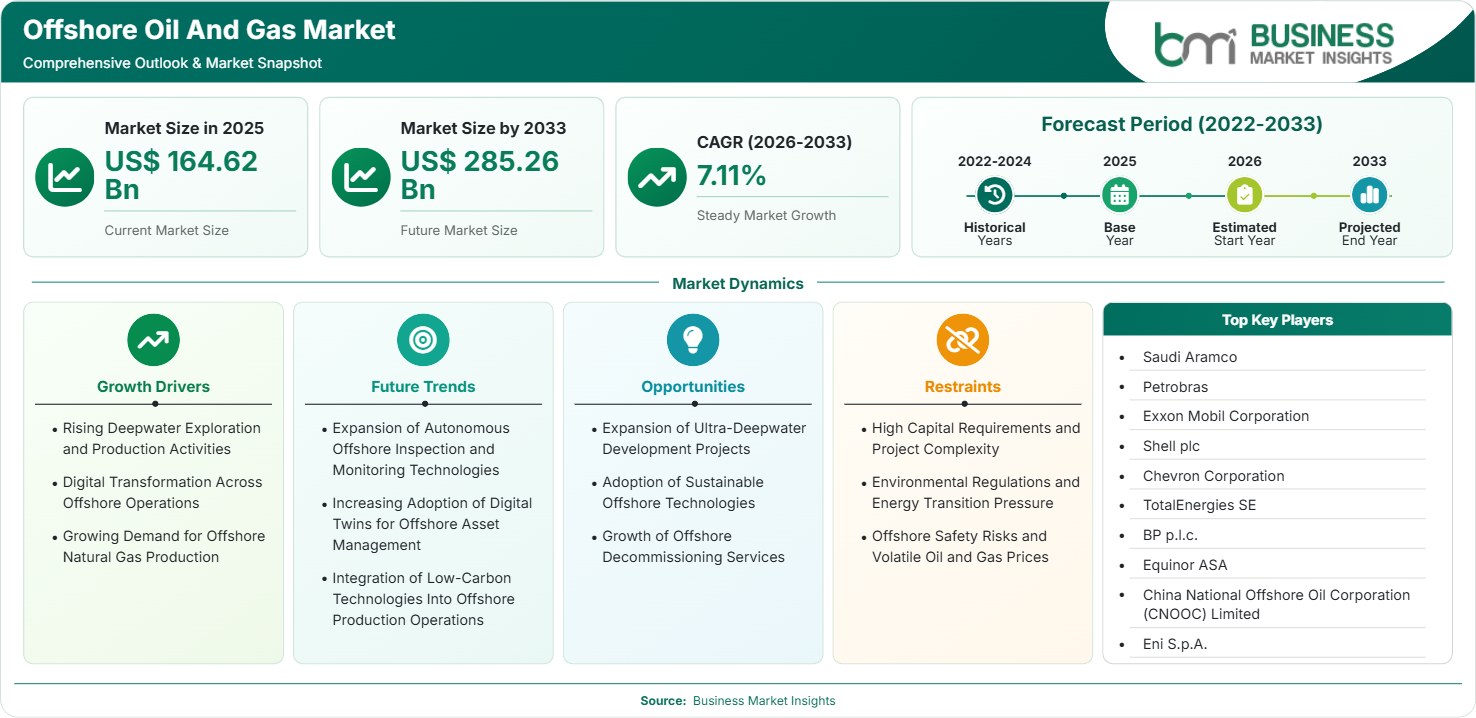
The Offshore Oil And Gas Market size was valued at US$ 164.62 Billion in 2025 and is projected to reach US$ 285.26 Billion by 2033, growing at a CAGR of 7.11% during 2026–2033. Rising offshore exploration investments, expanding deepwater production, and increasing demand for cleaner natural gas production are creating new opportunities for operators, service providers, and technology developers across global offshore energy value chains.

Report Coverage
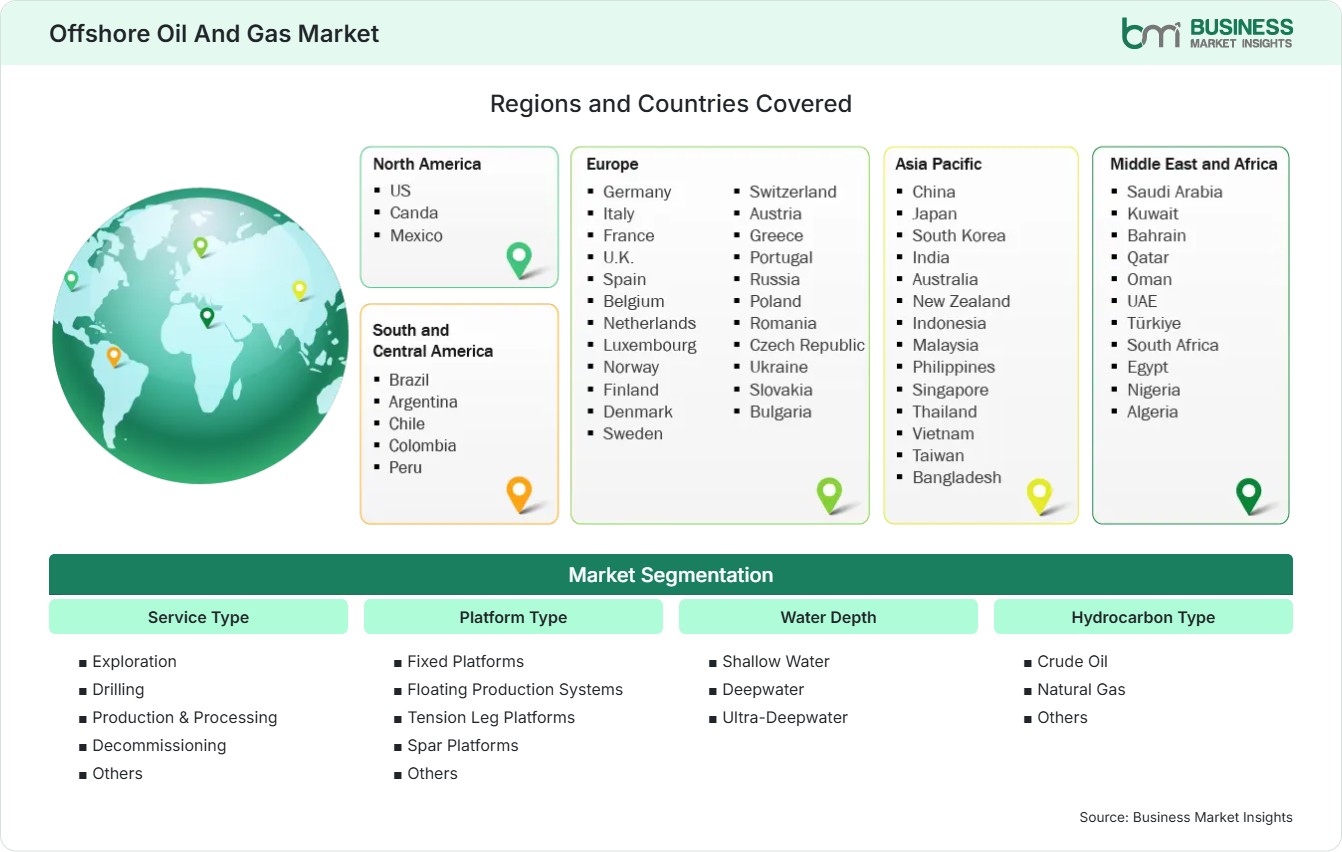
  • Service Type: Exploration , Drilling, Production & Processing, Decommissioning, Others
  • Platform Type: Fixed Platforms, Floating Production Systems , Tension Leg Platforms , Spar Platforms, Others
  • Water Depth: Shallow Water, Deepwater, Ultra-Deepwater
  • Hydrocarbon Type: Crude Oil, Natural Gas, Others
US$ 164.62 Bn Market size in 2025
US$ 285.26 Bn Market Size by 2033
7.11% CAGR, 2026 - 2033
2026-2033 Forecast Period

AI Overview

Offshore Oil And Gas Market Summary

  • North America Region: North America remains one of the leading regional markets, supported by sustained investments in the U.S. Gulf of Mexico, advanced offshore drilling technologies, and enhanced production efficiency. Mature infrastructure, favorable licensing activities, and digital asset optimization continue supporting long-term regional competitiveness.
  • Fastest Growing Region: Asia Pacific is emerging as the fastest-growing regional market due to increasing offshore discoveries, rising natural gas demand, expanding domestic energy security initiatives, and significant investments in deepwater developments across China, India, Malaysia, and Australia.
  • Leading Segment: Drilling continues to dominate service demand owing to increasing exploration activities, development of newly discovered offshore fields, and greater utilization of high-specification drilling rigs capable of operating in harsh offshore environments.
  • High Growth Segment: Ultra-Deepwater operations are expected to witness the strongest expansion as technological improvements lower operational risks while major discoveries in Brazil, Guyana, West Africa, and the Gulf of Mexico encourage long-term capital deployment.
  • Key Market Opportunity: Digital offshore platforms integrating artificial intelligence, predictive maintenance, subsea automation, remote inspection technologies, and carbon capture solutions are creating significant opportunities to improve operational efficiency, reduce emissions, and maximize recovery from mature offshore assets.
  • Major Market Players: Saudi Aramco, Petrobras, Exxon Mobil Corporation, Shell plc, Chevron Corporation, TotalEnergies SE, BP p.l.c., Equinor ASA, China National Offshore Oil Corporation (CNOOC) Limited, and Eni S.p.A.
Strategic Insights

Offshore Oil And Gas Market: Strategic Insights

Offshore Oil And Gas Market Strategic Framework
FREE PDF
Request your free sample
Request free sample
Stakeholder View

Key Takeaways

  • Integrated offshore value chain is gaining more relevance. Coordination between exploration companies, drilling contractors, subsea equipment providers, engineering companies, digital solutions providers, and logistics providers increases efficiency of projects execution and decreases operational expenses within offshore developments.
  • The investments into deepwater and ultra-deepwater oil are providing best prospects in the long run. Offshore finds in Brazil, Guyana, Gulf of Mexico, and certain offshore areas of Africa remain to attract high capital expenditure because of better drilling economics and advanced subsea technology.
  • Digital transformation is becoming a competitive differentiator. Artificial intelligence, predictive maintenance, digital twins, cloud-based asset management, and autonomous underwater inspection systems are helping operators improve production reliability while minimizing unplanned downtime and maintenance expenses.
  • Asia Pacific and selected emerging offshore provinces are attracting increasing international investments. Growing domestic energy demand, supportive government policies, expanding offshore licensing programs, and strategic partnerships between national and international oil companies continue strengthening regional development prospects.
  • Environmental sustainability is becoming an operational priority across offshore developments. Operators are investing in methane emission reduction, carbon capture integration, electrified offshore platforms, energy-efficient production systems, and digital monitoring technologies to improve environmental performance while maintaining production competitiveness.
  • Strategic partnerships and technology collaborations are accelerating innovation across the offshore ecosystem. Equipment manufacturers, engineering companies, software developers, and upstream operators are jointly developing next-generation drilling systems, subsea processing technologies, and remote operations capabilities to enhance project economics and operational resilience.
Geographic Outlook

Offshore Oil And Gas Market Regional Highlights

North America Offshore Oil And Gas Market

North America accounted for an estimated 34%–37% Offshore Oil And Gas Market share in 2025 and is projected to expand at a CAGR of 6.5%–7.0% during 2026–2033. The region benefits from mature offshore infrastructure, high investment in deepwater developments, and advanced drilling technologies across the Gulf of Mexico.

  • Expansion of deepwater developments in the U.S. Gulf of Mexico is supported by advanced floating production systems, digital reservoir management, and improved drilling efficiency, enabling operators to maximize recovery while controlling operating expenditures.
  • Increasing deployment of subsea processing equipment, remotely operated vehicles, and predictive maintenance platforms enhances operational reliability, minimizes downtime, and strengthens production performance across mature offshore assets.
  • Government lease auctions and continued private investment encourage exploration in frontier offshore blocks while supporting engineering, procurement, and construction activities across the regional supply chain.

US Offshore Oil And Gas Market

The United States Offshore Oil And Gas Market represented approximately 78%–82% of the North American market in 2025 and is expected to register a CAGR of 6.6%–7.1% through 2033. Offshore production from the Gulf of Mexico remains a strategic contributor to national energy security, supported by advanced subsea infrastructure, floating production systems, and continuous investments in exploration technologies.

  • Offshore operators continue investing in high-pressure, high-temperature drilling systems to improve recovery rates from technically complex reservoirs while reducing operational risk and project costs.
  • Digital twin platforms, artificial intelligence, and real-time production monitoring improve asset utilization, enabling operators to optimize maintenance schedules and increase production efficiency.
  • Continued collaboration between technology providers and upstream companies accelerates innovation in subsea robotics, autonomous inspection, and remote operations for offshore facilities.

Europe Offshore Oil And Gas Market

Europe Offshore Oil And Gas Market captured an estimated 22%–25% market share in 2025 and is forecast to grow at a CAGR of 5.8%–6.4% during the forecast period. Norway remains the leading offshore producer owing to sustained investments in North Sea developments, while the United Kingdom continues modernizing mature offshore infrastructure.

  • Norway maintains regional leadership through continuous investment in enhanced recovery technologies, subsea compression systems, and digital offshore operations that improve production efficiency and extend field life.
  • The United Kingdom represents the fastest-evolving offshore investment environment, emphasizing infrastructure upgrades, carbon capture integration, and lower-emission production technologies across mature assets.
  • Regional operators increasingly integrate renewable power sources with offshore platforms to reduce operational emissions while maintaining production reliability and supporting decarbonization strategies.
  • Collaboration among engineering firms, equipment manufacturers, and energy companies accelerates innovation in subsea processing, remote inspection, and intelligent asset management solutions.

Asia Pacific Offshore Oil And Gas Market

Asia Pacific Offshore Oil And Gas Market accounted for approximately 24%–27% of the global market in 2025 and is projected to achieve the fastest regional CAGR of 8.3%–8.9% through 2033. China leads regional offshore investments, while India, Malaysia, and Australia continue expanding exploration and production activities. Rising energy demand, supportive government policies, and growing natural gas consumption drive sustained offshore investment across the region.

  • China continues expanding offshore exploration programs through substantial investments in deepwater drilling, subsea production technologies, and domestic equipment manufacturing capabilities.
  • India is emerging as one of the region's fastest-growing offshore markets through expanded exploration licensing, infrastructure modernization, and increasing investment in domestic hydrocarbon production.
  • Australia strengthens offshore natural gas developments supported by LNG export capacity, advanced floating production systems, and strategic investments in offshore infrastructure.
  • Malaysia continues promoting offshore exploration through favorable fiscal frameworks and partnerships between national oil companies and international operators to unlock deepwater resources.

Rest of World Offshore Oil And Gas Market

The Rest of World region held an estimated 16%–19% market share in 2025 and is anticipated to grow at a CAGR of 7.4%–8.0% through 2033. South & Central America benefits from major offshore discoveries led by Brazil and Guyana, while the Middle East and Africa continue expanding offshore exploration through large-scale investments, improved production technologies, and supportive government policies. Brazil remains the regional leader owing to extensive pre-salt developments, whereas Guyana represents one of the fastest-growing offshore production hubs. In the Middle East and Africa, Saudi Arabia, Angola, Nigeria, and the UAE continue investing in offshore capacity expansion to strengthen long-term hydrocarbon production.

  • Brazil continues attracting substantial offshore investments through world-class deepwater discoveries, advanced floating production systems, and long-term production development strategies.
  • Guyana records exceptional offshore expansion supported by successive discoveries, international partnerships, and rapid infrastructure development enabling large-scale commercial production.
  • Saudi Arabia and the UAE strengthen offshore exploration using advanced seismic imaging, intelligent drilling systems, and integrated production technologies to maximize resource recovery.
  • African offshore producers increasingly invest in subsea infrastructure, local content development, and international partnerships to accelerate field development and improve production efficiency.
Global Market Geography
FREE PDF
Request your free sample
Request free sample
Segment Analysis

Offshore Oil And Gas Market Segmentation

Service Type

Service Type accounted for approximately 39%–42% of the market in 2025 and is projected to expand at a CAGR of 7.2%–7.7% through 2033. The Offshore Oil And Gas Market scope continues expanding as exploration programs increase globally, while drilling, production optimization, and decommissioning services become increasingly technology-driven to improve operational efficiency and maximize offshore asset value.

  • Exploration (Seismic & Survey): Advanced seismic imaging, geophysical surveys, and reservoir characterization technologies improve discovery success rates while reducing exploration uncertainty across conventional and frontier offshore basins.
  • Drilling: High-specification drilling rigs, managed pressure drilling, and digital well construction technologies enhance operational efficiency, improve safety, and support complex deepwater and ultra-deepwater developments.
  • Production & Processing: Integrated production systems, subsea processing technologies, and intelligent monitoring solutions optimize hydrocarbon recovery while reducing maintenance requirements and operational interruptions throughout offshore facilities.
  • Decommissioning: Aging offshore infrastructure drives demand for safe platform removal, well abandonment, environmental restoration, and specialized engineering services that comply with evolving regulatory requirements.

Platform Type

Platform Type represented approximately 30%–33% market share during 2025 and is forecast to register a CAGR of 6.9%–7.4% through 2033. Continuous innovation in offshore engineering supports deployment of specialized production platforms designed for varying reservoir conditions, water depths, and long-term production requirements.

  • Fixed Platforms: Preferred for shallow-water developments due to structural stability, long operational life, and cost-effective production from established offshore fields.
  • Floating Production Systems (FPSO, FPU): Increasingly adopted for deepwater developments because of operational flexibility, faster deployment, and suitability for remote offshore reservoirs without extensive pipeline infrastructure.
  • Tension Leg Platforms (TLP): Enable stable production in deeper waters through reduced platform motion, supporting efficient drilling and production activities under challenging offshore conditions.
  • Spar Platforms: Designed for ultra-deepwater environments, spar platforms provide exceptional stability, supporting long-term production and complex subsea developments in harsh offshore locations.

Water Depth

Water Depth segmentation accounted for nearly 28%–31% of market activity in 2025 and is expected to grow at a CAGR of 7.8%–8.4% during the forecast period. Increasing discoveries in deepwater provinces and technological improvements continue accelerating offshore investment while reducing development risks.

  • Shallow Water: Continues supporting reliable hydrocarbon production through established infrastructure, lower development costs, and simplified maintenance requirements across mature offshore regions.
  • Deepwater: Growing exploration activity, advanced drilling technologies, and improved project economics encourage increasing investments across newly discovered offshore reserves.
  • Ultra-Deepwater: Represents the fastest-growing operational environment due to significant hydrocarbon discoveries, advanced subsea engineering, and increasing capability to develop technically challenging reservoirs.

Hydrocarbon Type

Hydrocarbon Type contributed approximately 34%–37% of total market activity in 2025 and is anticipated to record a CAGR of 7.0%–7.5% through 2033. The Offshore Oil And Gas Market trends increasingly emphasize balanced production portfolios combining crude oil output with expanding offshore natural gas developments supporting global energy transition objectives.

  • Crude Oil: Continues generating the largest revenue contribution through extensive offshore production, sustained global demand, and ongoing development of high-capacity offshore fields.
  • Natural Gas: Rapidly expanding due to increasing LNG demand, cleaner energy transition strategies, and growing investment in offshore gas production infrastructure.
Market Forces

Offshore Oil And Gas Market Dynamics

Key Market Drivers

Rising Deepwater Exploration and Production Activities

The growing number of offshore discoveries and expansion in deepwater operations have been contributing significantly to the Offshore Oil And Gas Market growth. The drilling companies are employing sophisticated drilling equipment and subsea production systems and large floating units for exploration of complex offshore reserves. Regions such as Brazil, Guyana, the Gulf of Mexico, and certain offshore regions of Africa will keep on drawing investments owing to their huge oil and gas potential. The rising demand for energy globally, falling productivity from mature reserves and favorable economics of offshore projects have prompted companies to invest in difficult reserves.

Digital Transformation Across Offshore Operations

Artificial Intelligence, Automation, Digital Twins, and Real-Time Monitoring are reshaping offshore asset management. There is an increased usage of predictive maintenance technology to minimize equipment failure, enhance safety performance, and increase production efficiency. Remote monitoring enables companies to control offshore operations using reduced staffing requirements and achieving high levels of reliability. Analytics technology helps in making sound decisions through analysis of production data, equipment status, and reservoir performance.

Growing Demand for Offshore Natural Gas Production

Growing global demand for natural gas especially from the LNG industry is encouraging offshore gas exploration and production activities. Nations are adopting energy security policies through exploitation of offshore gas resources and minimizing their reliance on energy imports. Offshore gas development projects in Australia, Southeast Asia, the Middle East, and Africa have attracted more interest as a result of their supply capability in the future. Increased interest in low carbon energy has made natural gas attractive as an energy resource due to its flexible nature.

Key Market Opportunities

Expansion of Ultra-Deepwater Development Projects

Ultra-deep water exploration provides an exciting prospect because of the improvements in technology that make exploitation possible for hitherto untapped offshore oil reserves. Advanced offshore systems, drilling technology, and floating production solutions are making it feasible to develop oil reservoirs that exist in ultra-deep waters. Nations that have substantial offshore resources are inviting foreign investors by means of licensing programs and partnerships. The presence of large reserves of oil, alongside improvements in oil recovery technologies, is providing lucrative prospects to oil equipment manufacturers, engineering firms, and offshore contractors. According to the Offshore Oil And Gas Market Forecasts, such prospects are on the rise.

Adoption of Sustainable Offshore Technologies

The offshore industry has been making more efforts in adopting technologies that are less damaging to the environment but still efficient in terms of production. Platform electrification, monitoring of methane gas levels, carbon capture, and energy-efficient machinery are increasingly becoming relevant in offshore developments. Offshore players are also making efforts in exploring alternative sources of power and optimizing operations to lower emissions intensity. All these efforts give rise to a demand for technology suppliers focusing on environment, automation, and energy.

Growth of Offshore Decommissioning Services

Aging offshore infrastructure is creating new opportunities in decommissioning, asset removal, and environmental restoration services. Mature offshore regions such as the North Sea and Gulf of Mexico require specialized solutions for safe platform retirement, well abandonment, and subsea infrastructure management. Service companies are developing advanced engineering capabilities to address complex decommissioning requirements while meeting environmental regulations. Growing demand for sustainable offshore asset management is encouraging investment in recycling technologies, underwater inspection systems, and specialized marine services. This segment provides long-term opportunities as operators balance production activities with responsible management of aging offshore assets.

Market Restraints and Challenges

High Capital Requirements and Project Complexity

Factor: Offshore projects entail substantial capital expenditure on exploration, drilling, underwater, and production equipment. Impact: This translates into higher capital expenditures, which translate to greater risks, more time required to complete projects, and a delay in making investments, especially during times when commodity prices are volatile. In addition, there are higher costs because of the engineering challenges posed by offshore locations and the specialized equipment required.

Environmental Regulations and Energy Transition Pressure

Factor: The rising number of environmental laws, carbon reduction goals, and energy transition efforts globally is impacting offshore investment strategy. Impact: Companies will incur extra costs due to regulation and need to incorporate emission-reduction technologies in offshore projects. New regulations can impact approval and licensing of projects as well as decisions related to investment. Companies need to meet their hydrocarbon production goals along with meeting their sustainability goals. Natural gas and offshore technologies can provide transitional options, but stricter environmental regulations can reduce some exploration efforts.

Company Analysis

Competitive Landscape

The Offshore Oil And Gas Market analysis indicates a highly competitive environment dominated by integrated energy companies, national oil companies, and offshore exploration leaders. Companies compete through technological capabilities, offshore asset portfolios, production efficiency, strategic partnerships, and investment in digital transformation.

Company Name

Overview

Products and Services relevant to this market

Saudi Aramco

Saudi Aramco is one of the world’s largest integrated energy companies with extensive upstream capabilities and offshore production operations.

Offshore exploration, crude oil production, reservoir management, drilling services, and advanced production technologies.

Petrobras

Petrobras is a Brazilian energy company recognized for deepwater and pre-salt offshore development expertise.

Offshore exploration, FPSO operations, deepwater production, subsea systems, and offshore engineering solutions.

Exxon Mobil Corporation

ExxonMobil is a global energy company with significant offshore exploration and production activities.

Offshore drilling, deepwater development, reservoir technologies, and integrated upstream operations.

Shell plc

Shell operates offshore assets globally with expertise in deepwater production and energy technologies.

Offshore exploration, floating production systems, subsea solutions, and LNG-related offshore projects.

Chevron Corporation

Chevron develops offshore resources through advanced exploration and production technologies.

Offshore drilling, deepwater projects, production systems, and reservoir optimization solutions.

TotalEnergies SE

TotalEnergies manages offshore oil and gas projects across multiple international regions.

Offshore exploration, subsea development, LNG projects, and production optimization technologies.

BP p.l.c.

BP operates offshore assets while investing in technology-driven production efficiency.

Offshore production, drilling operations, digital asset management, and energy solutions.

Equinor ASA

Equinor is a major Norwegian offshore operator specializing in North Sea developments.

Offshore exploration, subsea production, floating platforms, and offshore field management.

China National Offshore Oil Corporation (CNOOC Limited)

CNOOC is China’s leading offshore exploration and production company.

Offshore drilling, marine engineering, deepwater exploration, and offshore production operations.

Eni S.p.A.

Eni operates offshore projects across Europe, Africa, and other global regions.

Offshore exploration, gas production, subsea technologies, and integrated energy development.

Trust & Transparency

Research Methodology

The market analysis combines proprietary research with secondary data from government agencies, company disclosures, regulatory filings, industry databases and expert interviews. Market estimates are validated through data triangulation, cross-market benchmarking and analyst review.

View Full Research Methodology

Questions Answered

Frequently Asked Questions

What is included in an Offshore Oil And Gas Market Report?

An Market Report typically covers market size analysis, segmentation, regional trends, competitive landscape, growth drivers, opportunities, and industry developments affecting offshore energy operations.

What role does natural gas play in offshore development?

Natural gas supports energy security and LNG supply chains. Offshore gas projects are expanding as countries seek reliable energy sources with lower carbon intensity compared with traditional fuels.

How is digital technology changing offshore operations?

Digital platforms, artificial intelligence, and predictive analytics help operators monitor equipment, optimize production, improve safety, and reduce maintenance costs across offshore facilities.

Why are deepwater projects becoming more important?

Deepwater projects provide access to large hydrocarbon reserves that cannot be developed through conventional offshore methods. Improved engineering solutions are reducing operational risks and increasing commercial viability.

What factors are driving offshore oil and gas investments globally?

Offshore investments are supported by rising energy demand, deepwater discoveries, technological improvements, and increasing demand for natural gas. Advanced drilling systems and subsea technologies are improving project economics.

Access the Full Offshore Oil And Gas Market Report

Get segment-level forecasts, regional estimates, competitive benchmarking, company profiles and downloadable Excel datasets.

Access the full Offshore Oil And Gas Market Report
350 pages PDF & Excel | 2026-08-17
Similar Research

Related Market Reports