
Landfill Gas Market Outlook: Size, Share, Trends, Growth Analysis, Competitive Landscape & Forecast, 2026-2033

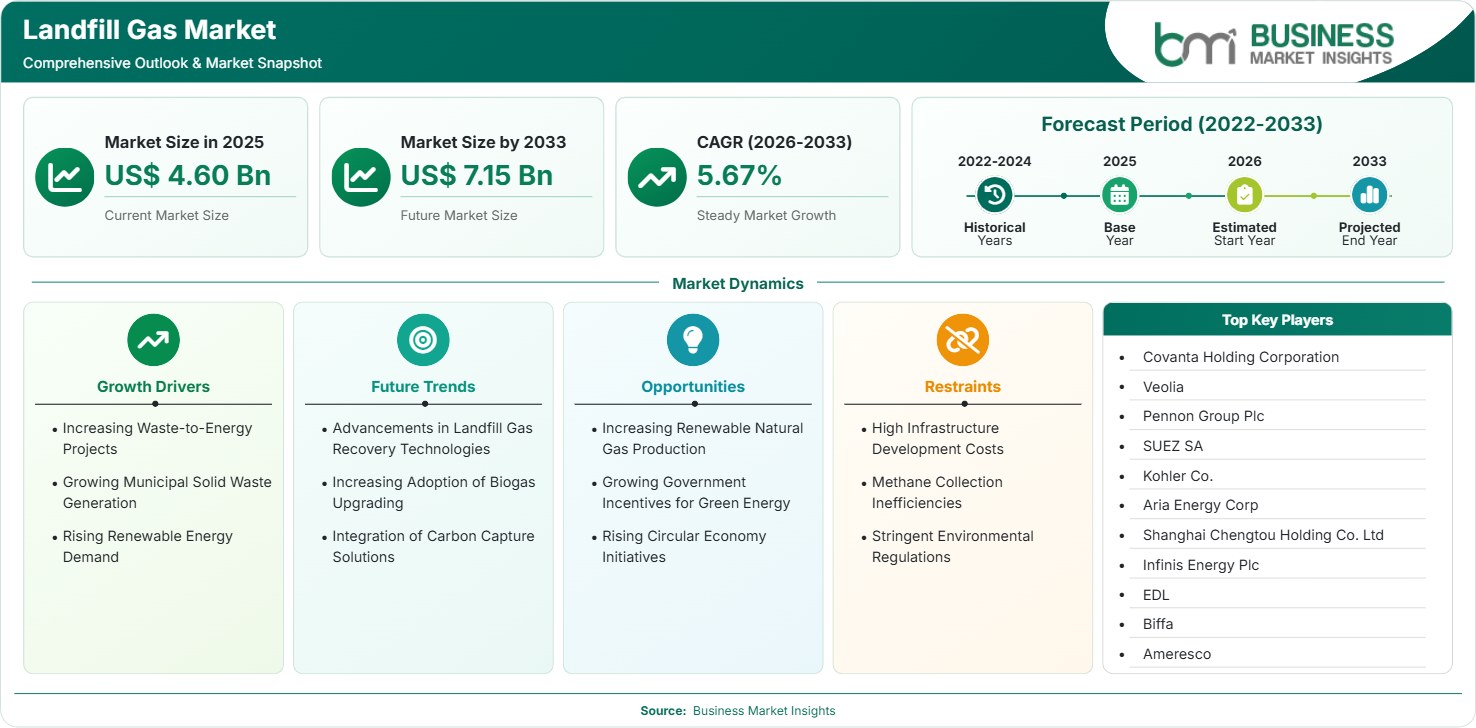
The Landfill Gas Market size was valued at 4.60 Billion in 2025 and is projected to reach 7.15 Billion by 2033, growing at a CAGR of 5.67% during 2026–2033, driven by increasing waste-to-energy adoption, renewable energy targets, methane reduction initiatives, and opportunities in renewable natural gas production and circular economy development.

Report Coverage
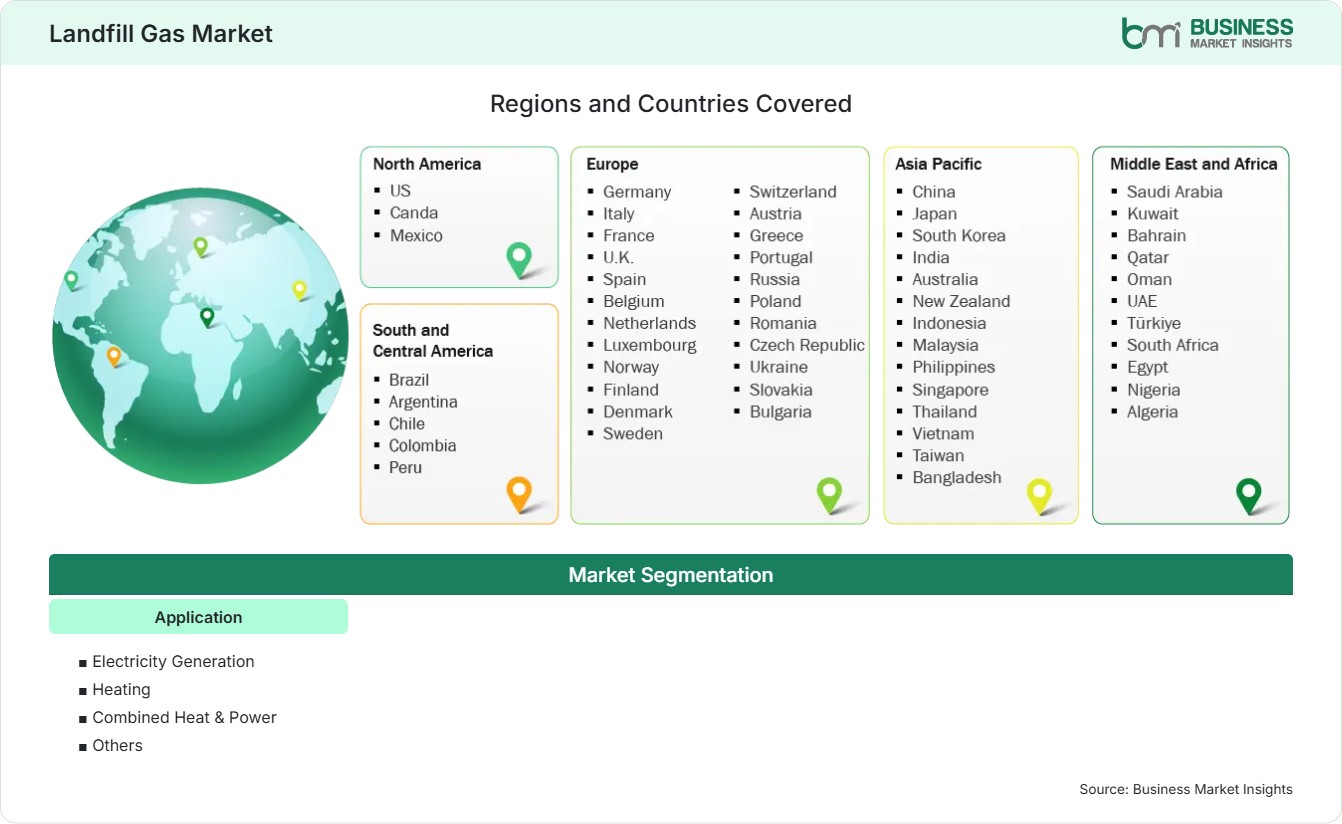
  • Application: Electricity Generation, Heating, Combined Heat & Power, Others
US$ 4.60 Bn Market size in 2025
US$ 7.15 Bn Market Size by 2033
5.67% CAGR, 2026 - 2033
2026-2033 Forecast Period

01 AI Overview

Landfill Gas Market Summary

  • North America Region: North America holds a share range of 38%–42% in 2025, growing with a CAGR range of 5.5%–6.0% during 2026–2033, supported by landfill methane capture regulations, waste management infrastructure, renewable energy incentives, and biogas utilization investments. The US market analysis indicates steady expansion with a CAGR range of 5.7%–6.2% due to federal and state-level landfill emission reduction programs.
  • Fastest Growing Region: Asia Pacific records a share range of 22%–26% in 2025, expanding with a CAGR range of 6.2%–6.8% during 2026–2033, supported by rising municipal waste generation, urbanization, renewable energy investments, landfill modernization programs, and increasing adoption of methane recovery technologies across emerging economies.
  • Leading Segment: Electricity Generation leads with a share range of 45%–50% in 2025, advancing at a CAGR range of 5.4%–5.9% during 2026–2033, driven by grid integration opportunities, renewable power demand, landfill gas-to-energy projects, and supportive energy transition policies.
  • High Growth Segment: Combined Heat & Power demonstrates a share range of 18%–22% in 2025, growing at a CAGR range of 6.0%–6.5% during 2026–2033, supported by industrial energy efficiency requirements, decentralized power solutions, and increasing demand for integrated heat and electricity generation systems.
  • Key Market Opportunity: Rising renewable natural gas adoption creates opportunities through landfill methane upgrading, transportation fuel applications, decarbonization strategies, and government-backed clean energy programs supporting long-term infrastructure investments and improved waste resource utilization.
  • Major Market Players: Covanta Holding Corporation, Veolia, Pennon Group Plc, SUEZ SA, Kohler Co., Aria Energy Corp, Shanghai Chengtou Holding Co. Ltd, Infinis Energy Plc, EDL, Biffa, Ameresco.
02 Strategic Insights

Landfill Gas Market: Strategic Insights

Landfill Gas Market Strategic Framework
FREE PDF
Request your free sample
Request free sample
03 Stakeholder View

Key Takeaways

  • Waste management companies are transitioning from disposal-focused operations toward integrated resource recovery models, creating value chains involving landfill operators, energy producers, technology suppliers, and renewable fuel developers.
  • Electricity generation remains the primary application area, while combined heat and power systems offer additional growth potential through improved energy efficiency and localized power solutions.
  • Advanced methane monitoring, gas upgrading technologies, and automated collection systems are reshaping project economics by improving recovery efficiency and reducing operational losses.
  • Asia Pacific presents a compelling investment opportunity due to rapid urbanization, increasing municipal waste volumes, and government initiatives supporting renewable energy infrastructure development.
  • Strategic partnerships and acquisitions among waste management firms, energy companies, and renewable technology providers are strengthening project portfolios and expanding landfill gas recovery capabilities.
  • Integration with circular economy strategies is enabling landfill operators to diversify revenue streams through renewable fuels, carbon reduction programs, and sustainable waste management solutions.
04 Geographic Outlook

Landfill Gas Market Regional Highlights

North America Landfill Gas Market

North America accounted for a share range of 38%–42% in 2025 and is projected to expand at a CAGR range of 5.5%–6.0% during 2026–2033. The region benefits from established landfill infrastructure, methane emission regulations, and mature waste-to-energy networks. The landfill gas share remains strong due to extensive landfill projects across the United States and Canada, while landfill gas market growth is supported by renewable energy incentives, carbon reduction programs, and increasing demand for recovered energy solutions.

  • The United States dominates regional adoption through landfill methane capture projects, supported by environmental regulations, renewable energy initiatives, and increasing investment in landfill gas utilization infrastructure.
  • Canada is expanding landfill gas recovery activities through municipal sustainability programs, waste diversion strategies, and renewable energy projects targeting methane emissions reduction and resource recovery.
  • Advanced monitoring technologies and improved gas collection systems are enhancing operational efficiency, enabling operators to maximize methane recovery and improve project profitability.
  • Regulatory frameworks promoting greenhouse gas reduction are encouraging utilities and waste companies to develop new landfill energy conversion facilities.

US Landfill Gas Market

The US represents a share range of 32%–36% within North America in 2025 and is expected to register a CAGR range of 5.7%–6.2% during 2026–2033. Strong landfill infrastructure, federal methane reduction initiatives, and renewable energy investments support market expansion. The country has a large installed base of landfill energy projects, with increasing adoption of gas upgrading technologies. Growing collaboration between municipalities and private operators continues to strengthen project development and long-term operational efficiency.

  • Federal and state environmental programs encourage landfill operators to capture methane emissions and convert waste gases into usable energy resources.
  • Utility partnerships are expanding landfill electricity generation projects by integrating recovered methane into renewable power portfolios and energy transition strategies.
  • Technological improvements in gas purification and monitoring systems are increasing efficiency across existing landfill gas recovery facilities.
  • Private sector investment is accelerating through renewable energy credits and sustainability commitments from large organizations.

Europe Landfill Gas Market

Europe held a share range of 28%–32% in 2025 and is anticipated to grow at a CAGR range of 5.0%–5.6% during 2026–2033. The region benefits from strict waste management regulations, landfill diversion policies, and renewable energy targets. Countries including Germany, the United Kingdom, and France are advancing landfill gas projects through circular economy initiatives. The landfill gas market share reflects strong environmental compliance, while adoption growth is supported by methane recovery improvements and sustainable waste treatment practices.

  • Germany continues developing landfill gas recovery projects through advanced waste management systems and renewable energy integration programs.
  • The United Kingdom supports landfill methane utilization through renewable energy incentives, landfill restoration projects, and decarbonization-focused waste policies.
  • France is increasing adoption through municipal waste treatment modernization and renewable gas development strategies.
  • European regulations focused on methane reduction are encouraging investment in collection efficiency improvements and landfill rehabilitation programs.

Asia Pacific Landfill Gas Market

Asia Pacific accounted for a share range of 22%–26% in 2025 and is projected to achieve a CAGR range of 6.2%–6.8% during 2026–2033, making it the fastest-growing region. Increasing urban waste generation, expanding landfill infrastructure, and government-supported renewable energy initiatives are accelerating adoption. China, India, Japan, and Southeast Asian countries are investing in waste-to-energy solutions. The region presents strong potential as municipalities seek sustainable alternatives for methane management and energy recovery.

  • China is strengthening landfill gas utilization through large-scale waste management improvements and renewable energy development programs.
  • India is increasing landfill methane recovery opportunities through urban waste management reforms and clean energy initiatives.
  • Japan focuses on efficient waste processing technologies, supporting advanced landfill gas collection and energy conversion systems.
  • Southeast Asian countries are developing landfill infrastructure through public-private partnerships and sustainability-focused waste management investments.

Rest of World Landfill Gas Market

South and Central America, along with Middle East and Africa regions, represented a share range of 8%–12% in 2025 and are expected to grow at a CAGR range of 5.8%–6.4% during 2026–2033. Developing waste management infrastructure and renewable energy priorities are creating new opportunities. Brazil, Mexico, South Africa, and Gulf countries are exploring methane recovery solutions to improve environmental performance and energy security.

  • Brazil is advancing landfill gas projects through municipal waste initiatives and renewable energy development programs supporting methane utilization.
  • Mexico is improving landfill management systems through environmental policies encouraging methane capture and energy generation.
  • Middle Eastern countries are exploring landfill gas recovery as part of broader sustainability and waste transformation strategies.
  • African markets are developing opportunities through international climate financing and infrastructure investments for landfill methane management.
  • Growing partnerships between governments and private operators are improving project feasibility across emerging waste management markets.
Global Market Geography
FREE PDF
Request your free sample
Request free sample
05 Segment Analysis

Landfill Gas Market Segmentation

Application

The Application segment defines adoption patterns across electricity, heating, and integrated energy recovery systems. The segment supports the landfill gas market scope through diverse utilization pathways, with electricity generation maintaining the largest share range of 45%–50% in 2025 and a CAGR range of 5.4%–5.9% during 2026–2033. Increasing waste conversion initiatives, renewable energy targets, and improved landfill infrastructure continue shaping application preferences.

  • Electricity Generation: This application remains dominant as landfill operators convert captured methane into power. Growing renewable electricity demand, grid integration opportunities, and emission reduction targets support continued project deployment.
  • Heating: Heating applications utilize recovered methane for industrial and commercial thermal requirements. Adoption is supported by energy efficiency goals, localized fuel availability, and demand for lower-carbon heating alternatives.
  • Combined Heat & Power: Combined heat and power systems improve energy utilization by producing electricity and thermal energy simultaneously. Industrial facilities increasingly adopt these systems for efficiency gains and operational cost optimization.
06 Market Forces

Landfill Gas Market Dynamics

Key Market Drivers

Increasing Waste-to-Energy Projects

Rising waste-to-energy initiatives have resulted in rapid growth of landfill gas due to conversion of methane into viable energy sources. Landfill gas recovery systems are being installed by governments to minimize environmental effects while ensuring renewable energy sources are available. Modern collection and purification technologies and economic viability have helped fuel landfill gas market trends in both developing and developed areas. Waste companies are increasingly collaborating with utility companies to build energy-producing facilities using landfill sources.

Growing Municipal Solid Waste Generation

The increase in volume of municipal solid waste will create more opportunities for methane recovery as waste management systems continue to develop. The growth of landfill gases will be aided by urbanization, growth in population, and development in waste treatment facilities. The improvements in landfill management will make it possible for the operators to harvest the methane easily without the risk of losing any.

Rising Renewable Energy Demand

Higher demand for renewable energy has led landfill managers to invest in landfill gas-powered generation facilities to meet their decarbonization goals. Increasingly, energy firms are considering landfill as an option for generating renewable energy and renewable natural gas. The growth in landfill gas has been driven by sustainability initiatives, carbon emission reductions and clean energy regulations. The trends in the landfill gas market have emerged on the back of increased utilization of recovered methane in diverse energy mixes.

Key Market Opportunities

Increasing Renewable Natural Gas Production

The rise in the production of renewable natural gas presents an opportunity for landfill owners to upgrade the methane into usable natural gas in the pipelines. Purification and compression technologies make the captured landfill gas usable for energy needs in the transport industry and industries. Landfill Gas Market Forecast More investments are expected as governments push low-carbon fuels and circular economy policies. Businesses are establishing upgrading facilities as a way of adding more sources of income aside from electricity production. The growing need for clean energy in the transport industry and other industries is making businesses collaborate.

Growing Government Incentives for Green Energy

Governments are offering incentives for renewable energy that have led to improved economics in landfills through renewable energy credits, carbon offset initiatives, and financing for clean energy. Government policies are leading to the involvement of private sector companies in waste-to-energy projects as a result of government initiatives. Regulations that have been put in place to reduce greenhouse gases are favoring landfill gas developers. Incentives assist in addressing the financial barriers at the beginning of the projects and ensuring their acceptance in developing countries.

Rising Circular Economy Initiatives

Circular economy programs are providing new avenues through which landfill gas recovery projects are being viewed as one aspect of sustainable resource management practices. The landfill operators are increasingly incorporating the technology of methane recovery into their overall program of recycling, composting, and renewable energy production. Growing emphasis of companies on environmental performance is prompting investment in the development of landfills and technologies for resource recovery. This helps in improving efficiency of the landfills as well as in minimizing the emissions of greenhouse gases.

Market Restraints and Challenges

High Infrastructure Development Costs

Factor: High infrastructure development costs represent a major challenge due to the requirement for extensive gas collection networks, monitoring equipment, processing units, and energy conversion systems. Impact: These costs may lead to a delay in the implementation of such projects, especially in places where financing is not readily available or where waste management infrastructure is still underdeveloped. Such projects take a lot of money before any revenue can be generated, which is a critical factor that affects investment plans of small-scale companies. Even though the advancement in technology has led to lower operational costs, financing challenges are still a key issue.

Methane Collection Inefficiencies

Factor: Methane collection inefficiencies caused by aging landfill infrastructure, inconsistent waste composition, and inadequate monitoring systems create operational challenges. Impact: Low recovery rates mean that there is a low potential for energy production, which has implications for profitability. There is need for investment in more effective collection techniques and better monitoring processes to boost gas recovery efficiency. Landfill differences may have an effect on the efficiency of the process, which calls for better management approaches. Efficiency in gas collection is essential for energy production.

07 Company Analysis

Competitive Landscape

The Landfill Gas Market analysis highlights a competitive ecosystem consisting of waste management companies, renewable energy developers, landfill operators, and technology providers. Key participants are focusing on methane recovery optimization, renewable natural gas development, energy conversion efficiency, and strategic partnerships to strengthen their positions across regional markets.

Company Name

Overview

Products and Services relevant to this market

Covanta Holding Corporation

Covanta operates waste-to-energy facilities and develops sustainable waste management solutions focused on resource recovery and environmental performance.

Provides waste conversion, landfill gas recovery support, renewable energy generation, and waste management infrastructure solutions.

Veolia

Veolia is a global environmental services company offering integrated waste, water, and energy management solutions across multiple regions.

Provides landfill operations, methane capture solutions, energy recovery services, and environmental management technologies.

Pennon Group Plc

Pennon Group operates sustainable environmental infrastructure businesses focused on water, waste management, and resource recovery activities.

Offers waste treatment services, renewable energy generation solutions, and landfill gas utilization capabilities.

SUEZ SA

SUEZ provides circular economy and environmental management solutions supporting waste transformation and resource recovery.

Delivers landfill management, methane recovery systems, waste-to-energy solutions, and renewable energy development services.

Kohler Co.

Kohler develops energy solutions and distributed power systems supporting sustainable infrastructure applications.

Provides energy generation technologies, power systems, and solutions applicable to landfill gas-based electricity generation.

Aria Energy Corp

Aria Energy specializes in renewable energy projects using landfill gas and other methane-based resources.

Develops landfill gas recovery facilities, renewable electricity projects, and methane-to-energy conversion systems.

Shanghai Chengtou Holding Co. Ltd

Shanghai Chengtou Holding develops urban infrastructure projects including waste treatment and environmental services.

Supports waste management infrastructure, landfill treatment projects, and energy recovery initiatives.

Infinis Energy Plc

Infinis Energy focuses on renewable energy generation from landfill gas and other low-carbon sources.

Provides landfill gas power generation, methane capture, renewable electricity production, and carbon reduction solutions.

EDL

EDL develops distributed energy solutions with expertise in converting landfill gas into reliable renewable power.

Offers landfill gas utilization, renewable energy projects, methane recovery systems, and energy management services.

Biffa

Biffa is a UK-based sustainable waste management company providing collection, treatment, and recycling solutions.

Provides landfill operations, methane recovery, renewable energy generation, and waste resource management services.

Ameresco

Ameresco develops energy efficiency and renewable energy projects for public and private sector customers.

Provides landfill gas energy systems, renewable natural gas projects, energy infrastructure development, and sustainability solutions.

10 Trust & Transparency

Research Methodology

The market analysis combines proprietary research with secondary data from government agencies, company disclosures, regulatory filings, industry databases and expert interviews. Market estimates are validated through data triangulation, cross-market benchmarking and analyst review.

View Full Research Methodology

11 Questions Answered

Frequently Asked Questions

How can companies benefit from the Landfill Gas Market Report?

The report provides insights into application trends, regional opportunities, competitive developments, and investment areas supporting strategic planning for waste-to-energy stakeholders.

What role does technology play in landfill gas projects?

Advanced monitoring systems, gas collection improvements, and purification technologies enhance methane recovery efficiency and improve the operational performance of landfill energy facilities.

Which application dominates landfill gas utilization?

Electricity generation represents the leading application due to established infrastructure, reliable energy conversion technologies, and integration opportunities with renewable power networks.

How does landfill gas market contribute to sustainability goals?

Landfill gas recovery reduces uncontrolled methane emissions while producing renewable energy, supporting climate strategies, circular economy initiatives, and cleaner waste management practices.

What factors are driving landfill gas adoption?

Increasing municipal waste generation, methane emission regulations, renewable energy targets, and improved recovery technologies are encouraging landfill operators to convert waste gases into electricity and renewable fuels.

Access the Full Landfill Gas Market Report

Get segment-level forecasts, regional estimates, competitive benchmarking, company profiles and downloadable Excel datasets.

Access the full Landfill Gas Market Report
350 pages PDF & Excel | 2026-08-06