
Gas Turbine Market Outlook: Size, Share, Trends, Growth Analysis, Competitive Landscape & Forecast, 2026-2033

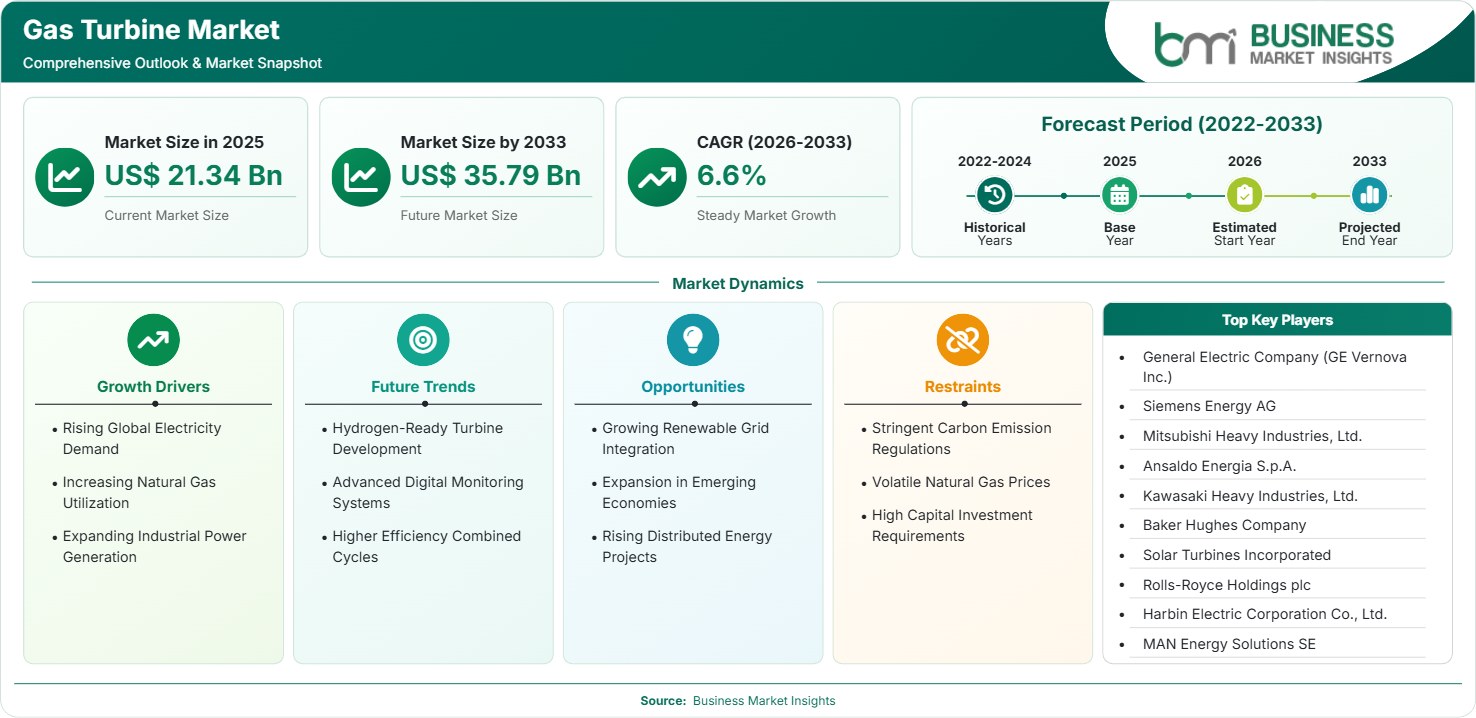
The Gas Turbine Market size was valued at USD 21.34 Billion in 2025 and is projected to reach USD 35.79 Billion by 2033, growing at a CAGR of 6.6% during 2026–2033. Rising electricity demand, expanding natural gas-fired power generation, and increasing investments in efficient combined-cycle power plants continue supporting industry expansion.

Report Coverage
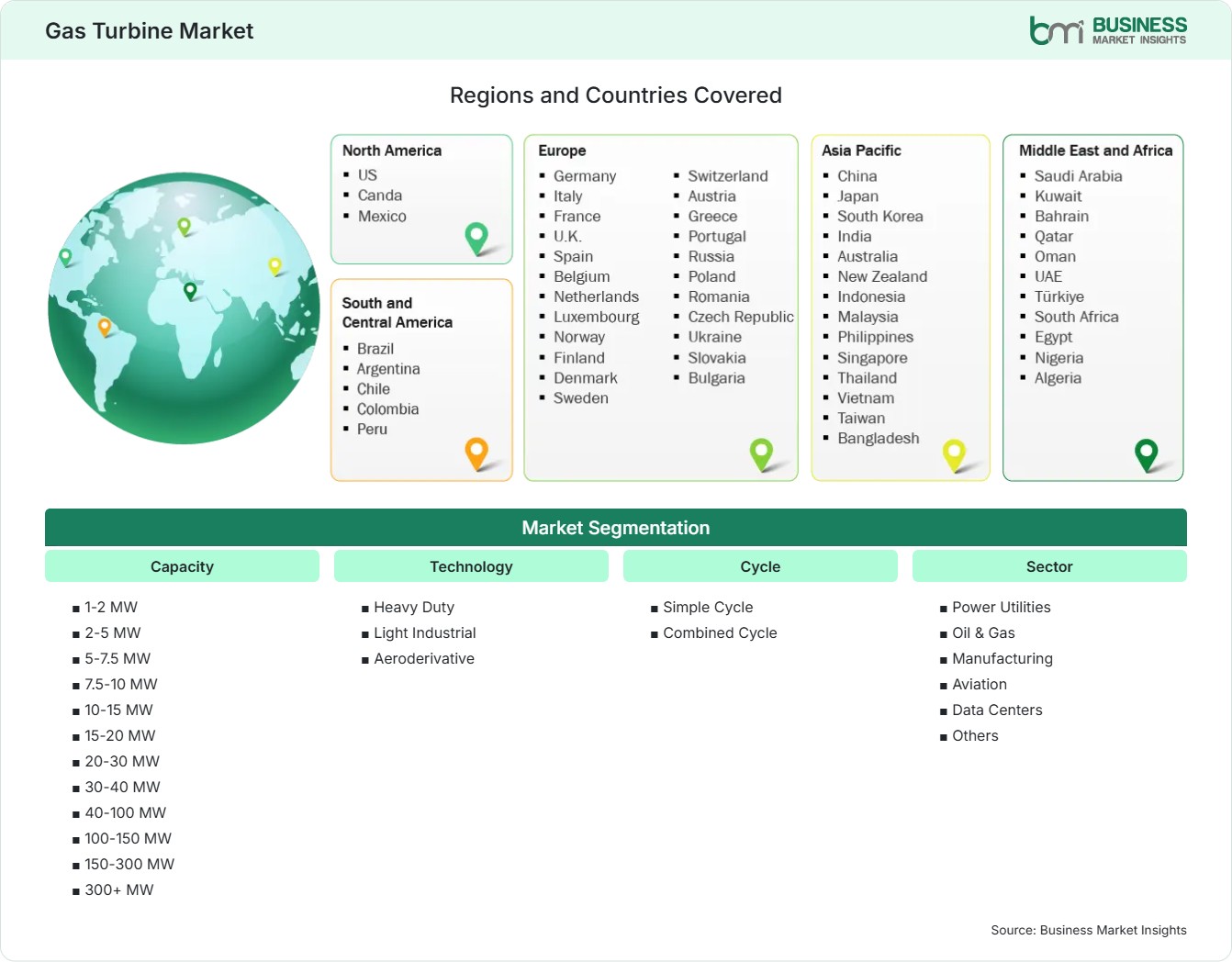
  • Capacity: 1-2 MW, 2-5 MW, 5-7.5 MW, 7.5-10 MW, 10-15 MW, 15-20 MW, 20-30 MW, 30-40 MW, 40-100 MW, 100-150 MW, 150-300 MW, 300+ MW
  • Technology: Heavy Duty, Light Industrial, Aeroderivative
  • Cycle: Simple Cycle, Combined Cycle
  • Sector: Power Utilities, Oil & Gas, Manufacturing, Aviation, Data Centers, Others
US$ 21.34 Bn Market size in 2025
US$ 35.79 Bn Market Size by 2033
6.6% CAGR, 2026 - 2033
2026-2033 Forecast Period

01 AI Overview

Gas Turbine Market Summary

  • North America Region: North America holds a 33%–36% market share in 2025 and is projected to grow at a CAGR of 6.4%–6.8% during 2026–2033. Utility modernization, expanding gas-fired generation capacity, data center investments, and hydrogen blending initiatives continue strengthening regional demand for advanced turbine technologies. The U.S. market is projected to register a CAGR of 6.5%–6.9%, supported by combined-cycle plant upgrades and increasing industrial power requirements.
  • Fastest Growing Region: Asia Pacific holds 30%–33% of global revenue in 2025 and is expected to expand at a CAGR of 7.2%–7.7% during 2026–2033. Rapid industrialization, electricity demand growth, LNG infrastructure expansion, and investments in high-efficiency power generation continue creating favorable conditions for new turbine installations.
  • Leading Segment: Combined Cycle accounts for 61%–64% of Gas Turbine Market revenue in 2025 and is anticipated to expand at a CAGR of 6.8%–7.2% through 2026–2033. Higher fuel efficiency, lower emissions, and increasing replacement of aging coal-fired generation continue supporting segment leadership across utility-scale power projects.
  • High Growth Segment: Data Centers represent 8%–10% of market revenue in 2025 and are forecast to register the fastest CAGR of 8.8%–9.4% during 2026–2033. Rising hyperscale infrastructure, AI computing workloads, and demand for reliable on-site power generation continue accelerating investment in gas turbine-based energy solutions.
  • Key Market Opportunity: Increasing deployment of hydrogen-capable turbines, expansion of distributed generation, and rising investments in resilient power infrastructure are creating attractive long-term opportunities across utility and industrial sectors.
  • Major Market Players: General Electric Company (GE Vernova Inc.), Siemens Energy AG, Mitsubishi Heavy Industries, Ltd., Ansaldo Energia S.p.A., Kawasaki Heavy Industries, Ltd., Baker Hughes Company, Solar Turbines Incorporated, Rolls-Royce Holdings plc, Harbin Electric Corporation Co., Ltd., and MAN Energy Solutions SE.
02 Strategic Insights

Gas Turbine Market: Strategic Insights

gas-turbine-market-market-strategic-framework
FREE PDF
Request your free sample
Request free sample
03 Stakeholder View

Key Takeaways

  • The market ecosystem is increasingly shifting toward lifecycle service contracts, digital asset management, predictive maintenance, and long-term equipment upgrades, enabling manufacturers to generate recurring revenue beyond new turbine installations.
  • Utility-scale combined-cycle projects and rapidly expanding data center infrastructure present the strongest investment opportunities and demand growth.
  • Innovation is increasingly centered on hydrogen-capable combustion systems and AI-enabled performance optimization to improve operational efficiency and plant flexibility.
  • Asia Pacific offers one of the strongest long-term investment opportunities owing to accelerating industrialization, LNG import infrastructure expansion, and increasing electricity consumption.
  • Strategic partnerships, technology licensing agreements, and service portfolio expansion continue reshaping competitive dynamics.
  • The growing convergence of natural gas generation with renewable energy, battery storage, and carbon capture technologies is creating new integrated business models.
04 Geographic Outlook

Gas Turbine Market Regional Highlights

North America Gas Turbine Market

North America accounted for 33%–36% of global revenue in 2025 and is projected to expand at a CAGR of 6.4%–6.8% during 2026–2033. The Gas Turbine Market share remains the largest globally due to continued investments in combined-cycle power plants, modernization of aging generation assets, and growing electricity demand from industrial facilities and hyperscale data centers.

  • The United States and Canada continue investing in high-efficiency combined-cycle power plants to replace aging coal-fired generation while supporting increasing renewable energy penetration across regional transmission networks.
  • Expanding LNG infrastructure, industrial manufacturing activity, and data center construction continue increasing demand for reliable gas turbine-based distributed generation and utility-scale power projects throughout North America.
  • OEMs continue strengthening long-term service agreements, predictive maintenance platforms, and digital monitoring solutions to maximize turbine efficiency, reduce downtime, and improve plant lifecycle performance.
  • Hydrogen blending initiatives and carbon capture integration projects continue supporting deployment of next-generation gas turbines capable of reducing emissions while maintaining dependable baseload electricity generation.

US Gas Turbine Market

The United States represented 28%–31% of global revenue in 2025 and is anticipated to register a CAGR of 6.5%–6.9% during the forecast period. Strong industrial activity, growing natural gas availability, rapid expansion of AI-enabled data centers, and modernization of combined-cycle generating stations continue driving Gas Turbine Market growth across multiple end-use sectors.

  • Utilities continue upgrading aging thermal power plants with high-efficiency combined-cycle technologies to improve operational flexibility, lower emissions, and enhance fuel utilization efficiency.
  • Expanding investments by hyperscale cloud providers continue driving demand for on-site backup generation and resilient power infrastructure utilizing advanced gas turbines.
  • Industrial facilities increasingly deploy aeroderivative and light industrial turbines to improve energy security, operational continuity, and process efficiency.
  • Continued natural gas production and pipeline expansion strengthen long-term fuel availability for power generation and industrial applications.

Europe Gas Turbine Market

Europe accounted for 24%–27% of global Gas Turbine Market revenue in 2025 and is projected to expand at a CAGR of 6.2%–6.6% during 2026–2033. Decarbonization strategies, modernization of flexible generation assets, and increasing investments in hydrogen-ready power plants continue supporting regional demand.

  • Germany continues leading regional deployment through investments in hydrogen-capable combined-cycle plants, industrial cogeneration facilities, and replacement of retiring conventional thermal generation assets.
  • Poland is projected to register a CAGR of 6.9%–7.3% as utilities accelerate modernization of power generation infrastructure and reduce dependence on older coal-fired facilities.
  • Italy, the United Kingdom, and Spain continue investing in flexible thermal generation to complement rapidly expanding renewable energy capacity.
  • Carbon reduction targets encourage manufacturers to commercialize low-emission combustion technologies compatible with hydrogen and carbon capture solutions.

Asia Pacific Gas Turbine Market

Asia Pacific accounted for 30%–33% of global revenue in 2025 and is projected to register the fastest CAGR of 7.2%–7.7% during 2026–2033. Rapid industrialization, urbanization, expanding LNG imports, and rising electricity consumption continue accelerating regional investment in modern gas-fired power generation infrastructure. China remains the largest regional market, while India is expected to record the highest growth rate.

  • China continues investing in high-efficiency combined-cycle facilities, industrial cogeneration, and grid modernization to support expanding electricity demand and emission reduction objectives.
  • India is projected to register a CAGR of 7.8%–8.3%, supported by industrial expansion, growing data center investments, and increasing deployment of flexible gas-fired generation.
  • Japan continues modernizing aging thermal assets with advanced high-efficiency turbine technologies to improve fuel efficiency and operational reliability.
  • Southeast Asian economies continue expanding LNG infrastructure and gas-based power generation to strengthen long-term electricity security.
  • Rapid manufacturing expansion continues increasing demand for industrial captive power systems across multiple heavy industries.

Rest of World Gas Turbine Market

The Rest of the World accounted for 8%–10% of global revenue in 2025 and is expected to expand at a CAGR of 6.3%–6.7% during 2026–2033. South & Central America continues investing in natural gas infrastructure and industrial power generation, while Middle East & Africa benefit from abundant gas reserves and large-scale utility projects supporting long-term energy diversification.

  • Brazil continues expanding gas-fired electricity generation to improve grid reliability and diversify its national energy mix.
  • Saudi Arabia continues investing in high-efficiency gas turbine projects supporting industrial expansion and national energy transition objectives.
  • The United Arab Emirates continues deploying advanced combined-cycle facilities integrated with renewable energy infrastructure.
  • South Africa continues modernizing electricity generation assets to improve energy security and reduce power shortages.
  • Growing investments across Latin America and the Middle East continue supporting demand for industrial turbines and long-term equipment service agreements.
global-market-geography
FREE PDF
Request your free sample
Request free sample
05 Segment Analysis

Gas Turbine Market Segmentation

Capacity

The 40 to 100 MW capacity range accounted for 22% to 25% of the overall gas turbine market in 2025 and is projected to grow at a CAGR of 6.8% to 7.2% from 2026 to 2033. Such a capacity range has wide applications in utility-scale combined-cycle power plants, industrial cogeneration plants, and distributed generation because it provides the best combination of efficiency, fuel flexibility, and economics. The market scope continues expanding as utilities modernize thermal generation infrastructure.

  • 1–2 MW: Primarily utilized for small industrial facilities, commercial buildings, and decentralized power generation where compact design, operational flexibility, and lower installation costs remain key purchasing considerations.
  • 2–5 MW: Increasingly adopted across manufacturing facilities, hospitals, and institutional campuses requiring reliable distributed generation, backup electricity, and combined heat and power applications.
  • 5–7.5 MW: Supports medium-sized industrial operations requiring continuous process power, improved fuel efficiency, and reduced dependence on centralized electrical grids.
  • 7.5–10 MW: Growing deployment across commercial power generation and industrial cogeneration projects benefits from operational reliability and relatively lower lifecycle maintenance requirements.
  • 10–15 MW: Widely installed in manufacturing facilities, district energy systems, and independent power projects requiring dependable mid-scale generation capacity.
  • 15–20 MW: Increasing demand from industrial plants and municipal utilities continues supporting deployment for continuous power generation and cogeneration applications.
  • 20–30 MW: Frequently selected for regional utilities and industrial users seeking efficient combined-cycle integration and operational flexibility under varying load conditions.
  • 30–40 MW: Gains traction in distributed utility projects, oil and gas facilities, and industrial campuses emphasizing efficiency improvements and emissions reduction.
  • 40–100 MW: Dominates the capacity landscape owing to widespread adoption in combined-cycle power stations, utility generation, and large industrial facilities requiring high operational efficiency.
  • 100–150 MW: Supports large utility installations and industrial power generation projects emphasizing high availability, lower fuel consumption, and long operating lifecycles.
  • 150–300 MW: Increasing investments in utility-scale electricity generation and grid modernization continue supporting demand for advanced high-capacity turbine systems.
  • 300+ MW: Primarily deployed in major combined-cycle power plants delivering large-scale baseload electricity generation with advanced efficiency and lower emissions.

Technology

The Heavy Duty segment accounted for 57%–60% of market revenue in 2025 and is projected to register a CAGR of 6.6%–7.0% during the forecast period. Utilities continue prioritizing heavy-duty turbines for continuous power generation with combined-cycle systems. Growing Gas Turbine Market trends also indicate increasing adoption of hydrogen-ready heavy-duty turbine technologies.

  • Heavy Duty: Remains the preferred technology for utility-scale generation due to high efficiency, long operational life, and suitability for continuous baseload electricity production.
  • Light Industrial: Continues expanding across manufacturing, commercial facilities, and district energy projects requiring dependable mid-scale generation with operational flexibility.
  • Aeroderivative: Experiences the fastest technological adoption owing to rapid start capability, lightweight design, higher operational flexibility, and increasing deployment in distributed energy and offshore applications.

Cycle

The Combined Cycle segment constituted 61%–64% of the worldwide gas turbine market share in 2025 and is estimated to grow at a CAGR of 6.8%–7.2% from 2026 to 2033. Improved thermal efficiency, lower fuel consumption, lower emissions, and the replacement of old coal-based power plants have been driving their installation on a large scale.

  • Simple Cycle: Remains important for peak-load generation, emergency backup power, and industrial operations requiring rapid startup and operational flexibility.
  • Combined Cycle: Continues leading adoption owing to superior efficiency, lower operating costs, improved fuel utilization, and increasing investments in cleaner utility-scale electricity generation.

Sector

The Power Utilities segment generated 44%-47% of the Gas Turbine Market revenue in 2025 and is anticipated to grow at a CAGR of 6.5%-6.9% during the forecast period. The utility companies are constantly adopting the latest technologies in gas turbines to enhance their reliability and incorporate renewable energy sources.

  • Power Utilities: Represents the largest application segment due to increasing electricity demand, utility modernization, combined-cycle expansion, and investments in flexible power generation infrastructure.
  • Oil & Gas: Continues utilizing gas turbines extensively for offshore platforms, LNG facilities, pipeline compression, and upstream production operations requiring highly reliable mechanical drive systems.
  • Manufacturing: Increasing industrial automation, captive power generation, and combined heat and power installations continue supporting adoption across energy-intensive manufacturing industries.
  • Aviation: Aeroderivative turbine technologies continue supporting airport infrastructure, auxiliary power applications, and specialized industrial aviation-related energy requirements.
  • Data Centers: Represents the fastest-growing sector as hyperscale facilities increasingly deploy gas turbine generation to ensure uninterrupted electricity supply, operational resilience, and support AI-driven computing infrastructure.
06 Market Forces

Gas Turbine Market Dynamics

Key Market Drivers

Rising Global Electricity Demand

Global electricity demand continues to rise owing to factors such as industrialization, urbanization, electrification, and the rapid deployment of digital infrastructure. The IEA claims that global electricity consumption will keep on rising throughout the gas turbine market forecast period because of industrial production, the use of electric vehicles, and data centers. Power companies are making investments in efficient gas-fired generation to ensure reliability of the power grid and supplement the intermittent renewable sources. Combined cycle gas turbines are characterized by flexibility, high efficiency, and a lower carbon footprint compared to coal-fired plants. These characteristics will continue propelling the growth of the market.

Increasing Natural Gas Utilization

The increase in natural gas production, the development of LNG trading, and the construction of pipelines are further consolidating fuel supply for electricity generation and other industrial uses. Several countries are considering natural gas as an alternative fuel since it produces fewer greenhouse gases than coal and is still reliable for providing baseload and flexible generation capacity. The development of LNG import terminals, regasification plants, and natural gas pipeline systems is increasing the security of supply over the longer term. There are ongoing initiatives in the industry to replace old oil-fired systems with gas turbines.

Expanding Industrial Power Generation

Growing investments in manufacturing, petrochemicals, refining, mining, and energy-intensive industries continue to increase demand for captive power generation. The advantages of gas turbines include producing electricity continuously, steam processing, and heat and power generation, which ensure efficiency and reduced dependence on the electrical grid system. With increased industrialization in Asia Pacific, the Middle East, and Latin America, the demand for medium and large turbine capacity is increasing. In addition to that, advanced technologies like digital monitoring systems and remote asset management help increase equipment lifespan and reduce maintenance costs.

Key Market Opportunities

Growing Renewable Grid Integration

The growing development of renewable energy generation is creating opportunities for flexible gas turbines that can offset the variability of solar and wind energy. Modern combined-cycle and aeroderivative gas turbines can achieve rapid start-up, allowing for stabilization of electricity generation amid changes in renewable energy output. Positive forecasts for the Market further fuel the development of hydrogen-ready combustion technology, digital controls, and reduced-emissions technology within the ever-changing electricity system. Thermal generation assets are more desired than ever due to their flexibility and ability to work with renewable energy sources.

Expansion in Emerging Economies

Emerging economies continue investing heavily in electricity generation infrastructure to support industrial development, urban expansion, and rising household electricity consumption. Countries across Asia Pacific, Africa, and the Middle East are expanding LNG infrastructure, gas transmission networks, and combined-cycle power plants to improve generation efficiency and diversify national energy portfolios. Government-led infrastructure initiatives, favorable investment policies, and increasing private sector participation continue creating attractive opportunities.

Rising Distributed Energy Projects

Distributed energy systems are gaining momentum across commercial buildings, industrial plants, hospitals, airports, universities, and data centers with an interest in having greater self-reliance in energy production. High-performance gas turbines enable the use of combined heat and power systems, microgrids, and hybrid systems that involve battery and renewable energy sources. Grid stability, extreme weather, and non-stop production remain key considerations behind the growing investments in local generation capabilities. Energy equipment providers are developing modular turbine technologies and digital energy management solutions for meeting rising needs for distributed power systems.

Market Restraints and Challenges

Stringent Carbon Emission Regulations

Factor: Governments across North America, Europe, and even some countries in Asia keep enacting strict carbon reduction policies, emissions standards, and decarbonization goals for electricity production. Growing regulatory pressure makes utilities speed up the transition to renewable energy while limiting their reliance on coal-powered generation. Impact: Changing environmental policies may cause companies to face delays in constructing new gas power stations, higher expenses, and the need to create hydrogen-compliant turbine technologies, carbon capture technologies, and ultra-low emissions turbines. Companies that manage to bring more advanced and environmentally friendly turbine technologies to market will be more competitive.

Volatile Natural Gas Prices

Factor: The global market for natural gas remains vulnerable to geopolitical uncertainties, supply disruptions, seasonal demand fluctuations, LNG shipping trends, and regional infrastructure limitations, leading to fuel price volatility. Impact: Uncertainty regarding fuel prices could affect utilities' decision-making on investments and project economics, pushing them towards renewable energy sources or alternative generating technologies. Turbine companies are consistently focusing on fuel flexibility, efficiencies, and hybrid power solutions to safeguard themselves against fuel price risks.

07 Company Analysis

Competitive Landscape

The gas turbine market analysis indicates that manufacturers are focusing on technological innovation, aftermarket services, strategic collaborations, and decarbonization solutions to strengthen their competitive positions and address evolving utility and industrial power generation requirements.

Company Name

Overview

Products and Services Relevant to this Market

General Electric Company (GE Vernova Inc.)

Global energy technology company specializing in advanced power generation equipment and grid modernization solutions.

Heavy-duty gas turbines, aeroderivative turbines, digital power plant software, lifecycle services, and hydrogen-ready turbine technologies.

Siemens Energy AG

Leading energy technology company serving utility, industrial, and infrastructure customers globally.

Gas turbines, combined-cycle systems, digital monitoring platforms, hydrogen-compatible combustion technologies, and long-term maintenance services.

Mitsubishi Heavy Industries, Ltd.

Industrial engineering company providing advanced thermal power generation technologies worldwide.

High-efficiency gas turbines, combined-cycle plants, hydrogen combustion technologies, and power plant engineering services.

Ansaldo Energia S.p.A.

European manufacturer specializing in thermal power generation equipment and modernization services.

Heavy-duty gas turbines, power plant upgrades, maintenance services, and advanced combustion systems.

Kawasaki Heavy Industries, Ltd.

Diversified industrial manufacturer focused on energy, aerospace, and transportation technologies.

Industrial gas turbines, cogeneration systems, hydrogen-compatible turbines, and distributed power generation solutions.

Baker Hughes Company

Global energy technology company delivering industrial turbomachinery and digital energy solutions.

Gas turbines, compressor systems, industrial power solutions, digital asset optimization, and lifecycle services.

Solar Turbines Incorporated

Industrial gas turbine manufacturer serving energy and industrial sectors globally.

Industrial gas turbines, compressor packages, mechanical drive systems, and distributed energy solutions.

Rolls-Royce Holdings plc

Engineering company providing advanced power generation and propulsion technologies.

Aeroderivative gas turbines, distributed energy systems, microgrid solutions, and long-term service agreements.

Harbin Electric Corporation Co., Ltd.

Chinese power equipment manufacturer supplying thermal and renewable energy technologies.

Utility-scale gas turbines, combined-cycle equipment, engineering services, and power generation systems.

MAN Energy Solutions SE

Global provider of industrial energy and decarbonization technologies.

Industrial gas turbines, combined heat and power systems, hydrogen solutions, and digital performance optimization services.

08 Industry Activity

Recent Developments

May 2025

Baker Hughes Company launched Flame Tracker Increased Low Gain (ILG), an advanced flame detection technology for gas turbines that improves flame sensing accuracy, enhances operational safety, and supports turbines operating with hydrogen-blended fuels.

October 2024

GE Vernova Inc. secured an order from The Kansai Electric Power Company to supply three 7HA.03 H-Class gas turbines for the Nanko Power Station in Japan, supporting power plant modernization with higher efficiency and lower carbon emissions.

July 2024

GE Vernova Inc. rolled out the first H-Class gas turbine manufactured at its GE Saudi Advanced Turbines (GESAT) facility in Saudi Arabia, marking a major regional manufacturing milestone and expanding local production capabilities for advanced gas turbines.

June 2024

Mitsubishi Power signed a Memorandum of Understanding (MoU) with the Electricity Generating Authority of Thailand (EGAT) to introduce hydrogen co-firing technology for large gas turbines, supporting the development of lower-carbon power generation and accelerating the energy transition.

10 Trust & Transparency

Research Methodology

The market analysis combines proprietary research with secondary data from government agencies, company disclosures, regulatory filings, industry databases and expert interviews. Market estimates are validated through data triangulation, cross-market benchmarking and analyst review.

View Full Research Methodology

11 Questions Answered

Frequently Asked Questions

Why is the market report valuable for stakeholders?

The Gas Turbine Market Report provides comprehensive analysis of market size, regional opportunities, technology trends, competitive positioning, investment outlook, and future industry developments, enabling manufacturers, investors, utilities, and policymakers to make informed strategic decisions.

What role do hydrogen-ready turbines play in future market development?

Hydrogen-compatible combustion technologies allow utilities to gradually reduce carbon emissions while utilizing existing gas turbine infrastructure, making them an important bridge technology supporting long-term energy transition strategies.

Which region offers the strongest future growth opportunities?

Asia Pacific is expected to record the fastest growth owing to rapid industrialization, increasing electricity consumption, LNG infrastructure expansion, and manufacturing investments.

Which technology dominates the Gas Turbine Market?

Heavy-duty gas turbines dominate because they provide high output, operational reliability, excellent fuel flexibility, and superior compatibility with large combined-cycle power generation facilities used by utilities worldwide.

What is driving demand in the Market?

Growing global electricity demand, increasing natural gas utilization, and rising investments in data centers and hydrogen-ready generation technologies are the primary growth drivers.

Access the Full Gas Turbine Market Report

Get segment-level forecasts, regional estimates, competitive benchmarking, company profiles and downloadable Excel datasets.

Access the full Gas Turbine Market Report
350 pages PDF & Excel | 2026-07-31