
Turbine Motor Market Outlook: Size, Share, Trends, Growth Analysis, Competitive Landscape & Forecast, 2026-2033

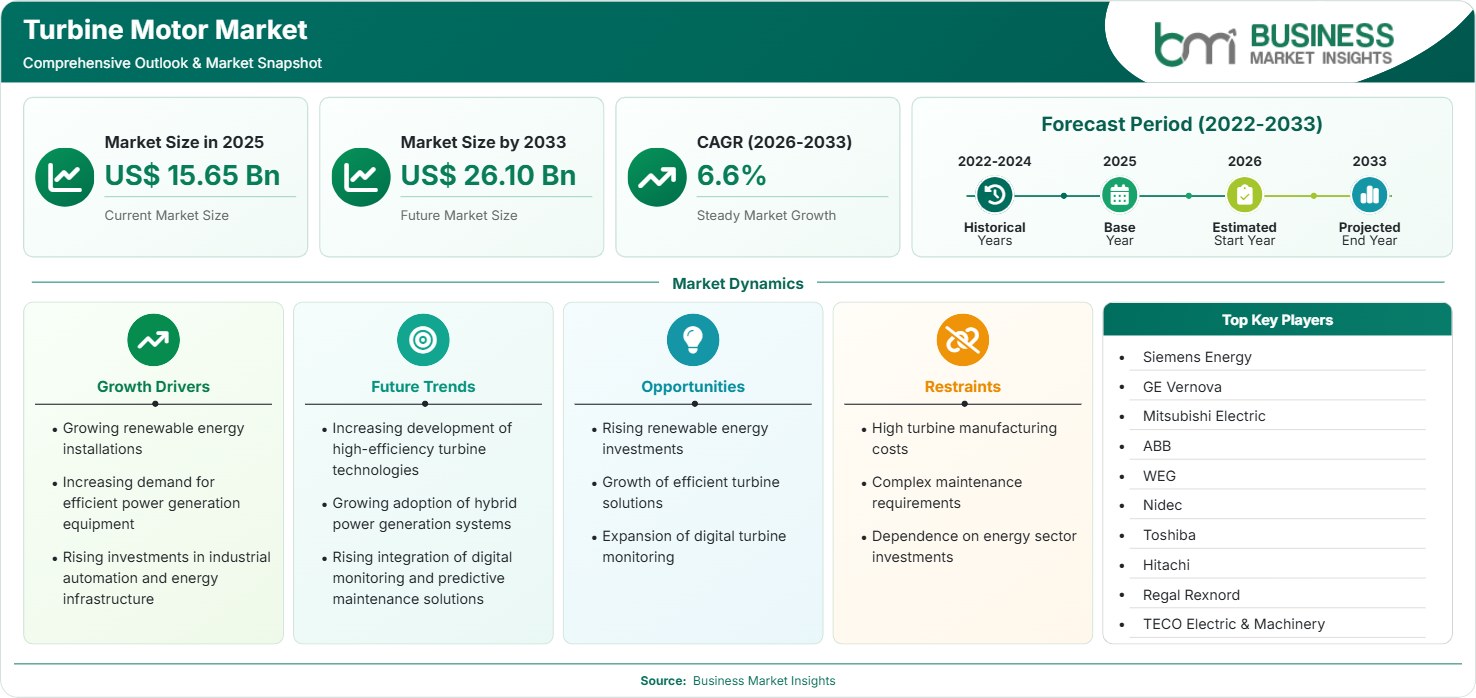
The Turbine Motor Market size was valued at US$ 15.65 Billion in 2025 and is projected to reach US$ 26.10 Billion by 2033, growing at a CAGR of 6.6% during 2026–2033, driven by renewable energy expansion, rising demand for efficient power generation systems, industrial automation investments, and modernization of energy infrastructure.

Report Coverage
  • Phase: Single Phase, Three Phase
  • Application: Wind Turbine, Gas Turbine, Water Turbine, Steam Turbine
US$ 15.65 Bn Market size in 2025
US$ 26.10 Bn Market Size by 2033
6.6% CAGR, 2026 - 2033
2026-2033 Forecast Period

AI Overview

Turbine Motor Market Summary

  • North America Region: North America holds a 29%–32% share in 2025 and is projected to grow at a CAGR of 6.1%–6.7% during 2026–2033, supported by renewable energy deployment, grid modernization, industrial automation, and replacement of aging power equipment. The US market is expected to expand at a 6.3%–6.9% CAGR, driven by wind energy expansion, industrial electrification, and infrastructure investments.
  • Fastest Growing Region: Asia Pacific represents a 34%–37% share in 2025 and is forecast to register the fastest CAGR of 7.1%–7.8%, supported by rapid industrialization, renewable energy projects, power infrastructure development, and increasing adoption of efficient turbine technologies.
  • Leading Segment: Three Phase turbine motors account for a 65%–68% share in 2025 and are expected to grow at a CAGR of 6.5%–7.0%, supported by industrial applications, high-power generation systems, efficiency advantages, and widespread adoption in large-scale turbine operations.
  • High Growth Segment: Wind turbine applications are projected to expand at a CAGR of 7.4%–8.1%, driven by renewable energy targets, increasing wind power installations, offshore wind development, and demand for efficient energy conversion systems.
  • Key Market Opportunity: Digital turbine monitoring, renewable energy integration, predictive maintenance technologies, and advanced efficiency solutions are creating opportunities for manufacturers to improve turbine performance and support next-generation energy infrastructure.
  • Major Market Players: Siemens Energy, GE Vernova, Mitsubishi Electric, ABB, WEG, Nidec, Toshiba, Hitachi, Regal Rexnord, TECO Electric & Machinery.
Strategic Insights

Turbine Motor Market: Strategic Insights

Turbine Motor Market Strategic Framework
FREE PDF
Request your free sample
Request free sample
Stakeholder View

Key Takeaways

  • The market ecosystem is evolving toward integrated turbine solutions combining motors, control systems, monitoring technologies, and energy management platforms to improve overall efficiency.
  • Renewable energy applications, particularly wind turbine systems, represent major growth opportunities as countries expand clean energy generation capacity and improve grid resilience.
  • Innovation is focused on high-efficiency motor designs, digital diagnostics, smart monitoring systems, and technologies that improve turbine reliability under demanding operating conditions.
  • Asia Pacific provides strong investment potential due to rapid power infrastructure development, industrial expansion, and increasing renewable energy deployment across emerging economies.
  • Strategic collaborations between turbine manufacturers, energy companies, and technology providers are increasing to accelerate digital transformation and improve turbine performance.
  • Companies are focusing on lifecycle service models, predictive maintenance solutions, and energy-efficient technologies to strengthen competitive positioning.
Geographic Outlook

Turbine Motor Market Regional Highlights

North America Turbine Motor Market

North America accounted for a 29%–32% share in 2025 and is projected to grow at a CAGR of 6.1%–6.7% from 2026–2033. The region benefits from renewable energy expansion, industrial automation adoption, power infrastructure modernization, and demand for efficient electricity generation systems. The United States remains a key contributor due to wind power investments, grid improvement programs, and industrial energy efficiency initiatives.

  • Renewable energy projects are increasing demand for advanced turbine motor technologies across power generation facilities.
  • Utilities are upgrading aging infrastructure with efficient and digitally monitored turbine systems.
  • Industrial facilities are adopting automation solutions to improve energy management.
  • Wind energy investments are supporting demand for reliable turbine components.
  • Digital monitoring technologies are improving turbine maintenance and operational efficiency.

US Turbine Motor Market

The US represented a 24%–27% share in 2025 and is forecast to grow at a CAGR of 6.3%–6.9% through the Turbine Motor Market forecast. Growth is supported by renewable energy expansion, industrial modernization, and increasing investments in efficient power generation equipment. Wind power development and grid improvement initiatives are creating demand for advanced turbine motors across multiple applications.

  • Wind energy expansion is increasing adoption of efficient turbine motor solutions.
  • Industrial automation is supporting demand for advanced electric motor systems.
  • Energy infrastructure upgrades are driving replacement of older turbine equipment.
  • Digital monitoring solutions are improving equipment reliability and maintenance planning.

Europe Turbine Motor Market

Europe held a 26%–29% the Turbine Motor Market share in 2025 and is expected to grow at a CAGR of 6.0%–6.6% during 2026–2033. The region benefits from renewable energy policies, decarbonization initiatives, and advanced industrial manufacturing capabilities. Germany, the United Kingdom, France, and Italy are important markets due to strong investments in wind power, energy efficiency, and modernization of power generation infrastructure.

  • Germany is expanding renewable energy capacity through wind and industrial energy projects.
  • The United Kingdom is investing in offshore wind development and grid modernization.
  • France is supporting efficient energy systems through clean energy initiatives.
  • Italy is adopting advanced turbine technologies across industrial applications.
  • European regulations are encouraging higher efficiency standards for energy equipment.

Asia Pacific Turbine Motor Market

Asia Pacific represented a 34%–37% share in 2025 and is projected to achieve the fastest CAGR of 7.1%–7.8% through 2033. Regional growth is driven by industrialization, electricity demand growth, renewable energy expansion, and infrastructure development. China, India, Japan, and South Korea are major contributors due to large-scale energy investments and manufacturing capabilities.

  • China is expanding renewable energy capacity and turbine infrastructure development.
  • India is increasing investments in wind power and energy infrastructure.
  • Japan is focusing on efficient turbine technologies and energy reliability.
  • South Korea is supporting renewable energy projects and industrial modernization.
  • Southeast Asia is developing power generation infrastructure to meet rising demand.

Rest of World Turbine Motor Market

Rest of World accounted for a 7%–10% share in 2025 and is expected to grow at a CAGR of 6.4%–7.2% between 2026–2033. Latin America, the Middle East, and Africa are increasing adoption due to expanding electricity demand, renewable energy initiatives, and infrastructure investments. Countries are improving power generation capacity through turbine-based energy solutions.

  • Latin America is increasing renewable energy investments, especially in wind and hydropower.
  • Middle Eastern countries are developing efficient energy infrastructure solutions.
  • African markets are expanding electricity generation capabilities through new projects.
  • Industrial development is supporting demand for turbine motor applications.
  • Energy diversification strategies are encouraging advanced turbine technology adoption.
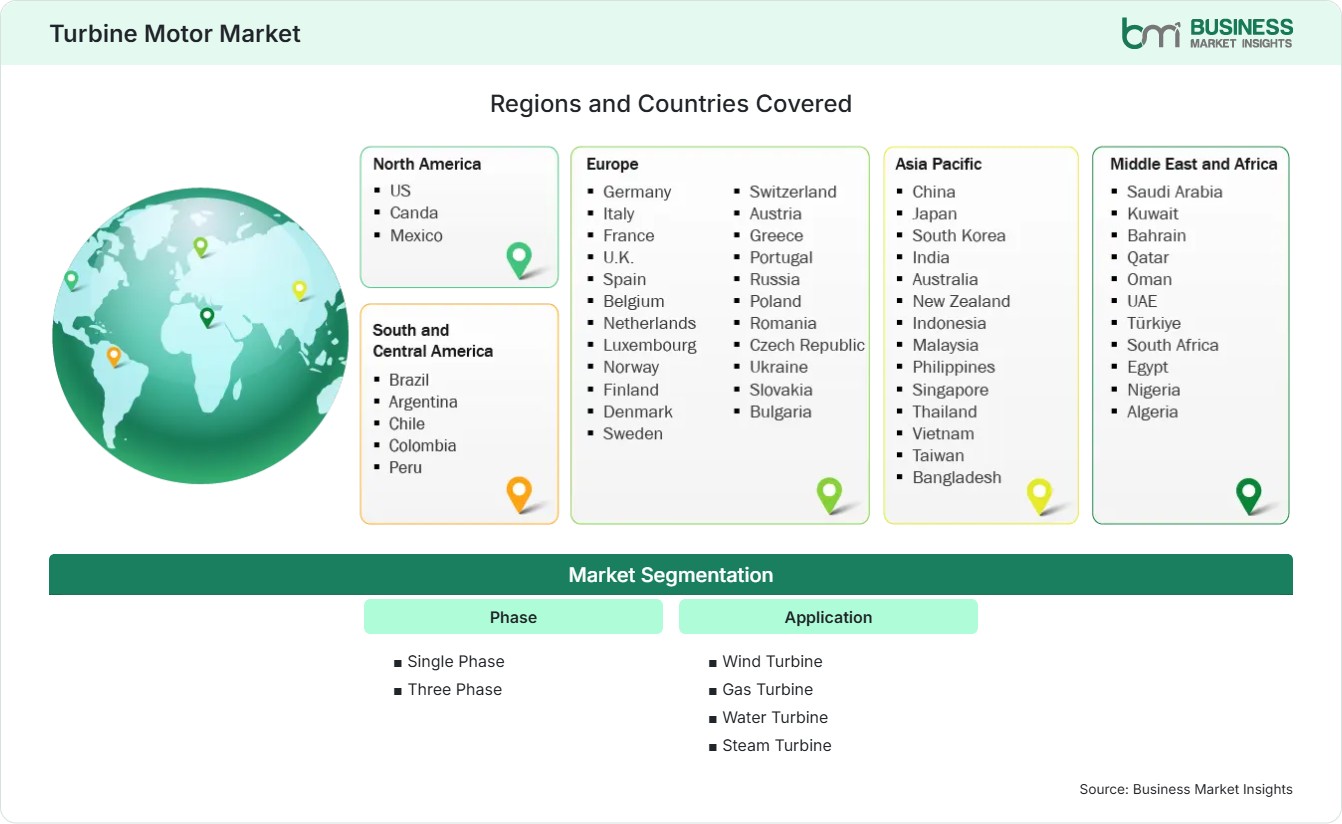
Global Market Geography
FREE PDF
Request your free sample
Request free sample
Segment Analysis

Turbine Motor Market Segmentation

Phase

The phase segment defines turbine motor adoption based on power requirements, operational efficiency, and application scale. Three phase turbine motors maintain higher adoption due to their suitability for large-scale industrial and energy generation applications requiring consistent performance and higher power output. The Turbine Motor Market scope is expanding as industries prioritize reliable motor systems for renewable energy projects, power plants, and automated industrial operations. Manufacturers are focusing on improving efficiency, durability, and compatibility with advanced control systems to meet increasing energy infrastructure requirements.

  • Single Phase: Single phase turbine motors are used in smaller-scale applications requiring simpler electrical configurations, lower power requirements, and cost-effective solutions for specific operational environments.
  • Three Phase: Three phase turbine motors dominate large industrial applications due to higher efficiency, improved reliability, balanced power distribution, and suitability for continuous turbine operations.

Application

The application segment is influenced by global energy transition initiatives, industrial power requirements, and demand for efficient electricity generation technologies. Turbine motors are widely used across renewable and conventional power generation systems, supporting energy conversion, operational reliability, and improved performance. Growing investments in clean energy infrastructure and modernization of existing power facilities are encouraging adoption across wind, gas, water, and steam turbine applications. The segment continues evolving through integration of digital monitoring systems, advanced controls, and efficiency-focused motor designs.

  • Wind Turbine: Wind turbine applications are expanding due to renewable energy investments, increasing wind power installations, and demand for efficient energy conversion technologies supporting clean electricity generation.
  • Gas Turbine: Gas turbine applications remain important for reliable power generation, supporting flexible electricity production, industrial operations, and backup energy requirements across multiple sectors.
  • Water Turbine: Water turbine applications benefit from hydropower development, long operational lifecycles, and demand for efficient renewable electricity generation solutions.
  • Steam Turbine: Steam turbine applications continue supporting power plants and industrial facilities requiring dependable high-capacity energy generation systems with improved operational efficiency.
Market Forces

Turbine Motor Market Dynamics

Key Market Drivers

Growing Renewable Energy Installations

The market growth is strongly influenced by increasing renewable energy installations across global power systems. Governments and utilities are expanding wind, hydropower, and other clean energy projects to improve energy security and reduce carbon emissions. Turbine motors are essential components in renewable generation systems, supporting efficient energy conversion and reliable operations. The Turbine Motor Market trends indicate rising demand for advanced motor technologies capable of operating under variable conditions while maintaining efficiency. Manufacturers are developing solutions with improved durability, digital monitoring capabilities, and optimized performance to support expanding renewable infrastructure. Increasing investment in clean energy projects continues creating demand for reliable turbine motor systems across multiple regions.

Increasing Demand for Efficient Power Generation Equipment

Power generation companies are increasingly adopting efficient turbine equipment to improve output, reduce operational costs, and optimize energy consumption. Modern turbine motors are being designed with improved electrical efficiency, enhanced materials, and advanced control capabilities to support reliable performance. Utilities are replacing older equipment with upgraded systems that provide better energy conversion and reduced maintenance requirements. Rising electricity demand from industrialization, urban development, and digital infrastructure is encouraging investment in efficient generation technologies. Equipment manufacturers are focusing on solutions that provide higher reliability, longer operating lifecycles, and compatibility with modern energy management systems.

Rising Investments in Industrial Automation and Energy Infrastructure

Industrial automation and energy infrastructure modernization are accelerating adoption of advanced turbine motor technologies. Manufacturing facilities, utilities, and industrial operators are integrating automated systems to improve operational efficiency and reduce downtime. Turbine motors equipped with digital monitoring, sensors, and predictive maintenance capabilities are becoming increasingly important in industrial environments. Infrastructure investments are supporting upgrades across power generation facilities, transportation systems, and industrial plants. The combination of automation and energy efficiency requirements is encouraging companies to adopt intelligent turbine solutions that improve performance visibility and operational control.

Key Market Opportunities

Rising Renewable Energy Investments

Increasing investments in renewable energy projects create significant opportunities for turbine motor manufacturers as countries expand clean power generation capacity. Wind and hydropower projects require efficient and reliable motor systems to support long-term operations. Manufacturers can benefit by developing advanced solutions designed for renewable applications, including improved efficiency, enhanced durability, and compatibility with digital control systems. The expansion of renewable energy infrastructure across emerging and developed economies is increasing demand for turbine-related equipment. Companies offering specialized solutions for renewable applications are positioned to capture opportunities from the global transition toward cleaner electricity generation.

Growth of Efficient Turbine Solutions

Demand for energy-efficient turbines is creating an opening for the development of highly efficient motors with superior performance and low energy losses. Producers and users of power are looking for machines that deliver maximum power output at minimum operating costs. Innovations in materials, motor design, cooling systems, and control technologies are enabling improved turbine efficiency. Companies investing in research and development can address growing requirements for reliable, high-performance equipment. Efficient turbine solutions are becoming increasingly important as industries focus on reducing energy consumption and improving sustainability across power generation operations.

Expansion of Digital Turbine Monitoring

Digital turbine monitoring represents a major opportunity as operators increasingly adopt predictive maintenance and data-driven management systems. Advanced monitoring technologies enable real-time performance tracking, fault detection, and improved maintenance planning. The integration of sensors, an analytics platform, and interconnected devices reduces the likelihood of unplanned downtime and increases equipment lifespan. Digital technologies are being used by turbine motor manufacturers to add value by providing services in addition to equipment manufacturing. The development of smart infrastructure programs is driving the adoption of smart turbines.

Market Restraints and Challenges

High Turbine Manufacturing Costs

Factor: Turbine motors require advanced engineering, specialized materials, precision manufacturing processes, and complex components that increase production expenses.

Impact: The high cost of production will reduce adoption, especially in case of small firms and emerging countries that do not have enough resources for investments. The cost of materials used, integration of technology, and performance demands make the equipment costly. The large amount of money needed for installing the turbine system hinders upgrades. Manufacturers need to optimize production processes and develop cost-effective solutions to improve accessibility. Managing production costs while maintaining efficiency and reliability remains a major challenge for turbine motor suppliers operating in competitive energy markets.

Complex Maintenance Requirements

Factor: Turbine motors involve sophisticated mechanical and electrical systems requiring specialized technical expertise, regular inspection, and advanced maintenance procedures.

Impact: Complex maintenance requirements can increase operational expenses and create reliability concerns for power producers and industrial users. The shortage of qualified technicians can pose an issue when it comes to service efficiency, particularly in new locations. Unforeseen malfunctions may cause delays in production as well as additional expenses associated with repairs. Firms are trying to solve this problem by using monitoring and diagnostics systems. The optimization of service networks and technical assistance is very important for proper turbine motor operation.

Company Analysis

Competitive Landscape

The Turbine Motor Market analysis highlights a competitive environment shaped by global energy companies and industrial technology providers focusing on efficiency, digitalization, renewable energy applications, and advanced motor technologies. Companies are investing in intelligent monitoring systems, high-performance designs, and integrated energy solutions to strengthen their market position across power generation and industrial sectors.

Turbine Motor Market: Competitive Landscape

The Turbine Motor Market analysis highlights a competitive environment shaped by global energy companies and industrial technology providers focusing on efficiency, digitalization, renewable energy applications, and advanced motor technologies. Companies are investing in intelligent monitoring systems, high-performance designs, and integrated energy solutions to strengthen their market position across power generation and industrial sectors.

Company Name

Overview

Products and Services Relevant to this Market

Siemens Energy

Energy technology company providing power generation solutions.

Turbine systems, generators, digital energy solutions.

GE Vernova

Energy company focused on electrification technologies.

Turbine systems, power generation equipment, monitoring solutions.

Mitsubishi Electric

Industrial automation and electrical technology provider.

Motors, control systems, energy solutions.

ABB

Electrification and automation technology company.

Industrial motors, drives, digital monitoring solutions.

WEG

Electrical equipment manufacturer serving industrial markets.

Motors, generators, automation products.

Nidec

Motor technology company providing industrial solutions.

High-efficiency motors and drive systems.

Toshiba

Technology company offering energy equipment solutions.

Turbine systems, motors, power technologies.

Hitachi

Industrial technology company supporting energy infrastructure.

Energy systems, motors, digital solutions.

Regal Rexnord

Motion control technology provider.

Industrial motors, power transmission solutions.

TECO Electric & Machinery

Electrical equipment manufacturer.

Motors, generators, industrial energy solutions.

Industry Activity

Recent Developments

June 2026

GE Vernova announced the launch of its 3.8 MW–154m onshore wind turbine in India and signed an agreement with Powerica Limited to supply 28 units for the 100 MW Botad Wind Farm in Gujarat. The project marks the first deployment of GE Vernova’s 3.8 MW workhorse turbine model in India and supports expansion of its onshore wind turbine manufacturing and supply operations.

June 2025

Mitsubishi Electric and GE Vernova strengthened cooperation on power semiconductor technologies for HVDC transmission systems, supporting integration of renewable power generation systems, including turbine-based electricity generation assets, into modern grids.

May 2025

Senvion India announced the successful installation and commissioning of its 1 GW wind turbine generator (WTG) portfolio in India. The company also completed manufacturing milestones of 500 nacelles and 500 blade sets across its Indian production facilities, strengthening its domestic wind turbine generator manufacturing capabilities.

February 2025

Siemens Energy announced a partnership agreement with Rolls-Royce SMR to supply steam turbines, generators, and auxiliary systems for future Small Modular Reactor (SMR) power plants. The agreement expands Siemens Energy’s turbine technology applications into next-generation nuclear power generation systems.

Trust & Transparency

Research Methodology

The market analysis combines proprietary research with secondary data from government agencies, company disclosures, regulatory filings, industry databases and expert interviews. Market estimates are validated through data triangulation, cross-market benchmarking and analyst review.

View Full Research Methodology

Questions Answered

Frequently Asked Questions

What challenges affect turbine motor adoption?

Major challenges include high manufacturing costs, complex maintenance requirements, specialized technical requirements, and significant capital investments associated with advanced turbine systems.

Which applications offer strong growth opportunities in the turbine motor industry?

Wind turbine applications offer strong opportunities due to renewable energy expansion, increasing wind power installations, clean energy targets, and demand for efficient electricity generation solutions.

How are digital technologies transforming turbine motor operations?

Digital technologies enable real-time monitoring, predictive maintenance, performance optimization, and fault detection. These solutions help operators reduce downtime, improve reliability, and extend turbine motor operational lifecycles.

Which phase segment dominates the Turbine Motor Market?

Three phase turbine motors dominate due to their suitability for high-power applications, improved efficiency, balanced power distribution, and widespread use across industrial facilities and large-scale power generation systems.

What factors are driving the Turbine Motor Market Report growth?

The Turbine Motors Report growth is driven by renewable energy expansion, increasing demand for efficient power generation equipment, industrial automation investments, grid modernization initiatives, and adoption of digital monitoring technologies.

Access the Full Turbine Motor Market Report

Get segment-level forecasts, regional estimates, competitive benchmarking, company profiles and downloadable Excel datasets.

Access the full Turbine Motor Market Report
350 pages PDF & Excel | 2026-08-04