
Wind Turbine Gearbox Market Outlook: Size, Share, Trends, Growth Analysis, Competitive Landscape & Forecast, 2026-2033

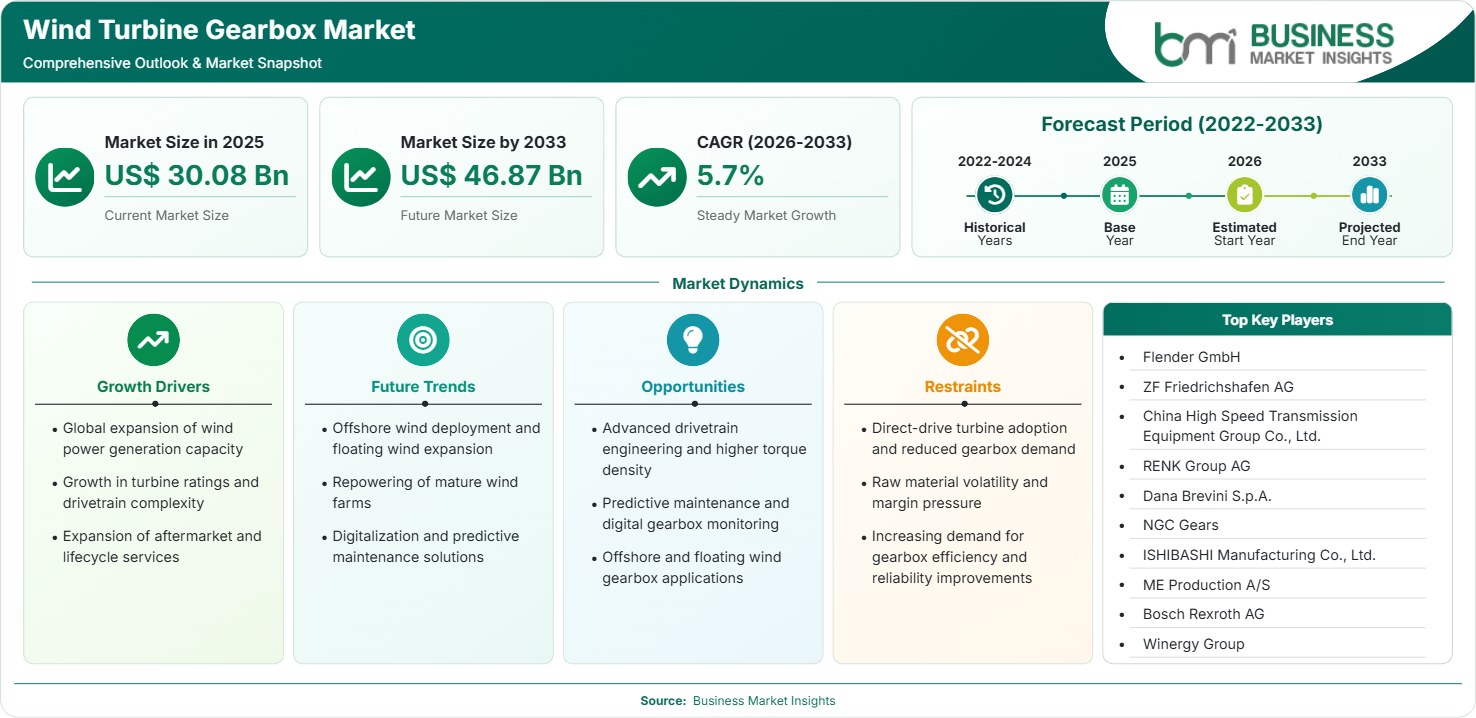
The Wind Turbine Gearbox Market size was valued at US$ 30.08 Billion in 2025 and is projected to reach US$ 46.87 Billion by 2033, growing at a CAGR of 5.7% during 2026–2033. Expansion of offshore wind installations, repowering projects, larger turbine platforms, predictive maintenance adoption, digital monitoring technologies, and grid decarbonization investments continue creating sustained demand and long-term revenue opportunities.

Report Coverage
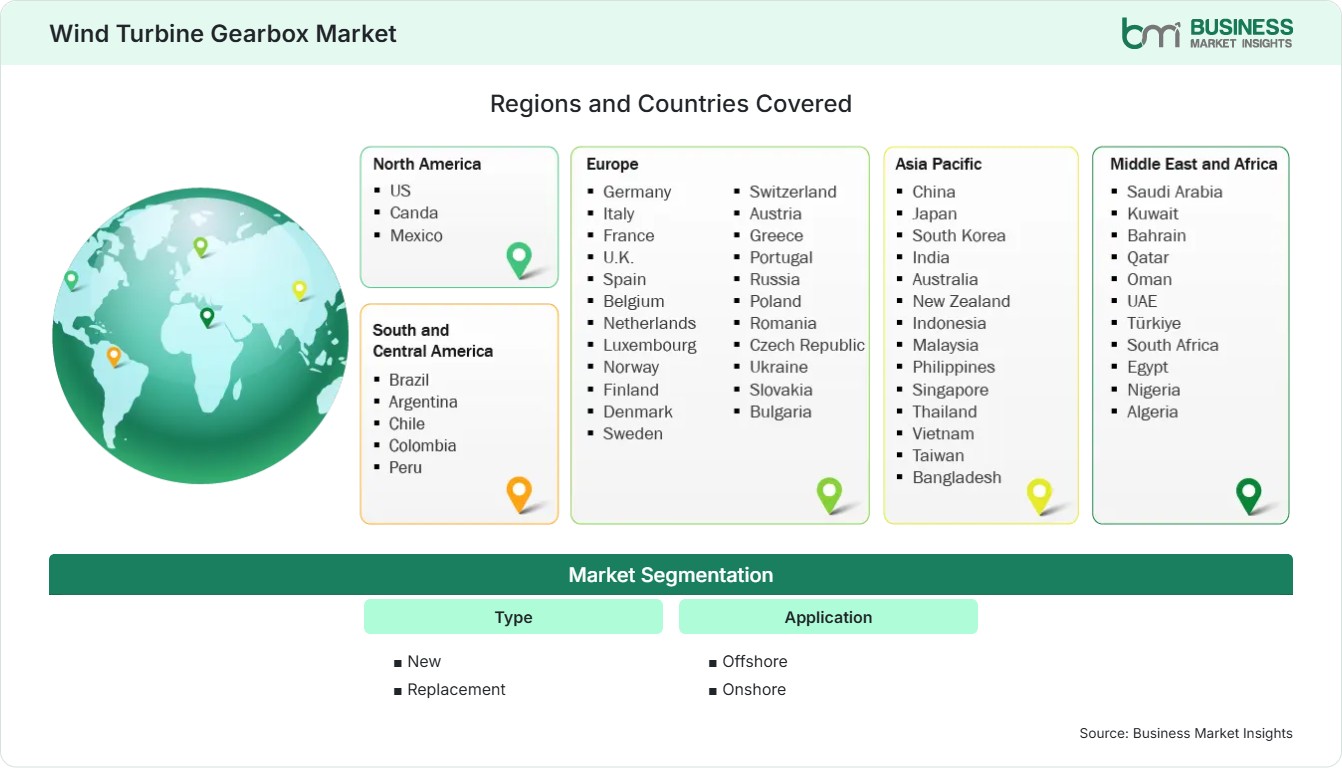
  • Type: New, Replacement
  • Application: Offshore, Onshore
US$ 30.08 Bn Market size in 2025
US$ 46.87 Bn Market Size by 2033
5.7% CAGR, 2026 - 2033
2026-2033 Forecast Period

AI Overview

Wind Turbine Gearbox Market Summary

  • North America Region: Holds a market share of 22%–25% in 2025, growing at a CAGR of 4.8%–5.3% during 2026–2033. Demand is supported by utility-scale wind repowering, domestic manufacturing incentives, advanced condition monitoring adoption, stronger transmission expansion, and growing replacement requirements across aging wind farms. The U.S. market benefits from extensive installed capacity, aftermarket spending, and a CAGR of 4.9%–5.4%.
  • Fastest Growing Region: Asia Pacific accounts for 43%–46% share in 2025 and expands at a 6.4%–7.0% CAGR. Growth stems from large wind deployment programs, localized manufacturing ecosystems, offshore investments, favorable renewable targets, grid modernization initiatives, and expanding turbine installation pipelines.
  • Leading Segment: New type installations represent 66%–70% share in 2025 and advance at 5.4%–5.9% CAGR. Continued turbine deployments, project commissioning activity, higher rated equipment demand, supply chain localization efforts, and renewable energy investment commitments sustain segment leadership.
  • High Growth Segment: Offshore application contributes 27%–31% share in 2025 and records a 7.0%–7.6% CAGR. Increasing turbine capacities, deeper-water developments, transmission enhancements, floating wind initiatives, and government-backed offshore procurement programs elevate future expansion potential.
  • Key Market Opportunity: Modernization of aging wind fleets creates strong demand for gearbox upgrades, predictive maintenance tools, digital diagnostics, service contracts, and lifecycle-extension solutions, supporting recurring revenue across mature wind generation markets.
  • Major Market Players: Flender GmbH, ZF Friedrichshafen AG, China High Speed Transmission Equipment Group Co., Ltd., RENK Group AG, Dana Brevini S.p.A., NGC Gears, ISHIBASHI Manufacturing Co., Ltd., ME Production A/S, Bosch Rexroth AG, and Winergy Group.
Strategic Insights

Wind Turbine Gearbox Market: Strategic Insights

Wind Turbine Gearbox Market Strategic Framework
FREE PDF
Request your free sample
Request free sample
Stakeholder View

Key Takeaways

  • The market ecosystem increasingly relies on close collaboration among turbine OEMs, gearbox manufacturers, bearing suppliers, digital monitoring providers, and service specialists to improve asset reliability and lifecycle economics.
  • Replacement and refurbishment activities across mature wind fleets offer attractive long-term revenue streams, particularly where operators seek cost-effective life-extension programs instead of full turbine replacement.
  • R&D focus is shifting toward higher torque density designs, advanced lubrication systems, sensor-enabled monitoring, and predictive maintenance capabilities that reduce downtime and improve operating efficiency.
  • Asia Pacific presents the strongest investment case due to manufacturing scale, expanding offshore programs, supportive policy frameworks, and substantial annual wind capacity additions.
  • Industrial consolidation, strategic partnerships, and service-business acquisitions are increasing as companies seek stronger aftermarket positions and broader geographic coverage.
  • Sustainable material innovation and circular-economy initiatives are becoming competitive differentiators as developers increasingly evaluate lifecycle sustainability alongside performance metrics.
Geographic Outlook

Wind Turbine Gearbox Market Regional Highlights

North America Wind Turbine Gearbox Market

North America accounts for 22%–25% Wind Turbine Gearbox Market share in 2025 and is projected to expand at a 4.8%–5.3% CAGR through 2033. Regional demand is supported by fleet modernization, repowering activity, transmission infrastructure investment, and federal clean-energy incentives. A large installed wind base creates sustained aftermarket opportunities, especially for gearbox replacement and refurbishment services. Operators increasingly deploy predictive maintenance technologies to reduce operational interruptions. Rising electricity demand and renewable integration objectives continue supporting equipment procurement across utility-scale projects.

  • Repowering programs across mature wind farms are accelerating replacement demand and extending operational lifetimes of installed assets.
  • Domestic manufacturing initiatives support localized supply chains, lowering delivery risks and improving project execution efficiency.
  • Asset owners are increasing investments in digital performance monitoring, vibration analysis, and condition-based maintenance systems.
  • Utility procurement strategies increasingly emphasize reliability, lifecycle costs, and service availability when selecting drivetrain suppliers.

US Wind Turbine Gearbox Market

The United States represents 74%–78% of North American share and is projected to record a 4.9%–5.4% CAGR through 2033. Demand benefits from extensive installed wind capacity, state-level renewable targets, and continued transmission investment. Developers are prioritizing equipment reliability and operational efficiency to maximize energy yields. Replacement services are becoming increasingly important as older wind farms enter lifecycle-extension phases. Advanced analytics and predictive maintenance platforms are strengthening aftermarket value creation across utility-scale installations.

  • Significant installed capacity supports recurring demand for refurbishment, service contracts, and component replacement activities.
  • Grid modernization initiatives encourage integration of larger renewable portfolios and associated equipment investments.
  • Advanced monitoring systems are reducing unplanned failures while improving maintenance scheduling efficiency.
  • Long-term energy transition objectives continue attracting investment into utility-scale wind infrastructure projects.

Europe Wind Turbine Gearbox Market

Europe maintains 26%–29% share in 2025 and progresses at a 5.2%–5.8% CAGR during 2026–2033. The region benefits from ambitious decarbonization commitments and extensive offshore wind development pipelines. Germany remains a leading market, while Poland emerges among the fastest-growing countries, supported by renewable investment programs. Manufacturers prioritize higher-performance gearbox architectures suitable for larger turbines and demanding offshore environments. Service providers continue expanding refurbishment and predictive maintenance offerings to support aging wind assets and improve lifecycle productivity.

  • Offshore wind procurement programs are increasing demand for high-capacity drivetrain systems and specialized service capabilities.
  • Germany remains a leading installation and technology center supported by mature wind infrastructure ecosystems.
  • Poland records among the fastest expansion rates, supported by new renewable development initiatives.
  • Circular-economy strategies encourage refurbishment, component recovery, and lifecycle optimization across wind assets.

Asia Pacific Wind Turbine Gearbox Market

Asia Pacific holds 43%–46% share in 2025 and achieves the highest CAGR of 6.4%–7.0% through 2033. China leads regional demand through large-scale deployment and manufacturing capacity, while India ranks among the fastest-growing markets. Strong policy support, domestic production capabilities, and offshore development programs sustain momentum. Regional suppliers continue investing in advanced drivetrain technologies and capacity expansion. Growing electricity consumption and energy-transition commitments underpin long-term installation opportunities throughout major economies.

  • China continues dominating manufacturing and deployment activities, supporting scale advantages across the supply chain.
  • India demonstrates strong expansion potential due to renewable procurement and infrastructure development programs.
  • Offshore wind investment is accelerating demand for higher-capacity and high-reliability gearbox platforms.
  • Localized production strategies strengthen competitiveness and reduce dependence on imported equipment.
  • Government targets for renewable generation continue supporting long-term project pipelines.

Rest of World Wind Turbine Gearbox Market

Rest of World contributes 7%–10% share in 2025 and expands at a 5.6%–6.2% CAGR during the forecast period. South and Central America benefit from renewable procurement programs, particularly in Brazil and Chile. Meanwhile, Middle Eastern and African markets gain momentum from diversification strategies and international investment. Brazil remains the leading market within the region, while Saudi Arabia and South Africa demonstrate notable growth potential. Grid modernization and energy-security considerations continue supporting future wind development activity.

  • Brazil maintains leadership through large-scale renewable deployment and established wind development ecosystems.
  • Chile supports additional growth through private renewable investments and expanding power-generation requirements.
  • Saudi Arabia is emerging as a high-growth market driven by energy diversification initiatives.
  • South Africa continues attracting investment for renewable capacity expansion and grid resilience improvements.
  • International financing institutions increasingly support wind infrastructure development across developing economies.
Global Market Geography
FREE PDF
Request your free sample
Request free sample
Segment Analysis

Wind Turbine Gearbox Market Segmentation

Type

Type segmentation is led by new installations with 66%–70% market share in 2025 and a 5.4%–5.9% CAGR through the forecast period. The Wind Turbine Gearbox Market scope is expanding through both newly commissioned projects and refurbishment activity. Increasing turbine deployment, grid investments, and renewable capacity additions support demand, while lifecycle-extension initiatives sustain replacement opportunities across mature wind fleets.

  • New: Dominates procurement activity as nations accelerate renewable deployment. Demand is supported by larger turbine ratings, offshore expansion, and increasing project approvals across both developed and emerging markets.
  • Replacement: Growth is driven by aging installations requiring performance optimization, reliability enhancement, refurbishment services, and component upgrades that extend operating life while reducing maintenance costs.

Application

Application demand remains concentrated in onshore projects with 69%–73% Wind Turbine Gearbox Market share in 2025, while offshore installations deliver the highest expansion trajectory at 7.0%–7.6% CAGR. The segment reflects changing deployment economics, turbine scaling trends, and project-location preferences. Growing offshore investments strengthen long-term prospects despite higher installation complexity and capital requirements.

  • Offshore: Expansion is supported by stronger wind resources, increasing turbine capacity, government procurement programs, and long-term decarbonization strategies favoring large-scale renewable generation.
  • Onshore: Continues benefiting from established infrastructure, lower installation costs, mature project-development practices, and broad geographic suitability across major renewable energy markets.
Market Forces

Wind Turbine Gearbox Market Dynamics

Key Market Drivers

Global expansion of wind power generation capacity

As per associations such as GWEC and IEA, worldwide wind capacity installations keep growing owing to the push for decarbonization and energy security by nations. An increase in installation means an increase in gearboxes since gear-based transmission systems are commonly used in utility-scale wind turbines. Wind Turbine Gearbox Market adoption is aided by government procurement policies, renewable portfolio standards, and power industry investment programs. The speeding up of development off shore raises the need for high-efficiency gearbox systems that can take on more torque and a difficult environment. Constant additions in Asia Pacific, Europe, and North America assure visibility for future demand.

Growth in turbine ratings and drivetrain complexity

The industry is fast moving towards bigger turbines that are engineered to maximize energy extraction and boost the economics of projects. Larger platforms demand the use of more sophisticated gearbox designs that can accommodate higher loads. The manufacturers of the technology are making increased efforts in terms of material technology, thermal management, lubrication and monitoring technology. Wind Turbine Gearbox Market trends increasingly reflect demand for compact yet powerful drivetrain solutions supporting both onshore and offshore deployments. As developers prioritize lower levelized cost of energy, gearbox suppliers able to improve efficiency, durability, and predictive maintenance capabilities gain stronger competitive positioning.

Expansion of aftermarket and lifecycle services

The aging fleets of turbines in North America and Europe have led to the creation of many requirements for retrofitting, diagnostic, and replacement services. The use of predictive maintenance approaches has become widespread to minimize downtime and maximize efficiency. Digital monitoring systems allow for real-time assessment of the vibration levels, temperatures, and performance of turbine components. Wind Turbine Gearbox Market growth is increasingly influenced by lifecycle support capabilities, as developers evaluate suppliers not only on hardware performance but also on maintenance expertise, service response times, and long-term reliability outcomes across installed assets.

Key Market Opportunities

Offshore wind deployment and floating wind expansion

Offshore wind farms need efficient gearbox technology that can function under harsh marine environments and provide high levels of reliability. With increased government auctioning and procurements, the pipeline for offshore projects is growing significantly. Floating wind developments present additional opportunities because many projects utilize large-capacity turbines with sophisticated drivetrain requirements. Wind Turbine Gearbox Market Forecasts include growing offshore-related demand increase through 2033. Corrosion resistant materials, better monitoring solutions, and design features supporting maintenance will enable companies to earn high-value revenues. The ongoing policies in Europe and Asia Pacific will ensure better visibility on investments for manufacturing companies designing offshore power generation units.

Repowering of mature wind farms

Thousands of turbines installed during earlier deployment waves are approaching refurbishment or replacement cycles. The operators aim to increase the efficiency and reliability of the process without necessarily having to change their whole turbine setup. It is for this reason that there will be a need for new designs of gearboxes, diagnostic software, and specialized maintenance. Repowering is likely to be economically viable since it takes advantage of the already present power grids and facilities on-site. The companies able to integrate the retrofitted systems with predictive maintenance technologies will gain a lot.

Digitalization and predictive maintenance solutions

Industrial digitalization is transforming asset management within wind generation facilities. The ability of monitoring systems using sensors, diagnostics with the help of AI, and analytics with the help of the cloud is expected to contribute significantly to failure prediction and maintenance planning, thus reducing downtime and extending the operational life of gearboxes. Such manufacturers of solutions that provide both hardware and software platforms would be able to differentiate themselves in terms of their services. High demand exists from companies managing their large fleet of units, where any increase in availability translates into significant cost savings.

Market Restraints and Challenges

Direct-Drive Turbine Adoption and Reduced Gearbox Demand

Factor: Direct drive turbine technology does not use a gearbox since the rotor is directly linked to the generator, thus lowering the number of mechanical parts in the drivetrain. Although gearboxes have been widely used in wind projects, the increased use of direct drive technology leads to competition among gearbox makers for selected turbine technologies. Wind project proponents can select direct drive technology where simplicity in the drivetrain and reliability are important considerations.

Impact: Greater use of direct-drive turbines could mean lower need for wind turbine gearboxes in certain situations, thereby affecting the equipment sales potential of conventional gearbox suppliers. This is especially true in cases where users look for simplicity and reduced maintenance needs in the drivetrain system. Gearbox suppliers thus have to enhance the reliability, efficiency, longevity, and life cycle costs of their products to stay ahead of the competition. Advanced materials, condition monitoring techniques, predictive maintenance solutions, and improved gearbox design are some measures that might be useful in this regard.

Raw Material Volatility and Margin Pressure

Factor: The production of gearboxes requires substantial amounts of steel and alloy materials, making the companies vulnerable to changes in the prices of these raw materials. Any changes in the price of steel, energy, transportation, and specialized components will make it more costly to manufacture these products. This, coupled with disruptions in international shipping and geopolitical conflicts, may adversely affect raw material costs.

Impact: Increasing input cost volatility may lead to decreased profit margins, increased difficulty in planning long-term contracts, and more difficulties in terms of procurement for gearbox producers. Disruptions in supply could also be among the causes of production delays and problems related to delivery schedules in projects, especially when companies are using parts from all over the world. Producers are solving the problem by producing locally, managing inventories, diversifying suppliers, and entering into long-term procurement deals. But despite that, increasing cost variability remains one of the factors contributing to risks to both profitability and project implementation.

Company Analysis

Competitive Landscape

Wind Turbine Gearbox Market analysis indicates competition is shaped by manufacturing scale, drivetrain expertise, lifecycle services, digital monitoring capabilities, and offshore wind participation.

Company Name

Overview

Products and Services relevant to this market

Flender GmbH

Global drivetrain specialist with strong wind energy presence and extensive service infrastructure.

Wind turbine gearboxes, refurbishment services, monitoring solutions, replacement programs, and drivetrain engineering.

ZF Friedrichshafen AG

Major industrial technology company with broad wind power transmission capabilities.

Multi-megawatt gearboxes, wind drivetrain solutions, engineering services, and digital performance support.

China High Speed Transmission Equipment Group Co., Ltd.

Leading Chinese gearbox producer serving domestic and international turbine manufacturers.

Wind gearboxes, transmission systems, maintenance support, and component optimization solutions.

RENK Group AG

Engineering company specializing in high-performance industrial transmission technologies.

Precision gearbox systems, drivetrain engineering, maintenance support, and industrial power-transmission solutions.

Dana Brevini S.p.A.

Industrial motion specialist serving renewable energy and heavy-equipment sectors.

Planetary gear systems, wind transmission products, aftermarket support, and engineering services.

NGC Gears

Large-scale gearbox manufacturer with established wind energy market presence.

Wind turbine gearbox platforms, replacement components, upgrades, and lifecycle service offerings.

ISHIBASHI Manufacturing Co., Ltd.

Specialized manufacturer focused on precision gearing technologies and industrial applications.

Gear systems, custom transmission solutions, refurbishment services, and technical support programs.

ME Production A/S

Wind-focused engineering and manufacturing company supporting gearbox requirements.

Wind gearbox components, repair services, maintenance support, and performance enhancement solutions.

Bosch Rexroth AG

Industrial automation and motion-control leader with renewable energy capabilities.

Drive technologies, transmission systems, hydraulic solutions, and operational optimization services.

Winergy Group

Dedicated wind power drivetrain brand recognized across global turbine markets.

Wind turbine gearboxes, monitoring technologies, maintenance contracts, and lifecycle support services.

Trust & Transparency

Research Methodology

The market analysis combines proprietary research with secondary data from government agencies, company disclosures, regulatory filings, industry databases and expert interviews. Market estimates are validated through data triangulation, cross-market benchmarking and analyst review.

View Full Research Methodology

Questions Answered

Frequently Asked Questions

Why are predictive maintenance systems becoming important?

They improve turbine availability, reduce unexpected downtime, optimize maintenance schedules, lower lifecycle costs, and provide real-time operational visibility through advanced analytics and monitoring tools.

What does a Wind Turbine Gearbox Market Report typically evaluate?

It commonly assesses market size, technology trends, competitive positioning, regional demand, segmentation performance, investment activity, supply chain developments, risks, and forecast opportunities.

Which region offers the strongest long-term growth prospects?

Asia Pacific remains the strongest growth region because of large installation volumes, manufacturing capacity, renewable energy targets, and substantial offshore wind investment across major economies.

How does offshore wind affect gearbox technology requirements?

Offshore turbines require higher torque capacity, enhanced corrosion resistance, improved sealing systems, and advanced monitoring technologies due to harsh marine operating environments and expensive maintenance logistics.

What factors most influence gearbox replacement demand?

Aging turbine fleets, operating hours, site conditions, maintenance practices, and reliability requirements significantly influence replacement cycles. Operators increasingly utilize predictive diagnostics to identify refurbishment needs before major failures occur.

Access the Full Wind Turbine Gearbox Market Report

Get segment-level forecasts, regional estimates, competitive benchmarking, company profiles and downloadable Excel datasets.

Access the full Wind Turbine Gearbox Market Report
350 pages PDF & Excel | 2026-09-02