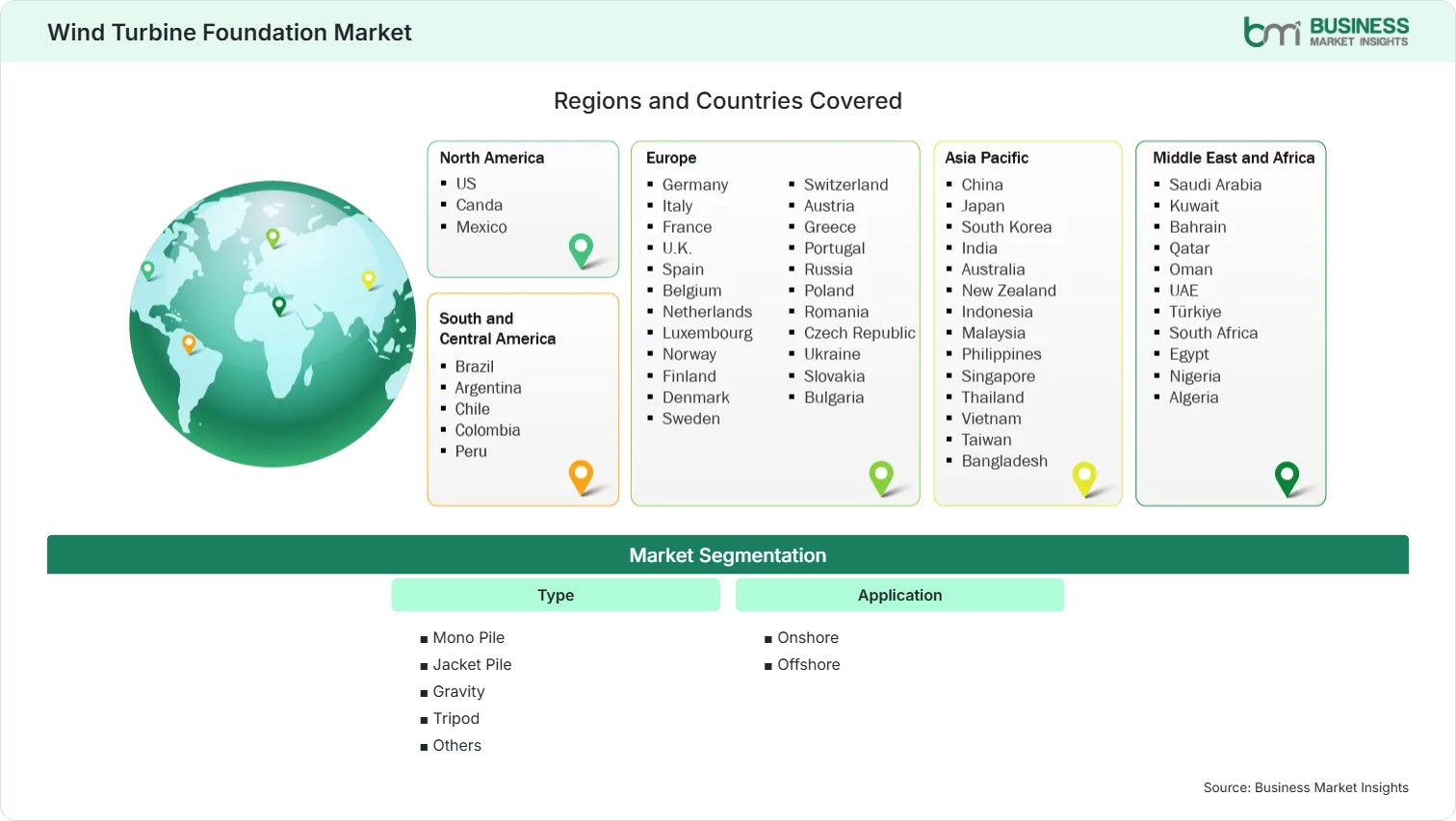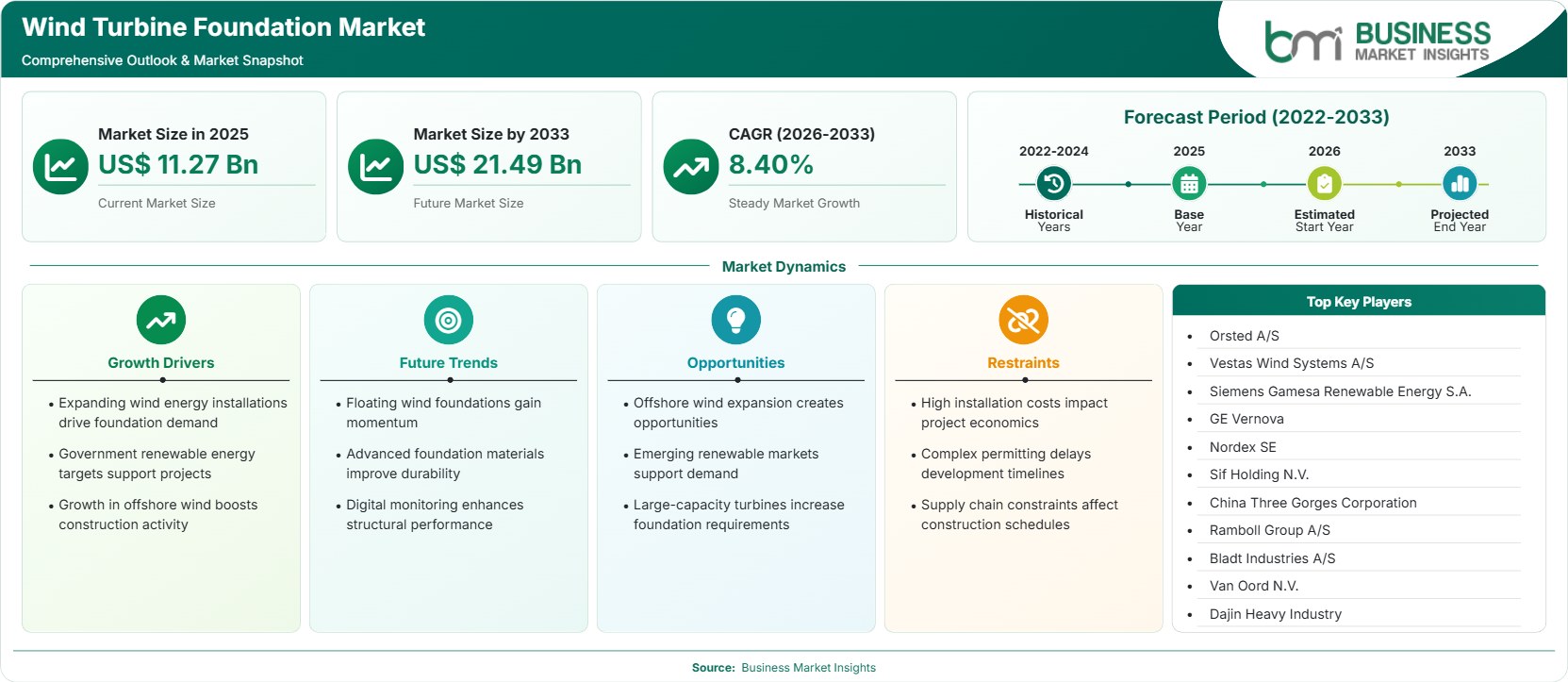
Wind Turbine Foundation Market Regional Highlights
North America Wind Turbine Foundation Market
North America accounts for 22%–25% of global revenue in 2025 and is projected to register a 7.8%–8.3% CAGR through 2033. The region benefits from expanding offshore wind pipelines, federal incentives, and investments in domestic manufacturing. The Wind Turbine Foundation Market share in North America continues to rise as utilities pursue decarbonization targets and coastal states accelerate project development. Supply-chain localization and engineering innovation remain central to regional competitiveness.
- U.S. offshore leasing activity is stimulating demand for monopile, jacket, and heavy fabrication capabilities.
- Port infrastructure modernization supports handling of larger turbine components and foundation structures.
- Domestic sourcing requirements encourage capacity investments across fabrication and logistics networks.
- Engineering firms increasingly deploy digital design tools to improve lifecycle performance.
US Wind Turbine Foundation Market
The United States represents 72%–76% of North American Wind Turbine Foundation Market demand and is expected to grow at 8.0%–8.5% CAGR. Offshore project pipelines along the Atlantic coast and renewable procurement commitments remain primary demand catalysts. Growing investments in specialized vessels, manufacturing facilities, and transmission infrastructure support market expansion. Government support mechanisms and long-term climate targets continue strengthening investor confidence.
- Atlantic Coast offshore developments are creating significant foundation fabrication requirements.
- Local content initiatives support domestic steel and engineering industries.
- Transmission expansion helps accommodate additional renewable generation capacity.
- Technology partnerships improve installation efficiency and lifecycle asset performance.
Europe Wind Turbine Foundation Market
Europe holds the leading regional position with 35%–38% Wind Turbine Foundation Market share and is forecast to expand at 7.5%–8.0% CAGR. Offshore wind remains a strategic energy pillar across the region. According to WindEurope and offshore industry bodies, Europe continues advancing offshore deployment pipelines and manufacturing investments. The United Kingdom and Germany lead installations, while Poland demonstrates among the fastest growth rates.
- The United Kingdom leads regional deployment supported by large offshore project pipelines.
- Germany continues investing in offshore transmission and foundation manufacturing capacity.
- Poland is emerging as a high-growth market with CAGR above regional averages.
- Supply-chain expansion supports long-term offshore development targets.
- Advanced engineering standards improve structural reliability and operational longevity.
Asia Pacific Wind Turbine Foundation Market
Asia Pacific commands 30%–33% share in 2025 and is projected to achieve the fastest CAGR of 9.5%–10.2%. China remains the largest contributor, while India, South Korea, Japan, and Taiwan are expanding offshore capacity. Strong industrial capabilities, competitive manufacturing costs, and supportive government policies stimulate project investments. Rapid renewable deployment is reinforcing regional leadership.
- China dominates regional demand through extensive wind-energy installations.
- India is accelerating renewable projects and associated infrastructure investments.
- Taiwan and South Korea are strengthening offshore wind supply chains.
- Japan continues evaluating deeper-water opportunities and advanced foundation systems.
- Manufacturing scale provides cost advantages for regional participants.
Rest of World Wind Turbine Foundation Market
Rest of World represents 10%–13% of global demand and records a CAGR of 8.5%–9.1%. South and Central America are expanding renewable energy programs, while Middle East and Africa countries pursue energy diversification. Brazil leads regional demand, whereas Saudi Arabia and South Africa are among notable growth markets. Infrastructure improvements and policy reforms encourage market participation.
- Brazil leads project activity through renewable-energy expansion initiatives.
- Saudi Arabia supports renewable infrastructure under long-term diversification strategies.
- South Africa is increasing wind investments to strengthen power-system reliability.
- International developers are entering emerging markets through joint ventures.
- Financing availability remains a key determinant of project execution speed.