
Wind Turbine Blade Market Size, Share, Trends & Forecast Report, 2026–2033

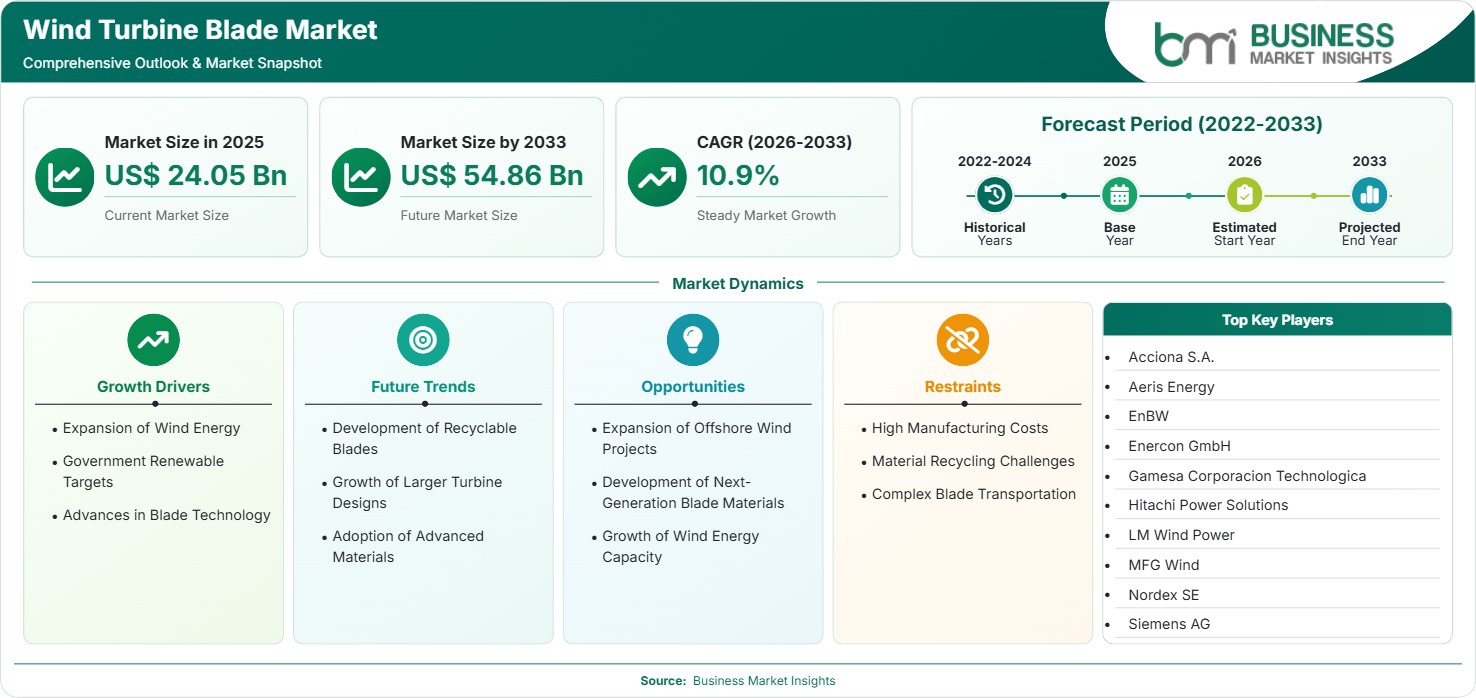
The Wind Turbine Blade Market size was valued at US$ 24.05 Billion in 2025 and is projected to reach US$ 54.86 Billion by 2033, growing at a CAGR of US$ 10.9% during 2026–2033, driven by renewable energy expansion, offshore wind investments, advanced materials, and increasing global decarbonization initiatives.

Report Coverage
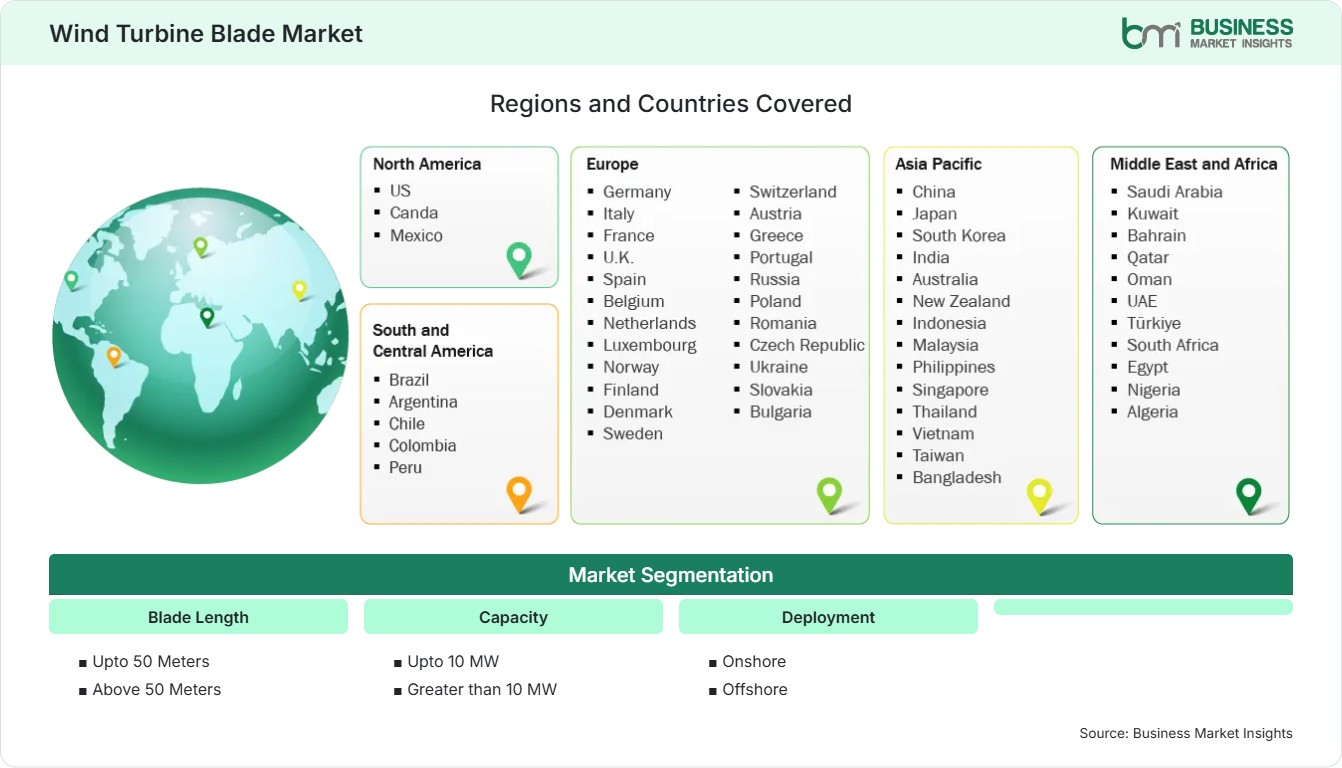
  • Blade Length: Upto 50 Meters, Above 50 Meters
  • Capacity: Upto 10 MW, Greater than 10 MW
  • Deployment: Onshore, Offshore
US$ 24.05 Bn Market size in 2025
US$ 54.86 Bn Market Size by 2033
10.9% CAGR, 2026 - 2033
2026-2033 Forecast Period

AI Overview

Wind Turbine Blade Market Summary

  • North America Region: North America holds a 27%–30% share in 2025, growing with a CAGR of 9.5%–10.5% influenced by renewable energy policies, offshore wind development, and turbine modernization programs. The US market expands at a CAGR of 10.0%–11.0% through 2033, supported by utility-scale wind installations.
  • Fastest Growing Region: Asia Pacific maintains a 38%–41% share in 2025, expanding at a CAGR of 11.5%–12.5% due to large-scale wind capacity additions, government renewable targets, industrial manufacturing strength, and offshore project investments.
  • Leading Segment: Onshore deployment accounts for a 72%–75% share in 2025, growing at a CAGR of 9.5%–10.5% due to established infrastructure, lower installation complexity, and continued utility-scale wind farm expansion.
  • High Growth Segment: Offshore deployment represents a 25%–28% share in 2025, achieving a CAGR of 13.0%–14.0% due to larger turbines, coastal energy projects, and increasing investment in marine renewable power.
  • Key Market Opportunity: Advanced composite materials, lightweight blade designs, recycling technologies, and offshore wind expansion create opportunities for manufacturers to improve efficiency, reduce lifecycle costs, and support global renewable energy targets.
  • Major Market Players: Acciona S.A., Aeris Energy, EnBW, Enercon GmbH, Gamesa Corporacion Technologica, Hitachi Power Solutions, LM Wind Power, MFG Wind, Nordex SE, Siemens AG.
Strategic Insights

Wind Turbine Blade Market: Strategic Insights

Wind Turbine Blade Market Strategic Framework
FREE PDF
Request your free sample
Request free sample
Stakeholder View

Key Takeaways

  • Wind turbine blade manufacturers are restructuring supply chains around advanced composites, specialized manufacturing facilities, and regional production capabilities to support increasing turbine installation volumes.
  • Offshore wind development represents a major growth opportunity as larger turbines require longer blades with improved aerodynamic performance and enhanced structural durability.
  • Blade innovation is shifting toward lightweight materials, recyclable composites, digital monitoring systems, and advanced manufacturing techniques that improve efficiency and reduce lifecycle costs.
  • Asia Pacific offers strong investment potential due to expanding wind capacity, supportive renewable energy policies, and the presence of established turbine manufacturing ecosystems.
  • Strategic collaborations and technology partnerships are increasing as companies seek expertise in materials science, offshore deployment capabilities, and sustainable blade lifecycle management.
  • Recycling solutions and circular economy approaches are becoming important competitive factors as the industry addresses end-of-life blade disposal challenges.
Geographic Outlook

Wind Turbine Blade Market Regional Highlights

North America Wind Turbine Blade Market

North America accounted for a 27%–30% share in 2025 and is projected to grow at a CAGR of 9.5%–10.5% during 2026–2033. Regional demand is supported by renewable energy investments, offshore wind initiatives, and modernization of existing wind farms. The market share is strengthened by the US and Canada, where government incentives and clean energy programs continue supporting turbine deployment.

  • The US remains the largest contributor due to expanding offshore wind projects, utility-scale installations, and renewable energy development programs.
  • Canada is increasing wind capacity through provincial clean energy initiatives and growing demand for low-carbon electricity generation.
  • Manufacturers are improving domestic production capabilities to reduce supply chain risks and support regional turbine deployment.
  • Advanced blade technologies are gaining adoption through investments in efficiency improvements, durability enhancement, and material innovation.

US Wind Turbine Blade Market

The US represented a 24%–27% share in 2025 and is expected to expand at a CAGR of 10.0%–11.0% from 2026–2033. The country benefits from strong renewable energy investment, offshore wind development, and increasing demand for high-capacity turbines. The Wind Turbine Blade Market growth is supported by federal clean energy initiatives and private sector infrastructure expansion.

  • Offshore wind projects along coastal regions are creating demand for larger blades designed for marine environments.
  • Domestic manufacturing investments are improving production capacity and reducing dependency on imported components.
  • Utility companies are increasing wind energy adoption to support emission reduction and renewable power objectives.

Europe Wind Turbine Blade Market

Europe accounted for a 25%–28% share in 2025 and is anticipated to grow at a CAGR of 10.0%–11.0% during 2026–2033. The region remains a major wind energy hub due to ambitious renewable targets, established turbine manufacturers, and strong offshore project pipelines. The Wind Turbine Blade Market share is supported by Germany, the UK, Spain, and Denmark, with offshore expansion driving future demand.

  • Germany continues expanding wind capacity through repowering projects, grid integration initiatives, and investments in advanced turbine technologies.
  • The UK is emerging as a high-growth offshore wind market, supported by large-scale marine energy projects and government renewable targets.
  • Spain maintains a strong manufacturing ecosystem with expertise in turbine components and blade production capabilities.
  • Denmark contributes through offshore wind innovation, research activities, and established expertise in turbine engineering solutions.
  • European manufacturers are focusing on recyclable blade materials and sustainable production processes to address lifecycle challenges.

Asia Pacific Wind Turbine Blade Market

Asia Pacific represented a 38%–41% share in 2025 and is expected to register a CAGR of 11.5%–12.5% from 2026–2033. The region leads global wind capacity expansion due to rapid renewable infrastructure development, industrial manufacturing capabilities, and supportive government policies. The Wind Turbine Blade Market share is driven by China, India, Japan, and South Korea, with offshore projects creating additional opportunities.

  • China dominates regional blade production through large-scale wind installations, domestic manufacturing capacity, and extensive renewable energy investments.
  • India is experiencing increased wind deployment supported by renewable energy targets, infrastructure expansion, and private sector participation.
  • Japan and South Korea are accelerating offshore wind development through coastal energy projects and advanced turbine technology adoption.
  • Southeast Asian countries are exploring wind energy investments as governments diversify renewable power sources and improve energy security.
  • Regional manufacturers are investing in automated blade production and lightweight materials to improve competitiveness and efficiency.

Rest of World Wind Turbine Blade Market

Latin America, Middle East, and Africa collectively represented an 8%–10% share in 2025 and are projected to grow at a CAGR of 8.5%–9.5% during 2026–2033. These regions are gradually expanding wind energy capacity through renewable investment programs and energy diversification strategies. The market share is supported by Brazil, South Africa, Egypt, and emerging renewable energy markets.

  • Brazil is strengthening wind energy deployment through favorable renewable resources, competitive auction mechanisms, and expanding utility-scale projects.
  • South Africa is developing renewable infrastructure through government-supported energy transition programs and private investment initiatives.
  • Middle Eastern countries are exploring wind power projects to diversify energy portfolios and reduce reliance on conventional sources.
  • Egypt is increasing renewable capacity through large-scale clean energy projects and international investment partnerships.
  • Regional manufacturers and suppliers are developing localized service capabilities to support growing turbine installations.
Global Market Geography
FREE PDF
Request your free sample
Request free sample
Segment Analysis

Wind Turbine Blade Market Segmentation

Blade Length

The Blade Length segment plays a critical role in determining turbine efficiency, energy output, and project economics. Blades above 50 meters accounted for a 58%–61% share in 2025, growing at a CAGR of 12.0%–13.0% during 2026–2033, driven by demand for larger turbines. The Wind Turbine Blade Market scope is expanding through advanced aerodynamic designs and offshore applications.

  • Upto 50 Meters: Shorter blades remain relevant for smaller installations, distributed wind projects, and regions requiring compact turbine designs with easier transportation.
  • Above 50 Meters: Longer blades support higher energy capture, improved turbine efficiency, and increasing adoption in utility-scale and offshore wind projects.

Capacity

The Capacity segment reflects increasing preference for higher-output turbines designed to maximize renewable energy generation. Turbines greater than 10 MW are gaining momentum through offshore installations and advanced engineering developments. The segment demonstrates evolving Wind Turbine Blade Market trends as manufacturers focus on larger blades, improved materials, and enhanced structural performance.

  • Upto 10 MW: Turbines within this category maintain adoption across onshore projects due to established infrastructure and proven operational performance.
  • Greater than 10 MW: High-capacity turbines are expanding through offshore wind projects requiring advanced blade designs, increased durability, and superior energy generation capabilities.

Deployment

The Deployment segment is influenced by project location, installation conditions, and renewable energy strategies. Onshore applications represented a 72%–75% share in 2025, growing at a CAGR of 9.5%–10.5% during 2026–2033, while offshore deployment demonstrates faster expansion. Increasing wind capacity additions continue shaping blade manufacturing requirements.

  • Onshore: Onshore wind projects maintain strong adoption due to lower installation costs, established infrastructure, and widespread renewable energy development.
  • Offshore: Offshore wind deployment is accelerating through larger turbines, stronger wind resources, coastal projects, and government-backed renewable energy investments.
Market Forces

Wind Turbine Blade Market Dynamics

Key Market Drivers

Expansion of Wind Energy

Growth in wind energy capacity globally will see an increase in demand for new blade technology that can increase efficiency in power generation. Nations have decided to invest in renewable technology in order to lower their carbon footprint and enhance energy security. Growth in the market is driven by high installation rates, larger turbines, and better blade technology. These Wind Turbine Blade Market trends reflect the transition toward higher-capacity turbines, optimized designs, and improved operational performance across global wind farms.

Government Renewable Targets

Government renewable energy commitments are accelerating wind power deployment by creating supportive policy frameworks, financial incentives, and long-term investment visibility. Strategies implemented by nations for clean energy are motivating utility companies and independent power producers to install more wind turbines, resulting in the growing need for better turbine technology. Various regulatory measures being taken to cut down on carbon emissions are aiding in the positive prospects. Countries in Europe, Asia-Pacific, and North America are formulating their renewable energy capacities.

Advances in Blade Technology

Technological advancements in blade design, composite materials, and manufacturing automation are improving turbine performance and reducing operational limitations. Lighter structures, more efficient aerodynamics, and durable materials are being designed in order to accommodate larger turbines in tough operating environments. Digital technology is being applied in monitoring and maintenance for blades in order to make them more reliable during the entire lifespan. All these factors will contribute to development in the field of wind energy due to increased efficiency and productivity.

Key Market Opportunities

Expansion of Offshore Wind Projects

The expansion of offshore wind projects creates significant opportunities for blade manufacturers as offshore turbines require larger, stronger, and more technologically advanced components. The growing number of investments in the construction of renewable structures along coasts is increasing the need for longer blades, higher-quality materials, and specialized manufacturing processes. The offshore market offers significant growth opportunities due to better wind quality and greater energy output. There are many companies that produce resistant materials, transportation technologies, and installation methods.

Development of Next-Generation Blade Materials

The development of next-generation blade materials provides opportunities to improve turbine performance, reduce weight, and address sustainability challenges. Companies are now considering composite materials, recyclable materials, and hybrid systems to increase durability while minimizing the environmental impact of manufacturing. The development of new materials would be very useful for producing longer blades and more powerful turbines for upcoming renewable energy projects. Organizations that can utilize such sustainable materials commercially will enjoy many advantages.

Growth of Wind Energy Capacity

The continued growth of global wind energy capacity creates opportunities across blade manufacturing, supply chains, and maintenance services. Increasing electricity demand, decarbonization goals, and energy diversification strategies are encouraging new wind farm development. Wind Turbine Blade Market Forecasts demonstrates continuous growth potential through growing installations pipelines, especially within developing renewable energy markets and offshore wind projects. Companies are emphasizing on scale production, localized manufacturing plants, and partnering up in order to accommodate the growing demand while ensuring efficient distribution and logistics.

Market Restraints and Challenges

High Manufacturing Costs

Factor: High manufacturing costs associated with advanced composite materials, specialized production equipment, large-scale facilities, and complex transportation requirements increase overall blade production expenses.

Impact: Higher costs may impact the financial feasibility of the project and result in higher costs of turbine installations along with increased prices for the manufacturers and wind power generators. Efforts are being made by firms to make manufacturing more cost-effective through better techniques and material optimization, but maintaining quality is difficult due to ever-growing turbine size.

Material Recycling Challenges

Factor: Difficulties associated with recycling composite blade materials, particularly fiberglass and carbon-based structures, create end-of-life management challenges.

Impact: Lack of recycling facilities could lead to higher costs for disposal, environmental challenges, and even issues with the sustainability goal of the wind industry. The manufacturers have been looking into recyclable materials, circular designs, and new processing methods due to such constraints. With the increasing amount of end-of-life turbines, recycling becomes an essential task.

Company Analysis

Competitive Landscape

The Wind Turbine Blade Market analysis highlights competition among turbine manufacturers, blade specialists, and renewable energy technology providers. Companies are focusing on advanced materials, manufacturing efficiency, offshore capabilities, and sustainable blade solutions to strengthen their market position. Strategic collaborations and technological innovation are becoming important factors as demand increases for larger and more efficient wind turbines.

Company Name

Overview

Products and Services relevant to this market

Acciona S.A.

Renewable energy company involved in sustainable infrastructure and wind solutions.

Wind turbine systems, renewable projects, blade technology solutions.

Aeris Energy

Wind turbine blade manufacturer specializing in composite structures.

Wind blades, manufacturing services, composite blade production.

EnBW

Energy company developing renewable power generation projects globally.

Wind farms, offshore wind solutions, renewable energy services.

Enercon GmbH

German wind turbine manufacturer with integrated turbine technologies.

Wind turbines, blade systems, renewable energy solutions.

Gamesa Corporacion Technologica

Wind technology company specializing in turbine engineering solutions.

Turbines, blade technology, wind energy components.

Hitachi Power Solutions

Energy technology company supporting renewable power infrastructure.

Wind energy systems, maintenance services, power solutions.

LM Wind Power

Specialist blade manufacturer serving global wind turbine markets.

Composite blades, blade engineering, manufacturing solutions.

MFG Wind

Wind component manufacturer focused on turbine solutions.

Wind turbine blades, composite components, production services.

Nordex SE

Global wind turbine manufacturer providing renewable energy systems.

Turbines, blade solutions, wind project services.

Siemens AG

Technology company providing energy and industrial solutions worldwide.

Wind turbines, blade technologies, renewable energy systems.

Industry Activity

Recent Developments

June 2026

Suzlon Energy Limited announced the commercial debut of its S175 (5.0 MW) wind turbine platform after securing a 105 MW order from Sunsure Energy. The project includes supply of 21 next-generation turbines featuring Suzlon’s latest rotor and blade technology for deployment in Karnataka, India.

May 2026

Nordex SE started production at its new wind turbine blade manufacturing facility in Menemen, İzmir, Turkiye. The new plant strengthens Nordex’s blade production capacity and will manufacture rotor blades for its latest turbine platforms, including the N163 and N175 models. The facility is designed to support growing demand for high-efficiency onshore wind turbines.

September 2025

Vestas Wind Systems A/S completed the acquisition of the Goleniow onshore wind blade factory in Poland from LM Wind Power. The facility became part of Vestas’ European manufacturing network and continues producing blades for Vestas onshore wind turbine solutions, including the V172-7.2 MW EnVentus turbine.

January 2025

Siemens Gamesa Renewable Energy S.A. advanced its recyclable blade initiatives through the DecomBlades project, demonstrating the reuse of recovered glass fiber from retired turbine blades in the production of new wind turbine blades. The company continued development of circular blade solutions to improve end-of-life sustainability for wind turbine components.

Trust & Transparency

Research Methodology

The market analysis combines proprietary research with secondary data from government agencies, company disclosures, regulatory filings, industry databases and expert interviews. Market estimates are validated through data triangulation, cross-market benchmarking and analyst review.

View Full Research Methodology

Questions Answered

Frequently Asked Questions

What factors are driving demand for wind turbine blades?

Demand is increasing due to global renewable energy expansion, government clean energy targets, offshore wind investments, and the need for higher-capacity turbines with improved energy generation efficiency.

What insights does the Wind Turbine Blade Report provide?

The Wind Turbine Blade Market Report provides analysis of market size, segmentation, regional trends, competitive strategies, technological developments, growth drivers, and challenges affecting blade manufacturers and renewable energy stakeholders.

Which region offers strong growth opportunities for blade manufacturers?

Asia Pacific offers significant opportunities due to rapid wind capacity expansion, large renewable energy investments, strong manufacturing capabilities, and increasing offshore wind development across major economies.

How are manufacturers improving blade sustainability?

Manufacturers are developing recyclable materials, advanced composite technologies, and circular economy solutions to reduce environmental impact and improve end-of-life management for retired turbine blades.

Why are longer wind turbine blades gaining importance?

Longer blades enable greater energy capture, improve turbine output, and support deployment in large-scale wind farms. They are particularly important for offshore projects where higher generation efficiency is required.

Access the Full Wind Turbine Blade Market Report

Get segment-level forecasts, regional estimates, competitive benchmarking, company profiles and downloadable Excel datasets.

Access the full Wind Turbine Blade Market Report
350 pages PDF & Excel | 2026-07-29