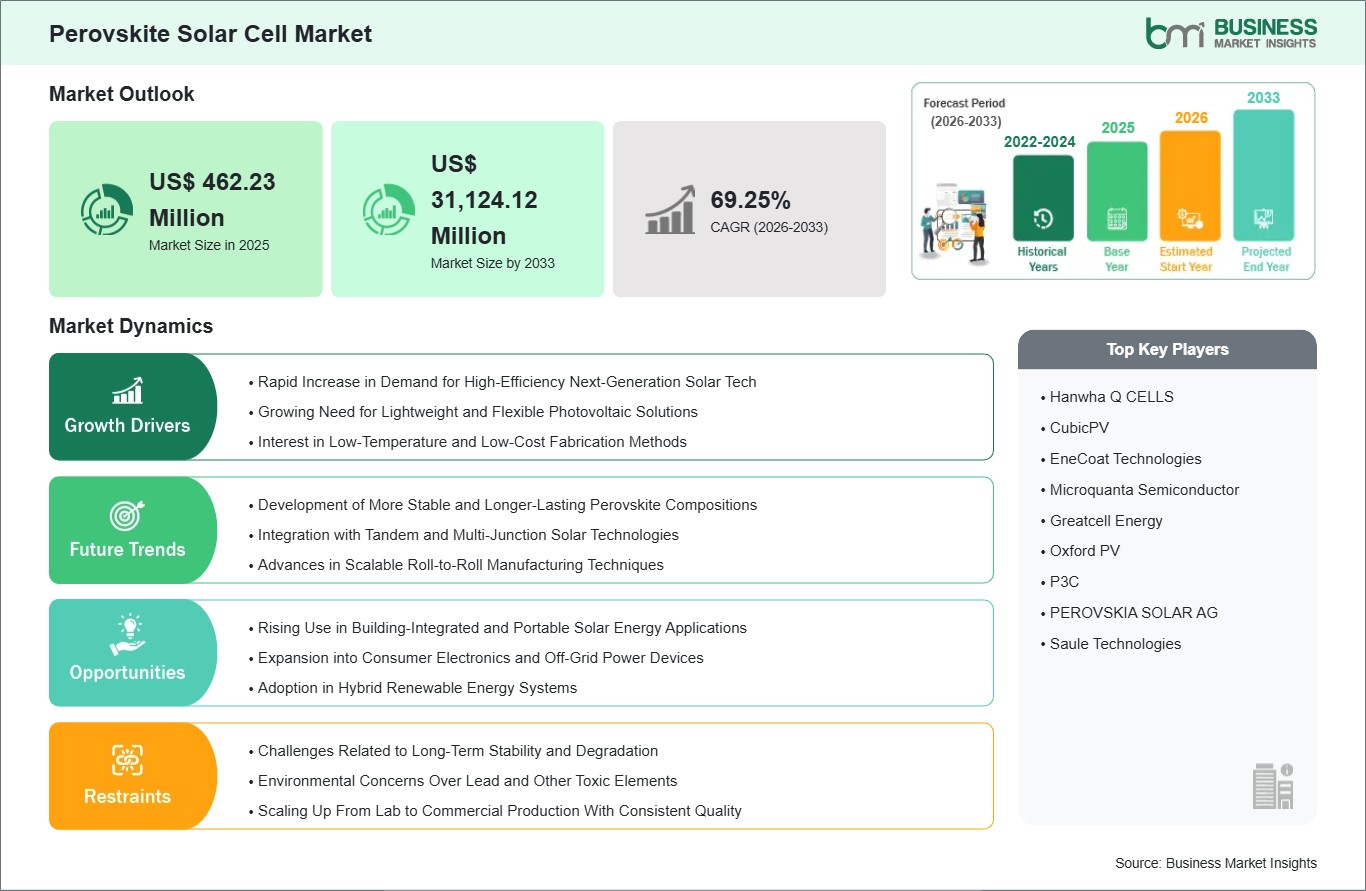
The Perovskite Solar Cell Market size is expected to reach US$ 31,124.12 million by 2033 from US$ 462.23 million in 2025. The market is estimated to record a CAGR of 69.25% from 2026 to 2033.
The global perovskite solar cells market is one of the transformative markets in the field of renewable energy technologies, with the demand for high-efficiency, cost-effective, and lightweight photovoltaic technology continuing to grow. Perovskite solar cells possess unique structural properties, which allow them to achieve high efficiencies in the absorption of sunlight. Moreover, the bandgap and high carrier mobility of perovskite solar cells ensure the promise of high efficiency in compact configurations. These factors contribute to the high potential for the application of perovskite solar cells in the field of photovoltaics.
One of the major factors driving the global perovskite solar cells market is the growing emphasis on the deployment of renewable energy technologies. Governments and private sector entities are increasingly looking for cost-effective alternatives to the deployment of silicon-based photovoltaic technology. Furthermore, the lightweight and pliable nature of perovskite cells provides new avenues in mobile, wearable, and space-constrained energy technologies, which extend their potential beyond traditional solar farms. However, the long-term durability of perovskite materials under environmental conditions, such as moisture, temperature, and exposure to UV rays, is a major area of concern before commercialization on a larger scale.
Additionally, environmental issues associated with lead-based perovskite materials are a key area of concern, which has led to a shift towards non-toxic or low-lead perovskite-based technologies. The global PSC market represents a highly innovative segment, where cutting-edge material science, sustainability, and energy efficiency are integrated to shape a new future for PV technologies.

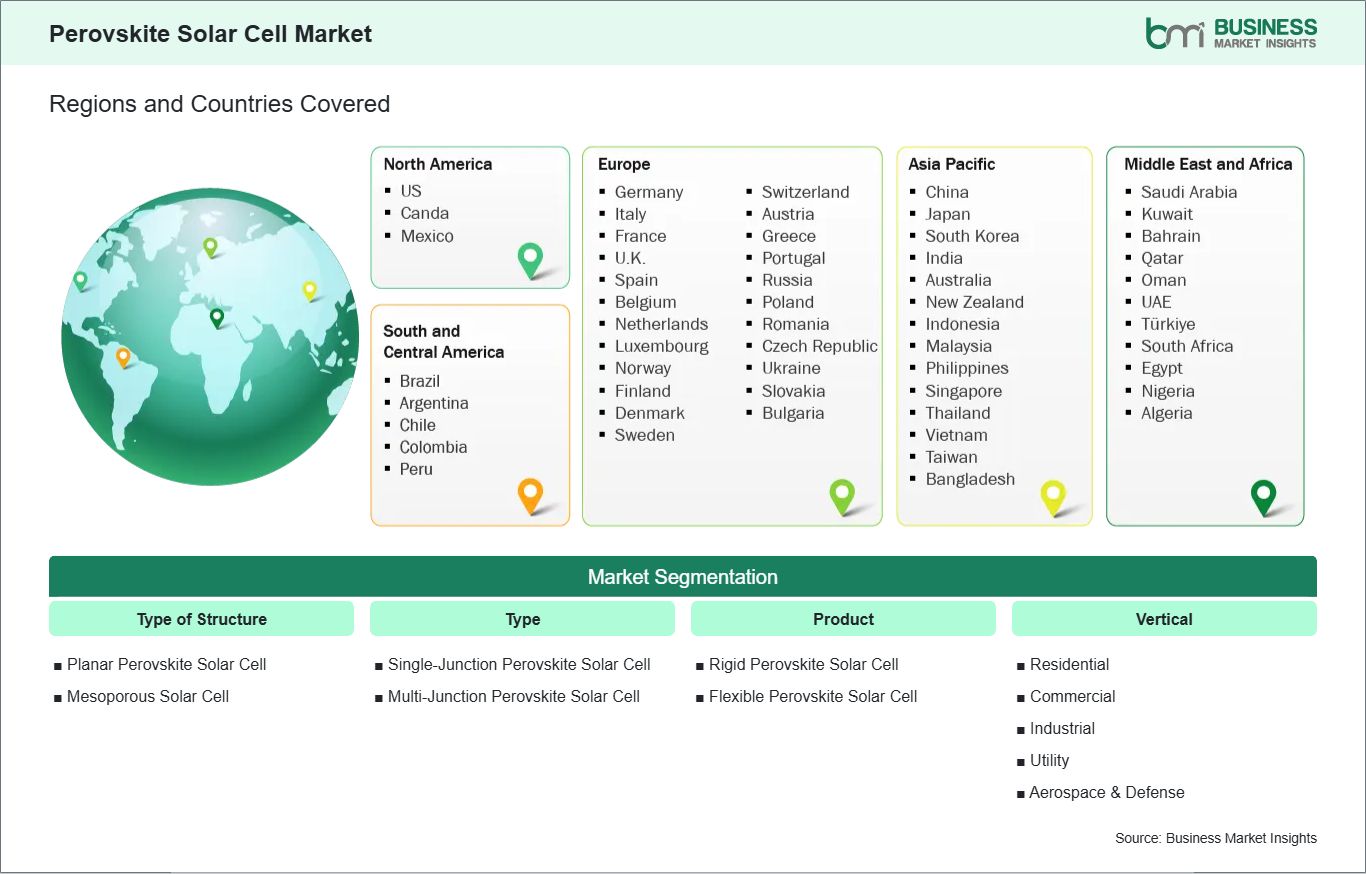
Key segments that contributed to the derivation of the perovskite solar cell market analysis are type of structure, type, product, vertical, application, and technology.
The global perovskite solar cell market is experiencing rapid growth driven by increasing demand for high-efficiency next-generation solar technologies. Perovskite solar cells (PSCs) offer remarkable power conversion efficiencies that rival traditional silicon-based solar panels while enabling lightweight and flexible module designs. Their ability to achieve high efficiency at a lower cost makes PSCs particularly attractive for utility-scale installations and distributed energy systems. As energy demand continues to grow globally and renewable energy adoption accelerates, perovskite technology is emerging as a key alternative to conventional photovoltaic systems.
Further development in material engineering and device architecture is also driving the development of perovskite solar cells. Developments such as the use of tandem cells and stacked cells have improved the stability of PSCs and are driving the development of these cells. The focus of PSC development is on enhancing stability and scalability. These are key drivers for the development of PSCs and are essential for bridging the gap between PSC development and commercialization. PSCs are considered a next-generation technology for fulfilling the increasing demand for high-performance and cost-effective solar cells.
In addition to this, the growing importance of sustainability and the reduction in the level of carbon footprint are also supporting the growth of the perovskite technology market. Governments, industries, and utilities are looking for high-efficiency technology to reduce the levelized cost of electricity. PSC technology is lightweight and can be used in many different applications. It can be used for rooftop applications as well as for the development of integrated energy solutions. It is seen that the global push for the development of efficient, flexible, and scalable solar technology is supporting the growth of the perovskite solar cell market.
The global perovskite solar cell market is also expanding due to the increasing use of these cells in building-integrated and portable solar energy applications. PSCs can be fabricated on flexible substrates, semi-transparent materials, and even glass panels, making them ideal for integration into windows, facades, and roofs without compromising aesthetics. Building-integrated photovoltaics (BIPV) allow architects and developers to incorporate energy generation directly into structures, creating opportunities for energy-efficient buildings that contribute to reduced operational costs and sustainable urban development.
Furthermore, the portability and lightweight features of perovskite solar cells are contributing to their increased adoption in mobile and off-grid applications. Portable solar panels, solar wearers, and emergency energy kits can leverage the high power-to-weight advantage of perovskite solar cells. These types of applications can play a significant role in disaster-prone areas and remote regions where access to conventional energy is limited. The flexibility and versatility of perovskite solar technology can create new opportunities in off-grid energy production, allowing access to energy in different environments and contributing to the global drive towards increasing renewable energy usage.
The versatility, efficiency, and light weight of PSCs ensure that the technology will continue to make more inroads in a wide variety of fields. The increasing need for integrated energy solutions and portable power sources will ensure that the market for perovskite solar cells experiences tremendous innovation and commercialization. The increasing reliability and longevity of PSCs, which have been made possible through ongoing research and pilot projects, ensure that the technology will make more inroads in residential and commercial sectors across the globe.
The perovskite solar cell market is experiencing steady growth, with market size and share analysis reflecting evolving treatment preferences and competitive dynamics among key players. The report evaluates important subsegments categorized within type of structure, type, product, vertical, application, and technology, highlighting their respective contributions to overall market performance.
By type of structure, the Planar Perovskite Solar Cell subsegment dominated the Perovskite Solar Cell market in 2025. Planar structures offer simpler fabrication, higher uniformity, and improved scalability, making them highly suitable for commercial solar applications, which drives their widespread adoption.
Based on type, the Single‑Junction Perovskite Solar Cell subsegment dominated the Perovskite Solar Cell market in 2025. Single-junction cells provide cost-effective manufacturing and reliable efficiency for standard solar installations, supporting strong demand for this segment.
In terms of product, the Rigid Perovskite Solar Cell subsegment dominated the Perovskite Solar Cell market in 2025. Rigid cells offer enhanced durability and stability, making them ideal for large-scale solar panels and utility applications, reinforcing their market preference.
On the basis of vertical, the Utility subsegment dominated the Perovskite Solar Cell market in 2025. Utility-scale projects require high-efficiency, durable solar solutions to meet energy demands, driving the widespread adoption of perovskite solar technologies in this sector.
In terms of application, the Solar Panel subsegment dominated the Perovskite Solar Cell market in 2025. Solar panels benefit from perovskite cells high efficiency and cost-effectiveness, making them the primary application driving market growth.
Based on technology, the One‑Step Method subsegment dominated the Perovskite Solar Cell market in 2025. The one-step fabrication method allows simpler processing, lower costs, and consistent performance, making it the preferred manufacturing approach in the industry.
| Report Attribute | Details |
|---|---|
| Market size in 2025 | US$ 462.23 Million |
| Market Size by 2033 | US$ 31,124.12 Million |
| Global CAGR (2026 - 2033) | 69.25% |
| Historical Data | 2022-2024 |
| Forecast period | 2026-2033 |
| Segments Covered | By Type of Structure
|
|
Regions and Countries Covered
| |
| North America | US, Canada, Mexico |
| Europe | Belgium, Austria, Finland, Denmark, Greece, Poland, Romania, Russia, Ukraine, Czech Republic, Slovakia, Bulgaria, Italy, Luxembourg, Germany, Switzerland, France, Netherlands, Norway, Portugal, Spain, Sweden, United Kingdom |
| Asia-Pacific | Australia, China, India, Japan, South Korea, Indonesia, Malaysia, Philippines, Singapore, Thailand, Vietnam, Bangladesh, New Zealand, Taiwan |
| South and Central America | Brazil, Argentina, Peru, Chile, Colombia |
| Middle East and Africa | Bahrain, Kuwait, Oman, Qatar, Saudi Arabia, United Arab Emirates, Turkiye, South Africa, Egypt, Algeria, Nigeria |
| Market leaders and key company profiles |
|
The "Perovskite Solar Cell Market Size and Forecast (2022 - 2033)" report provides a detailed analysis of the market covering below areas:
The geographical scope of the Perovskite Solar Cell market report is divided into five regions: North America, Asia Pacific, Europe, Middle East & Africa, and South & Central America. The Perovskite Solar Cell market in North America is expected to grow during the forecast period.
North America is a key player in the global perovskite solar cell market, thanks to its robust technology platform, advanced research facilities, and strategic focus on renewable energy technologies. The region is a key player in the global perovskite solar cell market due to its robust research and development activities in academic and industrial environments, with a focus on developing efficient, reliable, and scalable perovskite solar cell technology for commercialization. Perovskite solar cell technology is under investigation in North America for various applications, such as residential and commercial building rooftops, building-integrated photovoltaics, and portable solar power, which indicates the region's focus on renewable energy technologies and sustainability.
Perovskite solar cell technology, with its lightweight and flexible features, is a key trend in modern building and infrastructure, along with wearable technology, which indicates potential opportunities in this region for this technology in comparison to traditional silicon-based solar cell technologies. Additionally, North American players are seeking hybrid technologies that will enable them to capture more energy while ensuring system reliability through the integration of perovskite layers with silicon-based solar cells.
The challenges associated with material stability and environmental safety are still key areas of focus, which have led to further research in encapsulation, non-toxic perovskite, and durability technologies. North America not only commercializes PSCs but also sets a standard for the rest of the world in terms of technology and sustainability, which has a significant influence on global trends in future renewable energy technologies.

The perovskite solar cell market is evaluated by gathering qualitative and quantitative data post primary and secondary research, which includes important corporate publications, association data, and databases. A few of the key developments in the perovskite solar cell market are:
The Perovskite Solar Cell Market is valued at US$ 462.23 Million in 2025, it is projected to reach US$ 31,124.12 Million by 2033.
As per our report Perovskite Solar Cell Market, the market size is valued at US$ 462.23 Million in 2025, projecting it to reach US$ 31,124.12 Million by 2033. This translates to a CAGR of approximately 69.25% during the forecast period.
The Perovskite Solar Cell Market report typically cover these key segments-
The historic period, base year, and forecast period can vary slightly depending on the specific market research report. However, for the Perovskite Solar Cell Market report:
The Perovskite Solar Cell Market is populated by several key players, each contributing to its growth and innovation. Some of the major players include:
The Perovskite Solar Cell Market report is valuable for diverse stakeholders, including:
Essentially, anyone involved in or considering involvement in the Perovskite Solar Cell Market value chain can benefit from the information contained in a comprehensive market report.
Please tell us your area of interest
(Market Segments/ Regions and Countries/ Companies)