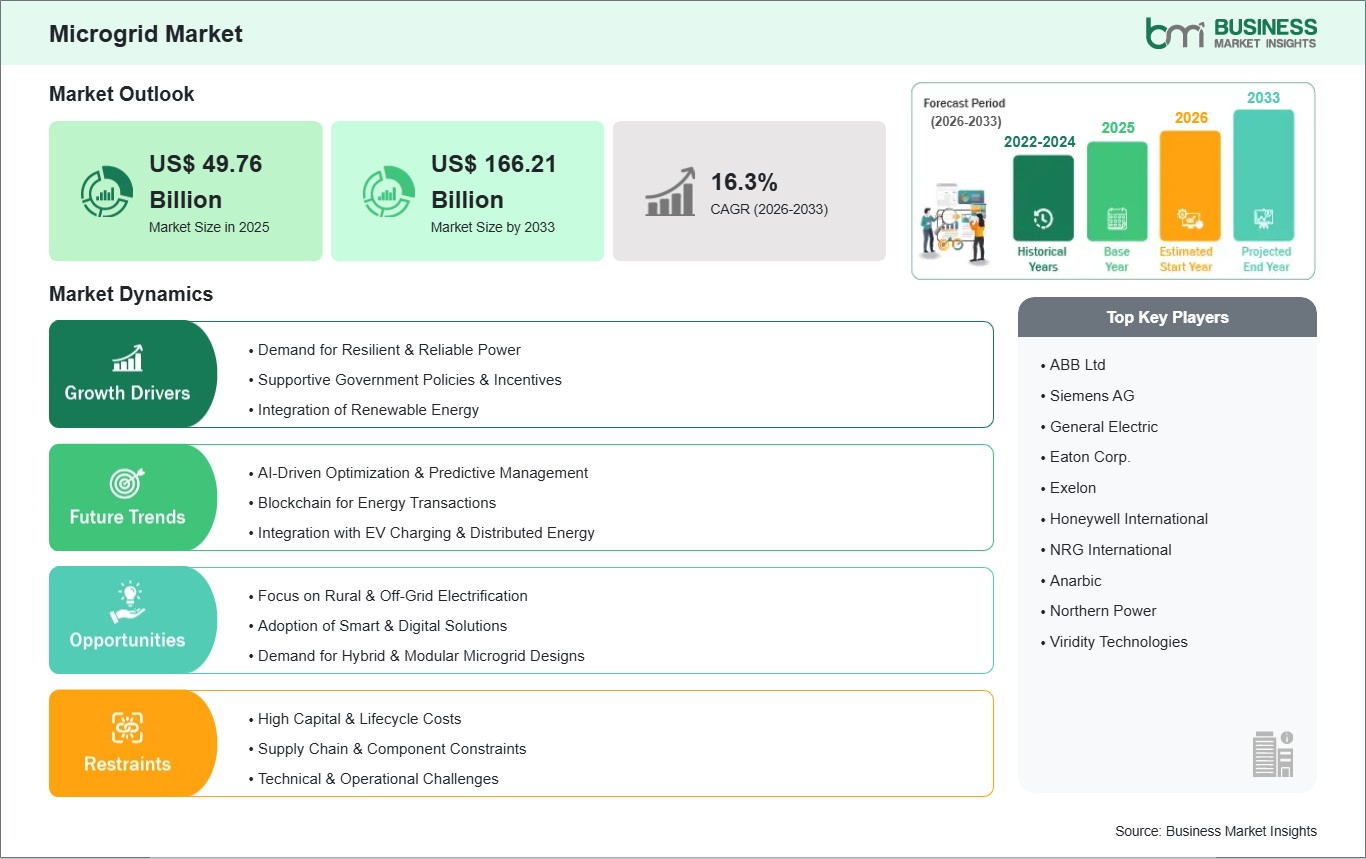
The microgrid market size is expected to reach US$ 166.21 billion by 2033 from US$ 49.76 billion in 2025. The market is estimated to record a CAGR of 16.3% from 2026 to 2033.
A microgrid is a localized energy system that can operate independently or in coordination with the main power grid, integrating distributed energy resources such as solar panels, wind turbines, energy storage systems, and conventional generators to supply electricity to a defined area. The primary benefit of a microgrid lies in its ability to enhance energy reliability and resilience, particularly during grid outages, while also improving energy efficiency and reducing greenhouse gas emissions through the use of renewable sources. Microgrids are widely used in campuses, hospitals, military bases, industrial facilities, remote communities, and commercial buildings where uninterrupted power supply and energy cost optimization are critical.
The demand for microgrids is driven by several factors. Key drivers include the rising penetration of renewable energy, increasing frequency of power outages due to extreme weather events, growing energy security concerns, and supportive government policies promoting decentralized energy systems. However, market growth faces restraints such as high initial capital investment, complex system integration, and regulatory challenges in certain regions. At the same time, significant opportunities exist in the electrification of remote and rural areas, advancements in energy storage and control technologies, and the growing adoption of smart grids and digital energy management systems. Current market trends include the increasing use of hybrid microgrids, incorporation of artificial intelligence for optimized energy management, and expanding investments by utilities and private players to support sustainable and resilient power infrastructure.

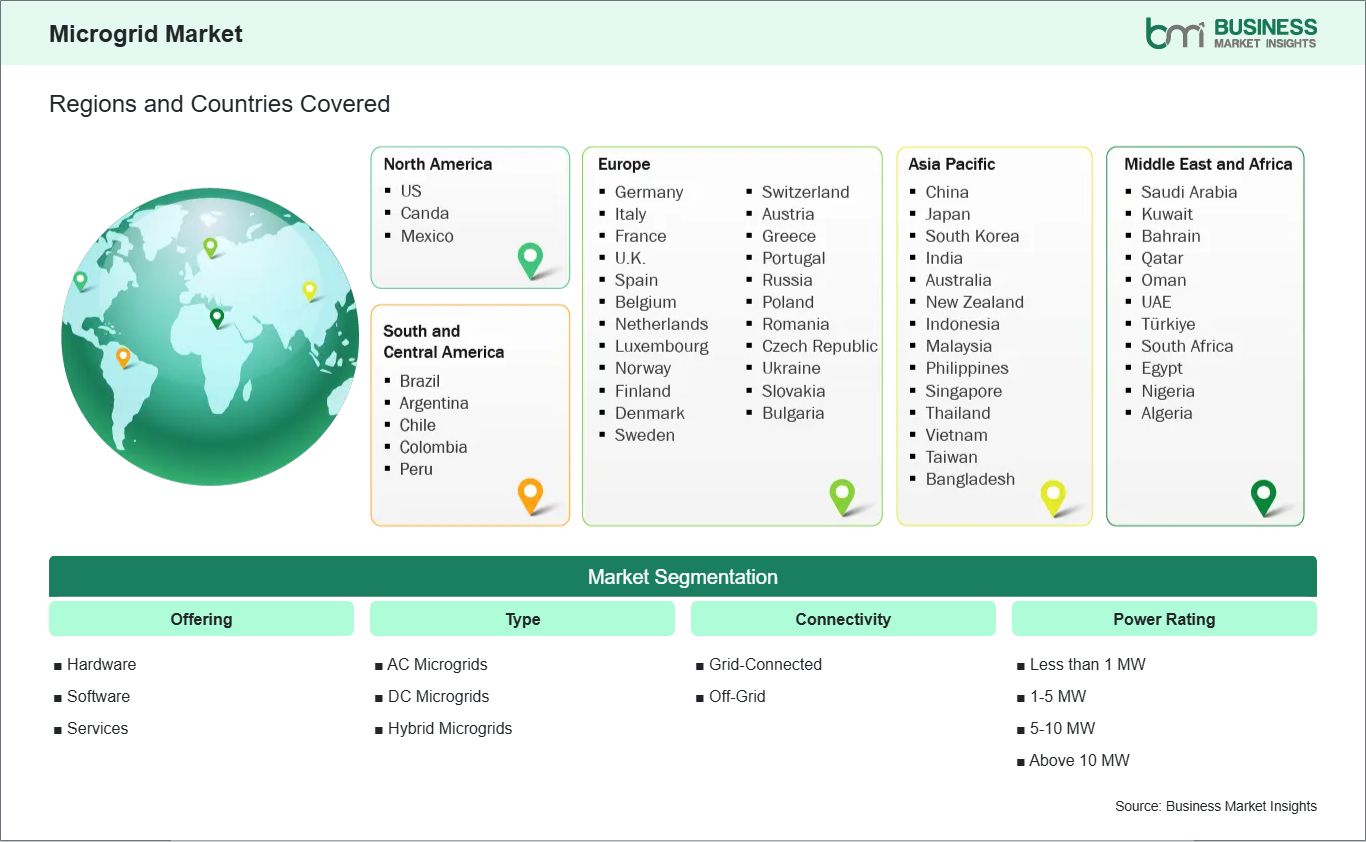
Key segments that contributed to the derivation of the microgrid market analysis are offering, type, connectivity, power rating, power source, and end user.
The growing need for energy resilience and reliability has become a central driver of innovation and investment in power systems worldwide. As extreme weather events, cyberattacks, aging infrastructure, and grid instability increase in frequency and severity, communities, industries, and governments are re-evaluating traditional centralized energy models that can be vulnerable to disruptions. Energy resilience means not just maintaining supply during peak demand, but also sustaining critical operations when the broader grid fails. Reliability extends this concept to consistent, high-quality power delivery, minimizing outages and fluctuations that can damage equipment or interrupt essential services. In this context, microgrids have emerged as a compelling solution because they can operate both connected to the main grid and independently in “island mode” during disruptions. By integrating distributed energy resources—such as solar panels, wind turbines, battery storage, and diesel generators—microgrids provide localized control over energy production and consumption, enhancing stability and responsiveness.
This shift toward localized, resilient power systems aligns directly with market growth trends in the microgrid sector. Organizations across residential, commercial, industrial, and institutional segments are increasingly adopting microgrids to hedge against grid unreliability and to meet sustainability goals. The demand for uninterrupted power in data centers, hospitals, military installations, and campuses has intensified interest in modular, scalable solutions that can guarantee uptime even under adverse conditions. Furthermore, policy initiatives and incentives promoting clean energy and grid modernization have expanded funding and reduced barriers for microgrid deployment. As a result, investors and energy developers are accelerating research, deployment, and commercialization efforts. The convergence of resilience needs with technological advances in energy storage and renewable generation is thus fueling substantial growth in the global microgrid market, transforming it from a niche innovation into a mainstream component of future energy infrastructure.
Digitalization and AI-enabled energy management are transforming how power systems are designed, monitored and optimized, driving efficiency, resilience, and decarbonization across the energy sector. Digitalization refers to the integration of advanced sensors, communication networks, and data platforms that continuously collect and transmit real-time information from energy assets such as distributed generators, storage units, and loads. When this digital infrastructure is coupled with artificial intelligence (AI) and machine learning algorithms, it enables predictive analytics, autonomous control, and demand forecasting that optimize energy flows with minimal human intervention. AI can analyze vast datasets to predict consumption patterns, detect anomalies, balance supply and demand, and dispatch distributed energy resources in response to dynamic conditions. This intelligent orchestration reduces operational costs, enhances reliability, and improves the integration of renewable energy sources like solar and wind, which are inherently variable.
Microgrids—localized energy systems capable of operating independently or in conjunction with the main grid—are especially well-positioned to benefit from digital and AI-driven management. By embedding AI into microgrid controllers, operators can achieve real-time optimization of generation, storage, and load priorities, ensuring resilience during outages and maximizing economic performance under normal conditions. The ability to efficiently manage complex, multi-source microgrid configurations accelerates their adoption among commercial, industrial, and community stakeholders seeking energy security and sustainability. Consequently, as digitalization and AI capabilities mature, they are significant growth enablers for the microgrid market, lowering barriers to deployment, enhancing performance, and unlocking new services such as virtual power plants and grid-interactive efficient buildings. This synergy underpins robust market expansion in response to evolving energy needs.
By offering, the microgrid market is divided into hardware, software, and services. The hardware segment dominated the market in 2025. The hardware segment in the microgrid market is driven by factors such as advanced energy storage systems, efficient power converters, renewable energy integration, smart meters, and reliable control systems. These components enhance performance, reduce costs, and improve overall grid resilience and stability.
By type, the market is segmented into AC microgrids, DC microgrids, and hybrid microgrids. The AC microgrids segment held the largest share of the market in 2025. The AC microgrids segment growth is driven by factors such as growing demand for reliable power, integration with renewable energy, cost-effectiveness, government incentives, urban electrification, technological advancements, scalability, and the need for resilient, decentralized energy systems in both commercial and industrial sectors.
By connectivity, the market is segmented into grid-connected and off-grid. The grid-connected segment held the largest share of the market in 2025. Increasing electricity demand, government policies promoting renewable integration, energy cost optimization, reliable power supply, demand for sustainable infrastructure, technological advancements, urbanization, and the ability to balance load efficiently while supporting grid stability.
By power rating, the microgrid market is divided into less than 1 MW, 1-5 MW, 5-10 MW, above 10 MW). The 1-5 MW segment dominated the market in 2025. The 1–5 MW segment in microgrids represents small-scale power systems suitable for commercial, industrial, and community applications. Rising demand is driven by energy resilience needs, renewable integration, cost savings, and the push for decentralized, reliable, and sustainable electricity solutions.
By power source, the market is segmented into natural gas, solar PV, CHP, diesel, and others. The natural gas segment held the largest share of the market in 2025. The natural gas segment in microgrids refers to systems powered by natural gas generators or turbines, offering flexible and reliable energy. Demand is rising due to lower emissions than coal, fuel availability, operational efficiency, and support for stable, continuous power supply.
By end user, the market is segmented into healthcare, educational institutes, military, utility, industrial/ commercial, remote, and others. The industrial/ commercial segment held the largest share of the market in 2025. The demand for microgrids in industrial and commercial applications is rapidly increasing due to their ability to enhance energy reliability, reduce costs, integrate renewable sources, and ensure uninterrupted operations. Businesses seek resilience against grid instability and sustainable, efficient energy solutions.

| Report Attribute | Details |
|---|---|
| Market size in 2025 | US$ 49.76 Billion |
| Market Size by 2033 | US$ 166.21 Billion |
| Global CAGR (2026 - 2033) | 16.3% |
| Historical Data | 2022-2024 |
| Forecast period | 2026-2033 |
| Segments Covered | By Offering
|
| Regions and Countries Covered | North America
|
| Market leaders and key company profiles |
|
The "Microgrid Market Size and Forecast (2022–2033)" report provides a detailed analysis of the market covering below areas:
The geographical scope of the microgrid market report is divided into five regions: North America, Asia Pacific, Europe, Middle East & Africa, and South & Central America. The microgrid market in Asia Pacific is expected to grow significantly during the forecast period.
The Asia-Pacific microgrid market is segmented into China, Japan, South Korea, India, Australia, New Zealand, Indonesia, Malaysia, the Philippines, Singapore, Thailand, Vietnam, Taiwan, Bangladesh, and the Rest of Asia. The demand factor driving the growth of the microgrid market in the Asia Pacific region is fundamentally rooted in the urgent need for reliable, resilient, and decentralized power supply solutions across diverse and rapidly evolving energy landscapes. A core driver is the rising demand for uninterrupted power, especially in remote, rural, and underserved areas where traditional grid infrastructure is either weak or non-existent; microgrids provide a practical and cost-effective way to bridge electrification gaps, support local energy needs, and improve energy access for communities and businesses alike. Alongside this, urbanization and industrial growth in major economies such as China, India, Japan, and Southeast Asian nations have escalated electricity demand significantly, increasing pressure on centralized grids and spurring the adoption of microgrids that can offer localized generation and enhanced energy security.
The region is also witnessing the integration of renewable energy sources such as solar, wind, and hybrid systems into energy portfolios; microgrids enable seamless incorporation of these intermittent sources with battery storage, enhancing grid flexibility and supporting national decarbonization targets, which governments in the region are actively promoting through policy incentives and subsidies. The need for resilience against natural disasters and grid instabilities also fuels demand, as microgrids can autonomously operate during outages, protecting critical infrastructure like hospitals, industrial facilities, and data centers. Furthermore, supportive regulatory frameworks, public-private investments, and international funding mechanisms are lowering barriers to deployment, making microgrid solutions increasingly attractive to utilities, commercial enterprises, and rural communities seeking robust and sustainable energy systems.

The microgrid market is evaluated by gathering qualitative and quantitative data post primary and secondary research, which includes important corporate publications, association data, and databases. A few of the key developments in the microgrid market are:
The Microgrid Market is valued at US$ 49.76 Billion in 2025, it is projected to reach US$ 166.21 Billion by 2033.
As per our report Microgrid Market, the market size is valued at US$ 49.76 Billion in 2025, projecting it to reach US$ 166.21 Billion by 2033. This translates to a CAGR of approximately 16.3% during the forecast period.
The Microgrid Market report typically cover these key segments-
The historic period, base year, and forecast period can vary slightly depending on the specific market research report. However, for the Microgrid Market report:
The Microgrid Market is populated by several key players, each contributing to its growth and innovation. Some of the major players include:
The Microgrid Market report is valuable for diverse stakeholders, including:
Essentially, anyone involved in or considering involvement in the Microgrid Market value chain can benefit from the information contained in a comprehensive market report.
Please tell us your area of interest
(Market Segments/ Regions and Countries/ Companies)