
LNG Market Outlook: Size, Share, Trends, Growth Analysis, Competitive Landscape & Forecast, 2026-2033

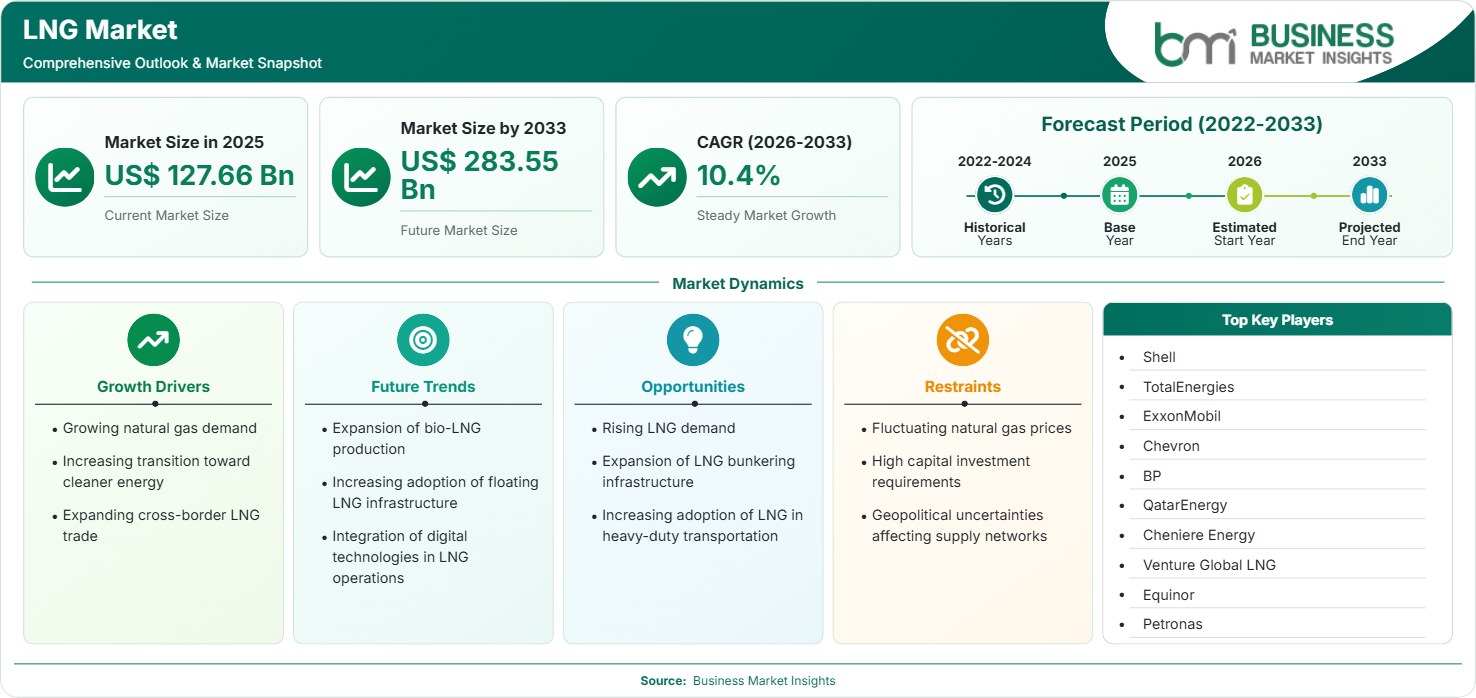
The LNG Market size was valued at US$ 127.66 billion in 2025 and is projected to reach US$ 283.55 billion by 2033, growing at a CAGR of 10.4% during 2026–2033, driven by growing natural gas demand, increasing transition toward cleaner energy, and expanding cross-border LNG trade, creating new opportunities across global energy markets.

Report Coverage
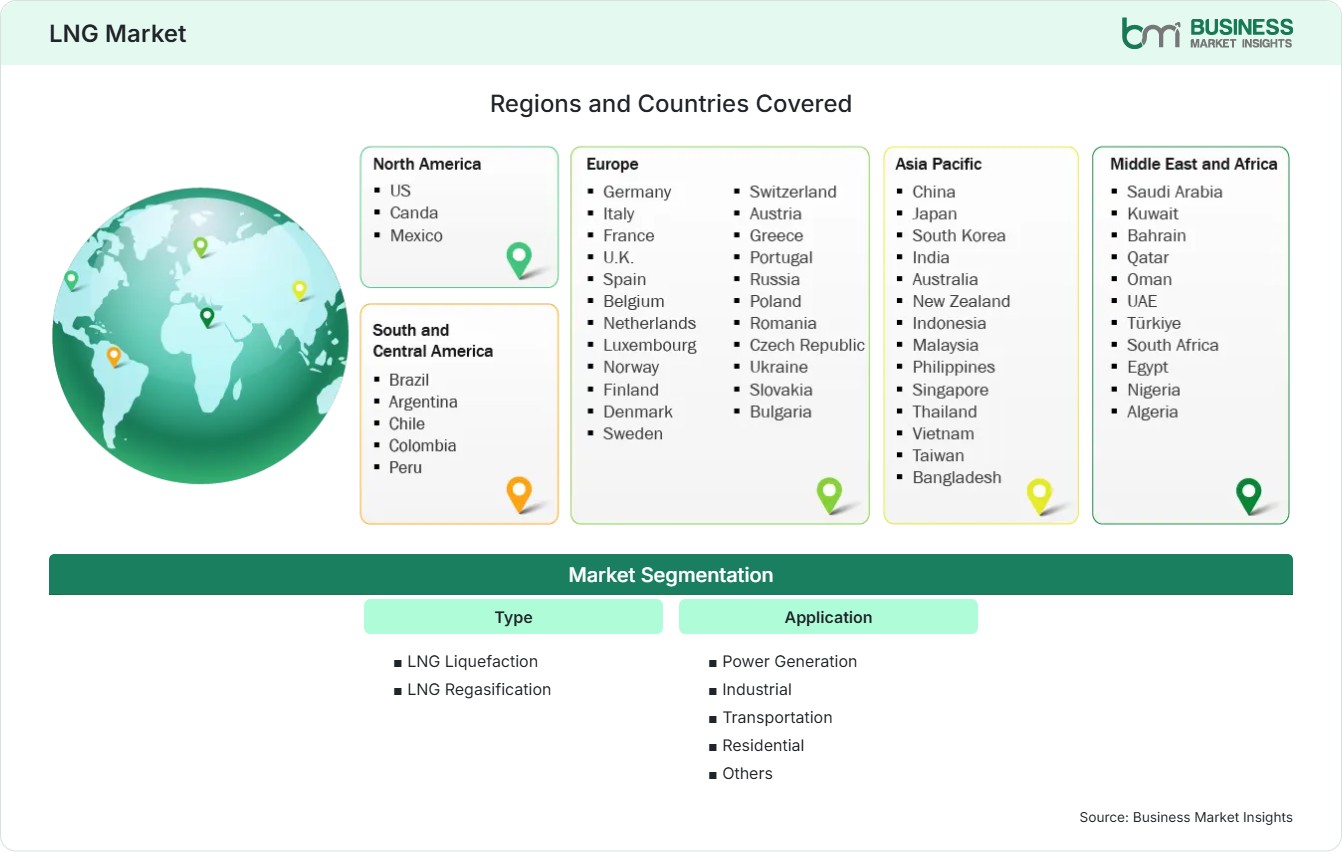
  • Type: LNG Liquefaction, LNG Regasification
  • Application: Power Generation, Industrial, Transportation, Residential, Others
US$ 127.66 Bn Market size in 2025
US$ 283.55 Bn Market Size by 2033
10.4% CAGR, 2026 - 2033
2026-2033 Forecast Period

01 AI Overview

LNG Market Summary

  • North America Region: North America holds a market share of 24%–27% in 2025, growing with a CAGR of 9.8%–10.2%, supported by LNG export capacity expansion, shale gas production, and increasing long-term supply agreements. The US market benefits from expanding export terminals and growing LNG production, registering a CAGR of 10.0%–10.4% during 2026–2033.
  • Fastest Growing Region: Asia Pacific accounts for 39%–42% of the market in 2025 and is expected to grow at a CAGR of 11.2%–11.8%, supported by rising energy demand, industrialization, and increasing LNG imports across major economies.
  • Leading Segment: LNG Liquefaction holds a market share of 62%–65% in 2025 and is projected to expand at a CAGR of 10.5%–10.9%, driven by investments in export terminals, liquefaction trains, and global LNG supply capacity.
  • High Growth Segment: Power Generation represents a market share of 37%–40% in 2025 and is anticipated to grow at a CAGR of 10.8%–11.3%, supported by increasing replacement of coal-fired generation with cleaner natural gas-based electricity.
  • Key Market Opportunity: Rising LNG demand, expansion of LNG bunkering infrastructure, and increasing adoption of LNG in heavy-duty transportation are creating long-term investment opportunities for producers, infrastructure developers, and transportation operators.
  • Major Market Players: Shell plc, TotalEnergies SE, Exxon Mobil Corporation, Chevron Corporation, BP p.l.c., QatarEnergy, Cheniere Energy, Inc., Venture Global LNG, Equinor ASA, and Petroliam Nasional Berhad (PETRONAS).
02 Strategic Insights

LNG Market: Strategic Insights

lng-market-market-strategic-framework
FREE PDF
Request your free sample
Request free sample
03 Stakeholder View

Key Takeaways

  • The LNG value chain is becoming increasingly integrated as upstream producers, shipping companies, terminal operators, and utilities establish long-term partnerships to improve supply security and operational efficiency.
  • LNG liquefaction remains the largest investment segment due to the continuous expansion of export capacity and increasing demand from international energy markets.
  • Technology improvements in liquefaction processes, cryogenic storage, and LNG transportation are enhancing operational efficiency while reducing production and logistics costs.
  • Asia Pacific continues to provide the strongest investment opportunity owing to rising electricity demand, industrial growth, and increasing dependence on imported LNG.
  • Strategic partnerships and long-term purchase agreements are becoming increasingly important as suppliers seek stable revenue streams while importing countries prioritize energy security.
  • Floating LNG infrastructure and modular regasification facilities are improving market accessibility by reducing deployment timelines and infrastructure costs.
04 Geographic Outlook

LNG Market Regional Highlights

North America LNG Market

North America accounted for 24%–27% of the global LNG market in 2025 and is expected to register a CAGR of 9.8%–10.2% through 2033. Strong shale gas production, expanding export terminals, and growing international LNG demand continue to support regional leadership. Major infrastructure investments and increasing export contracts are strengthening North America's position in global LNG trade.

  • The United States continues expanding LNG export capacity through new liquefaction terminals and long-term supply agreements with Europe and Asia.
  • Canada is increasing investment in LNG export infrastructure to diversify natural gas markets and strengthen international trade opportunities.
  • Technological improvements in liquefaction facilities are enhancing production efficiency and lowering operational costs.
  • Energy companies continue investing in terminal expansions to meet increasing international LNG demand.

US LNG Market

The United States represented 22%–24% of the global LNG market in 2025 and is forecast to grow at a CAGR of 10.0%–10.4% through 2033. Strong natural gas production, expanding export infrastructure, and increasing international demand continue driving market development.

  • Export terminal expansion continues supporting higher shipment volumes to Europe and Asia.
  • Long-term LNG purchase agreements are strengthening revenue stability for domestic producers.
  • Investments in pipeline connectivity and storage facilities continue improving export efficiency.

Europe LNG Market

Europe accounted for 20%–23% of the market in 2025 and is projected to grow at a CAGR of 9.5%–10.0% during the forecast period. Increasing LNG imports, diversifying gas supply sources, and investing in regasification terminals are strengthening regional demand. Germany, France, and the United Kingdom remain leading markets, while Poland demonstrates comparatively faster growth through expanding LNG infrastructure.

  • European countries continue investing in LNG import terminals to improve energy security.
  • Germany is expanding regasification capacity through permanent and floating LNG facilities.
  • France maintains strong LNG imports supported by established terminal infrastructure.
  • Poland continues strengthening LNG capacity to diversify regional gas supplies.
  • The United Kingdom remains an important LNG trading and import hub.

Asia Pacific LNG Market

Asia Pacific accounted for 39%–42% of the global market in 2025 and is projected to expand at a CAGR of 11.2%–11.8% from 2026–2033, making it the fastest-growing regional market. Rising electricity consumption, rapid industrialization, increasing urbanization, and limited domestic natural gas production are supporting LNG imports across major economies. China, Japan, India, and South Korea remain the largest consumers, while Southeast Asian countries continue investing in LNG infrastructure to strengthen long-term energy security.

  • China continues expanding LNG import terminals and storage infrastructure to support industrial growth and increasing natural gas consumption.
  • India is investing in regasification terminals, pipeline connectivity, and city gas distribution networks to strengthen LNG utilization across industrial and commercial sectors.
  • Japan and South Korea remain among the world's largest LNG importers due to limited domestic energy resources and stable long-term procurement strategies.
  • Southeast Asian countries are developing floating storage and regasification facilities to improve access to cleaner energy while supporting industrial expansion.
  • Long-term supply contracts between LNG exporters and Asian utilities continue supporting regional energy security and infrastructure investment.

Rest of World LNG Market

The Rest of World region accounted for 12%–15% of the global market in 2025 and is expected to register a CAGR of 10.0%–10.6% during 2026–2033. South America is increasing LNG imports to supplement seasonal energy demand, while the Middle East and Africa continue expanding LNG production and export capabilities. Infrastructure investments and growing industrial energy requirements are supporting regional market development.

  • Brazil and Argentina continue increasing LNG imports to improve electricity supply reliability during periods of higher seasonal demand.
  • Middle Eastern producers are expanding liquefaction capacity to strengthen export competitiveness in international markets.
  • African LNG projects are attracting investment through new production developments and export infrastructure expansion.
  • Floating LNG and regasification facilities are improving accessibility for countries with limited conventional import infrastructure.
  • Increasing industrial development across emerging economies continues to support long-term LNG consumption growth.
global-market-geography
FREE PDF
Request your free sample
Request free sample
05 Segment Analysis

LNG Market Segmentation

Type

The Type category comprises LNG Liquefaction and LNG Regasification. LNG Liquefaction accounted for the largest LNG market share in 2025 due to expanding export facilities and increasing international LNG production. Both segments are expected to witness sustained investment as global LNG trade expands, with the segment projected to grow at a CAGR of 10.5%–10.9% during 2026–2034.

  • LNG Liquefaction: Liquefaction facilities convert natural gas into liquid form for efficient storage and international transportation. Growing export terminal investments and rising global LNG demand continue to support segment expansion.
  • LNG Regasification: Regasification terminals convert LNG back into natural gas for domestic distribution. Increasing LNG imports and the expansion of import infrastructure continue to drive adoption across energy-importing countries.

Application

The Application segment includes Power Generation, Industrial, Transportation, Residential, and Others. Power Generation remains the largest application owing to the increasing replacement of coal-fired electricity generation with cleaner-burning natural gas. The application segment is projected to grow at a CAGR of 10.8%–11.3% during the forecast period as countries continue expanding LNG utilization across multiple sectors.

  • Power Generation: Utilities increasingly utilize LNG to reduce emissions while improving electricity reliability and supporting growing power demand.
  • Industrial: Manufacturing facilities adopt LNG to improve energy efficiency and reduce emissions from industrial heating and processing operations.
  • Transportation: LNG is gaining adoption in marine shipping and heavy-duty commercial vehicles as operators seek lower-emission fuel alternatives.
  • Residential: Residential consumption continues expanding through natural gas distribution networks, supporting cooking, heating, and household energy requirements.
06 Market Forces

LNG Market Dynamics

Key Market Drivers

Growing Natural Gas Demand

Growing natural gas demand remains the primary factor supporting LNG Market expansion. Growing electricity demand, industrialization, and urbanization are prompting countries to diversify their energy sources by importing LNG. Developing countries continue to build natural gas infrastructure to enhance energy access and reduce reliance on higher-emission fuels. Growing investment in liquefaction facilities, regasification facilities, and pipelines has enabled companies to supply energy to meet rising global demand. Procurement contracts between the exporting and importing nations have been helping improve market stability and infrastructure development.

Increasing Transition Toward Cleaner Energy

The growing transition to cleaner energy is accelerating LNG adoption as governments and industries pursue lower-carbon alternatives. LNG emits fewer greenhouse gases than coal during power generation, making it an important transition fuel in national decarbonization strategies. Utilities continue replacing aging coal-fired generation with natural gas-fired facilities to improve environmental performance while maintaining a reliable electricity supply. Policy support for cleaner energy and investments in modern gas infrastructure continue to encourage LNG consumption across developed and emerging economies.

Expanding Cross-Border LNG Trade

Expanding cross-border LNG trade is strengthening market development by improving supply diversification and energy security. Growing international trade enables importing countries to secure reliable fuel supplies while providing exporters with access to expanding global demand. New export terminals, additional LNG carriers, and long-term supply contracts are improving global trade efficiency. Increasing cooperation between producing and consuming nations continues to support investment in transportation infrastructure, storage facilities, and liquefaction capacity, contributing to sustained market expansion.

Key Market Opportunities

Rising LNG Demand

Rising LNG demand creates significant opportunities for producers, exporters, infrastructure developers, and shipping companies. Increasing electricity generation requirements, industrial fuel demand, and energy diversification strategies are encouraging long-term investments throughout the LNG value chain. Expanding consumption across Asia Pacific, Europe, and developing economies is supporting additional liquefaction projects and import infrastructure. Companies investing in production capacity and logistics networks are expected to benefit from increasing global LNG utilization throughout the forecast period.

Expansion of LNG Bunkering Infrastructure

Expansion of LNG bunkering infrastructure presents substantial growth opportunities as maritime operators increasingly adopt cleaner marine fuels to comply with international environmental regulations. Ports worldwide are investing in LNG bunkering terminals, storage facilities, fueling services, and distribution networks to support commercial shipping fleets and next-generation marine vessels. Increasing government support, public-private investments, and rising demand for low-emission maritime transportation are accelerating the development of LNG fueling infrastructure across major global ports. The growing availability of bunkering infrastructure is improving operational feasibility, reducing fuel supply constraints, and encouraging wider adoption of LNG in international maritime transportation, supporting LNG Market growth while creating new revenue opportunities for infrastructure developers, shipping companies, and energy providers.

Increasing Adoption of LNG in Heavy-Duty Transportation

The growing adoption of LNG in heavy-duty transportation presents considerable market potential as fleet operators seek cleaner, more cost-effective alternatives to conventional diesel fuel. Commercial trucking companies, long-haul transportation providers, and logistics operators are evaluating LNG-powered vehicles to improve fuel efficiency, reduce operating costs, and lower greenhouse gas emissions. Growing investments in LNG refueling infrastructure, advancements in engine technologies, and supportive government policies promoting cleaner transportation are further encouraging adoption across the commercial vehicle sector. Continued expansion of fueling infrastructure and vehicle availability is expected to strengthen LNG utilization within heavy-duty transportation, supporting LNG Market trends over the forecast period.

Market Restraints and Challenges

Fluctuating Natural Gas Prices

Factor: Fluctuating natural gas prices create uncertainty across LNG production, transportation, and purchasing activities.

Impact: Price volatility can significantly influence investment decisions, reduce procurement predictability, and affect long-term supply agreements between producers, distributors, and buyers. Fluctuations in natural gas prices, geopolitical developments, supply-demand imbalances, transportation costs, and currency exchange rates create uncertainty across the LNG value chain. Energy companies must continuously manage pricing risks through strategic sourcing, long-term contracts, and hedging strategies while maintaining profitability and supply reliability. Significant price fluctuations may also influence purchasing behavior among industrial consumers, utilities, power producers, and commercial users, delaying investment decisions, increasing operational costs, and affecting overall market stability and long-term growth.

High Capital Investment Requirements

Factor: High capital investment requirements remain a significant challenge due to the substantial costs associated with liquefaction plants, regasification terminals, storage facilities, and LNG transportation infrastructure.

Impact: Large infrastructure investments can extend project development timelines and limit market participation for smaller companies with constrained financial resources. High capital requirements for LNG liquefaction plants, storage terminals, transportation networks, regasification facilities, and bunkering infrastructure create significant financing challenges. In addition, long project payback periods require long-term contractual commitments, stable regulatory frameworks, and consistent market demand before major LNG infrastructure projects can proceed successfully. These financial and operational barriers may delay capacity expansion, increase investment risks, and slow the pace of market development in emerging regions.

07 Company Analysis

Competitive Landscape

The LNG Market analysis indicates increasing competition through capacity expansion, project development, and strategic partnerships to meet rising global LNG demand. Leading companies are expanding liquefaction capacity, strengthening LNG trading portfolios, investing in floating LNG technologies, and securing long-term purchase agreements to enhance global market presence.

Company Name

Overview

Products and Services Relevant to this Market

Shell plc

Global integrated energy company with one of the world's largest LNG portfolios and extensive international trading operations.

LNG production, liquefaction, shipping, LNG trading, regasification, integrated gas solutions, and energy supply services.

TotalEnergies SE

International energy company expanding LNG production and global marketing through diversified upstream and downstream operations.

LNG production, liquefaction, LNG trading, import terminals, regasification services, and natural gas supply.

Exxon Mobil Corporation

Global energy producer with significant LNG investments across upstream production and export infrastructure.

LNG exploration, production, liquefaction facilities, natural gas development, and international LNG exports.

Chevron Corporation

Integrated energy company with major LNG production assets and long-term export operations.

LNG production, liquefaction, upstream natural gas development, LNG exports, and energy infrastructure services.

BP p.l.c.

International energy company with an extensive LNG trading and supply portfolio.

LNG marketing, international trading, natural gas production, shipping, and integrated energy solutions.

QatarEnergy

State-owned energy company and one of the world's largest LNG producers with expanding export capacity.

LNG production, liquefaction, exports, shipping partnerships, and long-term LNG supply agreements.

Cheniere Energy, Inc.

Leading U.S. LNG exporter focused on large-scale liquefaction and international LNG supply.

LNG liquefaction, export terminal operations, natural gas processing, and global LNG marketing.

Venture Global LNG

U.S.-based LNG developer focused on low-cost liquefaction projects and export infrastructure.

LNG liquefaction, export facilities, natural gas processing, and international LNG supply.

Equinor ASA

Norwegian energy company expanding LNG production through upstream natural gas and international energy operations.

LNG production, natural gas development, LNG trading, and integrated energy supply solutions.

Petroliam Nasional Berhad (PETRONAS)

Malaysian integrated energy company with extensive LNG production and global export capabilities.

LNG production, liquefaction, shipping, LNG trading, regasification, and integrated natural gas services.

08 Industry Activity

Recent Developments

December 2025

PETRONAS signed a long-term Sale and Purchase Agreement (SPA) with CNOOC Gas and Power Singapore Trading & Marketing to supply 1.0 million tonnes per annum (MTPA) of LNG, strengthening its presence in the Asian market.

November 2025

Golar LNG completed a US$ 1.2 billion bank financing facility for the FLNG Gimi project, supporting the deployment of floating LNG infrastructure and expanding its FLNG business.

September 2025

Woodside Energy and PETRONAS finalized a 15-year LNG Sale and Purchase Agreement for the supply of 1.0 MTPA of LNG from 2028, strengthening long-term cooperation in the global LNG value chain.

August 2025

ADNOC Gas signed a 10-year LNG supply agreement with Hindustan Petroleum Corporation Limited (HPCL) to supply 0.5 MTPA of LNG from its Das Island liquefaction facility, expanding its long-term LNG business in Asia.

10 Trust & Transparency

Research Methodology

The market analysis combines proprietary research with secondary data from government agencies, company disclosures, regulatory filings, industry databases and expert interviews. Market estimates are validated through data triangulation, cross-market benchmarking and analyst review.

View Full Research Methodology

11 Questions Answered

Frequently Asked Questions

What are the major challenges affecting the LNG Market report?

Key challenges include fluctuating natural gas prices, which create price uncertainty, and high capital investment requirements for liquefaction plants, LNG terminals, shipping fleets, and regasification infrastructure.

What opportunities are emerging in the LNG industry?

Major opportunities include rising LNG demand, expansion of LNG bunkering infrastructure, and increasing adoption of LNG in heavy-duty transportation, supporting long-term investments across production, logistics, and fueling infrastructure.

Which segment accounts for the largest market share?

LNG Liquefaction is the leading segment due to the ongoing expansion of export terminals, rising liquefaction capacity, and growing international demand for LNG from both developed and emerging economies.

Which region dominates the Market?

Asia Pacific holds the largest market share owing to rising electricity demand, rapid industrialization, increasing LNG imports, and continued investment in energy infrastructure across China, Japan, India, and South Korea.

What is driving growth in the LNG Market Forecasts?

The market is primarily driven by growing natural gas demand, increasing transition toward cleaner energy, and expanding cross-border LNG trade. These factors continue to encourage investments in liquefaction capacity, LNG transportation, and regasification infrastructure worldwide.

Access the Full LNG Market Report

Get segment-level forecasts, regional estimates, competitive benchmarking, company profiles and downloadable Excel datasets.

Access the full LNG Market Report
350 pages PDF & Excel | 2026-07-31