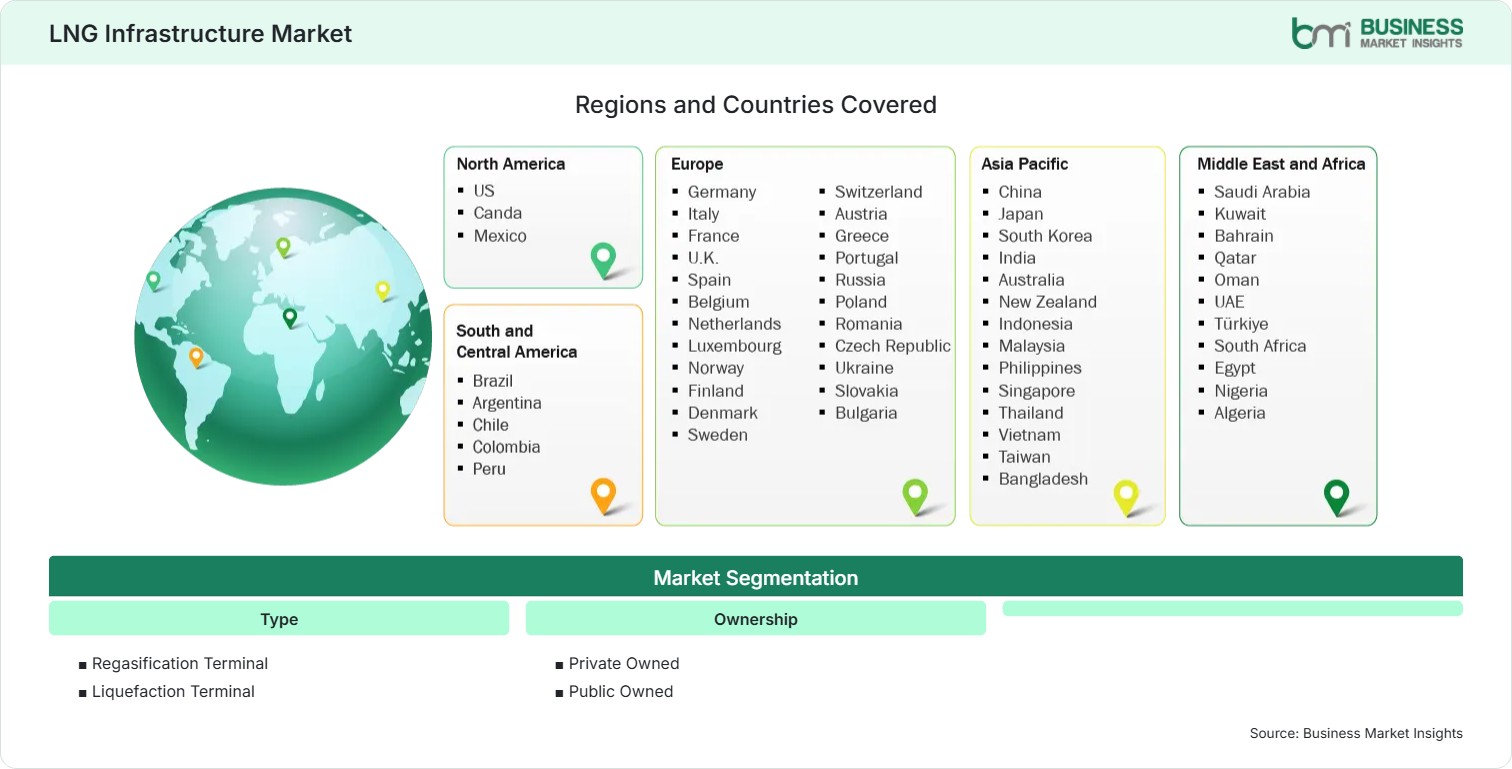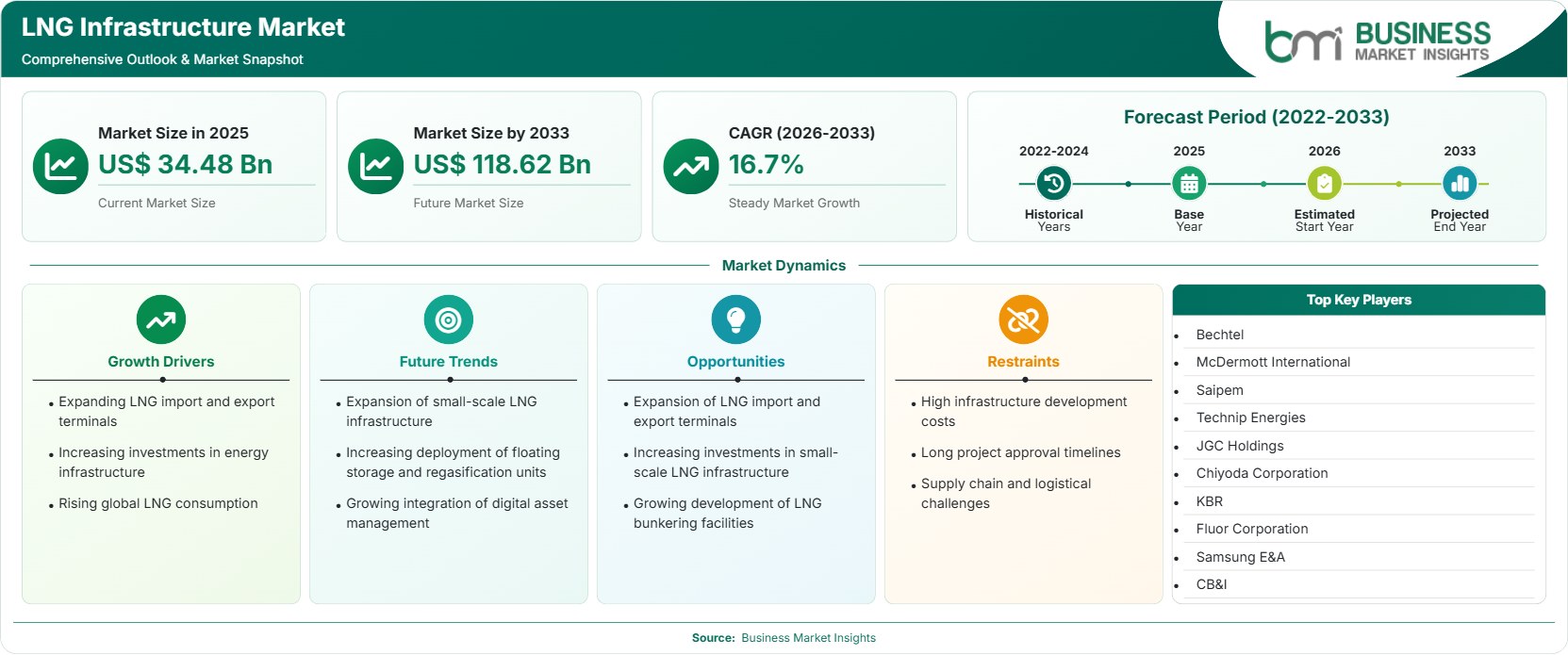
LNG Infrastructure Market Regional Highlights
North America LNG Infrastructure Market
North America accounted for a 31%–34% share of the LNG Infrastructure Market in 2025 and is projected to grow at a CAGR of 15.8%–16.6% during 2026–2033. The region remains a major LNG infrastructure hub due to abundant natural gas resources, export capacity expansion, and increasing demand from international markets. The US dominates regional development through large-scale liquefaction projects, while Canada continues advancing LNG export infrastructure.
- The US remains the leading regional contributor due to expanding LNG export terminals, increasing global supply commitments, and strategic investments in energy infrastructure.
- Growing LNG export activity is encouraging companies to develop additional liquefaction capacity, storage facilities, and supporting transportation infrastructure.
- Infrastructure operators are adopting advanced engineering solutions to improve terminal efficiency, reduce construction complexity, and enhance operational reliability.
- Private investment continues supporting LNG project development as energy companies seek opportunities linked to rising international natural gas demand.
US LNG Infrastructure Market
The US represented a 27%–30% share of the LNG Infrastructure Market in 2025 and is expected to grow at a CAGR of 16.0%–16.8% from 2026–2033. The country remains a global LNG export leader supported by extensive natural gas reserves, established pipeline networks, and growing liquefaction capacity. Continued investment in export terminals and associated infrastructure is strengthening the country’s position in international LNG trade.
- US LNG export terminal expansion is supported by long-term contracts, global energy security requirements, and increasing demand from international buyers.
- Gulf Coast infrastructure development remains a major focus due to existing industrial capabilities, port connectivity, and proximity to gas supply networks.
- Technology improvements in liquefaction processes are helping developers improve efficiency and manage operational costs across major projects.
Europe LNG Infrastructure Market
Europe held a 22%–25% share of the LNG Infrastructure Market in 2025 and is forecast to expand at a CAGR of 15.5%–16.4% during 2026–2033. The region is investing heavily in LNG import infrastructure to improve energy supply diversification and reduce dependence on traditional pipeline sources. Germany, Spain, France, Italy, and the Netherlands represent key markets, with floating and permanent regasification terminals supporting regional energy resilience.
- Germany is expanding LNG import capabilities through new terminal developments aimed at strengthening energy security and supply flexibility.
- Spain maintains a significant role due to extensive regasification infrastructure and strategic geographic positioning within European gas networks.
- France and Italy are increasing terminal utilization and infrastructure investments to support diversified LNG supply sources.
- European operators are focusing on floating storage and regasification units due to faster deployment advantages and flexible capacity expansion.
Asia Pacific LNG Infrastructure Market
Asia Pacific accounted for a 28%–31% share of the LNG Infrastructure Market in 2025 and represents the fastest-growing region with a CAGR of 17.8%–18.7% during 2026–2033. Rising energy consumption, industrial expansion, and increasing natural gas requirements are supporting infrastructure investments across China, India, Japan, South Korea, and Southeast Asia. The region continues attracting major LNG terminal development projects to improve energy accessibility.
- China is expanding LNG import infrastructure through additional receiving terminals, storage facilities, and pipeline connectivity projects.
- India is investing in regasification capacity to support industrial growth, urban energy demand, and natural gas adoption strategies.
- Japan and South Korea continue upgrading LNG infrastructure due to established import dependence and energy security priorities.
- Southeast Asian countries are developing new LNG facilities to support economic growth and diversify energy supply portfolios.
Rest of World LNG Infrastructure Market
Rest of World represented a 12%–15% of the LNG Infrastructure Market share in 2025 and is projected to grow at a CAGR of 16.2%–17.1% during 2026–2033. Latin America, the Middle East, and Africa are developing LNG infrastructure to improve energy access, support exports, and strengthen regional supply networks. Emerging projects are being influenced by natural gas availability, investment partnerships, and increasing energy demand.
- Middle Eastern countries are expanding LNG infrastructure through export-oriented projects and investments in large-scale liquefaction facilities.
- African markets are developing LNG projects to monetize natural gas resources and improve regional energy availability.
- Latin American countries are increasing LNG import capacity to address electricity demand and diversify fuel supply sources.
- Infrastructure partnerships are supporting project development by combining international expertise, financing capabilities, and regional energy strategies.