
Large Scale LNG Terminal Market Outlook: Size, Share, Trends, Growth Analysis, Competitive Landscape & Forecast, 2026-2033

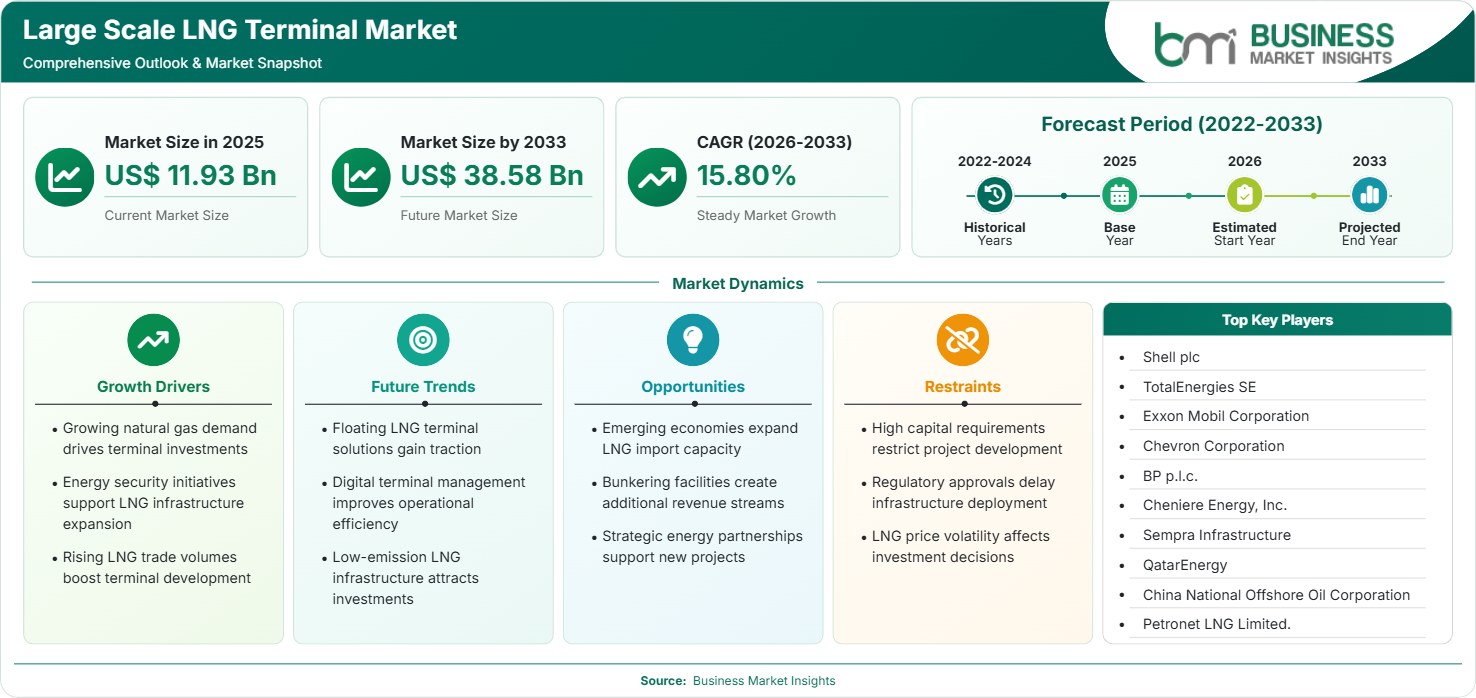
The Large-Scale LNG Terminal Market size was valued at US$ 11.93 Billion in 2025 and is projected to reach US$ 38.58 Billion by 2033, growing at a CAGR of 15.80% during 2026–2033. Rising energy security priorities, expanding LNG trade routes, regasification capacity additions, industrial fuel switching, and investments in low-carbon gas infrastructure continue creating substantial growth opportunities.

Report Coverage
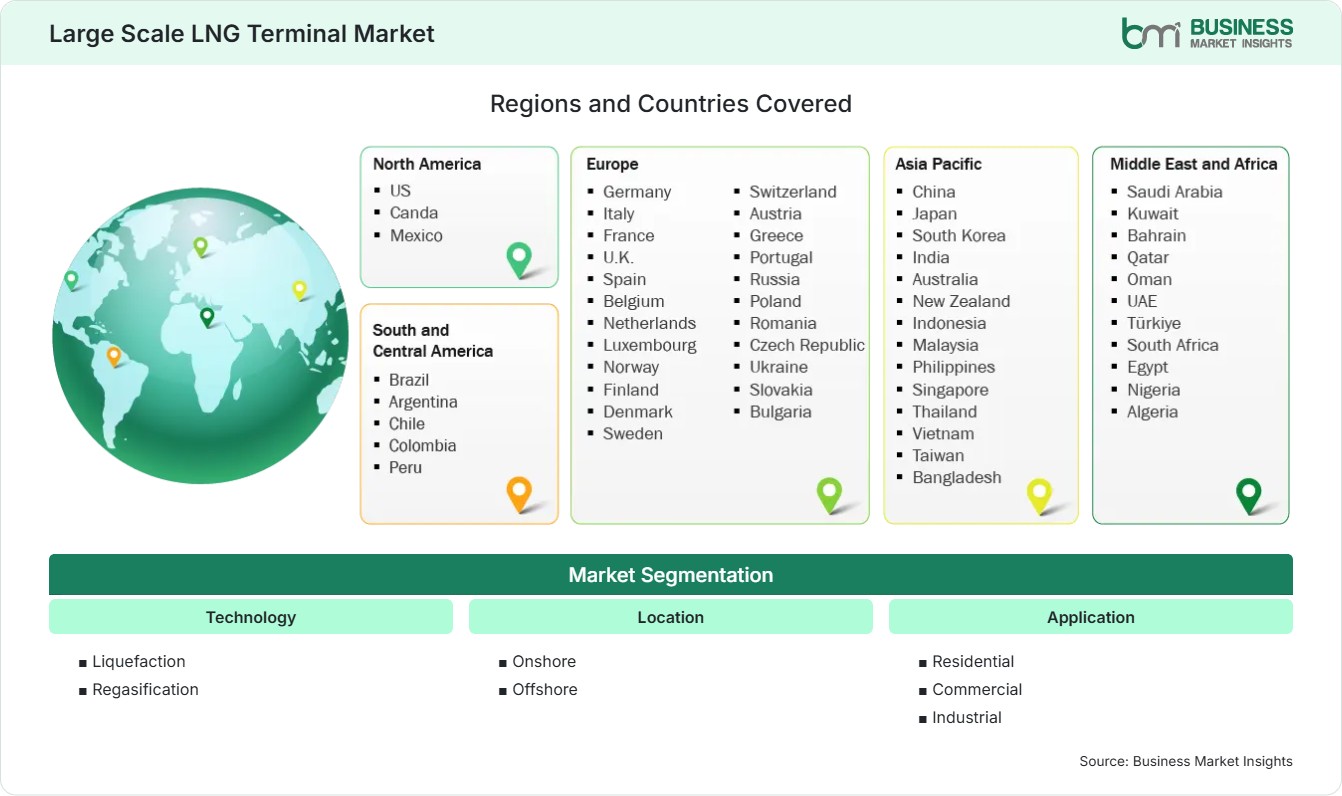
  • Technology: Liquefaction, Regasification
  • Location: Onshore, Offshore
  • Application: Residential, Commercial, Industrial
US$ 11.93 Bn Market size in 2025
US$ 38.58 Bn Market Size by 2033
15.80% CAGR, 2026 - 2033
2026-2033 Forecast Period

AI Overview

Large Scale LNG Terminal Market Summary

  • North America Region: Holds a 34%–37% share of the Large Scale LNG Terminal Market in 2025, growing at a CAGR of 14.2%–15.4% during 2026–2033. Export capacity expansion, shale gas availability, terminal modernization, and long-term supply contracts support growth. Opportunities emerge from Europe-focused LNG exports and Gulf Coast investments. US market remains dominant, supported by export project expansion and a CAGR of 14.5%–15.5%.
  • Fastest Growing Region: Asia Pacific holds a 27%–30% share in 2025, growing at a CAGR of 17.0%–18.5% during 2026–2033. Rising gas demand, coal replacement policies, industrial consumption, and import infrastructure investments strengthen regional expansion opportunities.
  • Leading Segment: Liquefaction accounts for a 54%–58% share in 2025 and advances at a CAGR of 15.0%–16.5% through 2033. Capacity additions, export-oriented infrastructure, efficiency improvements, and long-term off-take commitments drive sustained demand.
  • High Growth Segment: Offshore represents 24%–28% of the Large Scale LNG Terminal Market share in 2025 and grows at a CAGR of 17.5%–19.0% during 2026–2033. Floating infrastructure flexibility, faster deployments, remote resource monetization, and lower land constraints accelerate adoption.
  • Key Market Opportunity: Expansion of LNG import infrastructure across emerging Asian, Middle Eastern, and African economies creates opportunities for developers, equipment suppliers, terminal operators, storage providers, and long-term energy investors worldwide.
  • Major Market Players: Shell plc, TotalEnergies SE, Exxon Mobil Corporation, Chevron Corporation, BP p.l.c., Cheniere Energy, Inc., Sempra Infrastructure, QatarEnergy, China National Offshore Oil Corporation, and Petronet LNG Limited.
Strategic Insights

Large Scale LNG Terminal Market: Strategic Insights

Large Scale LNG Terminal Market Strategic Framework
FREE PDF
Request your free sample
Request free sample
Stakeholder View

Key Takeaways

  • The industry value chain is increasingly integrated, with upstream gas producers, terminal operators, shipping companies, storage providers, and utility buyers forming long-term commercial ecosystems.
  • Industrial users present the strongest growth opportunity as manufacturing, petrochemicals, refining, power generation, and heavy industries accelerate natural gas adoption for cost and emissions advantages.
  • Digitalized terminal management, predictive maintenance platforms, energy efficiency upgrades, and emissions-monitoring technologies are becoming critical investment areas for operators seeking margin improvement.
  • India, Vietnam, Philippines, and several Gulf economies offer compelling infrastructure investment prospects due to rising gas demand and ongoing import terminal development.
  • Strategic acquisitions, capacity expansion projects, and international partnerships continue reshaping competitive positioning as market participants secure supply chains and long-term customer contracts.
  • Floating and offshore terminal solutions are reducing development timelines and enabling resource commercialization in geographically constrained regions.
Geographic Outlook

Large Scale LNG Terminal Market Regional Highlights

North America Large Scale LNG Terminal Market

North America represents the largest regional presence with the Large Scale LNG Terminal Market share estimated at 34%–37% in 2025 and a CAGR of 14.2%–15.4% through 2033. The United States remains the global center of liquefaction investments supported by abundant shale gas resources, export infrastructure expansion, and strong international demand. Canada is increasing participation through new LNG export developments. Regional growth is reinforced by long-term supply agreements, advanced port infrastructure, and energy security demand from European and Asian buyers.

  • Gulf Coast expansion projects continue increasing liquefaction capacity, strengthening export competitiveness and improving international supply diversification.
  • Long-term LNG contracts with European and Asian utilities support infrastructure utilization and investment visibility.
  • Advanced automation and terminal optimization technologies are improving throughput efficiency and operational reliability.
  • Increased focus on low-emission LNG production enhances competitiveness among international buyers.
  • Cross-border pipeline connectivity strengthens feedgas availability for export-oriented facilities.

US Large Scale LNG Terminal Market

The United States accounts for approximately 72%–76% of regional activity and records a CAGR of 14.5%–15.5% through 2033. Large export terminals located along the Gulf Coast continue attracting investment due to competitive gas supplies and increasing global LNG demand. New project approvals, logistics improvements, and long-term contracting enhance the country's leadership position within global gas trade networks while supporting infrastructure expansion and export capacity growth.

  • Export-oriented investments remain concentrated around Louisiana and Texas infrastructure corridors.
  • International buyers increasingly secure long-term volumes from American suppliers to diversify sourcing.
  • Capacity debottlenecking projects improve plant utilization and operational efficiency.
  • Technological upgrades support emissions monitoring and sustainability objectives.

Europe Large Scale LNG Terminal Market

Europe holds a 24%–27% share in 2025 and advances at a CAGR of 15.5%–16.8% through 2033. Regional demand is driven by energy diversification objectives, gas storage requirements, and LNG import infrastructure investment. Germany, the Netherlands, and France remain leading markets, while Eastern European countries demonstrate faster expansion. Growing regasification demand and strategic energy resilience initiatives continue supporting new terminal projects, modernization programs, and storage additions across the region.

  • Germany leads infrastructure additions with sustained investment in LNG reception facilities.
  • Poland and Greece rank among higher-growth countries, supported by regional supply diversification goals.
  • Floating storage and regasification units improve deployment speed and flexibility.
  • Energy security policies continue accelerating infrastructure approvals and funding.
  • Long-term LNG procurement agreements support continued terminal utilization.

Asia Pacific Large Scale LNG Terminal Market

Asia Pacific region holds a 27% to 30% share of global market revenue in 2025 and is a rapidly growing region, with a CAGR of 17.0% to 18.5% during 2025-2033. China, Japan, and South Korea continue to be major LNG consumers, while India and Southeast Asian countries accelerate their infrastructure projects. Increased industrialization, growth in gas-powered electricity generation, and decarbonization drive the positive outlook for the region. Continues to benefit from government-backed gas adoption initiatives and increasing long-term LNG procurement activity.

  • China remains the leading market because of industrial demand and urban gas consumption.
  • India demonstrates among the strongest regional growth rates due to infrastructure expansion.
  • Southeast Asian countries are pursuing LNG imports to supplement domestic energy resources.
  • Industrial fuel-switching programs continue supporting sustained demand growth.
  • New receiving terminals enhance supply reliability across developing economies.

Rest of World Large Scale LNG Terminal Market

The Rest of World segment contributes around 11% to 14% of the revenue and has a CAGR of 16.0% to 17.2% till 2033. The Middle Eastern Large Scale LNG Terminal Market is positively impacted by investments and export-driven capacity additions, and growth in the import capabilities of South and Central American economies. Latin America is dominated by Brazil, but the United Arab Emirates and the growing economies of Africa attract infrastructure investment. Increasing energy demand, industrial development, and power-sector diversification continue to create favorable conditions for terminal deployment.

  • Brazil remains the leading Latin American market due to growing power sector gas consumption.
  • Argentina exhibits strong growth potential through import and gas infrastructure investments.
  • Gulf economies continue expanding LNG export and storage capabilities.
  • African nations increasingly view LNG as a transition fuel supporting electricity access.
  • Strategic partnerships help improve financing accessibility for major terminal developments.
Global Market Geography
FREE PDF
Request your free sample
Request free sample
Segment Analysis

Large Scale LNG Terminal Market Segmentation

Technology

Technology continues to be the leading segment due to rising demand for LNG in international markets and terminal upgrades. The segment holds a 54%-58% market share in 2025 and maintains a 15.0%-16.5% CAGR. The scope of the Large Scale LNG Terminal Market continues to expand due to developments in liquefaction, cryogenic storage, and regasification technologies, platforms designed to meet evolving supply chain and energy security requirements.

  • Liquefaction: Critical for export-oriented infrastructure, enabling natural gas conversion into transportable LNG while supporting cross-border energy trade and long-term commercial contracts.
  • Regasification: Essential for importing economies seeking reliable energy supplies, offering flexibility in power generation, industrial fuel use, and regional gas distribution networks.

Location

The location-based deployment strategy varies from one company to another. Currently, onshore deployment accounts for 72%-76% of the market and records an annual growth rate of 14.8%-16.0%. However, the trend is shifting towards offshore deployment. Current trends in the Large Scale LNG Terminal market indicate that companies are focusing on flexible infrastructure options.

  • Onshore: Favored for large storage capacities, integrated logistics networks, and compatibility with major industrial and utility demand centers.
  • Offshore: Attractive where land constraints exist, offering mobility, faster deployment, and access to remote natural gas resources.

Application

Application requirements continue to diversify across end-use areas. Industrial applications are leading, with a market share of 45%-49% in 2025 and a CAGR of 16.5%-17.8%. The large-scale LNG terminal market size is gaining momentum due to the adoption of natural gas across industries, utilities, and commercial applications.

  • Residential: Supports urban gas distribution networks and household energy consumption, particularly in regions promoting cleaner cooking and heating fuels.
  • Commercial: Gains traction among hospitality, institutional, and service-sector facilities prioritizing energy reliability and environmental performance.
  • Industrial: Driven by energy-intensive industries requiring consistent fuel supply, cost optimization, and emissions reduction initiatives.
Market Forces

Large Scale LNG Terminal Market Dynamics

Key Market Drivers

Expansion of Global LNG Trade Networks

Globally, the LNG market has continued to stimulate demand for large terminals. According to reports from industry bodies such as GIIGNL and the IEA, LNG trading remains buoyed by concerns over security of supply, supply diversification policies, and increased consumption in Asia and Europe. The increase in production capacity among major exporters and the continued construction of regasification facilities among importers lead to greater interstate movement of LNG, which in turn necessitates more LNG storage, terminal upgrades, and the development of new projects. Large scale LNG Terminal Market growth has begun to depend on the geographical diversification of gas supply chains, enabling reliance on pipeline networks while improving flexibility for governments, utilities, and industrial energy consumers.

Industrial Fuel Switching and Decarbonization Programs

There is an increase in natural gas use across the manufacturing, refining, and power plant industries to lower carbon intensity compared with traditional fuel sources. The government's decarbonization policies and sustainability goals have accelerated LNG adoption. It allows industrial companies to combine operational efficiency with emissions targets without compromising energy security. The increasing demand from industries encourages investments in the development of terminals, storage, and transport systems. Developing countries have shown particularly remarkable growth as they seek cleaner ways to grow their industries. Industrial adoption will continue to be a key factor in determining Large Scale LNG Terminal Market trends and dynamics throughout the forecast period.

Government Support for Energy Security Infrastructure

Energy policies in nations are now placing greater emphasis on LNG infrastructure to diversify energy sources. Various nations are implementing policies on permits, infrastructure funding, and public-private partnerships to encourage infrastructure development. Geopolitical issues in energy supply and delivery have made clear the need for flexibility in the design of import-export facilities. With increasing certainty and ease of obtaining permits, the motivation to expand capacity will grow stronger. Investments in strategic infrastructure, which can help increase energy security, are attracting growing interest. Such developments make the environment conducive to infrastructure investments and industrial growth.

Key Market Opportunities

Emerging Market Import Infrastructure Expansion

Several developing countries continue to lag in developing their LNG infrastructure amid rising energy demand. Countries in South Asia, Southeast Asia, Africa, and Latin America have been planning new import terminals to help ensure supply security and industrialization. There are numerous opportunities for investors to be involved in projects related to gas storage, regasification, transportation, and integrated gas distribution. According to Large Scale LNG Terminal Market forecasts, developing countries are set to make increasing contributions to the building of new infrastructure until 2033. Government-backed energy transition programs and multilateral financing support further improve project viability. Early participation offers operators the ability to establish strategic positions before demand reaches higher levels.

Growth of Floating LNG and Offshore Solutions

Floating technology provides an option for installing facilities in areas where on-site space or permit constraints exist. The offshore solution simplifies the construction process and helps access stranded natural gas deposits. Developers enjoy the advantages of simpler construction processes, greater flexibility in relocation, and cost-effective investment programs. Some countries are exploring floating solutions to gain immediate access to natural gas without investing in expensive onshore facilities. With growing technological advances in the industry, the offshore option becomes very attractive for engineering companies, infrastructure financiers, and energy producers.

Digital Terminal Optimization and Automation Platforms

The growing use of digitalization in industry offers possibilities for software vendors and terminal operators. Prediction-based maintenance, AI-driven operation monitoring, automation of safety management, and advanced analysis can minimize downtime and increase efficiency. Large volumes of information are generated within LNG terminals, adding value to digital solutions. To achieve cost efficiency, terminal managers are increasingly interested in adopting technologies to enhance their asset management and carbon footprint tracking. With the increasing importance of sustainability reporting, demand for digital solutions will continue to rise. This environment supports ongoing innovation and technology investment throughout terminal operations.

Market Restraints and Challenges

High Capital Requirements and Long Development Cycles

Factor: Large LNG terminals require substantial upfront capital investments, specialized engineering, storage infrastructure, marine facilities, and regulatory approvals. Impact: Extended development periods increase exposure to financing risks, construction inflation, market volatility, and changing demand assumptions. Developers often face multibillion-dollar commitments before revenue generation begins, creating barriers to entry and limiting participation to financially strong organizations. Complex project execution requirements can result in schedule delays and cost escalation. For emerging markets with constrained financing availability, securing adequate capital remains particularly challenging. These factors collectively slow project realization and increase investment risk across the infrastructure lifecycle.

Regulatory, Environmental, and Community Opposition Risks

Factor: LNG projects frequently undergo extensive environmental assessments, permitting reviews, and stakeholder consultations. Impact: Approval delays, compliance costs, and litigation risks may affect timelines and project economics. Increasing scrutiny of emissions, coastal development, and ecological impacts can lengthen project schedules and increase uncertainty. Community concerns regarding land use, marine activity, and environmental sustainability also influence infrastructure planning. Developers must invest heavily in environmental management, emissions controls, and public engagement initiatives. While these measures improve long-term acceptance, they contribute to higher development costs and operational complexity within the industry.

Company Analysis

Competitive Landscape

Large Scale LNG Terminal Market analysis reveals competition centered on integrated LNG value chains, terminal ownership, export infrastructure, regasification capabilities, and long-term contracting strategies.

Company Name

Overview

Products and Services relevant to this market

Shell plc

Global energy major with extensive LNG trading, liquefaction, shipping, and terminal operations across major markets.

LNG terminal operations, liquefaction projects, storage facilities, LNG trading, and integrated gas infrastructure services.

TotalEnergies SE

Diversified energy company with substantial LNG investments spanning import, export, and floating infrastructure assets.

LNG terminals, regasification services, gas supply agreements, floating LNG projects, and storage solutions.

Exxon Mobil Corporation

Major operator and investor in large-scale LNG export developments and integrated gas projects worldwide.

LNG project development, liquefaction infrastructure, export terminals, gas processing, and commercial LNG supply.

Chevron Corporation

Active participant in global LNG infrastructure through large export projects and strategic partnerships.

Liquefaction facilities, LNG shipping support, storage infrastructure, and long-term energy supply services.

BP p.l.c.

International energy company with LNG trading expertise and involvement across the gas value chain.

LNG procurement, terminal access, gas marketing, storage optimization, and energy trading services.

Cheniere Energy, Inc.

Leading U.S. LNG exporter operating major liquefaction facilities and expansion projects.

LNG export terminals, liquefaction services, storage systems, and long-term LNG supply agreements.

Sempra Infrastructure

Developer and operator focused on North American LNG export and regasification infrastructure.

LNG export terminals, infrastructure development, storage solutions, and project management services.

QatarEnergy

State-owned energy leader overseeing some of the world's largest LNG export assets.

LNG production, liquefaction capacity, terminal management, storage facilities, and international gas supply.

China National Offshore Oil Corporation

Key participant in Asian LNG imports, terminals, and integrated gas infrastructure.

LNG receiving terminals, regasification assets, gas distribution, and storage infrastructure services.

Petronet LNG Limited

Major LNG import and regasification operator supporting India's expanding gas economy.

LNG receiving terminals, regasification services, storage operations, and gas transmission support.

Trust & Transparency

Research Methodology

The market analysis combines proprietary research with secondary data from government agencies, company disclosures, regulatory filings, industry databases and expert interviews. Market estimates are validated through data triangulation, cross-market benchmarking and analyst review.

View Full Research Methodology

Questions Answered

Frequently Asked Questions

Why is the Large Scale LNG Terminal Market Report important for investors?

It provides insight into infrastructure investments, emerging demand centers, regulatory developments, technology adoption patterns, competitive positioning, and long-term growth opportunities shaping industry returns.

What makes Asia Pacific the fastest-growing regional market?

Rapid industrialization, urbanization, increasing gas-fired power generation, coal replacement policies, and extensive import terminal construction collectively support stronger expansion than other regions.

How do offshore LNG terminals differ from onshore facilities?

Offshore facilities provide deployment flexibility, shorter implementation timelines, and access to remote gas resources, while onshore facilities typically offer larger storage capacities and integrated logistics infrastructure.

What application segment creates the strongest long-term demand?

Industrial applications generate the greatest long-term demand due to manufacturing expansion, power generation needs, refining activity, and ongoing decarbonization initiatives across major economies.

What factors are increasing LNG terminal investments worldwide?

Energy security requirements, increasing LNG trade, industrial gas demand, supply diversification strategies, and infrastructure modernization programs are motivating governments and private investors to expand terminal capacity globally.

Access the Full Large Scale LNG Terminal Market Report

Get segment-level forecasts, regional estimates, competitive benchmarking, company profiles and downloadable Excel datasets.

Access the full Large Scale LNG Terminal Market Report
350 pages PDF & Excel | 2026-08-31