
LNG Liquefaction Technology Market Outlook: Size, Share, Trends, Growth Analysis, Competitive Landscape & Forecast, 2026-2033

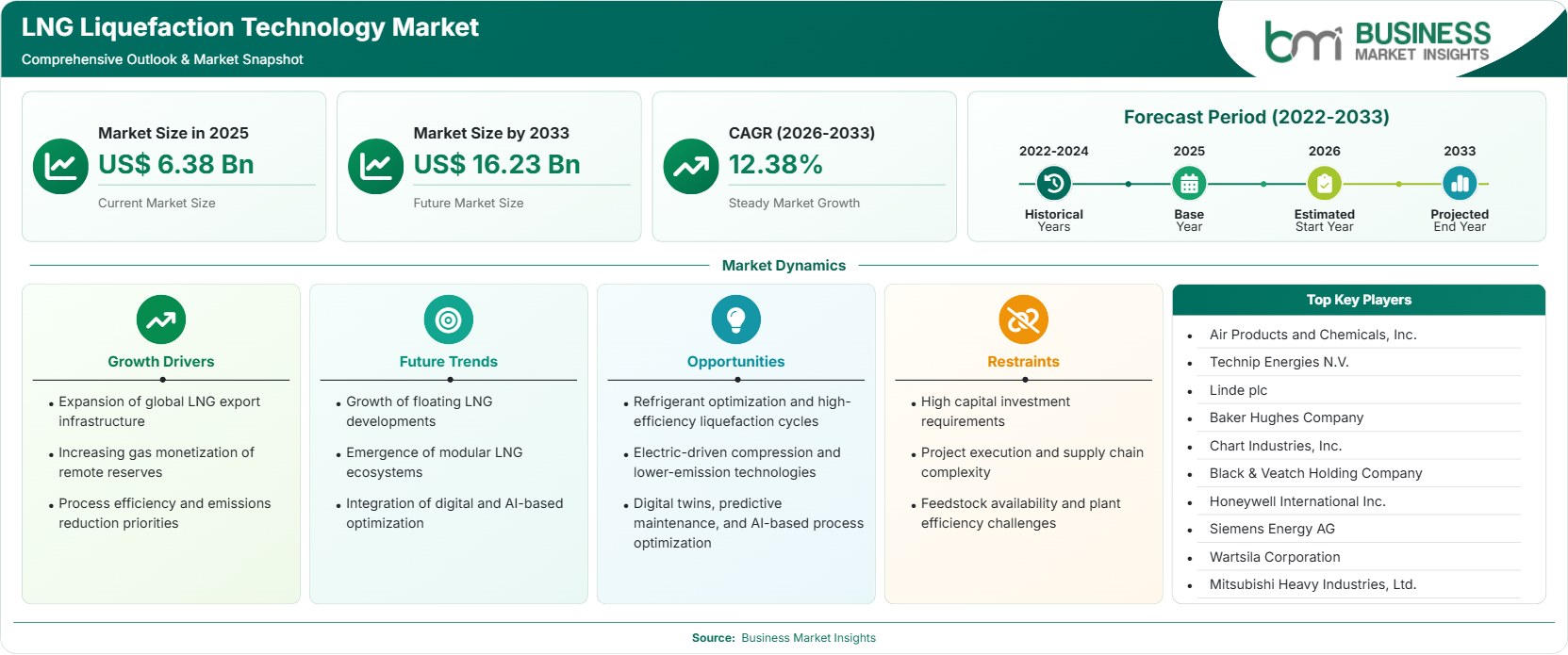
The LNG Liquefaction Technology Market size was valued at US$ 6.38 Billion in 2025 and is projected to reach US$ 16.23 Billion by 2033, growing at a CAGR of 12.38% during 2026–2033. Expansion of LNG export infrastructure, rising natural gas demand, increasing energy security initiatives, growth in FLNG projects, and adoption of modular liquefaction systems are creating substantial technology deployment opportunities globally.

Report Coverage
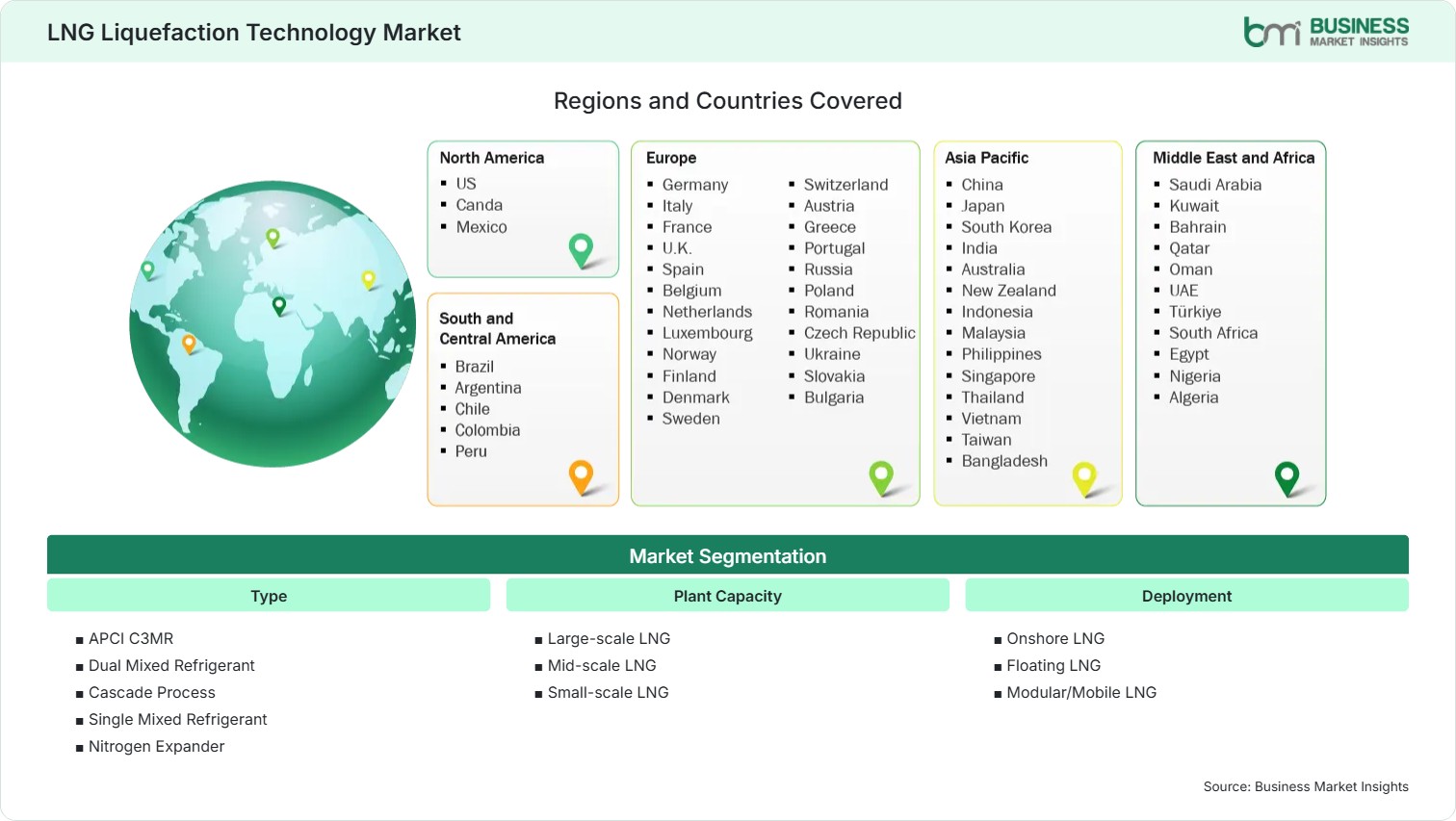
  • Type: APCI C3MR, Dual Mixed Refrigerant, Cascade Process, Single Mixed Refrigerant, Nitrogen Expander
  • Plant Capacity: Large-scale LNG, Mid-scale LNG, Small-scale LNG
  • Deployment: Onshore LNG, Floating LNG, Modular/Mobile LNG
US$ 6.38 Bn Market size in 2025
US$ 16.23 Bn Market Size by 2033
12.38% CAGR, 2026 - 2033
2026-2033 Forecast Period

AI Overview

LNG Liquefaction Technology Market Summary

  • North America Region: North America holds a market share of 34%–37% in 2025, growing with a CAGR of 11.5%–12.5% during 2026–2033, supported by LNG export terminal expansion, shale gas production growth, process efficiency upgrades, carbon management integration, and sustained investment across Gulf Coast liquefaction facilities. The U.S. dominates regional demand, benefiting from export capacity additions and a projected CAGR of 11.8%–12.8%.
  • Fastest Growing Region: Asia Pacific holds a market share of 24%–27% in 2025, growing with a CAGR of 13.5%–14.5% during 2026–2033, driven by increasing energy demand, new import-export infrastructure, industrial gas consumption, supportive government policies, and large-scale LNG project development across emerging economies.
  • Leading Segment: APCI C3MR accounts for 38%–42% share in 2025 and advances at a CAGR of 11.8%–12.8%, supported by proven reliability, operational efficiency, large-scale deployment capability, established engineering ecosystems, lower technical risks, and continued adoption in mega LNG export projects.
  • High Growth Segment: Floating LNG (FLNG) represents 14%–17% share in 2025 and expands at a CAGR of 14.8%–15.8%, supported by offshore gas monetization, reduced infrastructure requirements, remote field development opportunities, deployment flexibility, faster commercialization timelines, and technological progress.
  • Key Market Opportunity: Deployment of modular liquefaction solutions for remote gas reserves, stranded assets, and decentralized energy supply chains is creating scalable investment opportunities through reduced construction timelines and lower capital intensity.
  • Major Market Players: Air Products and Chemicals, Inc.; Technip Energies N.V.; Linde plc; Baker Hughes Company; Chart Industries, Inc.; Black & Veatch Holding Company; Honeywell International Inc.; Siemens Energy AG; Wärtsilä Corporation; Mitsubishi Heavy Industries, Ltd.
Strategic Insights

LNG Liquefaction Technology Market: Strategic Insights

LNG Liquefaction Technology Market Strategic Framework
FREE PDF
Request your free sample
Request free sample
Stakeholder View

Key Takeaways

  • The value chain increasingly integrates gas processing, refrigeration systems, compressors, cryogenic heat exchangers, storage infrastructure, and digital monitoring platforms, creating opportunities for vertically integrated solution providers.
  • Mid-scale and FLNG deployments present attractive growth potential because developers seek lower capital commitments and faster commercialization compared with conventional mega-project developments.
  • Innovation is concentrating on refrigerant optimization, electric-driven compression systems, waste heat recovery, predictive maintenance platforms, and carbon capture integration within liquefaction facilities.
  • Asia Pacific offers a compelling investment environment due to growing gas demand, expanding LNG supply chains, industrialization trends, and government-backed infrastructure investments.
  • Strategic partnerships between technology licensors, EPC contractors, and equipment manufacturers are increasing as project developers seek execution certainty and operational efficiency.
  • Digital twins, advanced analytics, and AI-driven process optimization are becoming important differentiators for improving plant uptime and reducing energy consumption.
Geographic Outlook

LNG Liquefaction Technology Market Regional Highlights

North America LNG Liquefaction Technology Market

North America accounts for 34%–37% LNG Liquefaction Technology Market share in 2025 and is projected to advance at a CAGR of 11.5%–12.5% through 2033. Regional leadership is supported by abundant shale gas resources, large LNG export capacity additions, and strong engineering capabilities. Technology deployments increasingly focus on efficiency enhancement, emissions management, and larger train capacities. New investments across the United States and Canada continue to strengthen technology demand while supporting export-oriented infrastructure development.

  • Expanding Gulf Coast export terminals are increasing demand for advanced refrigeration cycles, high-capacity compressors, and integrated process optimization solutions across newly sanctioned projects.
  • Carbon reduction initiatives encourage the adoption of lower-emission liquefaction designs, including electric drives, carbon capture integration, and enhanced energy efficiency systems.
  • Technology licensors benefit from long-term investments by export operators seeking higher production reliability and reduced lifecycle operating costs.
  • Canadian LNG developments support diversification of regional project activity while creating additional opportunities for process technology suppliers and cryogenic equipment manufacturers.

US LNG Liquefaction Technology Market

The United States represents approximately 78%–82% of North American LNG Liquefaction Technology Market demand in 2025 and is expected to grow at a CAGR of 11.8%–12.8% through 2033. Strong export economics, extensive shale gas availability, and large project pipelines underpin technology adoption. Developers increasingly favor proven liquefaction processes capable of delivering efficiency, operational flexibility, and high throughput. Strong EPC activity continues to support deployment across greenfield and brownfield expansion projects.

  • LNG export capacity expansions continue attracting significant engineering investments, strengthening technology licensing opportunities throughout the value chain.
  • Integration of emissions monitoring and digital optimization platforms improves plant efficiency while addressing environmental performance requirements.
  • Long-term supply agreements support final investment decisions, strengthening project visibility for liquefaction technology providers.
  • Growing industrial demand for lower-carbon fuels reinforces investment confidence across domestic LNG infrastructure.

Europe LNG Liquefaction Technology Market

Europe holds 21%–24% market share in 2025 and is forecast to expand at a CAGR of 11.0%–12.0% through 2033. Energy security priorities and diversification of gas supply chains support technology investments. Norway remains a leading regional market, while Cyprus and other emerging gas-producing areas demonstrate stronger growth momentum with CAGR ranges of 12.5%–13.5%. Efficiency improvements and decarbonization objectives influence technology selection across regional projects.

  • Energy diversification strategies continue driving infrastructure investment and technology modernization across LNG value chains.
  • Norway maintains leadership due to established offshore gas production and advanced liquefaction capabilities.
  • Emerging Eastern Mediterranean projects create opportunities for technology licensors targeting new LNG developments.
  • Environmental regulations encourage deployment of energy-efficient refrigeration cycles and lower-emission operational models.

Asia Pacific LNG Liquefaction Technology Market

Asia Pacific accounts for 24%–27% market share in 2025 and records the highest regional CAGR of 13.5%–14.5% through 2033. Australia leads current technology deployment, while Indonesia and Malaysia represent rapidly expanding opportunities with CAGR ranges of 14.0%–15.0%. Growing energy demand, industrial development, and LNG infrastructure expansion continue attracting major project investments. The region remains a strategic destination for technology innovation and capacity growth.

  • Large LNG investment programs across Australia support demand for advanced liquefaction systems and process upgrades.
  • Emerging Southeast Asian gas monetization initiatives increase opportunities for modular and mid-scale liquefaction technologies.
  • Strong industrialization trends strengthen long-term LNG demand and infrastructure development.
  • Government support for energy diversification encourages investment in new export and processing facilities.
  • Increasing private sector participation accelerates project execution and technology adoption.

Rest of World LNG Liquefaction Technology Market

Rest of World contributes 16%–19% market share in 2025 and is anticipated to grow at a CAGR of 12.5%–13.5% through 2033. The Middle East represents the dominant regional contributor owing to substantial gas reserves and export investments.

South & Central America demonstrate growing project activity, while Qatar and Mozambique remain among the most attractive high-growth markets with CAGR ranges near 13.5%–14.5%. Continuous investments in gas monetization strategies support technology procurement and project development.

  • Qatar continues investing in major LNG expansion programs, stimulating technology licensing demand.
  • Mozambique advances large-scale gas development projects, creating opportunities for advanced liquefaction technologies.
  • South American producers increasingly evaluate LNG infrastructure to monetize regional gas resources.
  • National energy diversification strategies enhance long-term market attractiveness across developing economies.
  • Strategic partnerships between governments and technology companies improve project bankability and execution capabilities.
Global Market Geography
FREE PDF
Request your free sample
Request free sample
Segment Analysis

LNG Liquefaction Technology Market Segmentation

Type

Type segment commands approximately 48%–52% share in 2025 and is anticipated to grow at a CAGR of 12.0%–13.0%. Technology selection depends on plant capacity, efficiency requirements, environmental targets, and project economics. The LNG Liquefaction Technology Market scope continues expanding as operators evaluate flexible refrigeration configurations capable of improving energy performance while supporting both large-scale and modular LNG developments.

  • APCI C3MR: Widely preferred for large export facilities due to operational reliability, strong reference installations, optimized energy consumption, and compatibility with high-capacity LNG production requirements.
  • Dual Mixed Refrigerant (DMR): Gains traction in colder environments where enhanced thermodynamic efficiency improves process performance and supports operational optimization.
  • Cascade Process: Suitable for projects prioritizing reliability and refrigerant separation benefits while maintaining stable long-term production performance.
  • Single Mixed Refrigerant (SMR): Preferred in compact and modular applications because of reduced complexity, lower capital requirements, and flexible deployment scenarios.
  • Nitrogen Expander: Supports smaller facilities and niche applications requiring simplicity, operational safety, and adaptability to varying feed gas conditions.

Plant Capacity

Plant Capacity represents around 31%–35% share in 2025 and is projected to achieve a CAGR of 12.6%–13.6%. Developers increasingly optimize capacity decisions based on project economics, market accessibility, feedstock availability, and infrastructure requirements. Growing diversification of LNG deployment models supports demand across small-scale, mid-scale, and large-scale facilities globally.

  • Large-scale LNG (>5 MTPA): Dominates investment value because of economies of scale, export competitiveness, and strong capacity utilization advantages.
  • Mid-scale LNG (1–5 MTPA): Expands through regional supply projects seeking balanced capital expenditure and operational flexibility.
  • Small-scale LNG (<1 MTPA): Benefits from remote energy applications, transportation fuel demand, and localized gas monetization opportunities.

Deployment

Deployment technologies account for roughly 27%–31% share in 2025 and are expected to expand at a CAGR of 13.4%–14.4%. The LNG Liquefaction Technology Market trends demonstrate growing diversification between conventional onshore facilities and flexible deployment solutions. Project developers increasingly evaluate construction schedules, location constraints, and capital efficiency when determining deployment strategies.

  • Onshore LNG: Maintains leadership due to established infrastructure, large production capacities, and extensive operational experience across global LNG markets.
  • Floating LNG (FLNG): Enables offshore gas monetization while reducing dependence on extensive land-based infrastructure and accelerating commercialization.
  • Modular/Mobile LNG: Supports remote operations through scalable deployment models, faster construction timelines, and lower upfront investment requirements.
Market Forces

LNG Liquefaction Technology Market Dynamics

Key Market Drivers

Expansion of Global LNG Export Infrastructure

Rising LNG export capacity additions across North America, the Middle East, and Asia are accelerating technology demand. Modern liquefaction plants need to be equipped with effective cooling systems, cryogenic heat exchangers, and control technologies. Issues of energy security have prompted importers to pursue diversification of their suppliers and thus have ensured a steady pipeline of projects for the coming years. Trade in LNG continues to grow due to natural gas acting as a transition fuel. This increases investments, which creates new markets for technology suppliers and equipment vendors.

Increasing Gas Monetization of Remote Reserves

Large quantities of stranded and remote natural gas reserves remain commercially underutilized. Governments and energy companies increasingly deploy liquefaction technologies to convert these reserves into transportable LNG products. Modular facilities, FLNG projects, and mid-scale plants provide economically attractive alternatives for resource monetization. Emerging producing countries seek LNG exports to strengthen fiscal revenues and energy sector growth. The LNG Liquefaction Technology Market growth benefits from rising investments targeting undeveloped resources. Technology providers capable of reducing capital intensity and improving project economics are positioned to capture expanding opportunities globally.

Process Efficiency and Emissions Reduction Priorities

Operators increasingly focus on lowering energy consumption and emissions intensity throughout LNG production. State-of-the-art refrigeration systems, digital optimization technologies, electric compression technologies, and carbon capture systems contribute to improving the facility performance. Both investors and regulatory authorities are focusing on sustainability aspects when evaluating the projects. Better efficiency results in lower operational costs and higher competitiveness of LNG in international markets. Innovation is now crucial and no longer an option for companies developing their facilities. The providers that deliver better results are preferred by developers.

Key Market Opportunities

Growth of Floating LNG Developments

Projects under FLNG provide the flexibility to produce gas from offshore sources without building up substantial onshore facilities. This method not only resolves some logistical issues but also provides greater flexibility in the development of offshore sites. Growing discoveries of offshore natural gas reserves in Africa, Asia-Pacific, and Latin America are increasing the number of FLNG projects. Technology licensor companies can make use of this situation. LNG Liquefaction Technology Market Forecasts continue to be influenced by operators seeking shorter development cycles, improved reserve accessibility, and capital optimization through floating production concepts.

Emergence of Modular LNG Ecosystems

Modular facilities provide scalable solutions for distributed energy supply, industrial fuel applications, and regional gas monetization projects. The use of standardized modules decreases engineering complexity and can even result in reduced timeframes of construction as opposed to large-scale, non-standard mega-projects. The rising demand from isolated industries, island countries, and the transportation industry is helping the cause. Providers of technology who are able to provide “plug and play” solutions are being offered access to previously untapped market segments. With evolving financing practices, modularity is becoming more bankable.

Integration of Digital and AI-Based Optimization

Digital transformation creates opportunities to improve plant performance through predictive analytics, machine learning, and digital twin technologies. Process optimization in real time improves throughput, reduces unexpected downtime, and lowers maintenance costs. Data-based asset management solutions are increasingly sought by operators as they work to optimize the performance of their facilities throughout their life cycle. Vendors of technology who offer advanced analytics solutions for liquefaction can create a business opportunity for services and enhance their client loyalty.

Market Restraints and Challenges

High Capital Investment Requirements

Factor: LNG liquefaction facilities require substantial investments in process equipment, storage infrastructure, utilities, and supporting logistics. Impact: High capital cost could cause a delay in the approval of a project and prevent small developers from participating in such a project. The issues of financing are accentuated further during instances when there is uncertainty in the markets or in the interest rates, or an uncertain gas demand scenario. Cost overruns are also possible in complex projects involving large-scale engineering work.

Project Execution and Supply Chain Complexity

Factor: LNG developments depend on specialized equipment, engineering expertise, and globally distributed supply chains. Impact: Delays in deliveries, lack of manpower, or obtaining permits may impact the timing and viability of the project. With the increased competition in cryogenic technology and skilled technical personnel, there is even more risk. Geopolitics and trade limitations may impact procurement decisions and project cost structures. The above-mentioned problems need to be well coordinated and may impact the growth of the market, especially if the project is located in undeveloped areas.

Company Analysis

Competitive Landscape

The competitive environment is characterized by established technology licensors, engineering specialists, and equipment manufacturers. LNG Liquefaction Technology Market analysis indicates that efficiency improvements, emissions reduction capabilities, and project execution expertise remain key competitive differentiators.

Company Name

Overview

Products and Services relevant to this market

Air Products and Chemicals, Inc.

Leading provider of LNG process technologies with extensive global project references and long-standing expertise in liquefaction innovation.

APCI liquefaction processes, cryogenic heat exchangers, refrigeration technology, engineering support, and operational optimization solutions.

Technip Energies N.V.

Global engineering and technology company supporting complex LNG facilities across multiple geographies.

LNG process technologies, engineering services, FLNG expertise, project execution, and integrated facility design solutions.

Linde plc

Industrial gas and engineering specialist with strong cryogenic technology capabilities and global project footprint.

Liquefaction processes, cryogenic equipment, gas processing systems, engineering design, and efficiency enhancement solutions.

Baker Hughes Company

Energy technology provider focused on LNG infrastructure and process equipment innovation.

Compressors, turbines, digital monitoring systems, rotating equipment, and liquefaction technology support services.

Chart Industries, Inc.

Specialized manufacturer of cryogenic equipment serving global LNG value chains.

Heat exchangers, storage systems, cryogenic processing equipment, and LNG infrastructure technologies.

Black & Veatch Holding Company

Engineering and consulting organization supporting LNG project development and deployment.

LNG facility engineering, modular solutions, project management, and infrastructure design services.

Honeywell International Inc.

Technology company providing automation and process optimization capabilities for industrial facilities.

Control systems, industrial software, process automation, analytics platforms, and operational technologies.

Siemens Energy AG

Global energy technology company serving LNG projects through advanced equipment and digital platforms.

Compressors, turbines, electrical systems, digitalization solutions, and plant efficiency technologies.

Wärtsilä Corporation

Energy and marine solutions provider expanding LNG infrastructure support capabilities globally.

LNG plant solutions, modular energy systems, engineering services, and operational optimization offerings.

Mitsubishi Heavy Industries, Ltd.

Diversified industrial company active in advanced energy infrastructure and LNG technologies.

Compressors, turbomachinery, engineering technology, energy systems, and process equipment solutions.

Trust & Transparency

Research Methodology

The market analysis combines proprietary research with secondary data from government agencies, company disclosures, regulatory filings, industry databases and expert interviews. Market estimates are validated through data triangulation, cross-market benchmarking and analyst review.

View Full Research Methodology

Questions Answered

Frequently Asked Questions

What does this LNG Liquefaction Technology Market Report evaluate?

The study examines technology categories, deployment models, plant capacities, regional dynamics, competitive positioning, strategic opportunities, investment patterns, innovation trends, and future growth prospects through 2033.

Which regions offer the strongest long-term opportunities?

Asia Pacific, the Middle East, and selected African markets present compelling opportunities due to gas resource development, industrial demand growth, and significant LNG infrastructure investment pipelines.

How do modular liquefaction systems benefit project developers?

Modular systems reduce construction complexity, improve scalability, accelerate deployment, and support economically viable development of smaller gas resources or distributed LNG supply networks.

Which deployment model is experiencing the fastest growth?

Floating LNG solutions are recording strong expansion because they enable offshore resource development, reduce onshore infrastructure dependency, and improve commercialization flexibility for remote gas reserves.

What factors are driving adoption of advanced LNG liquefaction technologies?

Growing LNG trade, energy security initiatives, emissions reduction targets, and demand for efficient gas monetization encourage deployment of modern liquefaction technologies across export, industrial, and offshore applications.

Access the Full LNG Liquefaction Technology Market Report

Get segment-level forecasts, regional estimates, competitive benchmarking, company profiles and downloadable Excel datasets.

Access the full LNG Liquefaction Technology Market Report
350 pages PDF & Excel | 2026-09-02