
Hydrogen Liquefaction Equipment Market Outlook: Size, Share, Trends, Growth Analysis, Competitive Landscape & Forecast, 2026–2033

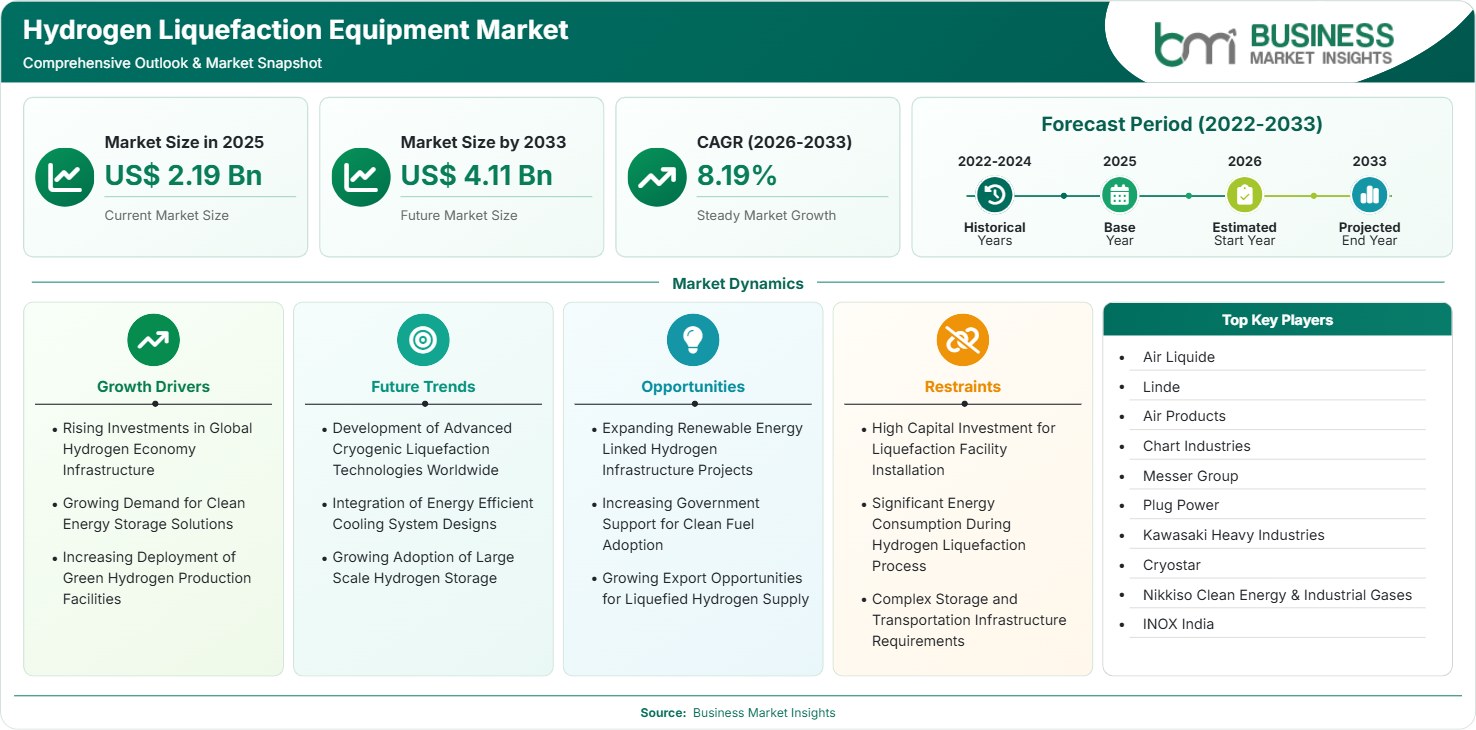
The Hydrogen Liquefaction Equipment Market size was valued at US$ 2.19 billion in 2025 and is projected to reach US$ 4.11 billion by 2033, growing at a CAGR of 8.19% during 2026–2033, driven by hydrogen infrastructure expansion, clean energy investments, renewable hydrogen projects, and increasing demand for efficient hydrogen storage and transportation solutions.

Report Coverage
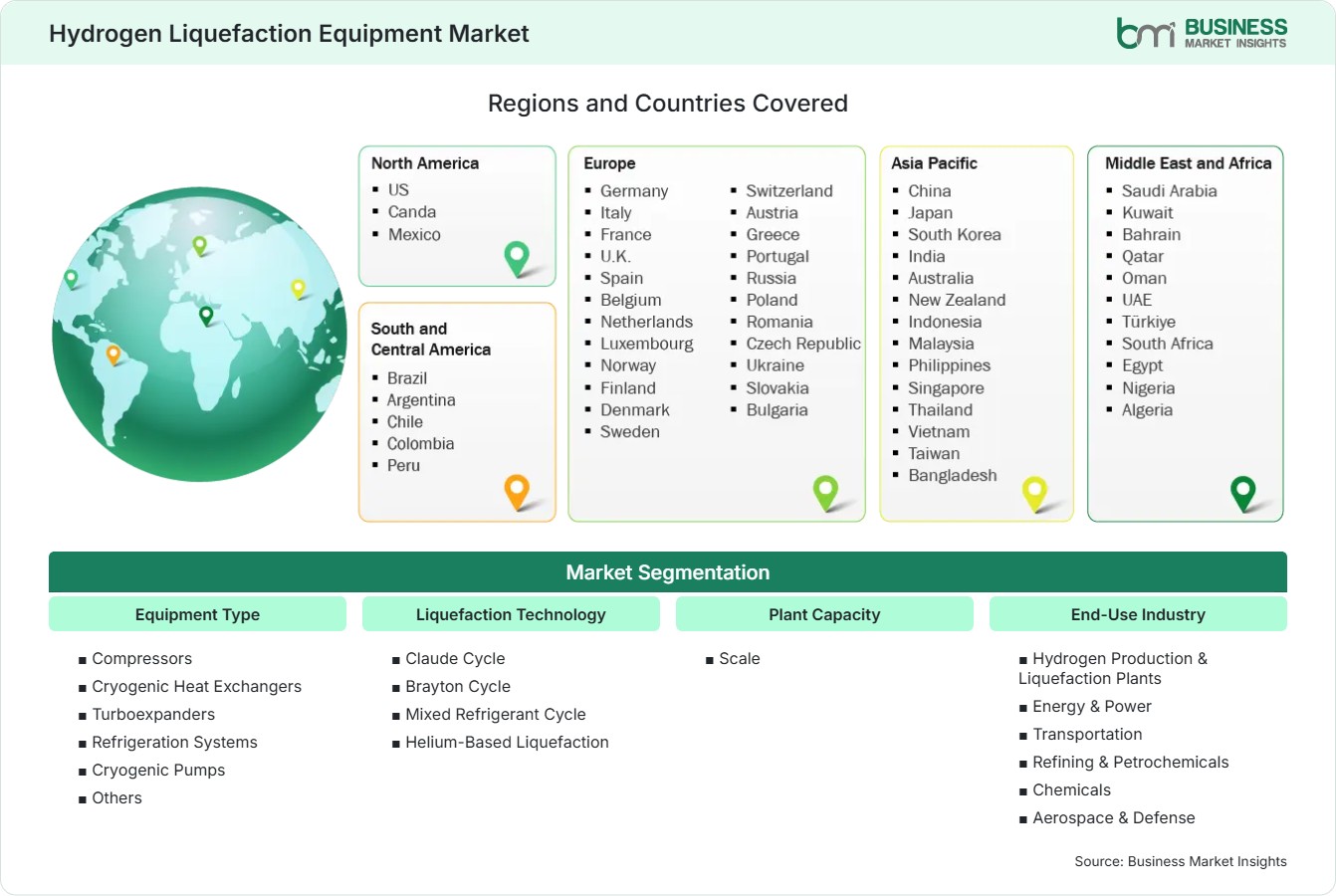
  • Equipment Type: Compressors, Cryogenic Heat Exchangers, Turboexpanders, Refrigeration Systems, Cryogenic Pumps, Others
  • Liquefaction Technology: Claude Cycle, Brayton Cycle, Mixed Refrigerant Cycle, Helium-Based Liquefaction
  • Plant Capacity: Scale
  • End-Use Industry: Hydrogen Production & Liquefaction Plants, Energy & Power, Transportation, Refining & Petrochemicals, Chemicals, Aerospace & Defense
US$ 2.19 Bn Market size in 2025
US$ 4.11 Bn Market Size by 2033
8.19% CAGR, 2026 - 2033
2026-2033 Forecast Period

AI Overview

Hydrogen Liquefaction Equipment Market Summary

  • North America Region: North America holds a 30%–33% share in 2025 and is projected to grow at a 7.8%–8.4% CAGR during 2026–2033. Growth is supported by hydrogen hub development, clean energy initiatives, industrial decarbonization programs, and investments in hydrogen production infrastructure. The U.S. market benefits from expanding low-carbon hydrogen projects, federal clean energy programs, and increasing demand for hydrogen mobility applications.
  • Fastest Growing Region: Asia Pacific represents a 35%–38% share in 2025 and is expected to expand at a 8.8%–9.5% CAGR during 2026–2033. Growth is driven by large-scale hydrogen projects, renewable energy integration, industrial demand, and government-backed hydrogen economy strategies across China, Japan, South Korea, and India.
  • Leading Segment: Cryogenic heat exchangers account for a 25%–29% share in 2025 and are projected to grow at a 7.9%–8.5% CAGR during 2026–2033. Demand is supported by their critical role in achieving ultra-low temperatures required for hydrogen liquefaction processes.
  • High Growth Segment: Transportation applications represent a 15%–18% share in 2025 and are expected to grow at a 9.0%–9.7% CAGR during 2026–2033. Increasing adoption of hydrogen-powered vehicles and development of fueling infrastructure are supporting segment expansion.
  • Key Market Opportunity: Expansion of renewable hydrogen projects, international hydrogen supply chains, and government-supported clean fuel initiatives is creating opportunities for equipment providers developing efficient, scalable, and energy-optimized liquefaction systems.
  • Major Market Players: Air Liquide, Linde, Air Products, Chart Industries, Messer Group, Plug Power, Kawasaki Heavy Industries, Cryostar, Nikkiso Clean Energy & Industrial Gases, and INOX India.
Strategic Insights

Hydrogen Liquefaction Equipment Market: Strategic Insights

Hydrogen Liquefaction Equipment Market Strategic Framework
FREE PDF
Request your free sample
Request free sample
Stakeholder View

Key Takeaways

  • The market value chain includes equipment manufacturers, hydrogen producers, energy companies, technology providers, infrastructure developers, and end users working together to establish hydrogen supply networks.
  • Large-scale hydrogen production facilities, transportation infrastructure, and export-oriented hydrogen projects represent attractive growth opportunities for companies developing advanced liquefaction solutions.
  • Technology innovation is focusing on improving energy efficiency, reducing operational complexity, enhancing cryogenic performance, and developing scalable liquefaction systems.
  • Asia Pacific presents strong investment potential due to government-led hydrogen strategies, industrial demand, and increasing renewable energy integration initiatives.
  • Strategic partnerships between equipment suppliers, energy companies, and infrastructure developers are becoming important for accelerating hydrogen ecosystem development.
  • Companies investing in efficient liquefaction technologies and integrated hydrogen solutions are positioned to benefit from increasing global focus on clean energy transition.
Geographic Outlook

Hydrogen Liquefaction Equipment Market Regional Highlights

North America Hydrogen Liquefaction Equipment Market

North America maintains a strong position due to hydrogen infrastructure investments, industrial decarbonization efforts, and clean energy development programs. The region accounted for 30%–33% share in 2025 and is expected to grow at a 7.8%–8.4% CAGR through 2033. Hydrogen Liquefaction Equipment Market share is influenced by hydrogen hub projects, energy transition initiatives, and increasing demand for clean fuel infrastructure.

  • The United States is developing hydrogen infrastructure through industrial projects and clean energy investment programs.
  • Energy companies are increasing focus on hydrogen production, storage, and transportation capabilities.
  • Equipment providers are developing advanced cryogenic systems to support large-scale hydrogen applications.
  • Industrial users are exploring hydrogen solutions for reducing emissions across energy-intensive sectors.

US Hydrogen Liquefaction Equipment Market

The U.S. represents a major North American market supported by clean hydrogen initiatives, industrial demand, and expanding hydrogen infrastructure projects. The country contributes 70%–75% of regional demand and is projected to grow at a 7.9%–8.5% CAGR during 2026–2033. Federal support and private investments are encouraging hydrogen ecosystem development.

  • Hydrogen hubs and clean energy projects are increasing demand for liquefaction infrastructure.
  • Transportation applications are supporting investment in hydrogen fueling networks.
  • Industrial companies are adopting hydrogen solutions to support emission reduction strategies.

Europe Hydrogen Liquefaction Equipment Market

Europe demonstrates steady growth due to strong decarbonization policies, renewable energy integration, and hydrogen economy development strategies. The region represents a 22%–25% share in 2025 and is expected to grow at a 7.5%–8.2% CAGR through 2033. Germany, France, the Netherlands, and the United Kingdom are leading markets due to hydrogen infrastructure investments.

  • European governments are supporting hydrogen projects through clean energy policies and funding programs.
  • Industrial sectors are adopting hydrogen solutions for reducing carbon emissions.
  • Cross-border hydrogen supply initiatives are encouraging infrastructure development.
  • Equipment manufacturers are collaborating with energy companies on large-scale projects.

Asia Pacific Hydrogen Liquefaction Equipment Market

Asia Pacific represents the fastest-growing regional market due to large-scale hydrogen investments, industrial demand, and government-backed clean energy programs. The region accounted for 35%–38% share in 2025 and is projected to grow at a 8.8%–9.5% CAGR through 2033. China, Japan, South Korea, and India are major markets supporting hydrogen infrastructure expansion.

  • Japan and South Korea are advancing hydrogen mobility and import infrastructure projects.
  • China is increasing hydrogen investments across industrial and energy applications.
  • Renewable energy expansion is supporting green hydrogen production opportunities.
  • Regional companies are developing hydrogen supply chains for future energy requirements.

Rest of World Hydrogen Liquefaction Equipment Market

Latin America, the Middle East, and Africa are emerging markets due to renewable energy potential, export opportunities, and increasing hydrogen investments. The region represents a 8%–11% share in 2025 and is projected to grow at a 7.0%–7.8% CAGR through 2033. Countries with renewable resources are developing hydrogen export strategies.

  • Middle Eastern countries are investing in hydrogen projects linked with renewable energy resources.
  • Latin American markets are exploring hydrogen exports supported by renewable electricity availability.
  • African nations are developing hydrogen initiatives targeting international energy markets.
  • Infrastructure development remains important for expanding regional hydrogen adoption.
Global Market Geography
FREE PDF
Request your free sample
Request free sample
Segment Analysis

Hydrogen Liquefaction Equipment Market Segmentation

Equipment Type

Equipment type segmentation is influenced by the technical requirements of hydrogen liquefaction facilities, including temperature control, compression efficiency, and cryogenic handling capabilities. The segment is expanding as operators invest in advanced systems that improve reliability, energy efficiency, and large-scale hydrogen processing performance. Equipment innovation is supporting broader adoption across industrial hydrogen projects.

  • Compressors: Essential for hydrogen compression stages, supporting pressure management and efficient liquefaction operations.
  • Cryogenic Heat Exchangers: Critical components enabling ultra-low temperature cooling during hydrogen liquefaction processes.
  • Turboexpanders: Support efficient cooling cycles by converting expansion energy into temperature reduction.
  • Refrigeration Systems: Provide cooling capacity required for maintaining cryogenic operating conditions.
  • Cryogenic Pumps: Enable safe transfer and handling of liquefied hydrogen within facilities.
  • Others [Cold Boxes, Valves, Insulation Systems]: Includes supporting components improving safety, thermal efficiency, and operational reliability.

Liquefaction Technology

Liquefaction technology segmentation reflects ongoing advancements in cryogenic engineering, energy optimization, and process efficiency. Different technologies are selected based on plant capacity, operational requirements, and energy consumption considerations. The Hydrogen Liquefaction Equipment Market trend indicates increasing focus on advanced cycles that reduce energy intensity and improve scalability.

  • Claude Cycle: Widely used technology offering efficient cooling through expansion and refrigeration processes.
  • Brayton Cycle: Applied for cryogenic cooling with improved flexibility and operational control.
  • Mixed Refrigerant Cycle: Supports efficient temperature management through combined refrigerant systems.
  • Helium-Based Liquefaction: Used in specialized applications requiring advanced cryogenic performance.

Plant Capacity

Plant capacity segmentation is shaped by increasing demand for centralized hydrogen production, storage, and distribution infrastructure. Large-scale facilities are gaining attention as industries seek efficient hydrogen supply networks. The Hydrogen Liquefaction Equipment Market scope is expanding through investments in export terminals, mobility infrastructure, and industrial hydrogen applications.

  • Scale [<10 TPD to >50 TPD]: Covers small, medium, and large liquefaction facilities based on production requirements and infrastructure needs.

End-Use Industry

End-use industry segmentation reflects growing hydrogen adoption across energy, transportation, industrial, and specialized applications. Companies are investing in liquefaction equipment to support hydrogen storage, mobility solutions, and decarbonization initiatives. Increasing demand from multiple industries is encouraging equipment providers to develop flexible and scalable systems.

  • Hydrogen Production & Liquefaction Plants: Supports large-scale hydrogen generation, processing, and distribution infrastructure.
  • Energy & Power: Enables hydrogen integration into clean energy storage and power generation systems.
  • Transportation: Supports hydrogen mobility through efficient storage and fueling infrastructure development.
  • Refining & Petrochemicals: Helps industries reduce emissions through hydrogen-based processing applications.
  • Chemicals: Provides hydrogen handling solutions for industrial chemical production processes.
  • Aerospace & Defense: Supports specialized hydrogen applications requiring reliable cryogenic technologies.
Market Forces

Hydrogen Liquefaction Equipment Market Dynamics

Key Market Drivers

Rising Investments in Global Hydrogen Economy Infrastructure

Greater investments in hydrogen infrastructure have driven the need for efficient liquefaction equipment that is efficient. Countries, oil and gas firms, and other organizations are setting up hydrogen ecosystems to achieve decarbonization and diversification of energy sources. Such large-scale projects call for cryogenic technologies that ensure operational efficiency and safety. There are many factors driving the Hydrogen Liquefaction Equipment Market growth, including greater infrastructure development, cross-border hydrogen projects, and increased emphasis on carbon-neutral energy. Manufacturers of such equipment are meeting the growing demands of hydrogen projects by providing scalable, efficient equipment.

Growing Demand for Clean Energy Storage Solutions

The increased use of renewable energy has led to a greater focus on hydrogen as a means of storing energy for longer periods. Liquid hydrogen makes transportation and storage easier than gaseous hydrogen in certain cases, facilitating integration into energy systems. Energy firms are developing hydrogen storage systems to manage fluctuations in renewable energy and increase their flexibility. The construction of renewable hydrogen facilities promotes the development of liquefaction equipment that could be applied in future energy systems. There is a growing emphasis on energy security and clean fuels in the energy sector, which is driving demand for cryogenics.

Increasing Deployment of Green Hydrogen Production Facilities

An increase in hydrogen manufacturing units will create a need for more sophisticated liquefaction systems capable of handling greater volumes of hydrogen. Projects that involve renewable-powered electrolysis are being built in places that have high potential for clean energy generation. Such plants will need specialized machinery to liquefy the hydrogen. The increasing use of green hydrogen is prompting more investment in manufacturing and liquefaction technology. The companies are now focusing on improving process efficiency, reducing energy consumption, and building durable machinery. Greater industrial focus on low-carbon hydrogen is providing opportunities for liquefaction technology providers.

Key Market Opportunities

Expanding Renewable Energy Linked Hydrogen Infrastructure Projects

With the rise in renewable energy investments, there is an increasing opportunity for hydrogen infrastructure projects linked to solar, wind, and other renewable energy sources. Nations endowed with renewable energy resources are constructing hydrogen plants to meet their own needs and for export. This necessitates effective liquefaction facilities to help store and transport hydrogen over longer distances. Companies can get an opportunity to provide systems in accordance with their capacity. There is an opportunity for companies to partner with energy firms and government agencies to create renewable hydrogen corridors. The growing demand for hydrogen projects provides companies with opportunities to sell their cryogenic equipment.

Increasing Government Support for Clean Fuel Adoption

Government initiatives related to the usage of clean fuels are providing good prospects for hydrogen infrastructure development. Through government initiatives, businesses are being encouraged to make use of hydrogen. Manufacturers of liquefaction equipment can capitalize on an increase in government-backed projects. According to the Hydrogen Liquefaction Equipment Market forecast, there are strong growth prospects driven by hydrogen-related policies and the adoption of hydrogen across sectors such as transportation and energy. With the help of government initiatives, technology development, and commercial hydrogen use, these will become more common.

Growing Export Opportunities for Liquefied Hydrogen Supply

Rising international interest in hydrogen trade is creating opportunities for liquefaction equipment providers supporting export-oriented infrastructure. Countries with renewable energy advantages are developing projects aimed at supplying hydrogen to regions with high energy demand. Liquefied hydrogen enables long-distance transportation and supports development of global hydrogen supply chains. Export terminals, storage facilities, and transportation networks require specialized cryogenic equipment. Companies providing reliable liquefaction solutions can participate in emerging international hydrogen projects. Growing collaboration between energy producers and importing countries is accelerating infrastructure planning. These developments are expanding opportunities for equipment manufacturers involved in hydrogen export ecosystems.

Market Restraints and Challenges

High Capital Investment for Liquefaction Facility Installation

Factor: Hydrogen liquefaction facilities require significant capital expenditure due to advanced cryogenic equipment, specialized infrastructure, and complex engineering requirements. Impact: High installation costs can delay project development, restrict adoption among smaller operators, and increase financial challenges during early deployment stages. Companies are addressing this challenge through technology optimization, modular systems, and improved project planning approaches. Reducing upfront costs remains important for accelerating hydrogen infrastructure expansion. Equipment manufacturers are focusing on standardized designs and operational improvements to enhance project feasibility. Lowering investment barriers will be essential for wider commercialization of hydrogen liquefaction technologies.

Significant Energy Consumption During Hydrogen Liquefaction Process

Factor: Hydrogen liquefaction requires substantial energy input due to the extremely low temperatures needed for converting hydrogen into liquid form. Impact: High energy consumption can increase operational costs and affect the overall efficiency of hydrogen supply chains. Manufacturers are developing improved cooling technologies, optimized process cycles, and energy-efficient equipment designs to address this challenge. Integration with renewable energy sources can help reduce environmental impact and improve sustainability. Companies are focusing on technological innovation to lower energy requirements while maintaining reliable liquefaction performance. Improving efficiency remains critical for expanding the commercial viability of hydrogen liquefaction systems.

Company Analysis

Competitive Landscape

The Hydrogen Liquefaction Equipment Market analysis highlights increasing competition among industrial gas companies, cryogenic technology providers, and clean energy solution developers. Leading players are focusing on advanced liquefaction technologies, energy-efficient equipment designs, integrated hydrogen infrastructure solutions, and strategic collaborations to support large-scale hydrogen production, storage, and transportation projects worldwide.

Company Name

Overview

Products and Services relevant to this market

Air Liquide

Global industrial gases company providing hydrogen technologies and clean energy solutions.

Offers hydrogen liquefaction systems, cryogenic technologies, industrial gas infrastructure, and hydrogen mobility solutions.

Linde

Industrial gas and engineering company specializing in hydrogen production and processing technologies.

Provides hydrogen liquefaction plants, cryogenic equipment, gas processing systems, and engineering services.

Air Products

Global hydrogen technology provider focused on clean energy and industrial gas applications.

Develops hydrogen production solutions, liquefaction technologies, cryogenic systems, and hydrogen infrastructure projects.

Chart Industries

Engineering company specializing in cryogenic equipment and clean energy technologies.

Supplies hydrogen liquefaction equipment, cryogenic heat exchangers, storage systems, and hydrogen infrastructure solutions.

Messer Group

Industrial gases company serving energy, manufacturing, and technology industries globally.

Provides hydrogen handling solutions, industrial gas systems, cryogenic technologies, and related equipment.

Plug Power Inc.

Clean hydrogen solutions company developing hydrogen production and infrastructure technologies.

Offers hydrogen generation systems, storage solutions, fueling infrastructure, and clean energy technologies.

Kawasaki Heavy Industries

Japanese industrial company developing hydrogen supply chain and energy technologies.

Provides hydrogen liquefaction technologies, cryogenic equipment, storage solutions, and hydrogen transportation systems.

Cryostar

Cryogenic equipment manufacturer specializing in gas processing applications.

Supplies cryogenic pumps, expanders, compressors, and hydrogen liquefaction-related equipment.

Nikkiso Clean Energy & Industrial Gases

Provider of clean energy and cryogenic equipment solutions for industrial applications.

Offers hydrogen fueling systems, cryogenic pumps, storage equipment, and liquefied gas technologies.

INOX India

Cryogenic equipment manufacturer supplying solutions for industrial gas applications.

Provides cryogenic tanks, gas handling equipment, storage systems, and hydrogen-related infrastructure solutions.

Trust & Transparency

Research Methodology

The market analysis combines proprietary research with secondary data from government agencies, company disclosures, regulatory filings, industry databases and expert interviews. Market estimates are validated through data triangulation, cross-market benchmarking and analyst review.

View Full Research Methodology

Questions Answered

Frequently Asked Questions

What does the Hydrogen Liquefaction Equipment Market report indicate about future competition?

The report indicates that competition will focus on energy efficiency, large-scale project capabilities, advanced cryogenic technologies, and integrated hydrogen solutions. Companies developing cost-effective systems and strengthening partnerships across the hydrogen value chain are expected to improve their market positioning.

Why are renewable hydrogen projects creating new opportunities for liquefaction equipment?

Renewable hydrogen projects are creating opportunities because they require scalable storage and transportation solutions. Liquefied hydrogen enables movement of hydrogen across longer distances, supporting international supply chains and improving integration of renewable energy resources.

How are advanced technologies influencing hydrogen liquefaction adoption?

Advanced technologies are improving adoption through more efficient cryogenic systems, optimized cooling cycles, improved heat exchanger designs, and digital monitoring capabilities. These developments help reduce operational challenges and enhance the reliability of hydrogen liquefaction facilities.

Which applications present the strongest opportunity in the market?

Hydrogen production plants, transportation infrastructure, energy storage systems, and industrial decarbonization projects represent strong opportunities. These applications require advanced liquefaction technologies to support large-scale hydrogen handling, distribution, and integration into emerging clean energy networks.

What factors are improving Hydrogen Liquefaction Equipment Market return on investment?

Increasing hydrogen infrastructure investments, clean energy transition initiatives, renewable hydrogen projects, and demand for efficient storage solutions are improving return on investment. Liquefaction equipment enables reliable hydrogen transportation and storage, supporting industrial, energy, and mobility applications.

Access the Full Hydrogen Liquefaction Equipment Market Report

Get segment-level forecasts, regional estimates, competitive benchmarking, company profiles and downloadable Excel datasets.

Access the full Hydrogen Liquefaction Equipment Market Report
350 pages PDF & Excel | 2026-08-25