
Blue Hydrogen Market Outlook: Size, Share, Trends, Growth Analysis, Competitive Landscape & Forecast, 2026-2033

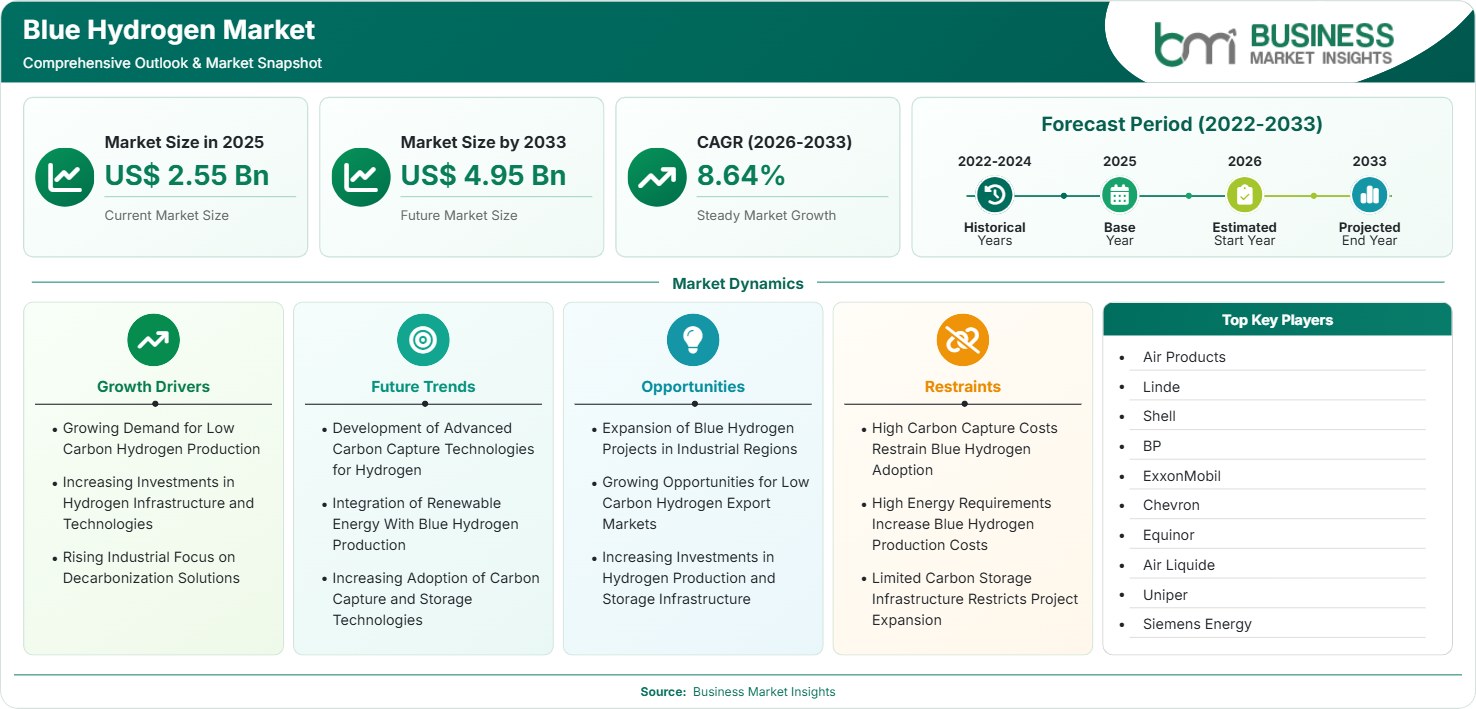
The Blue Hydrogen Market size was valued at US$ 2.55 billion in 2025 and is projected to reach US$ 4.95 billion by 2033, growing at a CAGR of 8.64% during 2026–2033. The market is being supported by increasing demand for low-carbon hydrogen, investments in carbon capture infrastructure, industrial decarbonization initiatives, and the development of hydrogen production and storage networks.

Report Coverage
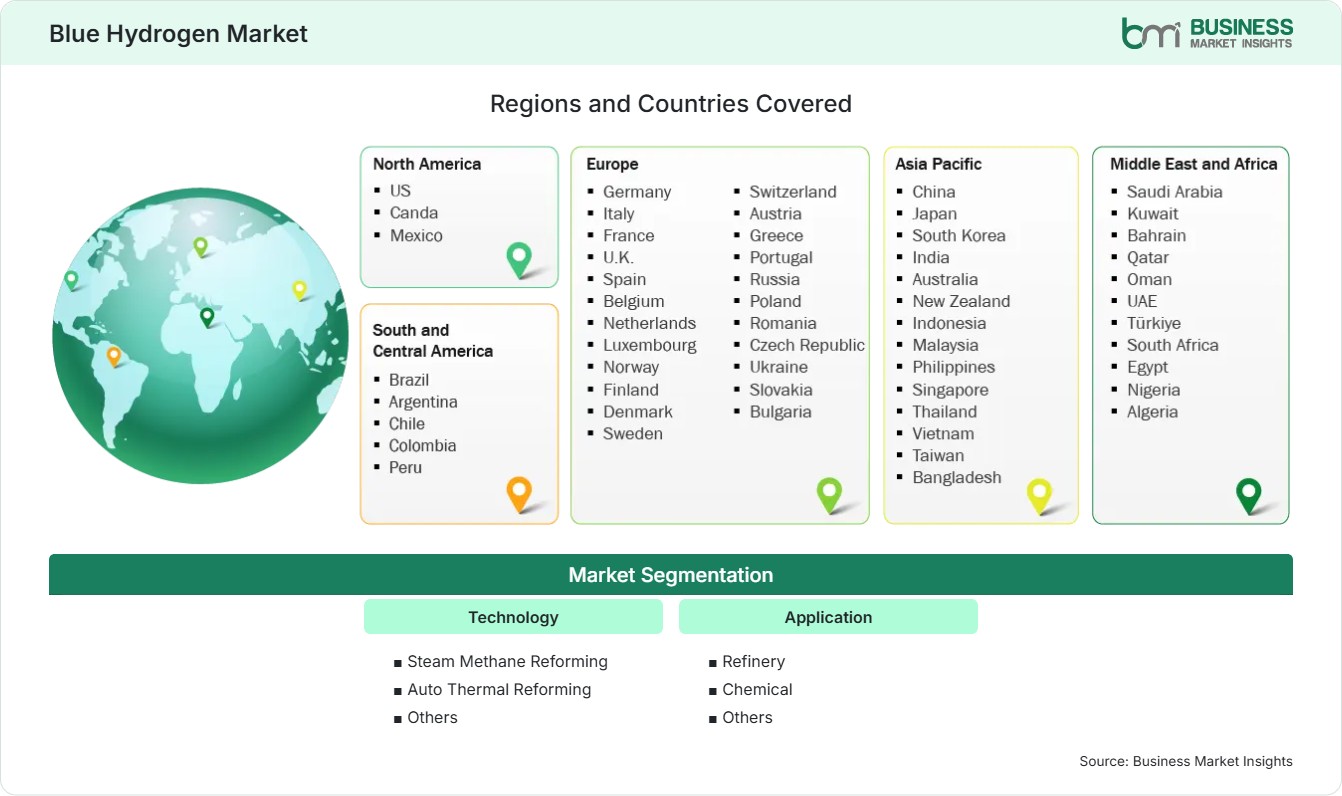
  • Technology: Steam Methane Reforming, Auto Thermal Reforming, Others
  • Application: Refinery, Chemical, Others
US$ 2.55 Bn Market size in 2025
US$ 4.95 Bn Market Size by 2033
8.64% CAGR, 2026 - 2033
2026-2033 Forecast Period

01 AI Overview

Blue Hydrogen Market Summary

  • North America Region: North America , 35%–39% share (2025) , 8.0%–9.0% CAGR (2026–2033) , Strong natural gas availability, carbon capture development, industrial demand, and government support for hydrogen infrastructure create favorable conditions.
  • Fastest Growing Region: Asia Pacific , 9.5%–10.5% CAGR (2026–2033) , Industrial decarbonization, hydrogen infrastructure development, refining demand, and emerging hydrogen trade opportunities support expansion.
  • Leading Segment: Steam Methane Reforming (SMR) , 55%–60% share (2025) , 7.5%–8.5% CAGR (2026–2033) , Established technology, existing hydrogen production infrastructure, and integration opportunities with carbon capture support adoption.
  • High Growth Segment: Auto Thermal Reforming (ATR) , 9.5%–10.5% CAGR (2026–2033) , Strong integration potential with carbon capture and increasing interest in large-scale low-carbon hydrogen production support growth.
  • Key Market Opportunity: Expansion of industrial hydrogen projects, low-carbon hydrogen export corridors, and carbon capture and storage infrastructure can create new opportunities for blue hydrogen producers and technology providers.
  • Major Market Players: Air Products, Linde, Shell, BP, ExxonMobil, Chevron, Equinor, Air Liquide, Uniper, Siemens Energy
02 Strategic Insights

Blue Hydrogen Market: Strategic Insights

Blue Hydrogen Market Strategic Framework
FREE PDF
Request your free sample
Request free sample
03 Stakeholder View

Key Takeaways

  • The ecosystem includes hydrogen producers, natural gas suppliers, reforming technology providers, carbon capture companies, pipeline operators, storage developers, industrial consumers, and energy companies.
  • Industrial regions with established hydrogen demand and access to carbon storage can provide attractive locations for blue hydrogen projects.
  • Technology development is focused on improving reforming efficiency, increasing carbon capture performance, reducing emissions, and integrating hydrogen production with carbon storage systems.
  • Asia Pacific offers strong potential as industrial economies seek lower-carbon hydrogen for refining, chemical production, and other energy-intensive applications.
  • Energy companies and infrastructure developers are increasingly evaluating integrated hydrogen projects that combine production, carbon capture, transportation, storage, and downstream applications.
  • Project economics depend on natural gas availability, carbon capture costs, infrastructure access, regulatory frameworks, and the ability to secure long-term hydrogen offtake agreements.
04 Geographic Outlook

Blue Hydrogen Market Regional Highlights

North America Blue Hydrogen Market

North America holds a 35%–39% share in 2025 and is projected to grow at an 8.0%–9.0% CAGR through 2033. The Blue Hydrogen Market share reflects strong natural gas resources, established industrial hydrogen consumption, carbon capture development, and expanding hydrogen infrastructure. The US is the leading contributor, while Canada offers additional opportunities through natural gas resources, industrial demand, and carbon storage potential.

  • The US benefits from established refining and chemical industries that already consume hydrogen, providing a foundation for blue hydrogen projects.
  • Carbon capture and storage development is creating opportunities to connect hydrogen production facilities with emissions management infrastructure.
  • Canada is evaluating hydrogen development opportunities that leverage natural resources, industrial capabilities, and potential access to carbon storage.
  • Existing pipeline and energy infrastructure can support the development of integrated hydrogen production and distribution networks.

US Blue Hydrogen Market

The US represents approximately 31%–35% of global market value in 2025 and is projected to expand at an 8.1%–9.1% CAGR through 2033. The market benefits from abundant natural gas resources, established industrial hydrogen demand, and expanding investment in carbon capture and hydrogen infrastructure. Refining, chemical production, and emerging clean energy hubs provide opportunities for large-scale project development.

  • Industrial clusters provide opportunities to connect hydrogen production with existing demand centers and carbon transportation infrastructure.
  • Natural gas availability supports competitive production economics where carbon capture systems can be effectively integrated.
  • Government initiatives supporting clean hydrogen and carbon management are encouraging investment in project development and associated infrastructure.

Europe Blue Hydrogen Market

Europe accounts for a 26%–30% share in 2025 and is expected to record a 7.5%–8.5% CAGR through 2033. The region is pursuing hydrogen as part of its broader industrial decarbonization strategy. Germany, the UK, the Netherlands, and Norway are important markets because of industrial demand, energy infrastructure, and carbon storage opportunities. The region is also developing hydrogen import and transport infrastructure that can support cross-border supply.

  • Germany's industrial base creates demand for lower-carbon hydrogen as manufacturers seek to reduce emissions from energy-intensive processes.
  • The Netherlands provides opportunities through its ports, industrial clusters, hydrogen infrastructure, and potential integration with carbon storage projects.
  • Norway benefits from natural gas resources, offshore expertise, and carbon storage capabilities that can support blue hydrogen development.
  • The UK is developing hydrogen and carbon capture infrastructure that can support integrated industrial decarbonization projects.

Asia Pacific Blue Hydrogen Market

Asia Pacific represents a 20%–24% share in 2025 and is projected to grow at a 9.5%–10.5% CAGR through 2033. Japan, China, South Korea, Australia, and Southeast Asia are important markets. The region's industrial base, refining capacity, chemical production, and growing hydrogen demand support market expansion. The Blue Hydrogen Market growth outlook is also supported by interest in hydrogen imports, regional energy partnerships, and development of large-scale production facilities.

  • Japan is exploring hydrogen supply chains to support industrial and energy transition objectives, creating opportunities for imported and domestically produced low-carbon hydrogen.
  • Australia has potential to develop blue hydrogen projects based on natural gas resources and carbon storage opportunities while also pursuing broader hydrogen export strategies.
  • South Korea's industrial economy and hydrogen development initiatives create demand for reliable lower-carbon hydrogen supply.
  • China has substantial industrial hydrogen consumption and is investing in hydrogen technologies, creating opportunities for lower-carbon production pathways.

Rest of World Blue Hydrogen Market

South and Central America account for an estimated 6%–9% share in 2025, while the Middle East and Africa contribute approximately 5%–8%. Combined growth is projected at a 7.5%–9.5% CAGR through 2033. The region's opportunities are linked to natural gas availability, industrial demand, carbon storage potential, and emerging hydrogen export ambitions.

The Blue Hydrogen Market trend across these regions is influenced by the availability of energy resources and infrastructure. Gulf economies are investing in hydrogen projects as part of broader energy diversification strategies. Latin American countries with natural gas resources and industrial clusters can also explore blue hydrogen development. Africa presents longer-term opportunities where natural gas resources and export infrastructure can support project development.

  • The Middle East offers opportunities for large-scale hydrogen production because of natural gas resources, industrial infrastructure, and growing interest in international hydrogen markets.
  • Latin American markets can leverage existing energy infrastructure and industrial demand to develop lower-carbon hydrogen supply chains.
  • South Africa provides opportunities through industrial demand and existing energy infrastructure, although project economics and carbon management capabilities remain important considerations.
Global Market Geography
FREE PDF
Request your free sample
Request free sample
05 Segment Analysis

Blue Hydrogen Market Segmentation

Technology

The Technology segment is led by Steam Methane Reforming, which held an estimated 55%–60% share in 2025 and is projected to grow at a 7.5%–8.5% CAGR through 2033. The Blue Hydrogen Market scope is influenced by the maturity of reforming technologies, carbon capture integration, natural gas availability, and the development of supporting infrastructure.

  • Steam Methane Reforming (SMR): SMR is an established hydrogen production technology with existing industrial applications. Integrating carbon capture can reduce emissions and support the transition toward lower-carbon hydrogen production.
  • Auto Thermal Reforming (ATR): ATR combines partial oxidation and steam reforming and can offer advantages for large-scale hydrogen projects where high carbon capture rates and integrated carbon management are priorities.
  • Others: Other technologies include emerging or alternative reforming approaches that may support hydrogen production with improved efficiency, emissions performance, or integration with carbon capture systems.

Application

The Application segment is projected to grow at a 7.5%–9.5% CAGR through 2033 as industries seek lower-carbon hydrogen for existing and emerging applications. The Blue Hydrogen Market analysis reflects the continued importance of established industrial demand alongside opportunities created by broader energy transition initiatives.

  • Refinery: Refineries use hydrogen for processes such as hydroprocessing and desulfurization. Blue hydrogen can provide a lower-carbon alternative to conventional hydrogen production while supporting existing industrial operations.
  • Chemical: The chemical industry is a major hydrogen consumer, using hydrogen in applications such as ammonia and methanol production. Lower-carbon hydrogen can help chemical producers address emissions reduction objectives.
  • Others: Other applications include energy generation, transportation fuels, industrial processing, and emerging hydrogen-based systems that may create additional demand as hydrogen infrastructure develops.
06 Market Forces

Blue Hydrogen Market Dynamics

Key Market Drivers

Growing Demand for Low Carbon Hydrogen Production

There are increasing efforts towards the development of ways of producing hydrogen in a way that could help reduce emissions while still guaranteeing supply reliability. Blue hydrogen may offer a transitional solution for areas with existing natural gas infrastructure and carbon storage capacity. Carbon capture technology makes it possible for companies to take care of the emissions from their normal reforming process. This solution is especially relevant to industrial clients who need to continue having reliable sources of hydrogen without switching to renewable hydrogen at the same time. The use of blue hydrogen in decarbonization solutions by companies will depend on various aspects.

Increasing Investments in Hydrogen Infrastructure and Technologies

Infrastructure investments are creating favorable conditions for blue hydrogen production. Hydrogen production plants need infrastructure that allows hydrogen transportation and carbon dioxide management. Infrastructure investments in the creation of hydrogen centers and industry clusters could positively influence the economics of such projects, since there will be more consumers and shared infrastructure for all producers. Providers of technology try to improve the process of reforming and increase its efficiency. These factors could make blue hydrogen competitive due to the presence of such infrastructure. Investments in pipeline, storage, port, and carbon management infrastructure will be key in achieving scale and creating sustainable value chains.

Rising Industrial Focus on Decarbonization Solutions

The industrial sector faces mounting pressure to reduce emissions while maintaining operational efficiency. Hydrogen offers a solution for emission reduction in industries where electrification may prove to be tricky or technologically complicated. The use of blue hydrogen offers industrial firms a way out when they are located in areas where natural gas and carbon storage options are available. The oil and chemical refining industry can make use of reduced-emission hydrogen in its processes. There is thus a need for technology development to allow hydrogen production to be coupled with carbon reduction.

Key Market Opportunities

Expansion of Blue Hydrogen Projects in Industrial Regions

Industrial regions with established hydrogen demand, natural gas infrastructure, and access to carbon storage provide attractive conditions for blue hydrogen projects. Existing industrial clusters can reduce the need for entirely new distribution networks because hydrogen producers may be located near established consumers. Shared carbon transportation and storage infrastructure can also improve project economics. Developers can pursue integrated projects connecting production facilities with refineries, chemical plants, and other industrial users. These projects may benefit from long-term offtake agreements that provide greater revenue visibility. The Blue Hydrogen Market forecast is therefore closely linked to the development of industrial hubs where production, consumption, and carbon management infrastructure can operate as an integrated system.

Growing Opportunities for Low Carbon Hydrogen Export Markets

International hydrogen trade is creating opportunities for regions with favorable natural gas resources and carbon storage capabilities. Export-oriented projects can supply hydrogen or hydrogen-derived products to markets where domestic production may be constrained by limited resources or infrastructure. The development of ports, storage facilities, and transportation systems is supporting the emergence of potential international supply chains. Producers can also explore partnerships with energy companies and industrial consumers to establish long-term export arrangements. However, the success of these opportunities will depend on certification requirements, carbon accounting standards, transportation costs, and demand for low-carbon hydrogen in destination markets.

Increasing Investments in Hydrogen Production and Storage Infrastructure

Investment in hydrogen production and storage infrastructure is creating opportunities for companies across the energy value chain. Large-scale projects require coordinated development of reforming facilities, carbon capture systems, pipelines, storage sites, and hydrogen distribution networks. Infrastructure investment can also support multiple projects by creating shared systems that improve utilization and reduce duplication. Technology companies can benefit by supplying equipment and digital management solutions, while energy companies can leverage existing infrastructure and project development capabilities. As hydrogen ecosystems mature, integrated infrastructure models may become increasingly important for establishing commercially viable supply chains.

Market Restraints and Challenges

High Carbon Capture Costs Restrain Blue Hydrogen Adoption

Factor: Carbon capture systems require significant capital investment, specialized equipment, energy inputs, transportation infrastructure, and long-term storage arrangements. Impact: High carbon capture costs can reduce the economic attractiveness of blue hydrogen compared with alternative hydrogen production pathways. Project developers must account for capture equipment, carbon dioxide transportation, storage development, and ongoing monitoring. Costs can be particularly challenging where carbon storage infrastructure is unavailable or where projects require dedicated transportation networks. The economic case may also depend on policy incentives and carbon pricing mechanisms. Developers can address this challenge through larger integrated projects, shared infrastructure, improved capture technologies, and partnerships that distribute infrastructure costs across multiple users.

High Energy Requirements Increase Blue Hydrogen Production Costs

Factor: Hydrogen production through reforming and carbon capture requires substantial energy input, which can increase operating costs and affect overall emissions performance. Impact: High energy consumption can reduce project efficiency and increase production expenses, particularly when energy prices are volatile. Carbon capture systems may require additional energy, creating an energy penalty that must be managed through process optimization. Producers are therefore investing in technologies designed to improve efficiency and reduce energy requirements. Integration with existing industrial facilities may also provide opportunities to utilize available heat and infrastructure more effectively. Improving energy efficiency will remain important for maintaining competitive production economics and ensuring that blue hydrogen delivers meaningful emissions reductions.

07 Company Analysis

Competitive Landscape

The Blue Hydrogen Market analysis indicates strong competition among integrated energy companies, industrial gas providers, hydrogen producers, technology developers, and infrastructure companies. Competitive positioning is influenced by access to natural gas, carbon capture capabilities, storage infrastructure, hydrogen production technologies, project development expertise, and long-term industrial relationships.

Company Name

Overview

Products and Services Relevant to This Market

Air Products

Industrial gas and energy company involved in hydrogen production and large-scale energy projects.

Hydrogen production, hydrogen distribution, carbon capture, and integrated low-carbon hydrogen projects.

Linde

Global industrial gases and engineering company with extensive hydrogen capabilities.

Hydrogen production, processing, distribution, storage, and associated engineering solutions.

Shell

Global energy company investing in hydrogen, carbon capture, and lower-carbon energy infrastructure.

Hydrogen production, carbon capture and storage, energy infrastructure, and hydrogen supply chain development.

BP

Integrated energy company developing hydrogen and carbon management projects.

Blue hydrogen production, carbon capture, hydrogen infrastructure, and integrated energy projects.

ExxonMobil

Global energy company investing in hydrogen and carbon capture technologies.

Hydrogen production, carbon capture and storage, and large-scale industrial decarbonization projects.

Chevron

Integrated energy company developing lower-carbon energy and hydrogen opportunities.

Hydrogen production, carbon capture, storage, and energy transition solutions.

Equinor

Norwegian energy company with capabilities in hydrogen and carbon capture development.

Hydrogen projects, carbon capture and storage, offshore energy expertise, and integrated energy solutions.

Air Liquide

Industrial gases company with extensive hydrogen production and distribution expertise.

Hydrogen production, hydrogen infrastructure, industrial gas solutions, and carbon management technologies.

Uniper

European energy company involved in hydrogen and energy transition infrastructure.

Hydrogen production, hydrogen import infrastructure, storage, and integrated energy projects.

Siemens Energy

Energy technology company providing equipment and systems for hydrogen and energy infrastructure.

Electrolyzers, hydrogen infrastructure technologies, energy systems, and equipment supporting hydrogen projects.

10 Trust & Transparency

Research Methodology

The market analysis combines proprietary research with secondary data from government agencies, company disclosures, regulatory filings, industry databases and expert interviews. Market estimates are validated through data triangulation, cross-market benchmarking and analyst review.

View Full Research Methodology

11 Questions Answered

Frequently Asked Questions

Which applications are driving demand?

Refineries and chemical industries are important applications because they already use hydrogen in established processes. Emerging applications and broader industrial decarbonization initiatives may create additional demand.

What are the main challenges facing blue hydrogen?

High carbon capture costs, substantial energy requirements, infrastructure needs, and the availability of suitable carbon storage sites can create challenges for project development and commercial adoption.

What is the Blue Hydrogen Market forecast?

The market forecast is supported by investments in hydrogen production, carbon capture, industrial decarbonization, storage infrastructure, and emerging international hydrogen supply chains.

Which technology segment leads the market?

Steam Methane Reforming is the leading technology segment because of its established industrial use, existing infrastructure, and potential integration with carbon capture systems.

What factors are driving the Market?

According to Blue Hydrogen Market report, the market is driven by demand for lower-carbon hydrogen, industrial decarbonization, investments in carbon capture infrastructure, and the need to provide reliable hydrogen supplies to refining and chemical industries.

Access the Full Blue Hydrogen Market Report

Get segment-level forecasts, regional estimates, competitive benchmarking, company profiles and downloadable Excel datasets.

Access the full Blue Hydrogen Market Report
350 pages PDF & Excel | 2026-08-05