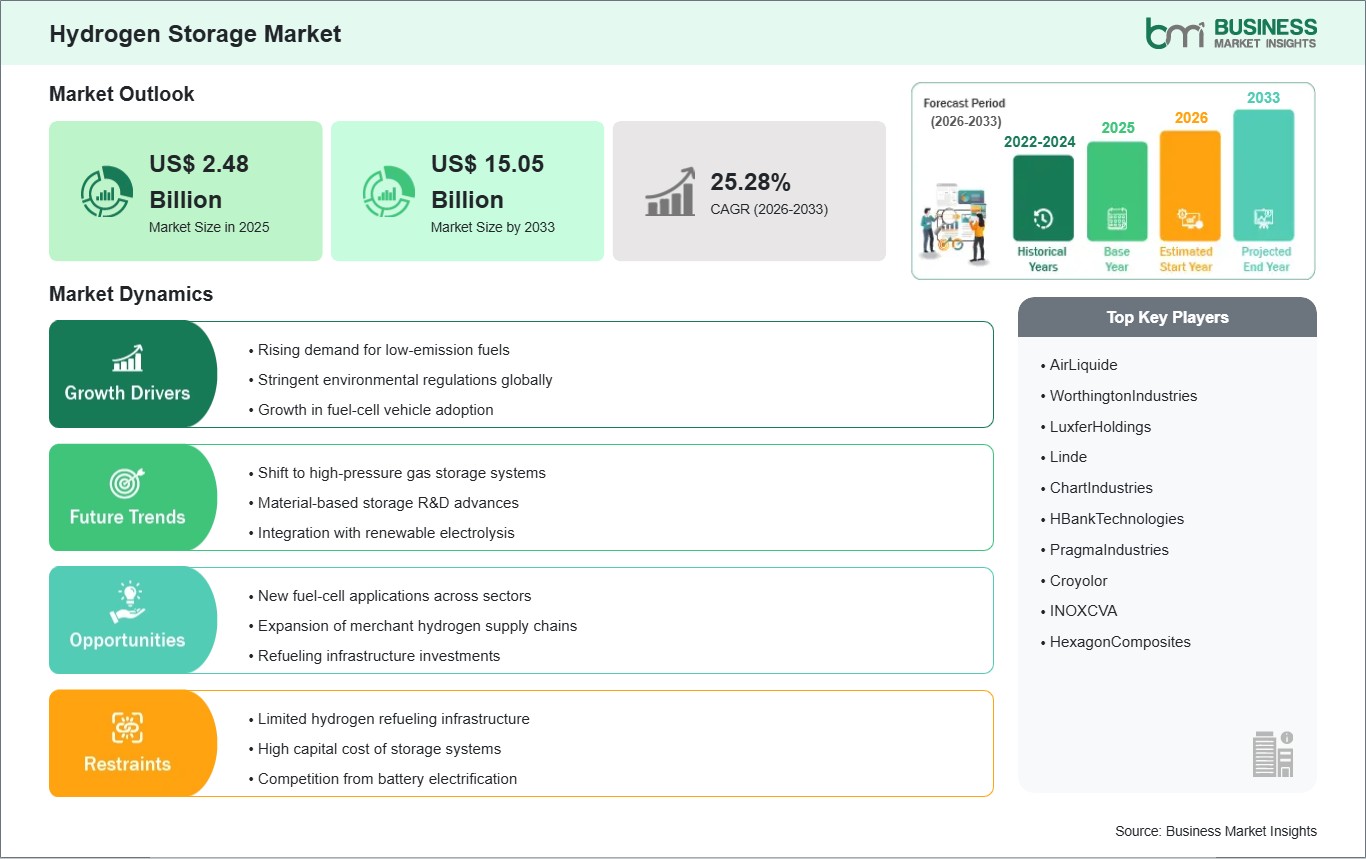
The Hydrogen Storage Market size is expected to reach US$ 15.05 Billion by 2033 from US$ 2.48 Billion in 2025.The market is estimated to record a CAGR of 25.28% from 2026 to 2033.
Hydrogen storage systems are technologies and infrastructure solutions designed to safely store hydrogen for industrial, mobility, and energy uses. These systems use physical compression, liquefaction, or material-based methods to keep hydrogen stable during transportation, distribution, and end-use operations. Storage capabilities are essential for enabling scalable hydrogen use across integrated energy ecosystems. Decarbonization efforts and clean fuel strategies are changing long-term investment priorities in the sector. Refining operations, chemical production facilities, and transportation networks increasingly need reliable hydrogen storage infrastructure to ensure uninterrupted supply chains. Governments and industry players also focus on energy diversification frameworks that support low-emission goals and fuel security. The market shows different demand patterns for storage types and application environments. Physical storage technologies remain popular due to established familiarity and infrastructure compatibility. On-site storage setups are increasingly deployed in industrial processing facilities, while on-board systems are gaining importance in hydrogen mobility and transportation. Technological improvements are boosting storage density, safety, and energy efficiency in hydrogen handling systems. Material-based storage technologies are attracting more attention for their ability to provide compact and thermally stable hydrogen storage. Digital monitoring systems, advanced pressure management tools, and engineered composite materials are also enhancing reliability in industrial and transportation applications. Competition in the industry highlights a growing focus on engineering skills, integrated infrastructure development, and specialized storage innovations. Market players are prioritizing system scalability, safety standards, and long-term supply agreements to improve their commercial position. Strategic partnerships among energy infrastructure developers, storage technology providers, and industrial operators are further shaping the competitive landscape in regional markets.

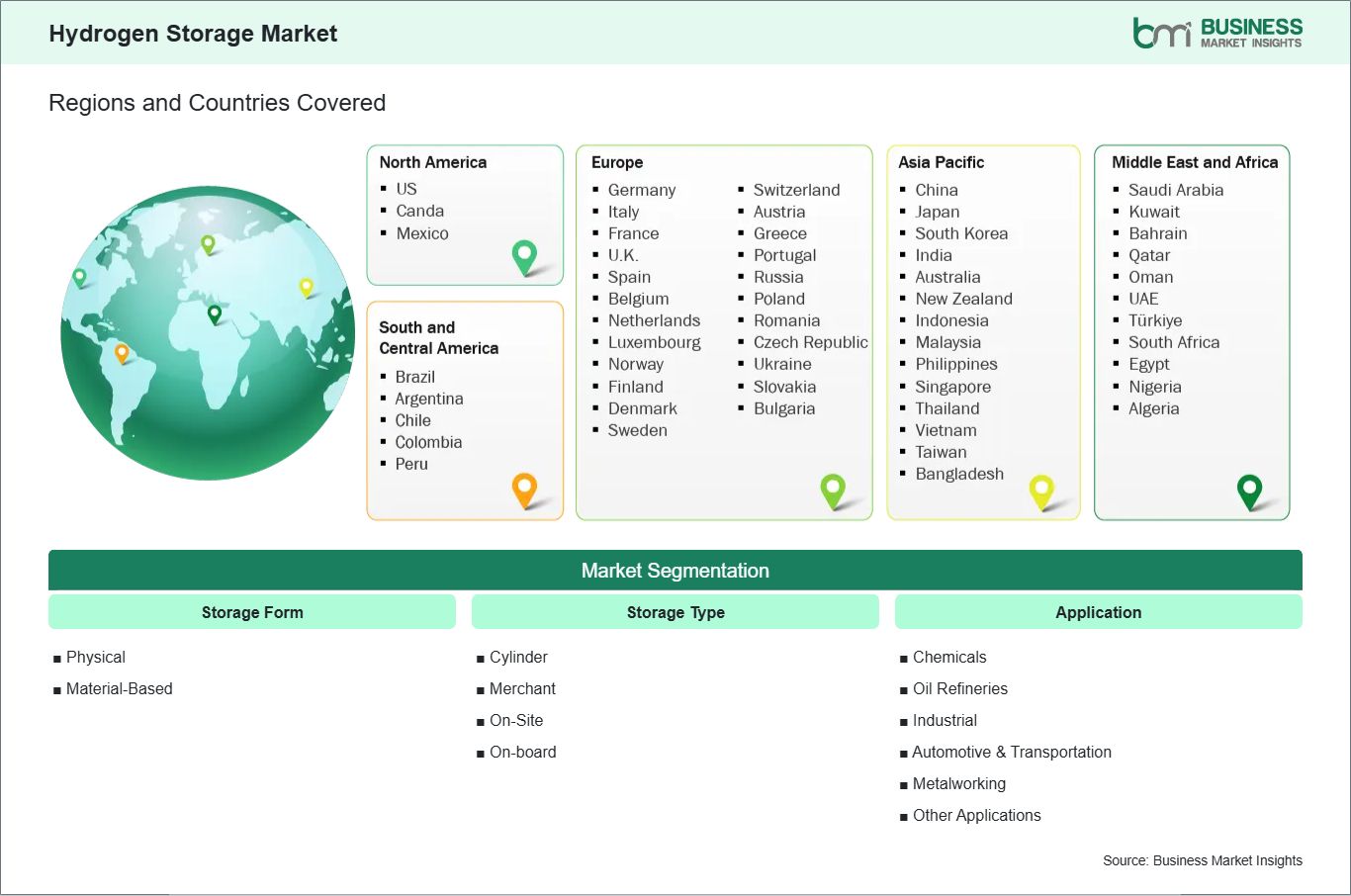
The hydrogen storage market is segmented according to storage methodology, deployment structure, and industrial application requirements.
The shift toward low-emission energy systems is speeding up investment in hydrogen production and storage. Industrial operators and energy developers need reliable storage solutions to support ongoing hydrogen distribution and use. Growing hydrogen integration in refining, chemicals, and transportation makes advanced storage technologies and engineered containment systems more valuable. Modernizing infrastructure is increasing the need for scalable and secure storage facilities. Regulations focusing on clean fuel systems are also promoting long-term investment in hydrogen supply chains and energy diversification projects. As strategies for industrial decarbonization change, storage technologies are becoming more important in integrated hydrogen value chains and energy transition frameworks across sectors.
Emerging material-based storage technologies are opening new possibilities for compact and efficient hydrogen storage solutions. Research on metal hydrides, adsorption materials, and engineered composites is improving storage density and operational stability. These developments are beneficial for applications that need to make the most of available space, especially in mobility infrastructure and distributed hydrogen deployment settings. In the future, we expect new opportunities to arise from the integration of smart monitoring systems and lightweight storage materials in transportation and industrial applications. Technology providers are also looking into modular storage designs that suit flexible deployment conditions. Better storage efficiency and improved thermal management are likely to boost commercial potential across growing hydrogen infrastructure networks.
The Hydrogen Storage Market is projected to grow from US$ 2.48 Billion in 2025 to US$ 15.05 Billion by 2033 , registering a CAGR of 25.28% from 2026 to 2033. Industry growth shows more integration of hydrogen into energy systems, transport infrastructure, and efforts to reduce carbon emissions. Storage technologies are still improving to ensure safety, energy efficiency, and the ability to distribute hydrogen at scale. Physical storage methods remain important because of mature infrastructure and established industrial use.
On-site storage solutions are widely used in processing industries that need a steady supply of hydrogen. On-board systems are also becoming more relevant as hydrogen mobility and transport infrastructure develop. Chemical processing and oil refining are seeing significant activity due to ongoing hydrogen consumption needs. The automotive and transportation sectors also help drive market growth through fuel cell initiatives and the development of alternative propulsion systems. Industrial manufacturing environments support this trend by modernizing and focusing on strategies to lower emissions.
| Report Attribute | Details |
|---|---|
| Market size in 2025 | US$ 2.48 Billion |
| Market Size by 2033 | US$ 15.05 Billion |
| Global CAGR (2026 - 2033) | 25.28% |
| Historical Data | 2022-2024 |
| Forecast period | 2026-2033 |
| Segments Covered | By Storage Form
|
|
Regions and Countries Covered
| |
| North America | US, Canada, Mexico |
| Europe | Germany, Italy, France, U.K., Spain, Belgium, Netherlands, Luxembourg, Norway, Finland, Denmark, Sweden, Switzerland, Austria, Greece, Portugal, Russia, Poland, Romania, Czech Republic, Ukraine, Slovakia, Bulgaria |
| Asia-Pacific | China, Japan, South Korea, India, Australia, New Zealand, Indonesia, Malaysia, Philippines, Singapore, Thailand, Vietnam, Taiwan, Bangladesh |
| South and Central America | Brazil, Argentina, Chile, Colombia, Peru |
| Middle East and Africa | Saudi Arabia, United Arab Emirates, Kuwait, Bahrain, Qatar, Oman, Turkiye, South Africa, Egypt, Nigeria, Algeria |
| Market leaders and key company profiles |
|
The "Hydrogen Storage Market Size and Forecast (2022-2033)" report provides a detailed analysis of the market covering below areas:
The hydrogen storage market has different regional adoption patterns. These are influenced by goals for reducing carbon emissions, investments in hydrogen infrastructure, modernization of transportation, and energy transition priorities. Regional deployment continues to change based on manufacturing levels, fuel diversification programs, and the readiness of technology in hydrogen production and distribution. North America shows strong commercial activity, backed by programs to modernize infrastructure and develop hydrogen mobility. Companies in refining, chemicals, and transportation are looking at new storage technologies to improve efficiency and meet sustainability goals. Investment also reflects a growing focus on developing an integrated hydrogen supply chain and distributed energy infrastructure. Asia Pacific is becoming a key region due to industrial growth, increased manufacturing capacity, and government-supported hydrogen initiatives. Countries in this area are speeding up the installation of hydrogen storage infrastructure to aid in transportation electrification and diversification of industrial fuels. More research activities and infrastructure investments will further support market growth in regional economies. Europe has a strong presence in the industry, thanks to clean energy policies and joint programs for hydrogen ecosystem development. Transportation initiatives and strategies to reduce industrial emissions continue to promote the use of storage technology across various sectors. Emerging economies in the Middle East, Africa, and South and Central America are also boosting hydrogen infrastructure planning to support goals for energy diversification and industrial modernization.

The Hydrogen Storage market is evaluated by gathering qualitative and quantitative data post primary and secondary research, which includes important corporate publications, association data, and databases. A few of the key developments in the Hydrogen Storage market are:
The Hydrogen Storage Market is valued at US$ 2.48 Billion in 2025, it is projected to reach US$ 15.05 Billion by 2033.
As per our report Hydrogen Storage Market, the market size is valued at US$ 2.48 Billion in 2025, projecting it to reach US$ 15.05 Billion by 2033. This translates to a CAGR of approximately 25.28% during the forecast period.
The Hydrogen Storage Market report typically cover these key segments-
The historic period, base year, and forecast period can vary slightly depending on the specific market research report. However, for the Hydrogen Storage Market report:
The Hydrogen Storage Market is populated by several key players, each contributing to its growth and innovation. Some of the major players include:
The Hydrogen Storage Market report is valuable for diverse stakeholders, including:
Essentially, anyone involved in or considering involvement in the Hydrogen Storage Market value chain can benefit from the information contained in a comprehensive market report.
Please tell us your area of interest
(Market Segments/ Regions and Countries/ Companies)