
Hydrogen Electrolyzer Market Outlook: Size, Share, Trends, Growth Analysis, Competitive Landscape & Forecast, 2026-2033

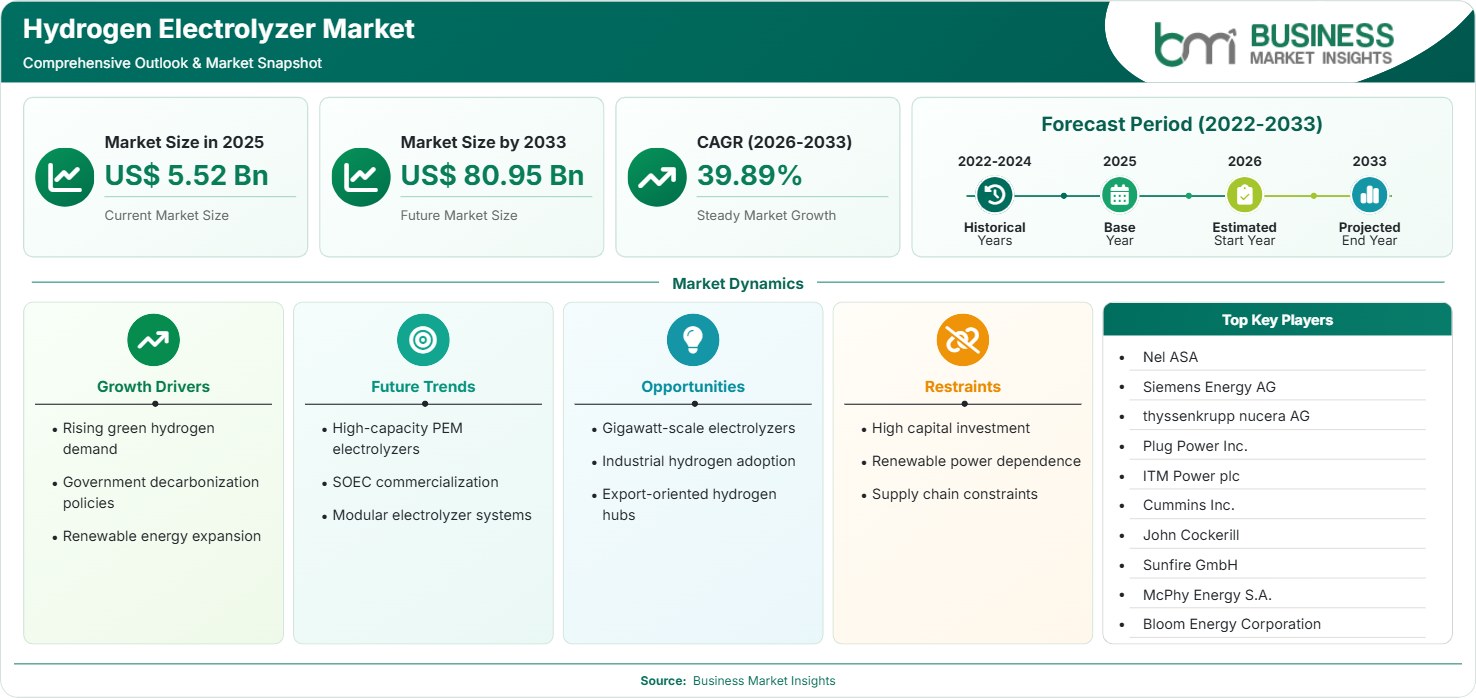
The Hydrogen Electrolyzer Market size was valued at US$ 5.52 billion in 2025 and is projected to reach US$ 80.95 billion by 2033, growing at a CAGR of 39.89% during 2026–2033. Growth is driven by rising green hydrogen demand, government decarbonization policies, and renewable energy expansion, while opportunities are emerging through gigawatt-scale electrolyzer projects, industrial hydrogen adoption, and export-oriented hydrogen hubs.

Report Coverage
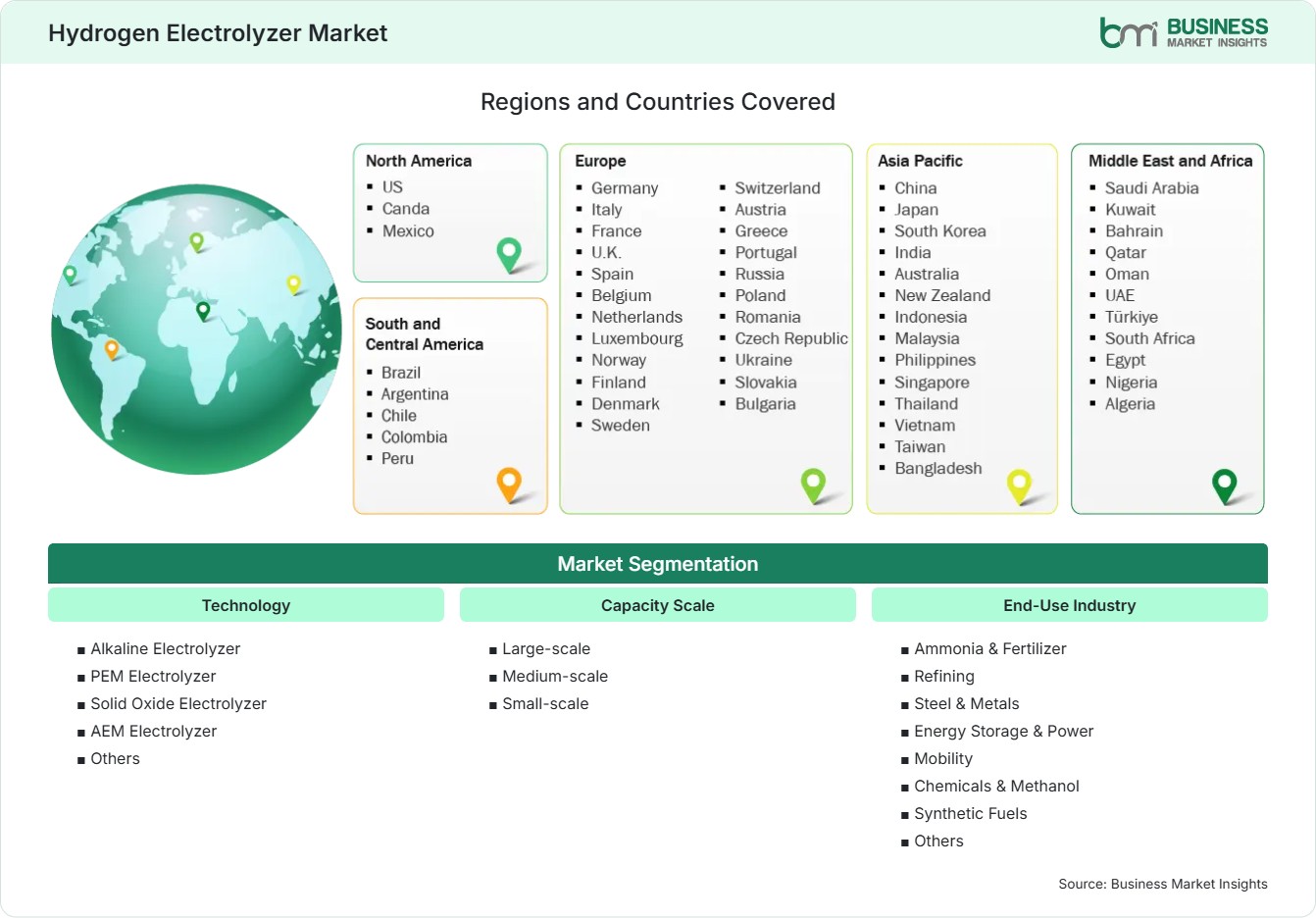
  • Technology: Alkaline Electrolyzer, PEM Electrolyzer, Solid Oxide Electrolyzer, AEM Electrolyzer, Others
  • Capacity Scale: Large-scale, Medium-scale, Small-scale
  • End-Use Industry: Ammonia & Fertilizer, Refining, Steel & Metals, Energy Storage & Power, Mobility, Chemicals & Methanol, Synthetic Fuels, Others
US$ 5.52 Bn Market size in 2025
US$ 80.95 Bn Market Size by 2033
39.89% CAGR, 2026 - 2033
2026-2033 Forecast Period

01 AI Overview

Hydrogen Electrolyzer Market Summary

  • North America Region: North America accounts for approximately 26%–30% market share in 2025 and is projected to grow at a 38.5%–40.5% CAGR during 2026–2033. The region benefits from clean hydrogen investments, government support programs, industrial decarbonization initiatives, and renewable energy expansion. The U.S. market is supported by hydrogen infrastructure development and is estimated to grow at approximately 39.0%–41.0% CAGR.
  • Fastest Growing Region: Asia Pacific represents around 35%–39% of the global market in 2025 and is expected to expand at 41.0%–42.5% CAGR through 2033. Large-scale renewable energy deployment, industrial hydrogen demand, manufacturing capabilities, and government-led hydrogen strategies are accelerating regional growth.
  • Leading Segment: Alkaline Electrolyzer (AEL) technology holds approximately 42%–46% of the Hydrogen Electrolyzer Market share in 2025 and is expected to grow at a 38.5%–39.5% CAGR. Lower technology maturity risks, cost advantages, and suitability for large-scale hydrogen production are supporting segment leadership.
  • High Growth Segment: PEM Electrolyzer technology represents approximately 30%–34% market share in 2025 and is projected to grow at 42.0%–43.5% CAGR. Rapid response capability, compatibility with variable renewable energy sources, and increasing mobility applications are accelerating adoption.
  • Key Market Opportunity: Gigawatt-scale electrolyzer installations, industrial hydrogen production, renewable-powered hydrogen hubs, and cross-border hydrogen supply chains are creating significant growth opportunities.
  • Major Market Players: Nel ASA, Siemens Energy AG, thyssenkrupp nucera AG, Plug Power Inc., ITM Power plc, Cummins Inc., John Cockerill, Sunfire GmbH, McPhy Energy S.A., and Bloom Energy Corporation.
02 Strategic Insights

Hydrogen Electrolyzer Market: Strategic Insights

Hydrogen Electrolyzer Market Strategic Framework
FREE PDF
Request your free sample
Request free sample
03 Stakeholder View

Key Takeaways

  • The market ecosystem includes electrolyzer manufacturers, renewable energy developers, hydrogen producers, industrial users, and infrastructure providers.
  • Alkaline and PEM electrolyzer technologies represent major growth areas due to scalability, efficiency improvements, and renewable energy compatibility.
  • Large-scale electrolyzer deployment is becoming a strategic priority as industries seek solutions for reducing carbon emissions.
  • Asia Pacific offers significant investment potential due to strong industrial demand, renewable energy capacity, and government hydrogen initiatives.
  • Companies are pursuing strategic partnerships, technology development, and large-scale project deployments to strengthen market positions.
  • Green hydrogen adoption in steel, ammonia, refining, and mobility sectors will remain a major driver of future electrolyzer demand.
04 Geographic Outlook

Hydrogen Electrolyzer Market Regional Highlights

North America Hydrogen Electrolyzer Market

North America accounted for approximately 26%–30% of the global market in 2025 and is projected to grow at a 38.5%–40.5% CAGR during 2026–2033. The region is witnessing rapid hydrogen ecosystem development due to government clean energy initiatives, industrial decarbonization targets, renewable energy expansion, and investments in hydrogen infrastructure. The Hydrogen Electrolyzer Market share is supported by increasing deployment of electrolyzers for green hydrogen production, clean fuel applications, and industrial emission reduction.

  • The United States represents the largest regional contributor due to hydrogen incentives, renewable energy investments, and industrial demand from refining, chemicals, and transportation sectors.
  • Canada is expanding hydrogen project development through abundant renewable resources and clean energy export opportunities.
  • Companies are investing in large-scale electrolyzer manufacturing facilities to support domestic hydrogen supply chains.
  • Increasing focus on low-carbon industrial processes is accelerating electrolyzer adoption across energy-intensive sectors.

US Hydrogen Electrolyzer Market

The United States represented approximately 22%–26% of the global market revenue in 2025 and is expected to expand at a 39.0%–41.0% CAGR through 2033. Growth is supported by federal clean hydrogen programs, renewable energy expansion, industrial decarbonization initiatives, and increasing investment in hydrogen hubs. The country is developing large-scale hydrogen production projects targeting applications in steel, ammonia, refining, transportation, and energy storage.

  • Clean hydrogen incentives are encouraging private sector investment in electrolyzer manufacturing and deployment.
  • Industrial companies are adopting electrolyzers to reduce emissions from hydrogen-intensive processes.
  • Renewable energy integration is increasing demand for flexible PEM and advanced electrolyzer systems.
  • Hydrogen infrastructure development is supporting expansion of production and distribution networks.

Europe Hydrogen Electrolyzer Market

Europe accounted for approximately 30%–34% of the global market in 2025 and is expected to grow at a 39.5%–40.5% CAGR between 2026 and 2033. Europe remains a major hydrogen market due to ambitious climate targets, renewable energy transition policies, and strong industrial decarbonization initiatives. Germany, the United Kingdom, France, and the Netherlands are key markets driving regional expansion. Germany is estimated to grow at 40.0%–41.0% CAGR, while the United Kingdom is projected to expand at 39.0%–40.0% CAGR.

  • Germany leads regional demand through industrial hydrogen strategies, renewable integration, and strong electrolyzer manufacturing capabilities.
  • The United Kingdom is expanding hydrogen investments across energy, transportation, and industrial applications.
  • France is developing hydrogen projects focused on clean industry and low-carbon mobility.
  • European countries are investing in hydrogen corridors, renewable-powered electrolyzer facilities, and import infrastructure.

Asia Pacific Hydrogen Electrolyzer Market

Asia Pacific accounted for approximately 35%–39% of global revenue in 2025 and represents the fastest-growing region with a projected 41.0%–42.5% CAGR during 2026–2033. China, Japan, India, South Korea, and Australia are driving regional expansion through renewable energy growth, industrial hydrogen demand, and government-supported hydrogen strategies. China is projected to grow at 41.5%–42.5% CAGR, while India is expected to expand at 42.0%–43.0% CAGR due to increasing renewable capacity and clean energy initiatives.

  • China is expanding electrolyzer deployment through renewable hydrogen projects, industrial applications, and domestic manufacturing capabilities.
  • India is developing hydrogen production capacity through national clean hydrogen programs and renewable energy expansion.
  • Japan supports market growth through hydrogen technology investments and clean energy transition initiatives.
  • South Korea is increasing electrolyzer adoption for mobility, industrial applications, and hydrogen infrastructure development.
  • Australia is emerging as a major hydrogen export hub due to renewable energy resources and international hydrogen partnerships.

Rest of World Hydrogen Electrolyzer Market

Latin America, the Middle East, and Africa collectively represented approximately 5%–9% of global revenue in 2025 and are forecast to grow at a 40.0%–41.5% CAGR between 2026 and 2033. These regions are emerging as important hydrogen production locations due to abundant renewable resources, export potential, and increasing international investment. Countries including Chile, Brazil, Saudi Arabia, UAE, and South Africa are developing hydrogen projects targeting domestic use and international markets.

  • Latin America is expanding green hydrogen opportunities through renewable energy availability and export-focused projects.
  • Chile and Brazil are developing hydrogen hubs for industrial applications and global hydrogen supply chains.
  • Middle Eastern countries are investing in large-scale renewable hydrogen projects supported by solar energy resources.
  • UAE and Saudi Arabia are developing hydrogen export initiatives and industrial decarbonization programs.
  • African markets are gaining attention due to renewable resource potential and international clean energy partnerships.
Global Market Geography
FREE PDF
Request your free sample
Request free sample
05 Segment Analysis

Hydrogen Electrolyzer Market Segmentation

Technology

Technology segmentation accounted for approximately 94%–97% of global revenue in 2025 and is projected to grow at a 39.5%–40.5% CAGR between 2026 and 2034. Increasing demand for green hydrogen production, renewable energy integration, and industrial decarbonization is driving adoption across electrolyzer technologies. Alkaline electrolyzers currently maintain a leading position due to their commercial maturity and suitability for large-scale hydrogen production. PEM and solid oxide technologies are gaining momentum due to higher efficiency, operational flexibility, and compatibility with renewable energy systems.

  • Alkaline Electrolyzer (AEL): Alkaline electrolyzers represent a leading technology due to long operational experience, lower capital costs, and suitability for large-scale hydrogen production projects.
  • PEM Electrolyzer: PEM electrolyzers are expanding rapidly due to high efficiency, compact design, fast response capabilities, and ability to operate effectively with intermittent renewable power sources.
  • Solid Oxide Electrolyzer (SOEC): Solid oxide electrolyzers are gaining attention due to high-temperature operation, improved efficiency potential, and applications in industrial processes requiring integrated heat sources.
  • AEM Electrolyzer: Anion exchange membrane electrolyzers are emerging as a developing technology offering potential cost advantages through reduced dependence on precious metals.
  • Others: Other electrolyzer technologies are being developed through research and innovation efforts focused on improving efficiency, scalability, and hydrogen production economics.

Capacity Scale

Capacity Scale segmentation represented approximately 90%–94% of hydrogen electrolyzer market demand in 2025 and is expected to expand at a 40.0%–41.0% CAGR through 2034. Large-scale electrolyzer projects are becoming increasingly important as governments and industries target gigawatt-scale green hydrogen production. Medium-scale systems are expanding through industrial applications, while small-scale electrolyzers support distributed hydrogen generation and localized energy solutions.

  • Large-scale (>100 MW): Large-scale electrolyzers represent a major growth segment due to increasing investment in hydrogen hubs, industrial decarbonization projects, and renewable energy integration.
  • Medium-scale (10 MW–100 MW): Medium-scale electrolyzers are expanding through industrial facilities, commercial hydrogen production, and regional clean energy projects.
  • Small-scale (<10 MW): Small-scale electrolyzers support decentralized hydrogen generation, research applications, mobility fueling, and localized energy storage solutions.

End-Use Industry

End-Use Industry segmentation accounted for approximately 92%–96% of market demand in 2025 and is forecast to grow at a 39.5%–40.8% CAGR during 2026–2034. Industrial sectors including ammonia production, refining, steel manufacturing, and chemicals are driving hydrogen electrolyzer adoption due to increasing decarbonization requirements. Energy storage, mobility, and synthetic fuel applications are emerging as important growth areas as hydrogen expands beyond traditional industrial uses.

  • Ammonia & Fertilizer: Ammonia and fertilizer industries represent a major application area due to demand for replacing conventional fossil-based hydrogen with green hydrogen.
  • Refining: Refineries are adopting electrolyzers to reduce emissions associated with hydrogen-intensive refining processes.
  • Steel & Metals: Steel and metals industries are increasing electrolyzer adoption to support low-carbon production methods and reduce reliance on fossil fuels.
  • Energy Storage & Power: Electrolyzers support renewable energy balancing by converting excess electricity into hydrogen for long-duration energy storage applications.
  • Mobility: Hydrogen mobility applications are driving demand for electrolyzers used in hydrogen fueling infrastructure and transportation systems.
  • Chemicals & Methanol: Chemical industries are integrating green hydrogen into low-carbon production pathways for methanol and other chemical products.
  • Synthetic Fuels (e-fuels): Synthetic fuel production is creating new opportunities through renewable hydrogen integration with carbon capture technologies.
  • Others: Additional applications include industrial heating, research facilities, distributed energy systems, and emerging hydrogen-based technologies.
06 Market Forces

Hydrogen Electrolyzer Market Dynamics

Key Market Drivers

Rising Green Hydrogen Demand

Increasing demand for green hydrogen as a clean energy carrier is accelerating adoption of electrolyzer systems across industrial sectors. Green hydrogen produced through renewable-powered electrolysis is gaining importance as industries seek alternatives to fossil-based hydrogen production methods. The Hydrogen Electrolyzer Market growth is supported by rising demand from ammonia production, steel manufacturing, refining, chemicals, transportation, and energy storage applications. Companies are investing in electrolyzer technologies to reduce carbon emissions and improve energy sustainability. Growing recognition of hydrogen as a critical component of future energy systems is encouraging governments and industries to establish large-scale production infrastructure. As global decarbonization efforts intensify, demand for efficient and scalable electrolyzer solutions is expected to increase significantly.

Government Decarbonization Policies

Government policies and incentives, and hydrogen policies, have been driving factors for the electrolyzers market growth. Countries around the world are implementing clean hydrogen policies, investment schemes, carbon dioxide emissions reduction targets, and renewable energy policies to produce hydrogen. These regulatory measures are encouraging investment in electrolyzer manufacturing, hydrogen infrastructure, and industrial adoption. The Hydrogen Electrolyzer Market trends reflect increasing collaboration between governments, energy companies, and technology providers to develop hydrogen ecosystems. Public funding and policy support are helping reduce project risks and improve economic feasibility. As nations strengthen climate commitments, government-backed hydrogen programs are expected to remain a key driver of market expansion.

Renewable Energy Expansion

Renewable energy capacity expansion is generating positive circumstances for deploying hydrogen electrolyzers because they can generate low-carbon electricity needed to produce green hydrogen. Solar and wind energy, along with other renewable energy sources, are expanding, enabling the integration of electrolyzers into clean energy systems. Electrolyzers enable the management of renewable energy variability by converting surplus electricity into hydrogen. Renewable energy expansion is driving the creation of hydrogen centers and large-scale production facilities. Energy firms are turning their attention to renewable-based hydrogen solutions for more grid flexibility and lower emissions.

Key Market Opportunities

Gigawatt-Scale Electrolyzer Deployment

Larger-scale electrolyzers present an attractive prospect as industry and government organizations strive towards building green hydrogen generation capabilities. There are gigawatt-scale electrolyzers that are being built to generate hydrogen for use in industrial processes, exports, and other green energy uses. Electrolyzer companies in the hydrogen electrolyzer market are now building larger platforms designed to support larger hydrogen hubs. Larger-scale production will help reduce the cost and increase efficiency. It is only companies that have been able to produce reliable, affordable, and scalable platforms that are likely to gain from increased demands for larger-scale hydrogen production facilities.

Industrial Hydrogen Adoption

Industrial hydrogen adoption is creating strong growth opportunities as sectors with difficult-to-abate emissions transition toward cleaner production methods. Industries such as steel, ammonia, refining, chemicals, and methanol are exploring green hydrogen to reduce carbon intensity. The use of electrolyzers allows these industries to switch from fossil fuel-based hydrogen to renewable hydrogen. Rising sustainability and emissions-reduction initiatives among companies are promoting the use of hydrogen solutions in these industries. Companies offering electrolyzer systems that meet the specific needs of industries can find good business opportunities. Demand for low-carbon industrial processes will remain a significant market opportunity.

Export-Oriented Hydrogen Hubs

The development of hydrogen export hubs is creating opportunities for countries with abundant renewable resources to produce and supply green hydrogen globally. Regions with strong solar and wind potential are investing in large-scale electrolyzer facilities aimed at international hydrogen trade. Export-oriented projects are encouraging the development of hydrogen production clusters, storage infrastructure, transportation networks, and related technologies. Countries in the Middle East, Australia, Latin America, and Africa are emerging as potential hydrogen exporters during hydrogen electrolyzer market forecasts. Companies participating in hydrogen hub development can benefit from increasing global demand for clean energy supply chains.

Market Restraints and Challenges

High Capital Investment

Factor: Hydrogen electrolyzer systems require significant upfront investment due to high equipment costs, advanced materials, manufacturing complexity, and supporting infrastructure requirements. Impact: High capital expenditure can delay project development and limit adoption, particularly for smaller companies and regions with limited financial resources. Large-scale hydrogen projects require substantial investment in electrolyzers, renewable power generation, storage systems, and distribution infrastructure. Although technology improvements and manufacturing scale are expected to reduce costs over time, initial investment remains a major barrier. Companies and governments are exploring financing models, subsidies, and partnerships to improve project feasibility.

Renewable Power Dependence

Factor: Green hydrogen production through electrolysis depends heavily on the availability of reliable and affordable renewable electricity. Impact: Variability in renewable power generation can affect electrolyzer utilization rates, operating costs, and overall hydrogen production economics. Regions with limited renewable energy resources may face challenges in developing competitive green hydrogen projects. Integration with energy storage systems and hybrid renewable solutions is becoming increasingly important to improve operational stability. While renewable energy capacity continues expanding globally, dependence on clean power availability remains a key challenge for widespread electrolyzer deployment.

07 Company Analysis

Competitive Landscape

The Hydrogen Electrolyzer Market analysis highlights a competitive landscape driven by electrolyzer manufacturers, energy technology companies, industrial solution providers, and clean energy developers. Leading players are focusing on increasing electrolyzer efficiency, developing gigawatt-scale systems, expanding manufacturing capacity, and establishing partnerships for large hydrogen projects. Companies are investing in alkaline, PEM, solid oxide, and emerging electrolyzer technologies to address growing demand from industrial decarbonization, renewable energy integration, and hydrogen infrastructure development.

Company Name

Overview

Products and Services relevant to this market

Nel ASA

Norwegian hydrogen technology company specializing in electrolyzer solutions.

Alkaline electrolyzers, PEM electrolyzers, hydrogen production systems, and fueling solutions.

Siemens Energy AG

Global energy technology company providing clean energy solutions.

PEM electrolyzers, hydrogen production systems, renewable hydrogen integration solutions.

thyssenkrupp nucera AG

Electrolyzer technology company focused on industrial-scale hydrogen production.

Large-scale alkaline water electrolysis systems and industrial hydrogen solutions.

Plug Power Inc.

Hydrogen solutions provider focused on clean hydrogen infrastructure.

PEM electrolyzers, hydrogen generation systems, storage, and fueling solutions.

ITM Power plc

UK-based company specializing in PEM electrolyzer technology.

PEM electrolyzers, hydrogen production systems, and renewable hydrogen projects.

Cummins Inc.

Power technology company offering hydrogen and energy solutions.

PEM electrolyzers, hydrogen production systems, and integrated energy solutions.

John Cockerill

Industrial technology company providing hydrogen production equipment.

Large-scale electrolyzers, alkaline electrolysis systems, and hydrogen infrastructure solutions.

Sunfire GmbH

German clean technology company developing advanced electrolysis solutions.

Solid oxide electrolyzers, alkaline electrolyzers, and industrial hydrogen technologies.

McPhy Energy S.A.

Hydrogen technology company focused on electrolyzer manufacturing.

Alkaline electrolyzers, hydrogen stations, and renewable hydrogen production systems.

Bloom Energy Corporation

Clean energy company developing high-efficiency hydrogen technologies.

Solid oxide electrolyzers, hydrogen production systems, and energy solutions.

08 Industry Activity

Recent Developments

July 2026

thyssenkrupp nucera and Bharat Heavy Electricals Limited (BHEL) signed a strategic collaboration agreement to manufacture alkaline water electrolyzers for green hydrogen projects in India, strengthening domestic electrolyzer production capacity and supporting the country's clean hydrogen ambitions.

May 2026

Samsung E&A and Nel Hydrogen launched the CompassH2 A+ 100 MW pressurized alkaline electrolysis platform at the World Hydrogen Summit 2026. The solution reduces plant footprint by 50% while delivering high-capacity hydrogen production, expanding the companies' portfolio of large-scale green hydrogen technologies.

April 2026

Sunfire launched the HyLink Alkaline 23, a new outdoor pressurized alkaline electrolyzer system featuring a 50 MW module for large-scale green hydrogen projects. The solution reduces total installed costs by up to 50%, enhancing the efficiency and scalability of industrial hydrogen production.

March 2025

Next Hydrogen Solutions Inc. entered into a strategic partnership with a leading Asian electrolyzer manufacturer to scale the production and commercialization of its water electrolyzer systems, expanding its global manufacturing capabilities for large-scale green hydrogen projects.

10 Trust & Transparency

Research Methodology

The market analysis combines proprietary research with secondary data from government agencies, company disclosures, regulatory filings, industry databases and expert interviews. Market estimates are validated through data triangulation, cross-market benchmarking and analyst review.

View Full Research Methodology

11 Questions Answered

Frequently Asked Questions

What challenges affect hydrogen electrolyzer deployment?

High capital investment, renewable electricity dependence, infrastructure requirements, and hydrogen production cost challenges remain major barriers.

Which industries are adopting hydrogen electrolyzers?

Major adoption areas include ammonia and fertilizer production, refining, steel and metals, chemicals, synthetic fuels, mobility, and energy storage.

Why is PEM electrolyzer adoption increasing?

In the hydrogen electrolyzer market report, PEM electrolyzers are gaining demand due to fast response capability, compact design, high efficiency, and compatibility with renewable energy sources.

Which electrolyzer technology dominates the market?

Alkaline electrolyzers represent a leading technology due to commercial maturity, cost advantages, and suitability for large-scale hydrogen production.

What factors are driving the hydrogen electrolyzer market growth?

Rising green hydrogen demand, government decarbonization policies, renewable energy expansion, and industrial hydrogen adoption are key growth drivers.

Access the Full Hydrogen Electrolyzer Market Report

Get segment-level forecasts, regional estimates, competitive benchmarking, company profiles and downloadable Excel datasets.

Access the full Hydrogen Electrolyzer Market Report
350 pages PDF & Excel | 2026-07-31