
Hydrogen To Power Market Outlook: Size, Share, Trends, Growth Analysis, Competitive Landscape & Forecast, 2026-2033

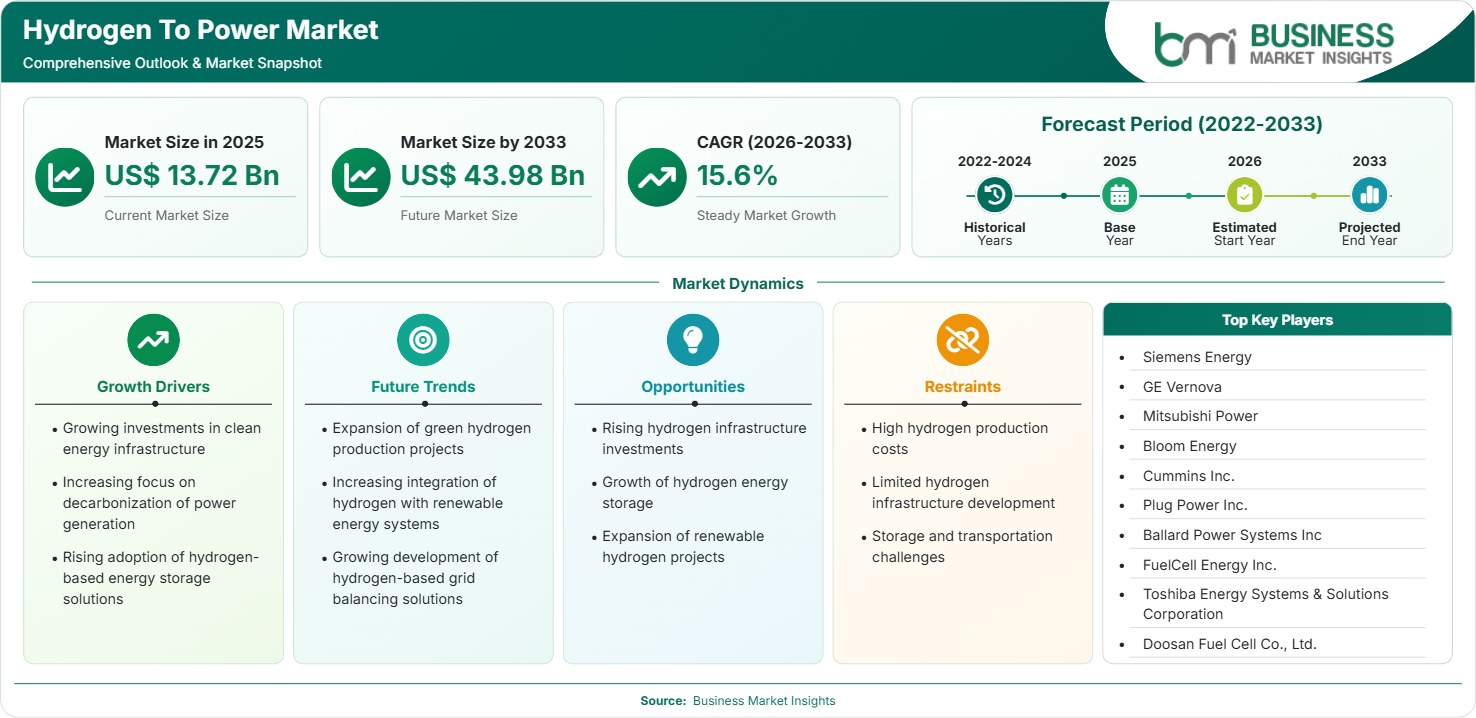
The Hydrogen To Power Market size was valued at US$ 13.72 Billion in 2025 and is projected to reach US$ 43.98 Billion by 2033, growing at a CAGR of 15.6% during 2026–2033, driven by accelerating clean energy investments, expanding hydrogen infrastructure, increasing decarbonization initiatives across power generation, and growing deployment of hydrogen-based energy storage systems supporting renewable energy integration.

Report Coverage
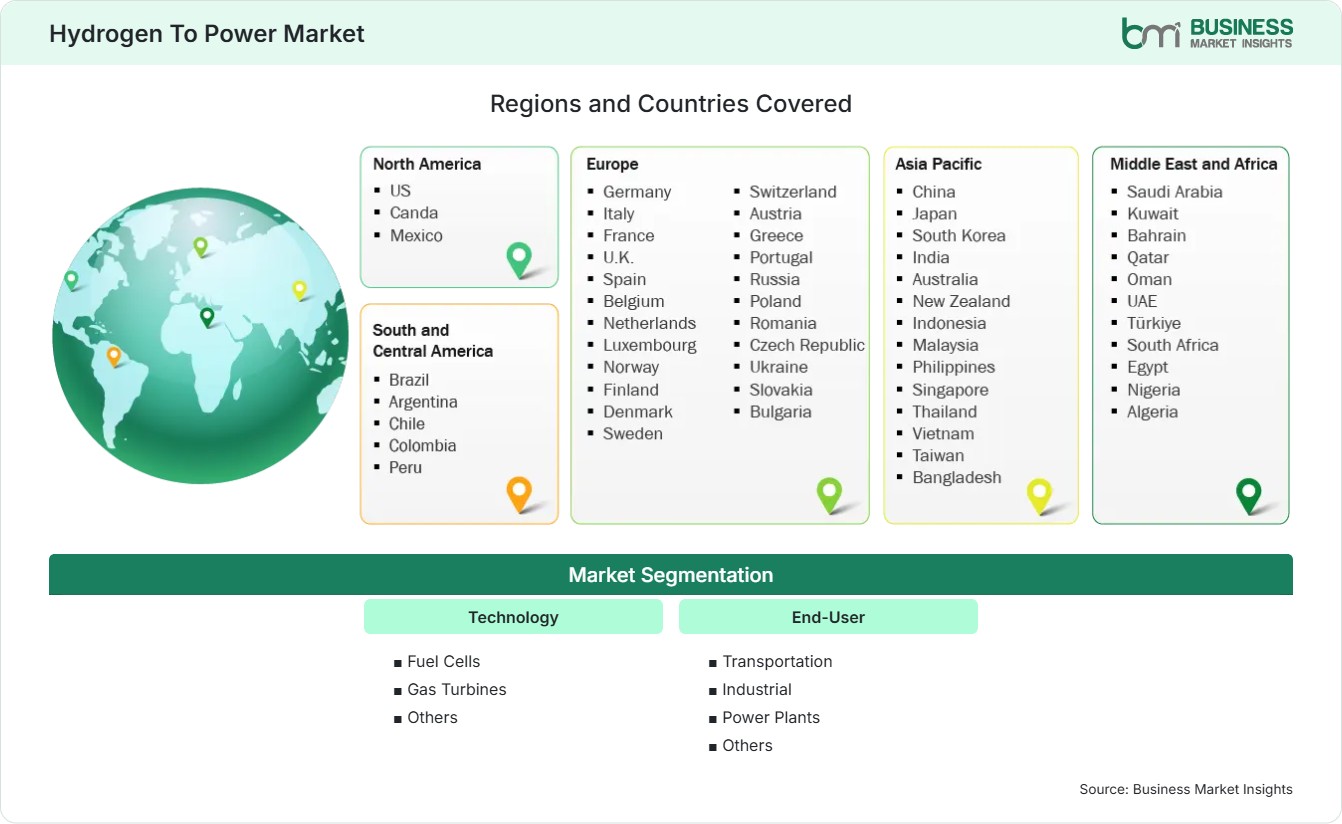
  • Technology: Fuel Cells, Gas Turbines, Others
  • End-User: Transportation, Industrial, Power Plants, Others
US$ 13.72 Bn Market size in 2025
US$ 43.98 Bn Market Size by 2033
15.6% CAGR, 2026 - 2033
2026-2033 Forecast Period

AI Overview

Hydrogen To Power Market Summary

  • North America Region: North America accounts for 34%–37% of the hydrogen to power market share in 2025 and is expected to grow at a CAGR of 14.5%–15.3% during 2026–2033. Growth is supported by federal hydrogen incentives, large-scale clean hydrogen hubs, utility investments, and commercialization of fuel cell technologies. The US market is projected to expand at a 14.8%–15.6% CAGR, supported by the Inflation Reduction Act, industrial decarbonization, and hydrogen production tax incentives.
  • Fastest Growing Region: Asia Pacific represents 29%–32% share in 2025 and is anticipated to register the fastest CAGR of 16.8%–17.6%, driven by hydrogen roadmaps in Japan, South Korea, China, and Australia alongside growing renewable hydrogen production capacity.
  • Leading Segment: Fuel Cells hold 56%–59% of the market in 2025 and are forecast to grow at 15.8%–16.5% CAGR, supported by increasing deployment across stationary power, backup power systems, distributed energy generation, and transportation infrastructure.
  • High Growth Segment: Power Plants account for 24%–27% market share in 2025 while expanding at 17.0%–18.0% CAGR, driven by utility-scale hydrogen blending, decarbonized electricity generation, and long-duration renewable energy storage applications.
  • Key Market Opportunity: Expansion of renewable hydrogen production, hydrogen storage technologies, and utility-scale hydrogen power projects creates long-term opportunities for technology developers, EPC contractors, and integrated energy companies worldwide.
  • Major Market Players: Siemens Energy, GE Vernova, Mitsubishi Power, Bloom Energy, Cummins Inc., Plug Power Inc., Ballard Power Systems Inc., FuelCell Energy, Inc., Toshiba Energy Systems & Solutions Corporation, Doosan Fuel Cell Co., Ltd.
Strategic Insights

Hydrogen To Power Market: Strategic Insights

Hydrogen To Power Market Strategic Framework
FREE PDF
Request your free sample
Request free sample
Stakeholder View

Key Takeaways

  • The industry value chain is shifting from standalone equipment manufacturing toward integrated hydrogen ecosystems combining production, storage, transportation, power generation, and digital energy management platforms.
  • Utility-scale power generation and industrial applications present the strongest commercial opportunities as utilities seek dispatchable low-carbon electricity capable of balancing intermittent renewable generation.
  • Technological innovation is focused on higher-efficiency electrolyzers, hydrogen-ready gas turbines, advanced fuel cells, digital monitoring platforms, and optimized hydrogen storage systems to improve project economics.
  • Asia Pacific remains the fastest-growing investment destination due to strong government funding, ambitious hydrogen strategies, manufacturing leadership, and expanding renewable energy deployment across major economies.
  • Strategic collaborations between utilities, engineering companies, technology providers, and governments are accelerating commercialization through pilot projects, demonstration plants, and long-term infrastructure investments.
  • Financial support mechanisms, including production tax credits, carbon pricing, grants, and clean energy funding programs, are expected to significantly improve project viability throughout the forecast period.
Geographic Outlook

Hydrogen To Power Market Regional Highlights

North America Hydrogen to Power Market

North America accounted for 34%–37% of the market in 2025 and is projected to expand at a CAGR of 14.5%–15.3% during 2026–2033. The region benefits from supportive hydrogen policies, substantial public funding, advanced utility infrastructure, and rapid commercialization of fuel cell technologies. The United States leads regional deployment, while Canada strengthens its position through renewable hydrogen production, carbon capture integration, and export-oriented hydrogen strategies. Increasing investments in hydrogen hubs and industrial decarbonization continue to strengthen long-term market prospects.

  • Government-backed hydrogen hub programs are accelerating commercialization through coordinated investments in production, storage, transportation, and end-use infrastructure across multiple industrial sectors.
  • Utilities are expanding hydrogen blending projects to decarbonize existing natural gas power plants while maintaining grid reliability and supporting renewable energy integration.
  • Strong collaboration between technology providers, research institutions, and energy companies is accelerating commercialization of hydrogen-ready turbines and large-scale fuel cell installations.
  • Industrial decarbonization initiatives across steel, chemicals, and refining industries continue driving demand for hydrogen-powered electricity generation and distributed energy systems.
  • Expansion of hydrogen refueling infrastructure supports broader ecosystem development, encouraging investment across transportation and stationary power applications.

US Hydrogen to Power Market

The United States represented 29%–32% market share in 2025 and is forecast to grow at a CAGR of 14.8%–15.6% through 2033. Federal incentives, hydrogen production tax credits, and investments under clean energy legislation continue supporting commercialization. Utility companies, industrial manufacturers, and technology developers are actively investing in hydrogen production, storage, and power generation projects aimed at achieving long-term carbon neutrality objectives.

  • Federal hydrogen incentives are improving investment returns for electrolyzer projects and utility-scale hydrogen power generation facilities.
  • Utilities continue testing hydrogen blending in existing gas turbine infrastructure to reduce emissions while preserving operational flexibility.
  • Public-private partnerships are expanding hydrogen infrastructure supporting industrial clusters, manufacturing facilities, and regional energy hubs.
  • Increasing renewable electricity generation provides favorable conditions for large-scale green hydrogen production and seasonal energy storage.

Europe Hydrogen to Power Market

Europe held 26%–29% of the market in 2025 and is anticipated to register a CAGR of 15.2%–16.0% between 2026 and 2033. Strong climate regulations, ambitious hydrogen roadmaps, and renewable energy expansion continue supporting Hydrogen To Power market development. Germany remains the regional leader due to significant hydrogen investments, while the Netherlands, Spain, and France are emerging as high-growth markets through infrastructure expansion and renewable hydrogen production projects.

  • Germany leads regional deployment through extensive hydrogen funding programs and industrial decarbonization initiatives supporting heavy manufacturing.
  • Spain is emerging as a renewable hydrogen production hub because of abundant solar resources and favorable investment policies.
  • The Netherlands continues expanding hydrogen import terminals, pipeline infrastructure, and industrial hydrogen distribution networks.
  • European utilities increasingly invest in hydrogen-compatible gas turbines to support renewable electricity integration and long-duration storage.
  • Cross-border hydrogen transportation projects are strengthening regional energy security while supporting the European Union's climate objectives.

Asia Pacific Hydrogen to Power Market

Asia Pacific represented 29%–32% of the market in 2025 and is expected to achieve the highest CAGR of 16.8%–17.6% during the forecast period. Government-backed hydrogen roadmaps, manufacturing leadership, expanding renewable energy investments, and industrial decarbonization initiatives continue accelerating market development. Japan and South Korea remain technology leaders, while China and Australia significantly expand hydrogen production capacity and export infrastructure.

  • Japan continues commercial deployment of hydrogen fuel cells and hydrogen-powered electricity generation through long-term national hydrogen strategies.
  • South Korea is investing heavily in hydrogen infrastructure, fuel cell manufacturing, and distributed clean power generation systems.
  • China is rapidly expanding electrolyzer manufacturing capacity and renewable hydrogen production supported by industrial policy initiatives.
  • Australia is strengthening its position as a global renewable hydrogen exporter through large-scale green hydrogen production projects.
  • Regional collaboration between governments and technology developers supports commercialization across industrial, transportation, and utility applications.

Rest of World Hydrogen to Power Market

Rest of World accounted for 8%–11% market share in 2025 and is projected to expand at a CAGR of 15.8%–16.6% through 2033. The Middle East is investing in large renewable hydrogen production facilities for domestic use and exports, while Latin America benefits from growing renewable electricity resources supporting competitive hydrogen production. South Africa is also emerging as a promising market due to abundant renewable energy potential and strategic mineral resources.

  • Saudi Arabia and the UAE continue developing integrated renewable hydrogen production projects targeting international export markets.
  • Brazil is expanding renewable electricity generation to support competitive green hydrogen manufacturing opportunities.
  • Chile benefits from abundant wind and solar resources, enabling cost-effective renewable hydrogen production.
  • South Africa is leveraging platinum group metals expertise to strengthen domestic fuel cell manufacturing capabilities.
  • International partnerships continue supporting hydrogen technology transfer, financing, and infrastructure development across emerging economies.
Global Market Geography
FREE PDF
Request your free sample
Request free sample
Segment Analysis

Hydrogen To Power Market Segmentation

Technology

The technology segment is the core segment within the Hydrogen to Power market, and its innovations have focused on boosting conversion efficiency, operational flexibility, and economic viability throughout its lifecycle. Fuel Cells were the market leaders, commanding 56%-59% of the market share in 2025 and are expected to grow with a CAGR of 15.8%-16.5% from 2025 to 2033. The increasing commercialization of fuel cells for stationary installations, distributed generation, and backup power applications is supporting this trend.

  • Fuel Cells: Fuel cells continue to be the top technology because of their high efficiency in generating electricity, the absence of direct carbon dioxide emissions during fuel cell operation, modularity, and use in distributed power generation, industrial power plants, microgrids, and backup power supplies.
  • Gas Turbines: More and more gas turbines are being built to use higher shares of hydrogen, allowing utilities to decarbonize their existing generation units.

End-User

The end-user segment is growing as the shift from demonstration projects to commercial applications across various industries accelerates. Industrial sectors are major customers due to decarbonization needs, whereas transportation and power generation see increased investment. The use of renewables, energy security programs, and favorable government policies continues to drive market growth across different segments.

  • Transportation: Hydrogen fuel for generating electricity ensures proper charging, railway electrification, port operations, airport operations, and industrial mobility where clean energy is needed.
  • Industrial: Industries use hydrogen fuel in their power systems to minimize emissions, ensure a reliable energy supply, and maintain continuous operations in sectors such as the chemical industry, refining, metallurgy, the cement industry, manufacturing, and others.
  • Power Plants: Increasingly, utilities are beginning to integrate hydrogen into existing thermal power plants and generate electricity using hydrogen.
Market Forces

Hydrogen To Power Market Dynamics

Key Market Drivers

Growing Investments in Clean Energy Infrastructure

Global investment in clean energy infrastructure continues to accelerate the deployment of hydrogen-based power systems. Funding is being committed to hydrogen production, storage, transport, and power generation initiatives to achieve net-zero targets. The International Energy Agency has concluded that hydrogen is an essential technology for achieving decarbonization goals in hard-to-decarbonize sectors. Increased capacity of renewable electricity is also making green hydrogen cost-effective by providing carbon-neutral power for electrolysis. Such trends have created incentives for utilities, industry players, and private firms to develop hydrogen technologies to enhance energy security and reduce reliance on fossil fuels.

Increasing Focus on Decarbonization of Power Generation

Power producers worldwide are under increasing pressure to reduce greenhouse gas emissions while maintaining electricity reliability. Hydrogen provides an attractive pathway by enabling low-carbon electricity generation through fuel cells and hydrogen-ready gas turbines. Many utilities are considering blending hydrogen into their current gas pipelines before shifting towards hydrogen production. Policies for carbon reduction, emission trading systems, and sustainable commitments from businesses are further driving investments in hydrogen-ready power infrastructure. With an increase in renewables in the power network, hydrogen will play an increasingly significant role as a dispatchable energy resource.

Rising Adoption of Hydrogen-Based Energy Storage Solutions

Energy storage for long-duration use is becoming increasingly important as more electricity from renewable sources is generated worldwide. Hydrogen enables the storage of excess energy generated from renewable sources for conversion back to electricity when demand rises. Hydrogen offers key benefits over battery technology for large-scale, long-duration energy storage in national electricity systems. Utilities are investing in integrated renewable hydrogen projects combining electrolysis, storage, and electricity generation. These systems improve grid resilience while reducing renewable energy curtailment and enhancing overall energy system flexibility.

Key Market Opportunities

Rising Hydrogen Infrastructure Investments

Hydrogen facilities, pipeline systems, storage facilities, and transportation networks are receiving huge investments from governments and private investors. Major infrastructure investments help improve supply chains and overcome challenges faced during the commercialization of the hydrogen value chain. Energy utilities, industries, and technology companies will be able to take advantage of this infrastructure expansion to deploy hydrogen-based electricity production. Cross-border trade is being facilitated through international collaborations, providing business opportunities for equipment providers, engineers, and infrastructure developers.

Growth of Hydrogen Energy Storage

Hydrogen energy storage is a promising business opportunity amid the increasing integration of renewable generation into the electricity mix. Power grids need energy storage to continuously balance variations in energy production. Energy storage through hydrogen allows the conversion of excess renewable energy into a chemical form and the subsequent production of electricity from hydrogen storage when needed. Growth in investment in hydrogen storage infrastructure will boost commercialization throughout the hydrogen to power market forecast period.

Expansion of Renewable Hydrogen Projects

Rapid growth of renewable hydrogen projects is creating opportunities across equipment manufacturing, engineering services, project development, and plant operations. Countries with abundant solar and wind resources are developing large-scale hydrogen production facilities targeting domestic consumption and international exports. Renewable hydrogen supports electricity generation with significantly lower lifecycle emissions than fossil-based alternatives. As production costs gradually decline through technological improvements and economies of scale, project pipelines are expected to expand considerably across developed and emerging hydrogen to power market trends.

Market Restraints and Challenges

High Hydrogen Production Costs

Factor: Renewable hydrogen production remains significantly more expensive than conventional fossil fuel-based energy due to electrolyzer costs, renewable electricity prices, and infrastructure requirements. Impact: Elevated production costs delay widespread commercial adoption, increase project financing risks, and limit competitiveness in price-sensitive electricity markets. Although technological improvements and manufacturing scale are expected to reduce costs over time, many commercial projects remain dependent on government incentives, grants, and supportive regulatory frameworks. Cost competitiveness remains one of the most important barriers to accelerated market expansion.

Limited Hydrogen Infrastructure Development

Factor: Insufficient production facilities, storage capacity, transportation networks, and distribution infrastructure constrain large-scale hydrogen deployment across many regions. Impact: Infrastructure limitations increase project complexity, extend development timelines, and raise overall investment requirements for hydrogen power projects. Developers often face challenges integrating hydrogen into existing energy systems because dedicated pipelines, storage terminals, and refueling infrastructure remain underdeveloped. Accelerating infrastructure investment will be essential for achieving broader commercial adoption and supporting long-term Hydrogen to Power market growth.

Company Analysis

Competitive Landscape

The Hydrogen To Power Market analysis is characterized by strategic collaborations between global energy companies, fuel cell manufacturers, gas turbine developers, and industrial technology providers. Companies are investing heavily in hydrogen-ready power generation technologies, renewable hydrogen production, digital monitoring platforms, and integrated energy solutions to strengthen long-term competitiveness.

Company Name

Overview

Products and Services Relevant to this Market

Siemens Energy

Global energy technology company focused on sustainable power generation.

Hydrogen-ready gas turbines, electrolyzers, grid integration, energy services.

GE Vernova

Energy technology provider supporting power generation decarbonization.

Hydrogen-compatible turbines, grid technologies, renewable integration solutions.

Mitsubishi Power

Leading provider of advanced thermal power technologies.

Hydrogen gas turbines, power plants, energy storage solutions.

Bloom Energy

Fuel cell technology specialist for distributed clean electricity.

Solid oxide fuel cells, hydrogen power systems, microgrid solutions.

Cummins Inc.

Industrial technology company expanding hydrogen capabilities.

Electrolyzers, hydrogen engines, fuel cell technologies, power solutions.

Plug Power Inc.

Integrated hydrogen solutions provider.

Electrolyzers, hydrogen infrastructure, fuel cell systems, storage solutions.

Ballard Power Systems Inc.

Global leader in proton exchange membrane fuel cells.

Fuel cell stacks, heavy-duty power applications, hydrogen technologies.

FuelCell Energy, Inc.

Developer of stationary fuel cell power generation systems.

Fuel cell power plants, carbon capture integration, distributed generation.

Toshiba Energy Systems & Solutions Corporation

Diversified energy infrastructure company.

Hydrogen production, storage technologies, power generation systems.

Doosan Fuel Cell Co., Ltd.

Manufacturer of stationary fuel cell systems.

Fuel cell power plants, distributed energy systems, hydrogen solutions.

Industry Activity

Recent Developments

August 2025

Fuji Electric and Mitsubishi Gas Chemical announced a joint study to develop a hydrogen fuel cell power generation system using hydrogen produced through methanol reforming. The companies aim to commercialize clean-energy systems combining hydrogen generators and fuel cells for distributed power applications.

July 2025

Doosan Fuel Cell began mass production of hydrogen-capable solid oxide fuel cell (SOFC) power systems using Ceres Power technology at its dedicated manufacturing facility in South Korea. The systems are targeted for commercial power generation applications, including emerging high-demand sectors such as data centers.

March 2025

AFC Energy launched Hy-5, a containerized hydrogen cracking module designed to supply hydrogen for its fuel cell generators. The system supports off-grid hydrogen power applications by enabling localized hydrogen supply for electricity generation.

January 2025

Panasonic announced plans to begin operation of a hydrogen-based energy demonstration facility in Germany using pure hydrogen fuel cell generators combined with photovoltaic systems to supply renewable electricity for an office building. The project demonstrates hydrogen-to-power technology for commercial buildings and distributed energy applications.

Trust & Transparency

Research Methodology

The market analysis combines proprietary research with secondary data from government agencies, company disclosures, regulatory filings, industry databases and expert interviews. Market estimates are validated through data triangulation, cross-market benchmarking and analyst review.

View Full Research Methodology

Questions Answered

Frequently Asked Questions

Why are utilities investing in hydrogen-based power generation?

Utilities are adopting hydrogen technologies to reduce carbon emissions, improve grid flexibility, integrate intermittent renewable energy, support long-duration energy storage, and meet increasingly stringent national decarbonization targets.

What are the major challenges facing the industry?

High renewable hydrogen production costs, insufficient transportation and storage infrastructure, limited hydrogen distribution networks, and significant upfront capital investment remain the primary barriers to widespread commercialization.

Which region is expected to witness the fastest growth in the Hydrogen To Power Market?

Asia Pacific is projected to record the fastest growth due to significant government investments, expanding renewable hydrogen projects, strong manufacturing capabilities, and ambitious hydrogen roadmaps across Japan, China, South Korea, and Australia.

Which technology dominates the market?

Fuel cells currently represent the leading technology segment because they offer high electrical efficiency, modular deployment, zero direct carbon emissions during operation, and suitability for stationary, distributed, and backup power applications.

What is driving the Hydrogen to Power Market report?

The market is primarily driven by increasing investments in clean energy infrastructure, national hydrogen strategies, decarbonization of electricity generation, and growing deployment of renewable hydrogen for long-duration energy storage.

Access the Full Hydrogen To Power Market Report

Get segment-level forecasts, regional estimates, competitive benchmarking, company profiles and downloadable Excel datasets.

Access the full Hydrogen To Power Market Report
350 pages PDF & Excel | 2026-07-30
Similar Research

Related Market Reports