Market Summary
Executive Summary and Global Market Analysis
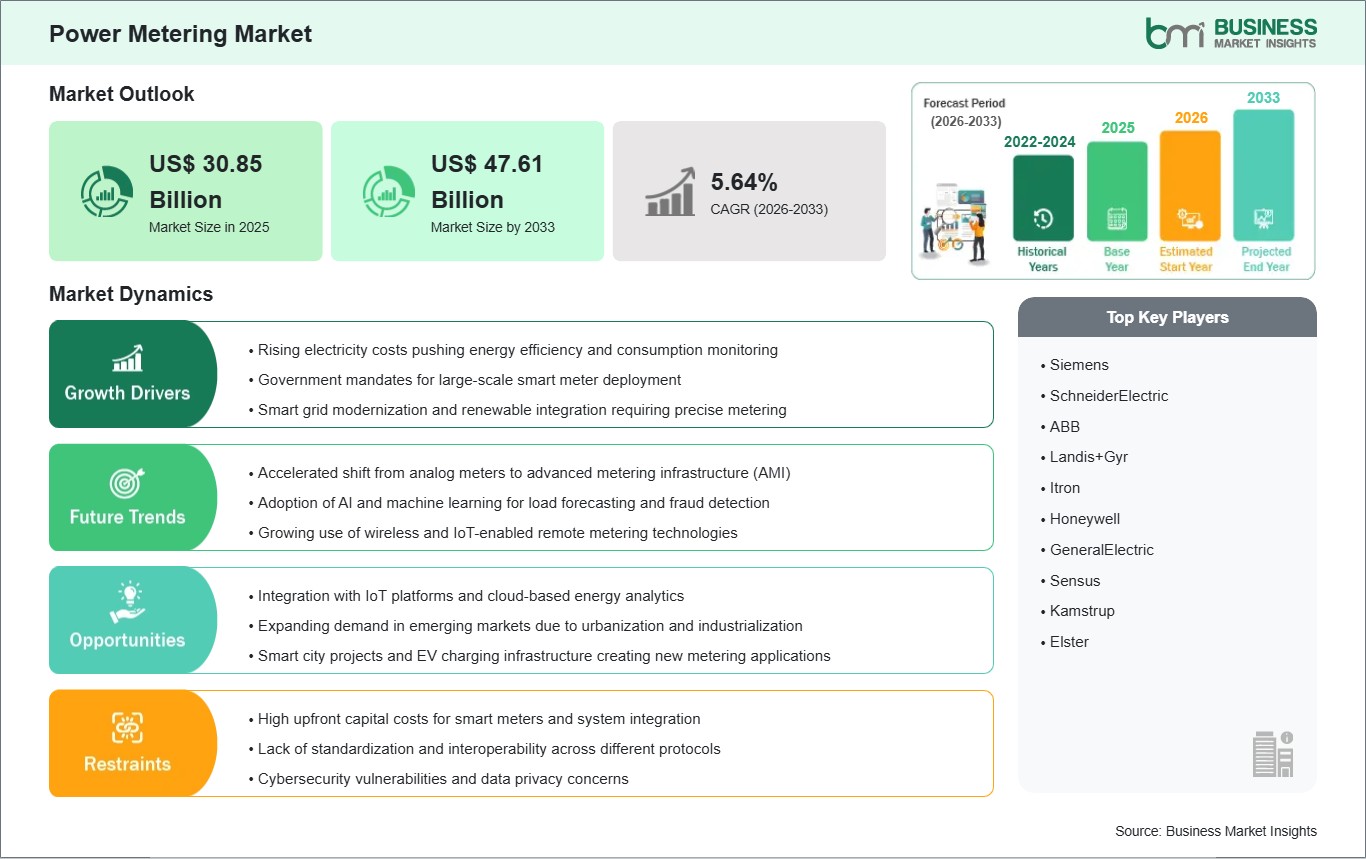
Power metering systems are devices that monitor, record, and manage electricity consumption in residential, commercial, and industrial settings. They enhance billing accuracy, grid monitoring, operational efficiency, and energy optimization by continuously measuring voltage, current, frequency, and power usage. The market is expanding as utilities and facility operators seek greater visibility into electricity distribution and consumption. Aging infrastructure, increasing electricity demand, and the shift toward intelligent grid systems are driving the modernization of metering frameworks. Regulatory emphasis on energy accountability and consumption monitoring is also supporting wider deployment in urban and industrial areas.
Industry segmentation reflects changing operational priorities among end users. Smart meters are increasingly preferred for their remote monitoring and real-time data communication. Three-phase systems remain prevalent in industrial and commercial operations that require accurate monitoring of higher electrical loads. Residential applications are adopting digital solutions to improve consumption transparency and billing management.
Technological advancements are expanding metering systems beyond traditional measurement. Advanced communication protocols, cloud-based monitoring, and integrated analytics are improving utility response and forecasting. Interoperability with smart grids and distributed energy resources is driving innovation in hardware and software. Competition is shaped by product differentiation, software integration, and regional modernization initiatives. Manufacturers are prioritizing scalable architectures, enhanced cybersecurity, and remote diagnostics to strengthen their market position. Partnerships among utilities, technology providers, and grid modernization agencies continue to influence product development and deployment strategies globally.
Segment Analysis
Power Metering Market Segmentation
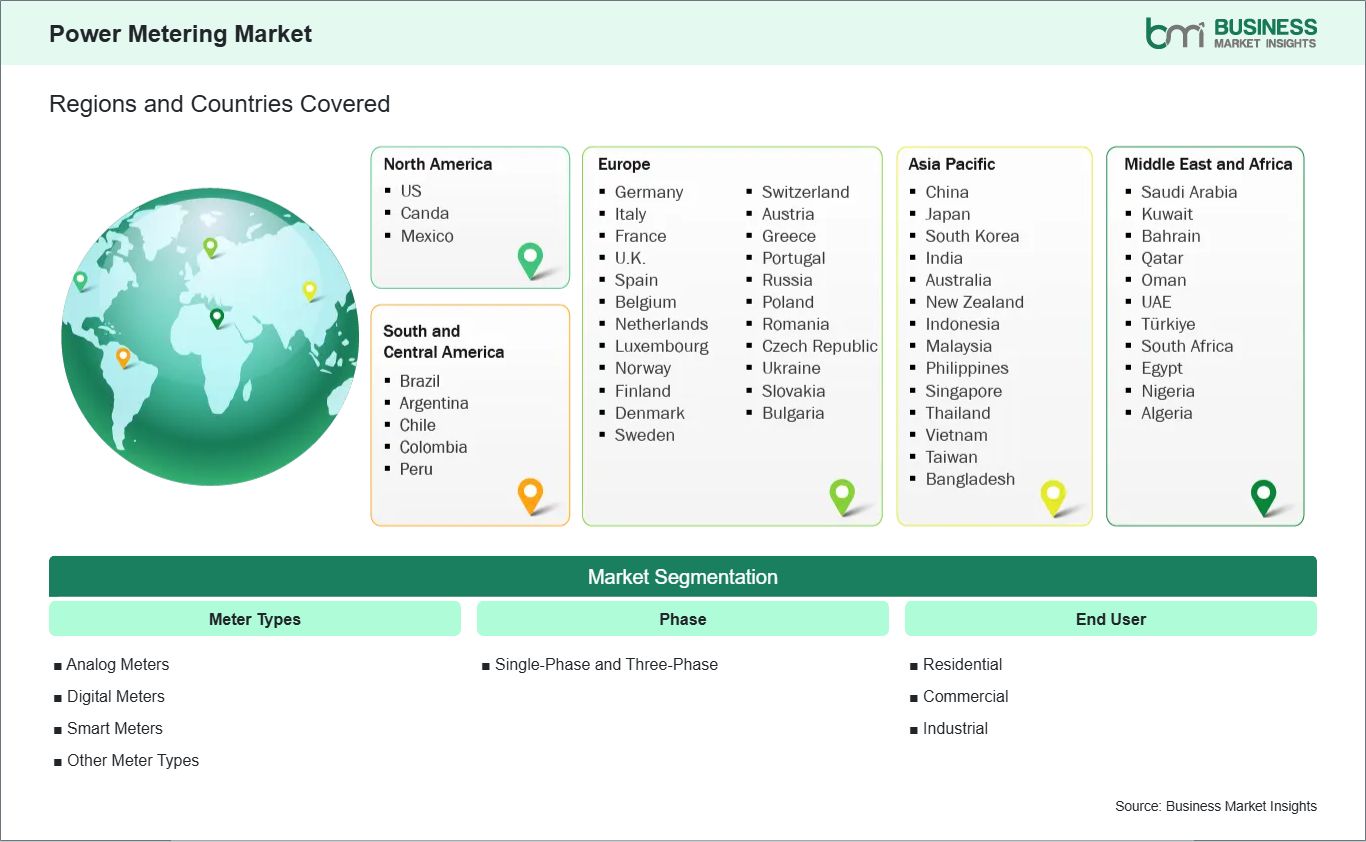
The Power Metering market is segmented by meter types, phase, and end user, with adoption trends varying according to metering configuration, electrical phase needs, and operational priorities.
By Meter Type
- Analog Meters - Retained in legacy installations requiring basic consumption monitoring.
- Digital Meters - Preferred for improved reading precision and operational reliability.
- Smart Meters - Expanding deployment through remote monitoring and data communication capabilities.
- Other Meter Types - Specialized applications support customized industrial measurement requirements.
By Phase
- Single-Phase - Commonly utilized across residential electricity distribution networks.
- Three-Phase - Supports heavy-load commercial and industrial electrical operations.
By End User
- Residential - Deployment increases alongside smart housing infrastructure initiatives.
- Commercial - Energy optimization targets encourage advanced metering integration.
- Industrial - Continuous monitoring improves operational efficiency and power management.
Market Forces
Power Metering Market Drivers and Opportunities
Expansion of Smart Grid Infrastructure
Utility operators are upgrading electricity distribution systems to enhance monitoring precision and operational responsiveness. Traditional metering technologies limit real-time visibility into consumption and network performance. As utilities adopt automated grid management, power metering solutions with communication and analytics features are being deployed more widely across transmission and distribution networks.
The shift to intelligent grid ecosystems has increased the need for accurate energy measurement and remote operational control. Advanced metering frameworks enable outage detection, demand forecasting, and energy balancing in interconnected networks. These features have made digital and smart metering technologies more relevant in utility modernization and large-scale infrastructure projects.
Integration of Data Analytics and Energy Management Platforms
Power metering systems are increasingly integrated with analytics platforms that provide real-time operational insights and predictive monitoring. Facility operators are adopting intelligent monitoring that combines consumption data with automation to improve energy efficiency and infrastructure use. This trend is creating opportunities for software-enabled metering solutions in commercial and industrial settings.
Future market growth will likely benefit from the wider adoption of cloud-based energy management and distributed energy infrastructure. Advanced metering platforms that support renewable integration and decentralized grid operations are expected to see increased deployment. Improved interoperability and remote access will also drive broader implementation in emerging smart infrastructure projects.
Size and Share Analysis
Power Metering Market Size and Share Analysis
The power metering market is projected to reach US$ 47.61 billion by 2033, up from US$ 30.85 billion in 2025, with a CAGR of 5.64% from 2026 to 2033. This growth reflects the ongoing shift to intelligent electrical infrastructure and the modernization of utility monitoring in residential, commercial, and industrial sectors.
Smart meters hold a significant share of the market due to their remote communication features and compatibility with smart grids. Digital metering technologies are also replacing analog systems as utilities focus on operational efficiency, data accessibility, and automated consumption monitoring.
Industrial applications represent significant deployment, as large facilities require continuous energy monitoring and load management. Commercial establishments are also adopting advanced metering systems to enhance energy optimization and improve visibility into electricity consumption.
Report Coverage
Power Metering Market Report Coverage and Deliverables
The " Power Metering Market Size and Forecast (2022-2033)" report provides a detailed analysis of the market covering the following areas:
- Market size and forecast at global, regional, and country levels for all market segments covered under the scope
- Market trends, as well as drivers, restraints, and opportunities
- Market analysis covering key trends, global and regional framework, major players, regulations, and recent developments
- Industry landscape and competition analysis covering market concentration, heat map analysis, prominent players, and recent developments for the market
- Detailed company profiles, including SWOT analysis
Geographic Insights
Power Metering Market Geographic Insights
The Power Metering market displays varied regional adoption patterns shaped by infrastructure modernization, electricity consumption, utility digitization, and regulatory approaches. Market growth differs between mature utility ecosystems and developing distribution environments, leading to diverse deployment strategies across regions.
North America continues to focus on grid reliability and intelligent utility management. Utilities are adopting advanced metering infrastructure to enhance operational visibility and enable remote monitoring. Commercial and industrial sectors are implementing advanced metering technologies to support energy optimization and improve power usage transparency in large facilities.
Asia Pacific demonstrates substantial deployment potential due to ongoing urbanization, industrial expansion, and electricity infrastructure development projects. Governments and utility operators throughout the region are prioritizing smart grid implementation programs to improve distribution efficiency and support rising electricity demand. Expanding residential electrification initiatives and industrial modernization activities continue to reinforce the requirement for advanced power metering systems.
Europe maintains a strong focus on energy efficiency compliance and sustainable infrastructure transformation, encouraging the adoption of intelligent metering technologies. Regulatory frameworks supporting carbon reduction and energy transparency continue shaping deployment activity across the region. Emerging markets within the Middle East, Africa, and South and Central America are gradually strengthening utility modernization efforts, creating new opportunities for digital and smart metering integration across evolving power distribution networks.
Industry Activity
Recent Developments
The Power Metering market is assessed using qualitative and quantitative data from primary and secondary research, including corporate publications, association data, and databases. Key recent developments in the market include:
- In November 2026, Kimbal partnered with MicroEJ to implement its new software platform, Kimbal EI (Edge Intelligence), aimed at enhancing smart meters with distributed intelligence. This partnership is set to facilitate faster customization and global deployment in alignment with AMI 2.0 and energy transition goals. Kimbal, a leading energy-tech company in India, distributes nearly 10 million smart meters annually and is integral to the country's plan to deploy 250 million smart meters by 2028. The modular, agile software strategy will enable these meters to offer AI-enabled services for both utilities and consumers.
- In July 2025, LEM launched the DCES600 and DCES1500 series of DC energy meters designed for fast and megawatt EV chargers. These meters achieve Class B accuracy at currents up to 1,500 A and can operate in temperatures from -40° to +85° C without derating. They meet international metrology certifications, ensuring precise measurements for kWh billing and regulatory compliance. The meters feature an RS485 communication interface with cybersecurity capabilities and are supported by various application programming interfaces (APIs) for software integration.
Trust & Transparency
Research Methodology
The market analysis combines proprietary research with secondary data from government agencies, company disclosures, regulatory filings, industry databases and expert interviews. Market estimates are validated through data triangulation, cross-market benchmarking and analyst
review.
View Full Research Methodology
Key Sources Referred:
European Commission US Department of Energy International Atomic Energy Agency (IAEA) International Energy Agency (IEA) Company Websites Company Annual Reports Company Investor Presentations