
Power Cables Market Outlook: Size, Share, Trends, Growth Analysis, Competitive Landscape & Forecast, 2026-2033

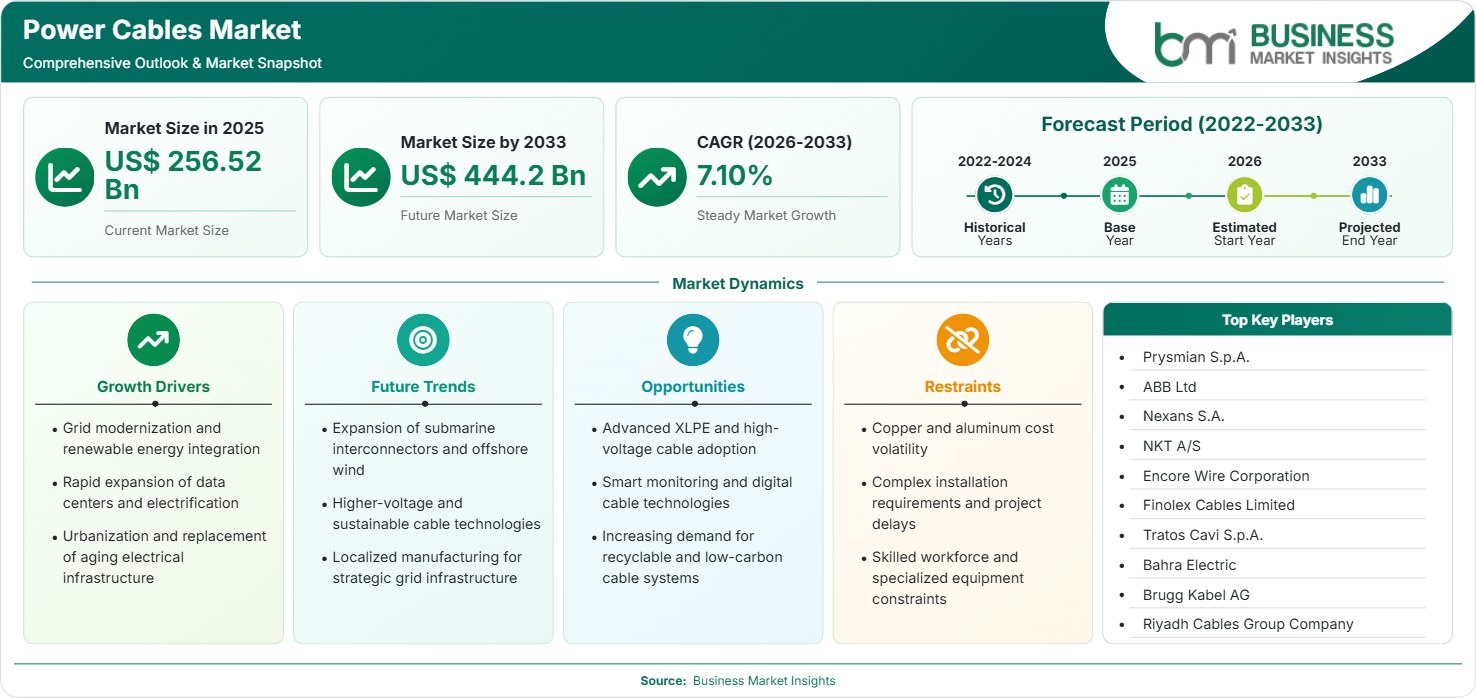
The Power Cables Market size was valued at US$ 256.52 Billion in 2025 and is projected to reach US$ 444.2 Billion by 2033, growing at a CAGR of 7.10% during 2026–2033, supported by grid modernization, renewable integration, electrification, data centers, industrial expansion, rail infrastructure, and underground transmission investments.

Report Coverage
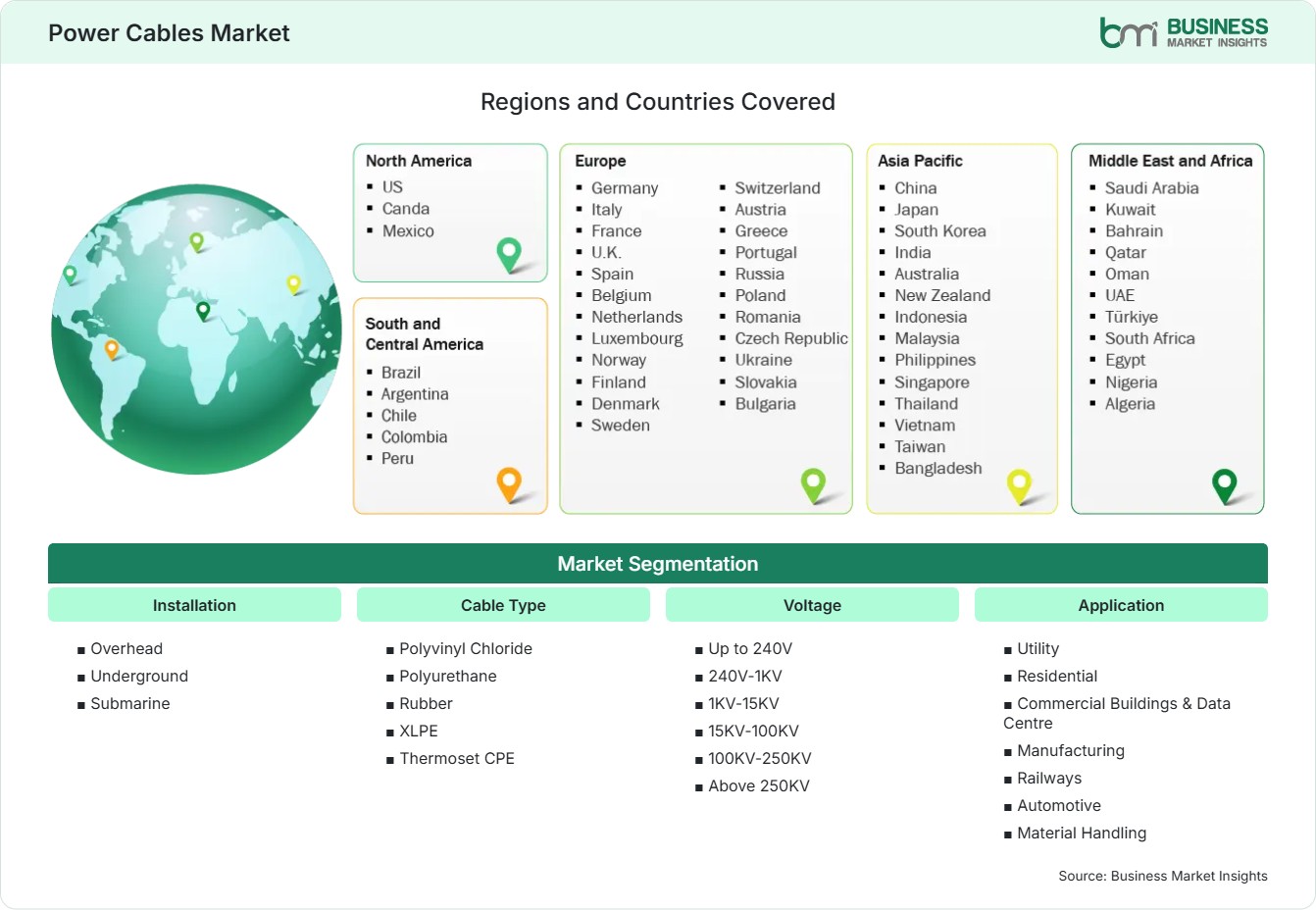
  • Installation: Overhead, Underground, Submarine
  • Cable Type: Polyvinyl Chloride, Polyurethane, Rubber, XLPE, Thermoset CPE
  • Voltage: Up to 240V, 240V-1KV, 1KV-15KV, 15KV-100KV, 100KV-250KV, Above 250KV
  • Application: Utility, Residential, Commercial Buildings & Data Centre, Manufacturing, Railways, Automotive, Material Handling
US$ 256.52 Bn Market size in 2025
US$ 444.2 Bn Market Size by 2033
7.10% CAGR, 2026 - 2033
2026-2033 Forecast Period

AI Overview

Power Cables Market Summary

  • North America Region: North America holds a 20%–21% share of the Power Cables Market in 2025, with a modeled 6.7%–7.1% CAGR during 2026–2033, supported by grid replacement, data-center expansion, renewable generation, electrification, utility modernization, and resilient distribution infrastructure. The U.S. represents most regional demand, with a modeled 6.8%–7.2% CAGR, driven by utility upgrades, data centers, renewable projects, and industrial electrification.
  • Fastest Growing Region: Asia Pacific holds a 38%–39% share in 2025, with a modeled 7.6%–8.1% CAGR during 2026–2033, supported by urbanization, electricity demand, renewable capacity additions, industrialization, transmission expansion, metro development, and large-scale infrastructure investment.
  • Leading Segment: Underground installation holds a 42%–44% share of the Power Cables Market in 2025, with a modeled 7.3%–7.7% CAGR during 2026–2033, supported by urban grid expansion, reliability requirements, land constraints, renewable interconnection, infrastructure resilience, and replacement of aging overhead networks.
  • High Growth Segment: Submarine installation holds a 7%–9% share of the Power Cables Market in 2025, with a modeled 8.2%–8.6% CAGR during 2026–2033, supported by offshore wind, cross-border interconnectors, island connectivity, floating generation, renewable integration, and long-distance high-voltage transmission projects.
  • Key Market Opportunity: Higher-voltage transmission, submarine interconnectors, recyclable insulation, low-carbon materials, smart monitoring, renewable integration, and data-center power infrastructure create attractive opportunities for technologically differentiated cable suppliers.
  • Major Market Players: Prysmian S.p.A., ABB Ltd, Nexans S.A., NKT A/S, Encore Wire Corporation, Finolex Cables Limited, Tratos Cavi S.p.A., Bahra Electric, Brugg Kabel AG, and Riyadh Cables Group Company.
Strategic Insights

Power Cables Market: Strategic Insights

Power Cables Market Strategic Framework
FREE PDF
Request your free sample
Request free sample
Stakeholder View

Key Takeaways

  • Cable manufacturers are increasingly competing through conductor efficiency, insulation technology, testing capabilities, project execution, manufacturing scale, and long-term utility relationships rather than commodity pricing alone.
  • Underground and submarine infrastructure provides substantial upside as cities face land constraints while renewable projects increasingly require long-distance transmission and interconnection capacity.
  • XLPE technology remains strategically important because it supports compact installations, higher operating temperatures, improved reliability, and applications across medium- and high-voltage networks.
  • Asia Pacific provides the strongest investment case because China, India, and Southeast Asian economies are expanding electricity networks alongside industrial, renewable-energy, transport, and urban infrastructure.
  • Consolidation and capacity investment are reshaping the competitive environment, with major manufacturers pursuing geographic expansion, vertical integration, technology development, and strategic acquisitions.
  • Cable producers must manage copper and aluminum exposure while simultaneously meeting increasingly demanding sustainability, fire performance, recycling, reliability, and lifecycle requirements.
Geographic Outlook

Power Cables Market Regional Highlights

North America Power Cables Market

North America held a 20%–21% share in 2025 and is modeled to expand at 6.7%–7.1% CAGR during 2026–2033. The Power Cables Market share reflects strong utility investment, data-center construction, renewable integration, industrial electrification, and replacement of aging infrastructure. Demand is increasingly concentrated around high-capacity transmission, underground distribution, and resilient grid projects. The U.S. dominates regional consumption, while Canada and Mexico provide additional opportunities through renewable development, industrial projects, transmission modernization, and cross-border electricity infrastructure.

  • Utility modernization is supporting replacement demand for aging distribution networks, while reliability requirements encourage undergrounding and higher-performance cable systems.
  • Data-center construction is creating concentrated demand for medium- and high-voltage power infrastructure capable of supporting large, continuous electricity loads.
  • Renewable projects require new transmission connections, increasing demand for high-voltage cables and specialized systems connecting remote generation to population centers.
  • Mexico and Canada provide incremental opportunities through industrial investment, renewable generation, grid modernization, and cross-border electricity infrastructure.

US Power Cables Market

The U.S. represented approximately 72%–74% of North American demand in 2025 and is modeled at 6.8%–7.2% CAGR during 2026–2033. The Power Cables Market growth is supported by grid replacement, renewable-energy interconnection, data centers, manufacturing investment, electric transportation, and utility resilience programs. Demand is increasingly shifting toward higher-capacity systems and underground infrastructure as electricity consumption becomes more concentrated and grid operators prioritize reliability.

  • Large data centers require dedicated electrical infrastructure, increasing procurement of medium- and high-voltage cables around technology clusters and new power-generation projects.
  • Utility resilience programs support replacement of aging conductors and expansion of underground networks in areas exposed to severe weather and reliability constraints.
  • Manufacturing and electrification projects are increasing demand for industrial power cables across factories, logistics facilities, transportation infrastructure, and commercial developments.

Europe Power Cables Market

Europe accounted for a 24%–25% share in 2025 and is modeled at 6.2%–6.6% CAGR of the Power Cables Market during 2026–2033. Germany, the U.K., France, Italy, and the Nordic countries remain important demand centers. Germany is modeled at 6.3%–6.7% CAGR, while the U.K. is modeled at 6.6%–7.0%. Offshore wind, interconnection, renewable integration, and network modernization are shaping procurement priorities across the region.

  • Offshore wind development is increasing demand for submarine export cables and interconnectors connecting renewable generation with national electricity grids.
  • Germany is expanding transmission infrastructure to connect renewable generation with industrial demand centers, supporting high-voltage cable procurement and grid reinforcement.
  • The U.K. offers strong opportunities in offshore wind, subsea interconnection, transmission reinforcement, and electricity-network modernization.
  • Nordic markets benefit from renewable electricity development and cross-border transmission projects requiring advanced high-voltage and submarine cable technologies.

Asia Pacific Power Cables Market

Asia Pacific held a 38%–39% share in 2025 and is modeled to grow at 7.6%–8.1% CAGR during 2026–2033, making it the fastest-growing region. China and India represent major demand centers, while Southeast Asia contributes additional growth. The region's Power Cables Market trends are closely linked with urbanization, renewable capacity, industrialization, metro systems, transmission expansion, and rapidly increasing electricity consumption.

  • China combines extensive transmission requirements with renewable generation, industrial electrification, urban development, and large-scale infrastructure projects requiring diverse cable technologies.
  • India is expanding transmission and distribution infrastructure alongside renewable-energy additions, industrial corridors, metro systems, data centers, and urban electrification.
  • Southeast Asia offers attractive growth as manufacturing relocation, urbanization, renewable projects, and electricity-network expansion increase cable procurement.
  • Japan and South Korea provide demand for high-quality transmission, industrial, marine, renewable, and infrastructure applications requiring stringent technical specifications.

Rest of World Power Cables Market

Rest of World accounted for 15%-16% of the market share in 2025 and is forecast to grow at a CAGR of 6.5%-7.2% between 2026 and 2033. South and Central America are powered by renewable energy production, mining, infrastructure development, and industrial growth. Opportunities include Brazil and Chile, while Mexico contributes through manufacturing and power investment. The Middle East & Africa are growing due to increased renewable energy projects, industrial diversification, and infrastructure development.

  • Brazil is expanding renewable generation and transmission networks, creating demand for overhead, underground, and high-voltage cable systems.
  • Chile's mining and renewable sectors require dependable electricity transmission infrastructure across geographically dispersed industrial and generation locations.
  • Saudi Arabia and the UAE are developing power infrastructure alongside industrial diversification, smart cities, renewable generation, and large-scale construction.
  • African markets provide longer-term potential through electrification, renewable generation, urban development, and regional transmission interconnection projects.
Global Market Geography
FREE PDF
Request your free sample
Request free sample
Segment Analysis

Power Cables Market Segmentation

Installation

The Installation segment includes Overhead, Underground, and Submarine. Underground held 42%–44% share in 2025 and is modeled at 7.3%–7.7% CAGR of the Power Cables Market during 2026–2033, supported by urban density, grid resilience, land constraints, renewable interconnection, and replacement of aging infrastructure.

  • Overhead: Overhead cables remain important for cost-efficient transmission and distribution across open areas, supporting utility expansion, rural electrification, renewable connections, and long-distance networks.
  • Underground: Underground systems support dense cities, resilient grids, transport corridors, and visually sensitive locations where reliability, land availability, and weather protection influence infrastructure design.
  • Submarine: Submarine cables connect offshore generation, islands, and national grids, with demand supported by offshore wind, interconnectors, and long-distance renewable transmission.

Cable Type

The Cable Type segment includes Polyvinyl Chloride (PVC), Polyurethane (PUR), Rubber, XLPE, Thermoset CPE, and Others. XLPE represents the leading technology class, supported by electrical performance, temperature capability, compact construction, and broad use in medium- and high-voltage applications.

  • Polyvinyl Chloride (PVC): PVC cables remain widely used in lower-voltage applications because of cost efficiency, established manufacturing processes, installation flexibility, and broad building infrastructure compatibility.
  • Polyurethane (PUR): PUR provides abrasion, flexibility, and environmental resistance, supporting specialized industrial, transportation, automation, and demanding cable-routing applications.
  • Rubber: Rubber-insulated cables remain relevant where flexibility, mechanical durability, and resistance to harsh operating conditions are required across industrial and specialized electrical environments.
  • XLPE: XLPE supports high-performance transmission and distribution because of thermal stability, electrical strength, compact designs, and suitability for medium- and high-voltage infrastructure.
  • Thermoset CPE: Thermoset CPE provides durable insulation and jacketing characteristics for demanding industrial applications requiring resistance to heat, chemicals, moisture, and mechanical stress.

Voltage

The Voltage segment includes Upto 240V, 240V-1KV, 1KV-15KV, 15KV-100KV, 100KV- 250KV, and Above 250KV. Higher-voltage systems are gaining strategic importance as renewable generation, interconnection, and long-distance electricity transmission expand.

  • Up to 240V: Low-voltage cables serve residential and basic commercial applications, supporting building electrification, appliances, lighting, controls, and localized electricity distribution.
  • 240V-1KV: This range serves commercial, industrial, and building systems where dependable low-voltage distribution is required for equipment and facility operations.
  • 1KV-15KV: Medium-voltage systems support distribution networks, industrial facilities, renewable installations, and infrastructure requiring higher electrical capacity and reliability.
  • 15KV-100KV: Higher-voltage cables increasingly support utility distribution, industrial networks, renewable connections, and regional transmission infrastructure.
  • 100KV- 250KV: These cables support major transmission projects where efficient electricity movement across longer distances requires stronger insulation and specialized engineering.
  • Above 250KV: Extra-high-voltage systems enable high-capacity transmission, renewable integration, and interconnection projects requiring advanced insulation, testing, installation, and monitoring capabilities.

Application

The Application segment includes Utility, Residential, Commercial Buildings & Data Centre, Manufacturing, Railways, Automotive, Material Handling, and Others. Utility applications remain the largest demand center because transmission and distribution networks require extensive cable deployment.

  • Utility: Utilities require cables for generation interconnection, transmission, distribution, substations, grid reinforcement, renewable integration, and replacement of aging infrastructure.
  • Residential: Residential demand is supported by new construction, electrification, renovation, distribution upgrades, and increasing electrical loads within modern homes.
  • Commercial Buildings & Data Centre: Commercial buildings and data centers require reliable high-capacity electrical distribution to support digital infrastructure, cooling systems, automation, and continuous operations.
  • Manufacturing: Manufacturing facilities use industrial cables for machinery, motors, production systems, automation, plant distribution, and energy-intensive equipment.
  • Railways: Railways require specialized electrical cable systems for traction, signaling, infrastructure power, stations, and electrified transport networks.
  • Automotive: Automotive manufacturing uses power cables across plants, automated production equipment, charging infrastructure, and high-load industrial systems.
  • Material Handling: Material-handling facilities use durable electrical cables across conveyors, cranes, automated warehouses, lifting equipment, and logistics systems.
Market Forces

Power Cables Market Dynamics

Key Market Drivers

Grid Modernization and Renewable Energy Integration

Grid modernization is strengthening demand for new transmission and distribution infrastructure as electricity systems accommodate renewable generation, electrification, and changing load profiles. The IEA still considers grid investments an important need for integrating new generation and power supplies. The Power Cables Market growth in the underground, high-voltage, and submarine sectors. Renewable projects are typically located far from major consumption centers, which will increase transmission needs. Utility companies now prioritize high-capacity cables, improved insulation, robust designs, and advanced testing. The transition from traditional generation to renewable energy also means more connections to grid systems and, thus, greater cable needs in substations, transmission lines, offshore projects, and interconnections between regions. Power cable makers with advanced high-voltage engineering expertise can benefit from this situation.

Rapid Expansion of Data Centers and Electrification

Data centers are now creating high-power loads, which require dependable power distribution from utility companies to the facilities and within the internal power system. Artificial intelligence workloads have further increased the power load, reinforcing the need for an efficient electrical system. Electric mobility, industrial electrification, heat pumps, and digital infrastructures, on the other hand, are increasing electricity consumption. All this development is driving up demand for medium- and high-voltage cables for substations, distribution, commercial establishments, and direct power connections. This trend is especially relevant in the U.S., Europe, and the Asia-Pacific region because technology investments and grid limitations occur simultaneously in these regions.

Urbanization and Replacement of Aging Electrical Infrastructure

The process of urbanization is fueling the need for electricity while making the development of more overhead infrastructure impractical in crowded spaces. Cables that run underground are a viable option, as factors such as space, aesthetics, reliability, and weather exposure will influence the infrastructure design. Another factor driving the market is aging infrastructure, as utilities are forced to upgrade existing conductors, insulation systems, and other components. Upgrading in current times focuses on improving reliability, capacity, and resilience to extreme weather. These Power Cables Market trends fuel demand regardless of whether new generation facilities are being constructed. Asia Pacific has significant opportunities in this regard due to urbanization and industrialization, while North America and Europe have replacement needs in mature infrastructure.

Key Market Opportunities

Expansion of Submarine Interconnectors and Offshore Wind

Offshore wind is also presenting an increasingly specific opportunity for submarine power cables to link generating facilities with onshore transmission networks. Interconnectors between countries are another avenue for growth, enabling the trade of power across national boundaries and helping balance renewables. Prysmian established the technology path back in March 2026 when it completed testing of a 525kV submarine HVDC cable capable of transmitting 2.5 GW per cable at elevated temperatures. Both of these innovations enable higher capacity transmission while requiring fewer cables. Suppliers with submarine manufacturing, installation vessel, testing, and project management capabilities will benefit more, as the technology is more challenging than traditional cables.

Higher-Voltage and Sustainable Cable Technologies

Utilities are increasingly seeking cable technologies that combine higher electrical capacity with improved environmental performance. Prysmian’s contract with Alliander, signed in March 2026, concerns medium- and low-voltage cables used for Dutch network upgrades and utilizes recyclable P-Laser, recycled copper, low-carbon and recycled aluminum, recycled PVC, and raw material passports. This provides an example of the emerging opportunity for the supplier to differentiate itself based on lifecycle performance, in addition to electrical characteristics. Characteristics such as advanced insulation, material recyclability, digital traceability, and a low carbon footprint during production may be beneficial in procurement processes when considering sustainability criteria. Power Cables Market Forecasts therefore increasingly favor suppliers capable of combining engineering performance, material efficiency, regulatory compliance, and transparent sourcing.

Localized Manufacturing for Strategic Grid Infrastructure

Local manufacturing would be an opportunity to reduce lead time, logistical risk, and supply chain disruption, and to increase the company’s responsiveness to utilities' needs. In March 2026, ABB announced plans for an additional investment of about $75 million in India to enhance manufacturing and R&D facilities for renewable energy projects, metro rail networks, and data centers. Such a strategy may work well for cable manufacturers as it would put their production closer to fast-growing electricity markets. Local manufacturing would help in adapting manufacturing processes to local regulations, project-specific requirements, installation practices, and utilities’ procurement systems. Firms that integrate their local manufacturing capabilities with global engineering knowledge may be well-placed to develop stronger customer relationships and pursue competitive projects, especially in countries with rapid infrastructure investment.

Market Restraints and Challenges

Copper and Aluminum Cost Volatility

Factor: Copper and aluminum represent major input costs in power cable manufacturing, exposing producers to commodity-price movements, supply disruptions, currency fluctuations, and procurement timing. High-voltage projects can require substantial quantities of conductive metals, amplifying cost sensitivity. Impact: Sudden material-price increases can compress manufacturer margins when contracts contain limited escalation mechanisms and can also increase project costs for utilities and infrastructure developers. Producers therefore require disciplined procurement, hedging strategies, inventory management, recycled-material sourcing, and contract structures that address commodity fluctuations. Material substitution can provide limited relief because electrical performance, conductor dimensions, regulatory requirements, and project specifications constrain the ability to replace copper with aluminum across every application.

Complex Installation Requirements and Project Delays

Factor: High-voltage underground and submarine cable projects require specialized engineering, route surveys, jointing, testing, permitting, installation equipment, and skilled technical personnel. Subsea projects also depend on limited vessel availability and complex marine conditions. Impact: Installation bottlenecks can extend project schedules, increase financing costs, and constrain the pace at which new transmission capacity becomes operational. Qualification requirements further lengthen procurement cycles because utilities require extensive testing and reliability assurance. Manufacturers must therefore invest in engineering teams, installation capabilities, testing infrastructure, digital project management, and long-term technical partnerships. These requirements create barriers to entry but can also limit market expansion when skilled capacity and specialized equipment cannot scale as quickly as project pipelines.

Company Analysis

Competitive Landscape

The Power Cables Market analysis indicates competition is concentrated among integrated cable manufacturers and electrical technology companies with capabilities spanning conductors, insulation, high-voltage systems, engineering, testing, and project execution.

Company Name

Overview

Products and Services relevant to this market

Prysmian S.p.A.

Italy-based global cable manufacturer with extensive electrification, transmission, distribution, and subsea capabilities.

Power cables, high-voltage systems, submarine cables, grid solutions, installation, testing, and project services.

ABB Ltd

Global electrification and automation company serving utilities, infrastructure, industrial, and transportation customers.

Electrification products, cable systems, grid technologies, charging infrastructure, and electrical distribution solutions.

Nexans S.A.

France-based cable specialist focused on electrification, grids, infrastructure, industry, and energy transition applications.

Low-, medium-, and high-voltage cables, submarine systems, grid solutions, and installation services.

NKT A/S

Danish power-cable specialist with strong positioning in European transmission infrastructure and high-voltage projects.

High-voltage AC/DC cables, submarine cables, accessories, installation, and grid project solutions.

Encore Wire Corporation

U.S. manufacturer serving electrical distribution, construction, commercial, and industrial applications.

Copper and aluminum building wire, electrical conductors, and power distribution products.

Finolex Cables Limited

Indian cable manufacturer with broad electrical and infrastructure product capabilities.

Power cables, electrical cables, industrial cables, building wires, and specialized cable products.

Tratos Cavi S.p.A.

Italian cable manufacturer serving energy, industrial, transportation, and infrastructure markets internationally.

Medium- and high-voltage cables, industrial cables, submarine products, and customized cable systems.

Bahra Electric

Saudi Arabian cable producer serving regional construction, utility, infrastructure, and energy requirements.

Power cables, medium- and high-voltage cables, building wires, and electrical infrastructure products.

Brugg Kabel AG

Swiss cable specialist with expertise in energy transmission, distribution, and specialized cable systems.

Medium- and high-voltage cables, underground systems, accessories, and transmission solutions.

Riyadh Cables Group Company

Saudi Arabian manufacturer supporting regional electricity, construction, utility, and infrastructure projects.

Power cables, high-voltage products, building wires, control cables, and infrastructure cable systems.

Trust & Transparency

Research Methodology

The market analysis combines proprietary research with secondary data from government agencies, company disclosures, regulatory filings, industry databases and expert interviews. Market estimates are validated through data triangulation, cross-market benchmarking and analyst review.

View Full Research Methodology

Questions Answered

Frequently Asked Questions

What is the long-term Power Cables Market Report opportunity?

The strongest opportunities are concentrated in grid modernization, renewable integration, offshore transmission, underground networks, data centers, industrial electrification, and higher-voltage systems. Suppliers combining manufacturing scale with advanced engineering, sustainable materials, and project execution capabilities can capture greater value.

How does copper pricing affect cable manufacturers?

Copper is a major conductor input, so price movements directly influence production costs, inventory values, contract margins, and project economics. Manufacturers manage exposure through procurement strategies, inventory planning, contract mechanisms, hedging, and selective use of aluminum conductors.

What is driving demand for submarine power cables?

Offshore wind farms, cross-border electricity interconnectors, island grids, and long-distance renewable transmission are increasing demand. Higher-capacity HVDC technologies are also improving the economics of transmitting large amounts of electricity across long subsea distances.

Why are XLPE cables widely used in power networks?

XLPE provides strong electrical insulation, thermal performance, compact construction, and suitability for medium- and high-voltage applications. These characteristics make it practical for underground distribution, industrial networks, renewable interconnections, and transmission infrastructure requiring reliable long-term performance.

How are power cables selected for renewable-energy projects?

Selection depends on voltage, current capacity, transmission distance, installation environment, conductor material, insulation technology, thermal requirements, route conditions, and applicable standards. Offshore projects additionally require specialized submarine construction, mechanical protection, jointing, testing, and installation capabilities.

Access the Full Power Cables Market Report

Get segment-level forecasts, regional estimates, competitive benchmarking, company profiles and downloadable Excel datasets.

Access the full Power Cables Market Report
350 pages PDF & Excel | 2026-08-27