
AI In Power Utilities Market Outlook: Size, Share, Trends, Growth Analysis, Competitive Landscape & Forecast, 2026–2033

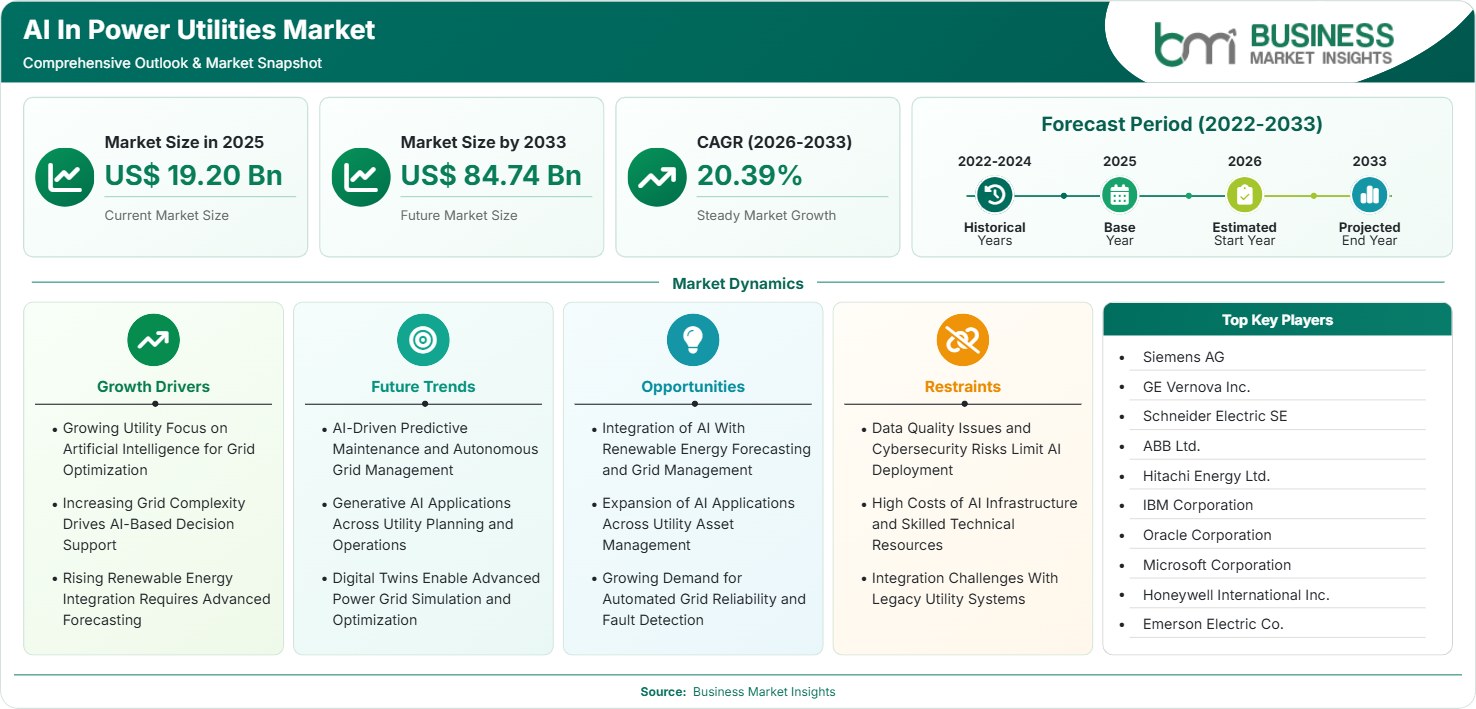
The AI In Power Utilities Market size was valued at US$ 19.20 Billion in 2025 and is projected to reach US$ 84.74 Billion by 2033, growing at a CAGR of 20.39% during 2026–2033, driven by grid digitalization, renewable integration, predictive analytics, automation, asset intelligence, and demand for resilient power infrastructure.

Report Coverage
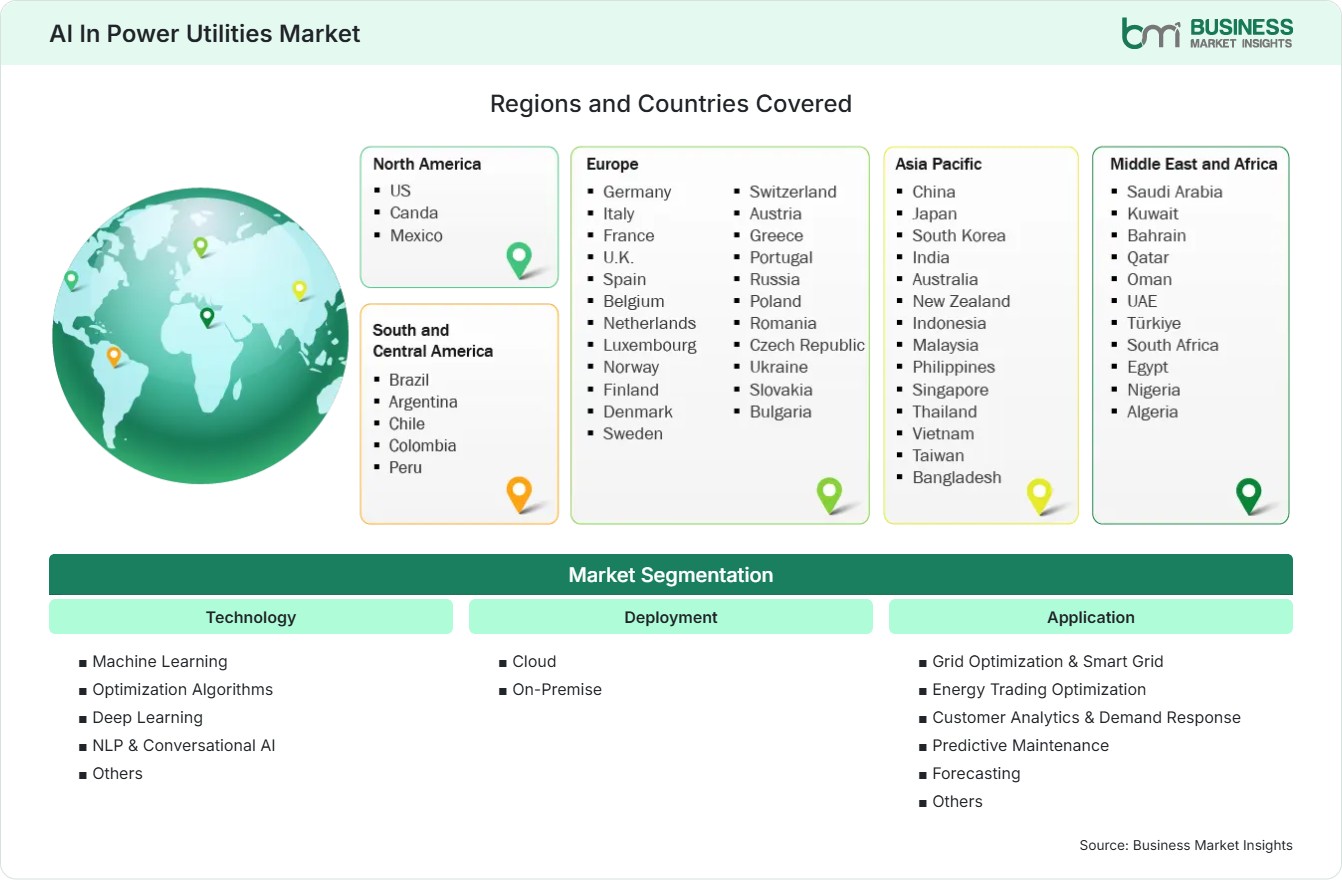
  • Technology: Machine Learning, Optimization Algorithms, Deep Learning, NLP & Conversational AI, Others
  • Deployment: Cloud, On-Premise
  • Application: Grid Optimization & Smart Grid, Energy Trading Optimization, Customer Analytics & Demand Response, Predictive Maintenance, Forecasting, Others
US$ 19.20 Bn Market size in 2025
US$ 84.74 Bn Market Size by 2033
20.39% CAGR, 2026 - 2033
2026-2033 Forecast Period

01 AI Overview

AI In Power Utilities Market Summary

  • North America Region: North America holds a 34%–38% AI In Power Utilities Market share in 2025, with a 19.6%–20.4% CAGR during 2026–2033, supported by grid modernization, utility digitalization, cybersecurity investment, and rising electricity demand. The US represents 82%–86% of regional demand, with a 19.8%–20.6% CAGR during 2026–2033, supported by advanced grid infrastructure, AI investment, utility automation, and increasing system complexity.
  • Fastest Growing Region: Asia Pacific holds a 24%–28% share in 2025, with a 22.4%–23.2% CAGR during 2026–2033, supported by rapid electricity demand growth, smart-grid deployment, renewable capacity expansion, digital infrastructure investment, utility modernization, and expanding AI capabilities.
  • Leading Segment: Machine Learning holds a 31%–35% share in 2025, with a 20.1%–20.8% CAGR during 2026–2033, supported by forecasting, anomaly detection, predictive maintenance, demand management, asset monitoring, and scalable utility analytics.
  • High Growth Segment: Predictive Maintenance holds a 18%–22% share in 2025, with a 22.8%–23.6% CAGR during 2026–2033, supported by aging infrastructure, connected assets, equipment monitoring, failure prediction, maintenance optimization, and reliability requirements.
  • Key Market Opportunity: Integration of AI with grid management, renewable forecasting, asset intelligence, automated fault detection, demand response, and utility planning creates opportunities for scalable digital transformation.
  • Major Market Players: Siemens AG, GE Vernova Inc., Schneider Electric SE, ABB Ltd., Hitachi Energy Ltd., IBM Corporation, Oracle Corporation, Microsoft Corporation, Honeywell International Inc., Emerson Electric Co.
02 Strategic Insights

AI In Power Utilities Market: Strategic Insights

AI In Power Utilities Market Strategic Framework
FREE PDF
Request your free sample
Request free sample
03 Stakeholder View

Key Takeaways

  • Utility AI adoption is shifting from standalone analytics toward integrated operational platforms connecting planning, asset management, forecasting, control-room decision support, customer intelligence, and grid optimization.
  • Machine learning remains the leading technology segment, while predictive maintenance provides strong commercial upside because utilities can apply AI to equipment-health monitoring, failure prediction, and maintenance scheduling.
  • Data infrastructure is becoming a strategic prerequisite. Sensor connectivity, standardized utility datasets, cloud integration, cybersecurity, and IT-OT interoperability determine how effectively AI models can support operational decisions.
  • Asia Pacific presents the strongest expansion case as electricity demand, renewable generation, smart-grid investment, distributed resources, and utility modernization increase the volume and complexity of operational data.
  • Investment priorities are increasingly moving toward software platforms, digital twins, AI-enabled grid management, asset intelligence, forecasting, cybersecurity, and automation rather than isolated analytics tools.
  • Rising electricity demand from electrification and digital infrastructure is strengthening the requirement for accurate forecasting, capacity planning, congestion management, and automated grid coordination.
04 Geographic Outlook

AI In Power Utilities Market Regional Highlights

North America AI In Power Utilities Market

North America holds a 34%–38% share in 2025 and North America AI In Power Utilities Market forecast to expand at a 19.6%–20.4% CAGR through 2033. Utility modernization, grid resilience programs, renewable integration, electrification, and rising computational loads are increasing demand for intelligent grid management. The region benefits from mature digital infrastructure, extensive utility datasets, and established software adoption.

  • Aging transmission and distribution infrastructure is increasing demand for predictive analytics, condition monitoring, automated inspection, and maintenance optimization across critical utility assets.
  • Renewable generation and distributed resources are increasing operational variability, creating greater requirements for forecasting, power-flow optimization, flexible dispatch, and real-time grid visibility.
  • Utility modernization programs are encouraging integration between operational technology, enterprise software, cloud platforms, sensors, and advanced analytics to improve system-wide decision-making.

US AI In Power Utilities Market

The US AI In Power Utilities Market represents 82%–86% of North American demand in 2025 and is projected to grow at a 19.8%–20.6% CAGR through 2033. Grid congestion, renewable integration, electrification, distributed resources, and rapidly increasing electricity demand are creating strong requirements for advanced forecasting and automated decision support. AI deployment is also being encouraged by the need to improve infrastructure utilization and accelerate grid planning.

  • Utility investment is increasingly focused on grid visibility, automated operations, predictive maintenance, demand forecasting, and software-supported capacity planning.
  • Increasing data-center electricity requirements are creating more complex load profiles and strengthening demand for forecasting, interconnection analysis, and flexible grid management.
  • Cybersecurity and reliability requirements are encouraging utilities to deploy AI within controlled environments with stronger governance, monitoring, human oversight, and secure IT-OT integration.

Europe AI In Power Utilities Market

Europe AI In Power Utilities Market accounts for a 21%–25% share in 2025 and is projected to grow at a 18.7%–19.5% CAGR through 2033. Germany, the United Kingdom, France, and Italy remain leading markets because of grid modernization, renewable integration, digital infrastructure, and established utility technology ecosystems. Spain provides comparatively high growth at a 20.5%–21.3% CAGR, supported by renewable deployment and grid digitalization.

  • Germany remains a major market because renewable integration, industrial electrification, network modernization, and distributed generation require advanced operational intelligence.
  • The United Kingdom benefits from grid flexibility requirements, renewable integration, network digitalization, and growing need for predictive planning across increasingly decentralized electricity systems.
  • France and Italy provide diversified opportunities through renewable integration, transmission modernization, smart-grid development, and increasing digitalization of utility operations.
  • Spain provides comparatively faster expansion as renewable generation increases the requirement for forecasting, balancing, grid optimization, and automated operational decision-making.

Asia Pacific AI In Power Utilities Market

Asia Pacific AI In Power Utilities Market represents a 24%–28% share in 2025 and is projected to grow at an 22.4%–23.2% CAGR through 2033, making it the fastest-growing regional market. China, Japan, South Korea, India, and Australia provide substantial opportunities through grid modernization, renewable expansion, industrial electrification, and digital utility investment. India provides comparatively strong growth at a 24.0%–24.8% CAGR, supported by smart-grid programs, renewable capacity additions, expanding electricity demand, and increasing digitalization of utility operations.

  • China provides substantial demand through extensive electricity infrastructure, renewable integration, grid automation, industrial digitalization, and large-scale investment in intelligent energy systems.
  • India provides strong growth potential as electricity consumption, renewable generation, smart-meter deployment, distribution modernization, and utility digitization continue expanding.
  • Japan and South Korea benefit from sophisticated electricity infrastructure, advanced technology adoption, renewable integration requirements, and strong demand for operational reliability.
  • Australia provides opportunities through renewable penetration, distributed generation, storage deployment, network modernization, and increasing requirements for intelligent energy management.

Rest of World AI In Power Utilities Market

Rest of World accounts for a 11%–15% share in 2025 and is projected to grow at a 18.0%–19.0% CAGR through 2033. South and Central America are supported by renewable expansion, distribution modernization, electrification, and digital infrastructure investment. Brazil and Mexico remain leading markets, while Chile provides comparatively high growth at a 20.0%–20.8% CAGR. Middle Eastern and African markets are increasingly investing in smart grids, renewable generation, storage, and utility automation as electricity demand and infrastructure requirements expand. South and Central American adoption is driven by renewable generation, transmission expansion, grid reliability requirements, distributed resources, and utility modernization. Middle Eastern and African opportunities are supported by renewable projects, electricity-access programs, smart-grid investment, infrastructure development, and digital transformation.

  • Brazil and Mexico provide substantial demand through renewable integration, distribution modernization, grid reliability programs, and increasing digitalization of utility operations.
  • Chile provides comparatively strong growth as renewable penetration, storage deployment, transmission development, and system flexibility requirements increase.
  • Saudi Arabia and the United Arab Emirates benefit from large infrastructure programs, renewable investment, digital utility initiatives, and smart-grid development.
  • African markets provide longer-term potential as electrification, renewable deployment, grid expansion, and utility digitalization improve operational data availability.
Global Market Geography
FREE PDF
Request your free sample
Request free sample
05 Segment Analysis

AI In Power Utilities Market Segmentation

Technology

Technology adoption is centered on machine learning, optimization algorithms, deep learning, NLP and conversational AI, reflecting different requirements across utility planning and operations. Machine Learning leads with a 31%–35% share in 2025 and a 20.1%–20.8% CAGR through 2034, supported by forecasting, anomaly detection, predictive maintenance, demand management, and scalable analytical deployment across utility environments.

  • Machine Learning: Supports load forecasting, anomaly detection, asset monitoring, demand prediction, renewable forecasting, and operational analytics using structured utility datasets and continuously updated information.
  • Optimization Algorithms: Improve power-flow management, generation scheduling, energy trading, resource allocation, network planning, and operational decisions where utilities manage multiple technical constraints simultaneously.
  • Deep Learning: Enables complex pattern recognition across high-volume operational data, supporting advanced forecasting, image-based inspection, anomaly identification, and sophisticated asset intelligence applications.
  • NLP & Conversational AI: Improves access to utility information through natural-language interfaces, automated knowledge retrieval, operator assistance, document analysis, and conversational decision-support capabilities.

Deployment

Deployment preferences reflect security requirements, infrastructure maturity, data governance, scalability, and utility operating models. Cloud deployment holds a 55%–59% share in 2025 and is projected to grow at a 21.2%–21.9% CAGR through 2034, supported by scalable computing, centralized analytics, flexible software access, and integration with expanding utility data environments.

  • Cloud: Provides scalable computing, centralized analytics, flexible infrastructure, faster software deployment, and integration capabilities for utilities managing growing volumes of operational data.
  • On-Premise: Supports stringent security, operational control, data sovereignty, low-latency processing, and integration requirements across critical infrastructure and sensitive utility environments.

Application

Application demand is broadening from forecasting toward integrated grid optimization, asset intelligence, customer analytics, trading, and automated reliability management. Grid Optimization & Smart Grid leads with a 28%–32% share in 2025 and a 20.8%–21.5% CAGR through 2034, supported by grid complexity, automation, and increasing demand for real-time operational visibility.

  • Grid Optimization & Smart Grid: Supports power-flow management, network visibility, distributed-resource coordination, automated operations, and improved utilization of increasingly complex electricity infrastructure.
  • Energy Trading Optimization: Uses predictive analytics, market information, generation forecasts, and optimization models to improve trading decisions, portfolio management, and exposure management.
  • Customer Analytics & Demand Response: Enables consumption analysis, demand prediction, segmentation, personalized engagement, load shifting, and flexible demand management across customer groups.
  • Predictive Maintenance: Uses asset data, condition monitoring, and analytical models to identify deterioration, prioritize maintenance, reduce failures, and improve equipment availability.
  • Forecasting: Supports electricity demand, renewable generation, load profiles, market conditions, and operational planning through continuously updated predictive models.
06 Market Forces

AI In Power Utilities Market Dynamics

Key Market Drivers

Growing Utility Focus on Artificial Intelligence for Grid Optimization

AI has been increasingly used by utilities in order to enhance network visibility, optimize power flow, coordination of distributed resources and enhancing decision making. Increasing availability of data due to connectivity and digitization of the utilities’ environment is increasing the feasibility of advanced analytics applications. AI driven optimization allows dealing with several factors simultaneously, allowing utilities to adapt to changes in demand, renewable generation, equipment status and network limitations. According to the International Energy Agency, AI is a technology that has the potential to improve efficiency and lower cost and promote innovation of the energy system while demand for electricity from AI infrastructure increases. These developments directly reinforce AI In Power Utilities Market growth and strengthen AI In Power Utilities Market trends toward intelligent, data-driven operations.

Increasing Grid Complexity Drives AI-Based Decision Support

Power systems are becoming more complex to manage due to distributed energy resources, bidirectional power flow, electrification, energy storage, fluctuating renewable energy output, and dynamic loads. Traditional rule-based systems might face difficulties when many operating variables change simultaneously. AI-based decision support systems help utility companies analyze large amounts of data quickly and detect patterns that classical monitoring methods cannot. Thus, the increasing need for situational awareness is one of the drivers of the use of AI-based decision support.

Rising Renewable Energy Integration Requires Advanced Forecasting

Renewable generation introduces variability that increases the importance of accurate forecasting and coordinated grid management. Solar and wind output can change rapidly because of weather conditions, creating challenges for dispatch, storage, balancing, transmission utilization, and reserve planning. AI models can combine historical generation, weather, demand, and operational data to improve prediction and support more responsive decisions. Increasing renewable penetration therefore strengthens demand for intelligent forecasting and reinforces the broader AI In Power Utilities Market trends toward automated, data-driven grid coordination.

Key Market Opportunities

Integration of AI With Renewable Energy Forecasting and Grid Management

AI could deliver value to utilities by connecting renewable forecasting to grid planning, storage, power flow, and demand-side management. Such an integrated solution could provide a broader picture of the changes occurring on the supply and demand sides, enabling prompt action. However, the possibilities of such a solution are not limited only to increased forecast accuracy. Such systems could help with resource planning, congestion management, and flexibility. Higher penetration rates of renewables, along with distributed generation, increase the demand for such solutions.

Expansion of AI Applications Across Utility Asset Management

The opportunity presented by asset management is wide-ranging due to the nature of utilities that have large networks consisting of transformers, substations, lines, switchgear, generators, and other distribution components. By integrating data such as equipment conditions, maintenance records, environment, operations, and inspections, AI can identify the appropriate course of action. This could allow for shifting from time-based maintenance to condition-based maintenance, which might improve asset availability and increase their lifespan.

Growing Demand for Automated Grid Reliability and Fault Detection

Automated fault detection provides an important opportunity as utilities face more complex networks, extreme weather exposure, distributed resources, and tighter reliability expectations. AI-enabled systems can analyze equipment signals, network conditions, historical events, and environmental information to identify abnormal behavior and support faster restoration decisions. Advanced automation can also improve coordination between monitoring, protection, maintenance, and control functions. As utilities pursue resilience without relying solely on physical infrastructure expansion, intelligent software becomes increasingly attractive.

Market Restraints and Challenges

Data Quality Issues and Cybersecurity Risks Limit AI Deployment

Factor: Utilities often operate fragmented legacy systems with inconsistent data structures, incomplete asset information, and complex IT-OT environments that increase cybersecurity exposure. Impact: Poor data quality can reduce model reliability, while security concerns can delay deployment and require additional investment in governance, monitoring, secure architecture, and validation.

High Costs of AI Infrastructure and Skilled Technical Resources

Factor: AI deployment requires computing infrastructure, software integration, specialized engineering capabilities, data management, cybersecurity expertise, and continuous model maintenance. Impact: High implementation costs and limited availability of specialized personnel can lengthen deployment cycles, particularly for utilities with constrained technology budgets and complex legacy environments.

07 Company Analysis

Competitive Landscape

The AI In Power Utilities Market analysis indicates the competition that increasingly dependent on AI capabilities, knowledge of the utility sector, interoperable software, cybersecurity, cloud computing, asset intelligence, grid management capability, and versatility in implementation. Technology providers with a wide range of technologies are able to cater to various utilities use cases, whereas domain expertise helps differentiate in various domains.

Company Name

Overview

Products and Services relevant to this market

Siemens AG

Global technology company providing digital infrastructure, automation, electrification, and software capabilities for utility modernization.

Grid management software, AI-enabled analytics, forecasting, digital twins, grid optimization, asset management, automation, and planning solutions.

GE Vernova Inc.

Energy technology company focused on electricity generation, grid infrastructure, electrification, and digital utility transformation.

Grid software, AI-enabled grid orchestration, forecasting, asset intelligence, digital twins, distribution management, and optimization solutions.

Schneider Electric SE

Energy technology and automation provider supporting digital transformation across electricity networks and utility operations.

Digital grid platforms, AI-enabled grid management, ADMS, DERMS, analytics, asset management, and automated restoration solutions.

ABB Ltd.

Global electrification and automation provider offering digital solutions for utility infrastructure and energy management.

Grid automation, analytics, asset management, control systems, optimization software, digital substations, and intelligent monitoring solutions.

Hitachi Energy Ltd.

Electrification and grid technology provider combining physical infrastructure with digital intelligence and advanced analytics.

AI-enabled asset management, predictive maintenance, grid automation, digital twins, network management, and energy optimization solutions.

IBM Corporation

Technology company providing AI, cloud, analytics, and enterprise software capabilities for utility transformation.

AI platforms, cloud analytics, asset management, forecasting, data management, optimization, cybersecurity, and utility decision-support solutions.

Oracle Corporation

Enterprise technology provider delivering cloud, analytics, database, and utility-specific software capabilities.

Utility analytics, cloud infrastructure, customer analytics, asset management, forecasting, data platforms, and AI-enabled enterprise applications.

Microsoft Corporation

Global technology company providing cloud, AI, cybersecurity, and data platforms for digital utility environments.

Azure AI, cloud computing, data analytics, cybersecurity, machine learning, conversational AI, digital twins, and utility integration capabilities.

Honeywell International Inc.

Industrial technology provider supporting automation, control, operational intelligence, and infrastructure management across energy environments.

AI analytics, industrial automation, asset performance management, predictive maintenance, control systems, and operational intelligence solutions.

Emerson Electric Co.

Automation technology provider supporting utility operations through control, measurement, software, and industrial intelligence capabilities.

AI-enabled automation, asset performance management, predictive analytics, control systems, optimization, monitoring, and operational software.

10 Trust & Transparency

Research Methodology

The market analysis combines proprietary research with secondary data from government agencies, company disclosures, regulatory filings, industry databases and expert interviews. Market estimates are validated through data triangulation, cross-market benchmarking and analyst review.

View Full Research Methodology

11 Questions Answered

Frequently Asked Questions

What will determine the long-term success of AI projects?

Long-term success will depend on data quality, cybersecurity, interoperability, model validation, measurable returns, and appropriate human oversight for safety-critical utility decisions.

How will cloud deployment affect utility AI adoption in AI In Power Utilities Market report?

Cloud deployment can provide scalable computing, centralized data management, faster model deployment, and flexible access to advanced analytics. However, utilities with strict operational, security, latency, or data-sovereignty requirements will continue maintaining hybrid and on-premise environments.

Why is cybersecurity important for AI-enabled utility systems?

AI systems require access to operational and enterprise data, making secure IT-OT integration essential. Utilities must protect sensitive infrastructure information, and ensure AI-supported decisions remain trustworthy.

Which utility functions offer the strongest AI adoption potential?

Grid optimization, predictive maintenance, renewable forecasting, asset management, fault detection, demand response, and operational planning provide strong adoption potential.

What is driving artificial intelligence adoption in power utilities?

Adoption is being driven by grid complexity, renewable integration, aging infrastructure, rising electricity demand, distributed resources, and the need for faster operational decisions.

Access the Full AI In Power Utilities Market Report

Get segment-level forecasts, regional estimates, competitive benchmarking, company profiles and downloadable Excel datasets.

Access the full AI In Power Utilities Market Report
350 pages PDF & Excel | 2026-08-20