Market Summary
Executive Summary and Global Market Analysis
Nuclear energy systems cover both large and modular power plants that use controlled nuclear fission to generate electricity. These systems use reactor technology, safety features, and thermal conversion to deliver steady baseload power. They help keep the grid stable and meet industrial energy needs. As the demand for low-carbon electricity grows, nuclear power is becoming a bigger part of energy transition plans. Governments are focusing on stable generation to support renewables and ensure reliable output, even when fuel supplies are limited.
The market is divided between large reactors and small modular reactors, with more use in industrial heat and desalination. Different capacity levels match various investment cycles: large plants supply national grids, while smaller units meet local energy needs. There is also steady demand for operations and maintenance services throughout the plant lifecycle.
Recent technology improvements focus on passive safety, modular construction, and digital monitoring. These changes help lower construction risks and make operations more reliable. Standard modular designs are speeding up deployment and making it easier to scale projects in different regions. The industry faces long development times, strict rules, and high costs. Working together—utilities, technology companies, and governments—is important for project success. The sector is moving toward reactor designs that can be used and exported worldwide.
Segment Analysis
Nuclear Power Market Segmentation
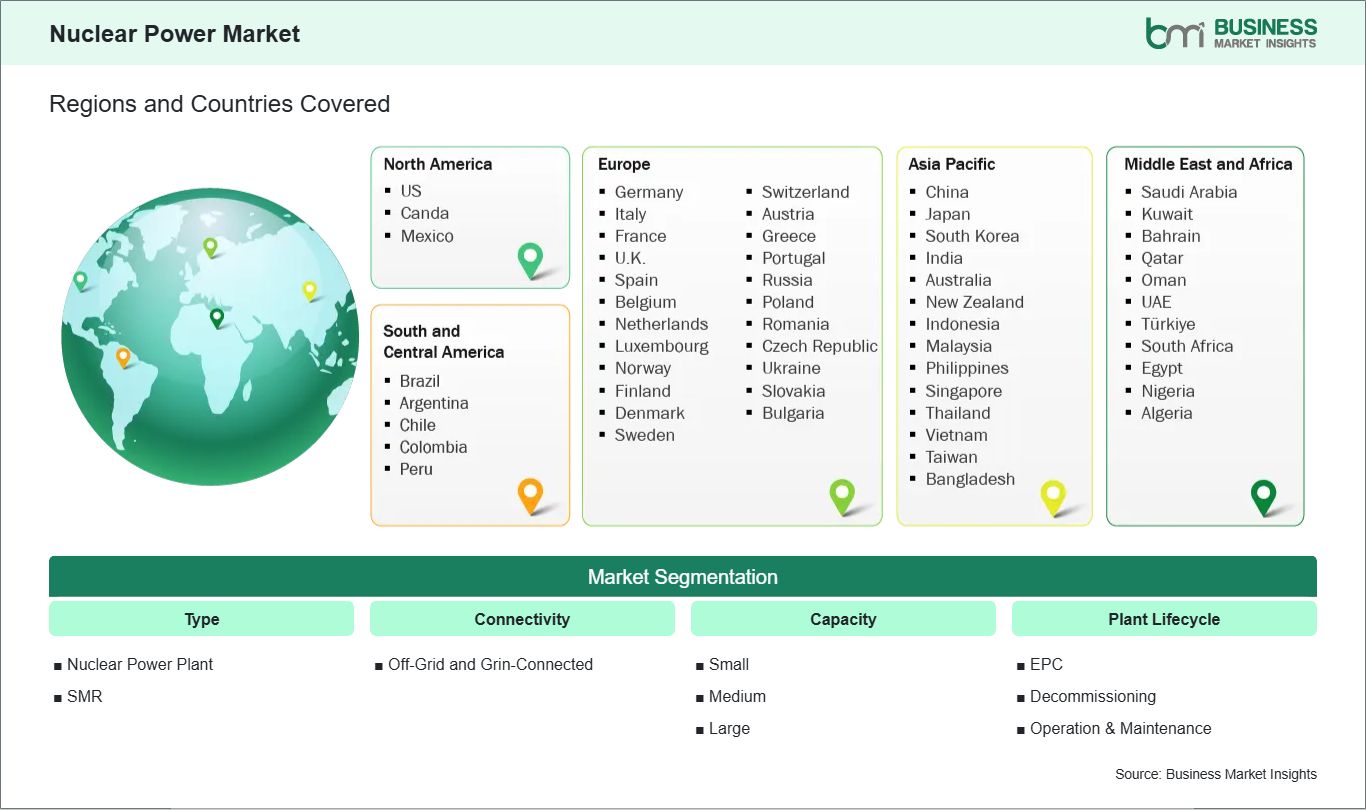
The Nuclear Power market is segmented by type, connectivity, capacity, plant lifecycle, and application, reflecting diverse deployment patterns across different technologies and end-use environments.
By Type
- Nuclear Power Plant - Conventional high-output generation infrastructure.
- SMR - Compact modular systems enabling flexible deployment.
By Connectivity
- Off-Grid - Supports isolated or remote industrial applications.
- Grid-Connected - Integrated into national electricity transmission systems.
By Capacity
- Small (less than 500 MW) - Distributed and remote power applications.
- Medium (500-1000 MW) - Balanced utility-scale deployment.
- Large (Above 1000 MW) - Centralized baseload generation assets.
By Plant Lifecycle
- EPC - Engineering and construction-focused project phase.
- Decommissioning - End-of-life dismantling and safety management.
- Operation & Maintenance - Long-term performance and reliability services.
By Application
- Power Generation - Core electricity supply function.
- Desalination - Energy-driven water treatment systems.
- Industrial - High-temperature process energy use.
- Other Applications - Research and auxiliary energy systems.
Market Forces
Nuclear Power Market Drivers and Opportunities
Increasing Demand for Low-Carbon Baseload Generation
Energy systems are shifting to stable, low-emission sources that provide steady power. Nuclear plants generate reliable electricity in any weather, helping keep the grid stable as more renewables are added. Utilities are investing in long-term assets to secure energy supplies and cut emissions.
The increasing demand for low-carbon industrial power is driving nuclear adoption in energy-intensive sectors. Electrification and coal phase-out strategies further support this trend. Nuclear infrastructure provides a stable foundation for diverse energy portfolios in both developed and emerging markets.
Expansion of Modular Reactor Deployment Models
Advances in small modular reactor designs allow scalable installations at distributed sites. Prefabrication improves construction efficiency and reduces on-site complexity. These systems enable flexible capacity additions to match local demand growth.
Growth is expected in remote industrial sites and island grids. Using modular reactors makes projects more flexible and reduces financial risk for each unit. This method lets operators expand capacity gradually while keeping operations running smoothly in different settings.
Size and Share Analysis
Nuclear Power Market Size and Share Analysis
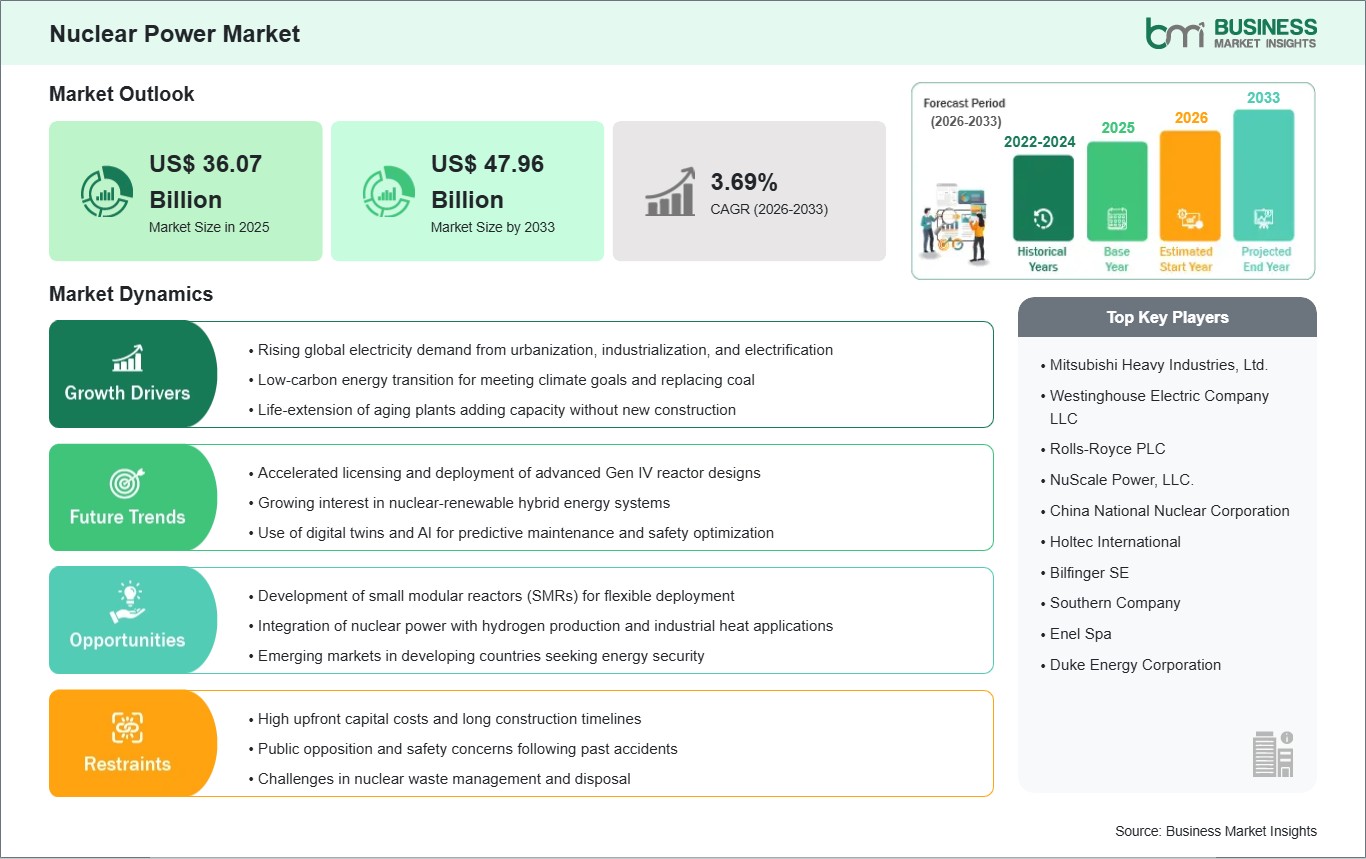
The Nuclear Power market is expected to rise from US$ 36.07 billion in 2025 to US$ 47.96 billion by 2033, growing at a CAGR of 3.69% from 2026 to 2033. This growth comes from continued investment in long-lasting power plants and modernizing reactors in leading economies.
Large-scale reactor systems dominate the market due to their established operations and integration with utilities. Small modular reactors are gaining interest for their flexible deployment and simpler construction.
Application dominance remains concentrated in power generation activities, supported by consistent baseload requirements. Industrial and desalination uses continue expanding as energy-intensive sectors seek stable, low-emission heat and electricity sources.
Report Coverage
Nuclear Power Market Report Coverage and Deliverables
The " Nuclear Power Market Size and Forecast (2022-2033)" report provides a detailed analysis of the market covering the following areas:
- Market size and forecast at global, regional, and country levels for all market segments covered under the scope
- Market trends, as well as drivers, restraints, and opportunities
- Market analysis covering key trends, global and regional framework, major players, regulations, and recent developments
- Industry landscape and competition analysis covering market concentration, heat map analysis, prominent players, and recent developments for the market
- Detailed company profiles, including SWOT analysis
Geographic Insights
Nuclear Power Market Geographic Insights
Nuclear Power adoption varies by region, influenced by long-term energy security and decarbonization goals. Investment levels depend on local regulations, how developed the infrastructure is, and public support.
North America is progressing steadily, supported by reactor life-extension programs and new modular reactor initiatives. Policy backing for clean baseload generation enhances long-term capacity planning for utilities and industry.
Asia Pacific is seeing fast growth, driven by rising electricity needs and big infrastructure projects. Countries are working to diversify energy sources, cut dependence on fossil fuels, and keep the grid reliable.
Europe is focused on safety, modernizing plants, and extending the life of its nuclear facilities. In the Middle East and South America, emerging markets are looking at nuclear power to help with industrial growth and water desalination, where energy is limited.
Industry Activity
Recent Developments
The Nuclear Power market is evaluated by gathering qualitative and quantitative data post-primary and secondary research, which includes important corporate publications, association data, and databases. Recent developments and news in the market include:
- In May 2026, Kazakhstan will start active construction of the Balkhash Nuclear Power Plant in 2027, a significant milestone in its energy strategy. Preparations are underway, and cooperation with Russia is expected to strengthen during President Putin's upcoming visit. Two intergovernmental agreements related to the project may also be signed during these discussions.
- In May 2026, the US Export-Import Bank (EXIM) approved a USD 57.3 million loan to EnergoNuclear, a subsidiary of Romania's Nuclearelectrica, aimed at financing engineering and project management for the expansion of the Cernavodă nuclear power plant, which will double its capacity.
Trust & Transparency
Research Methodology
The market analysis combines proprietary research with secondary data from government agencies, company disclosures, regulatory filings, industry databases and expert interviews. Market estimates are validated through data triangulation, cross-market benchmarking and analyst
review.
View Full Research Methodology
Key Sources Referred:
European CommissionWorld Nuclear AssociationUS Department of EnergyOECD Nuclear Energy AgencyInternational Atomic Energy Agency (IAEA)International Energy Agency (IEA)Company WebsitesCompany Annual ReportsCompany Investor Presentations