
Green Power Market Outlook: Size, Share, Trends, Growth Analysis, Competitive Landscape & Forecast, 2022-2033

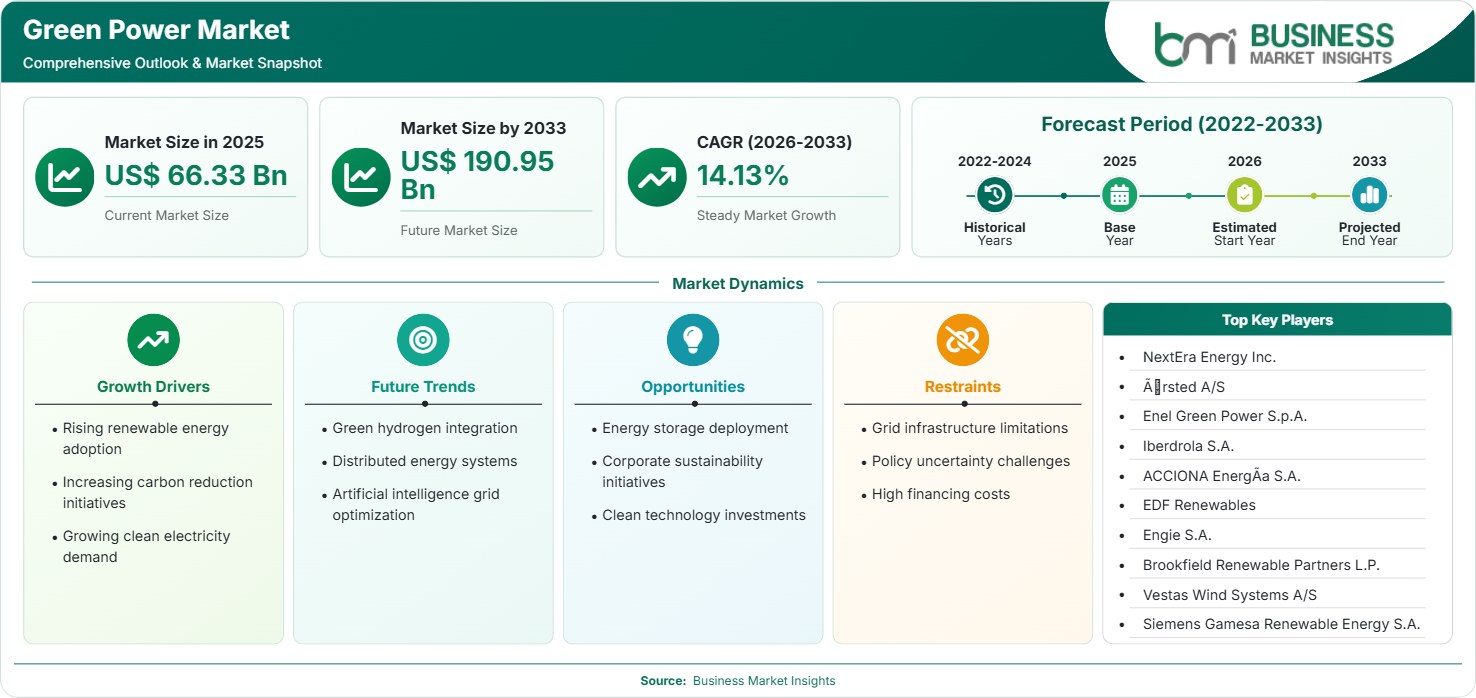
The Green Power Market size was valued at US$ 66.33 billion in 2025 and is projected to reach US$ 190.95 billion by 2033, growing at a CAGR of 14.13% during 2026–2033. Expanding energy storage deployment, corporate sustainability initiatives, and increasing clean technology investments are accelerating market growth. Growing renewable energy adoption and grid modernization continue creating long-term opportunities for industry participants.

Report Coverage
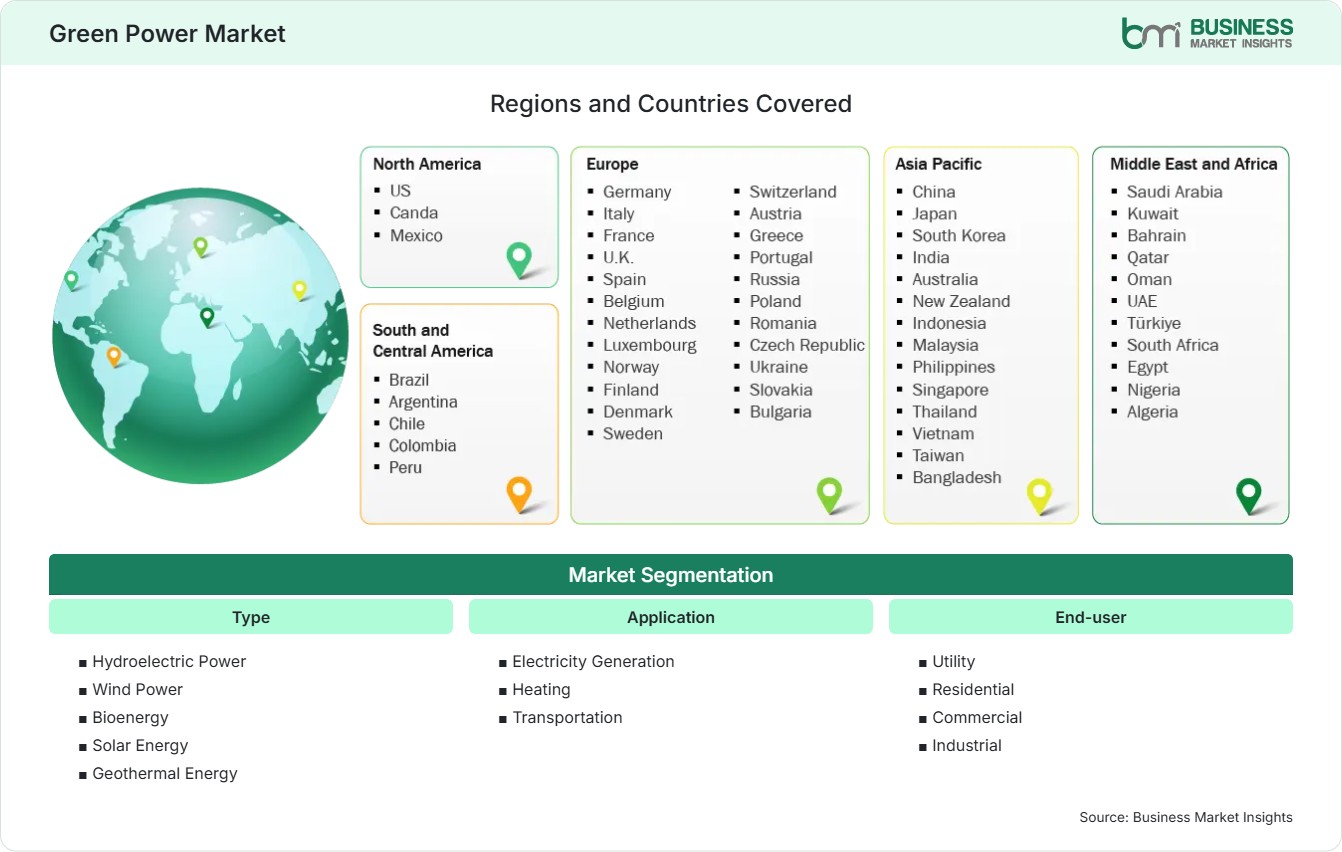
  • Type: Hydroelectric Power, Wind Power, Bioenergy, Solar Energy, Geothermal Energy
  • Application: Electricity Generation, Heating, Transportation
  • End-user: Utility, Residential, Commercial, Industrial
US$ 66.33 Bn Market size in 2025
US$ 190.95 Bn Market Size by 2033
14.13% CAGR, 2026 - 2033
2026-2033 Forecast Period

01 AI Overview

Green Power Market Summary

  • North America Region: North America accounts for 30%–33% market share in 2025 and is projected to grow at a CAGR of 13.5%–14.1% during 2026–2033. Strong renewable energy investments, supportive federal policies, and increasing corporate renewable power procurement continue driving regional demand. The U.S. market is expected to register a CAGR of 13.7%–14.3% through 2033, supported by utility-scale solar and wind projects.
  • Fastest Growing Region: Asia Pacific holds 31%–34% market share in 2025 while expanding at a CAGR of 15.0%–15.6% during 2026–2033. Rapid renewable capacity additions, expanding electricity demand, and government decarbonization targets continue accelerating market growth.
  • Leading Segment: Solar Energy accounts for 34%–37% market share in 2025 and is expected to grow at a CAGR of 14.6%–15.2%. Declining module costs, supportive incentive programs, and rapid utility-scale deployment continue supporting segment leadership.
  • High Growth Segment: Utility contributes 46%–49% market share in 2025 while growing at a CAGR of 14.7%–15.3%. Large-scale renewable installations, transmission upgrades, and increasing power purchase agreements continue driving investment.
  • Key Market Opportunity: Expansion of energy storage systems, green hydrogen integration, and corporate renewable power purchase agreements are creating substantial opportunities for renewable energy developers and technology providers.
  • Major Market Players: NextEra Energy Inc., Ørsted A/S, Enel Green Power S.p.A., Iberdrola S.A., ACCIONA Energía S.A., EDF Renewables, Engie S.A., Brookfield Renewable Partners L.P., Vestas Wind Systems A/S, Siemens Gamesa Renewable Energy S.A.
02 Strategic Insights

Green Power Market: Strategic Insights

green-power-market-market-strategic-framework
FREE PDF
Request your free sample
Request free sample
03 Stakeholder View

Key Takeaways

  • Utility-scale renewable projects remain the primary source of market expansion, supported by long-term government policies and rising private sector investment.
  • Solar and wind technologies continue attracting the largest capital investments due to competitive generation costs and rapid deployment capabilities.
  • Energy storage integration and digital grid management are improving renewable energy reliability and supporting higher renewable penetration.
  • Asia Pacific offers the strongest investment opportunity through large-scale renewable installations, industrialization, and ambitious carbon reduction targets.
  • Strategic partnerships between utilities, renewable developers, and technology providers continue accelerating project deployment and innovation.
04 Geographic Outlook

Green Power Market Regional Highlights

North America Green Power Market

North America remains one of the largest regional markets due to strong renewable energy investments, expanding utility-scale projects, and supportive clean energy policies. The region accounts for 30%–33% of the Green Power Market share in 2025 and is projected to grow at a CAGR of 13.5%–14.1% through 2033. Corporate renewable procurement and energy storage deployment continue supporting market expansion.

  • Utility-scale solar and wind installations continue expanding across the United States and Canada.
  • Corporate renewable power purchase agreements strengthen investment in clean electricity generation.
  • Battery energy storage deployment improves renewable grid reliability and flexibility.
  • Grid modernization initiatives continue supporting market growth throughout the region.

US Green Power Market

The United States represents the largest national market in North America, accounting for 25%–28% global market share in 2025 while registering a CAGR of 13.7%–14.3% through 2033. Federal incentives, utility-scale renewable projects, and strong corporate sustainability commitments continue driving investment.

  • Solar and wind capacity additions remain the largest contributors to renewable electricity generation.
  • Energy storage projects support grid stability and renewable integration.
  • Large corporations increasingly procure renewable electricity through long-term power purchase agreements.

Europe Green Power Market

Europe accounts for 27%–30% market share in 2025 and is expected to expand at a CAGR of 13.8%–14.4% through 2033. Germany remains the leading market, while Poland records one of the fastest growth rates at 14.8%–15.3% due to accelerating renewable investments and grid modernization.

  • Germany continues leading renewable electricity generation through wind and solar deployment.
  • Poland benefits from expanding renewable capacity and supportive energy transition policies.
  • Offshore wind development continues strengthening regional renewable generation.
  • Grid upgrades improve renewable energy integration across European electricity networks.

Asia Pacific Green Power Market

Asia Pacific is the fastest-growing regional market, accounting for 31%–34% market share in 2025 while expanding at a CAGR of 15.0%–15.6% through 2033. China leads regional demand, while India records the fastest growth at 15.4%–16.0% owing to large-scale renewable deployment and increasing electricity demand.

  • China continues investing heavily in utility-scale solar, wind, and hydropower projects.
  • India expands renewable generation through national clean energy initiatives.
  • Japan and Australia strengthen investments in battery storage and offshore wind.
  • Rising electricity demand accelerates renewable energy capacity additions across the region.

Rest of World Green Power Market

The Rest of World region contributes 10%–12% market share in 2025 and is projected to register a CAGR of 14.2%–14.8% through 2033. Brazil leads South & Central America, while Saudi Arabia records one of the fastest growth rates at 14.7%–15.2% driven by large-scale renewable diversification projects.

  • Brazil continues expanding hydropower, wind, and solar generation capacity.
  • Saudi Arabia invests significantly in renewable energy as part of economic diversification initiatives.
  • Growing electricity demand supports renewable infrastructure investment across emerging markets.
  • International renewable developers continue expanding regional project portfolios and strategic partnerships.
global-market-geography
FREE PDF
Request your free sample
Request free sample
05 Segment Analysis

Green Power Market Segmentation

Type

The type segment is led by Solar Energy owing to declining photovoltaic module costs, rapid installation rates, and strong government incentives supporting renewable electricity generation. The segment accounts for 34%–37% market share in 2025 and is projected to grow at a CAGR of 14.6%–15.2% during 2026–2033. Increasing deployment across residential, commercial, and utility-scale projects continues expanding the Market scope worldwide.

  • Hydroelectric Power: Hydropower remains a major renewable energy source due to reliable baseload electricity generation, long operational life, and continued modernization of existing hydroelectric facilities.
  • Wind Power: Wind energy continues experiencing robust growth through onshore and offshore developments supported by larger turbine capacities, improved efficiency, and favorable renewable energy policies.
  • Bioenergy: Bioenergy supports renewable electricity and heat production by utilizing agricultural residues, forestry waste, and municipal biomass while contributing to circular economy initiatives.
  • Solar Energy: Solar energy dominates the market through declining equipment costs, simplified installation, high scalability, and increasing adoption across distributed and utility-scale renewable energy projects.
  • Geothermal Energy: Geothermal energy continues expanding in regions with favorable geological resources by providing stable, low-emission electricity and heating for industrial and residential applications.

Application

Electricity Generation represents the largest application segment due to accelerating renewable capacity additions and increasing demand for low-carbon power. The segment contributes 68%–71% market share in 2025 while expanding at a CAGR of 14.4%–15.0% through 2033. Expanding renewable installations continue strengthening the Market share across global electricity systems.

  • Electricity Generation: The dominant application, supported by large-scale renewable energy projects, power purchase agreements, and national decarbonization strategies.
  • Heating: Renewable heating applications continue growing through geothermal systems, biomass utilization, and renewable district heating infrastructure that improve energy efficiency.
  • Transportation: Renewable electricity increasingly supports electric mobility, green hydrogen production, and low-carbon transportation infrastructure as countries accelerate transport electrification.

End-user

The Utility segment remains the largest end-user owing to substantial investments in renewable power plants, transmission infrastructure, and grid modernization. The segment accounts for 46%–49% market share in 2025 and is projected to grow at a CAGR of 14.7%–15.3% through 2033. Long-term renewable procurement and utility-scale clean energy projects continue supporting market expansion.

  • Utility: Utilities remain the primary investors in renewable generation through large-scale solar, wind, hydroelectric, and hybrid renewable projects integrated into national grids.
  • Residential: Residential adoption continues increasing through rooftop solar systems, battery storage, and distributed renewable energy technologies supported by government incentives.
  • Commercial: Commercial organizations increasingly procure renewable electricity through on-site generation and long-term renewable power purchase agreements to achieve sustainability targets.
  • Industrial: Industrial facilities adopt renewable power to reduce carbon emissions, improve energy security, and lower long-term electricity costs across manufacturing operations.
06 Market Forces

Green Power Market Dynamics

Key Market Drivers

Rising renewable energy adoption

Renewable Energy is being deployed at an increasingly rapid pace by governments, utilities, and private entities to diversify electricity generation and reduce reliance on fossil fuel-based energy sources. Solar power, Wind energy, hydropower, bioenergy, and Geothermal energy sources have grown at an increasing rate due to decreasing technology costs and the economic feasibility of these projects. Good policies, renewable energy targets, and monetary support are making it easy to invest in developed and developing nations. Growth in renewable energy generation enhances energy security and reduces greenhouse emissions.

Increasing carbon reduction initiatives

The efforts to reach zero net carbon emissions across the world are leading to significant investments being made towards renewable electricity production. Governments are adopting more rigorous environmental policies, and corporations are implementing renewable energy plans as part of their decarbonization efforts. In addition, carbon pricing, emissions reduction, and clean energy incentives are still working towards developing renewable energy infrastructure. The growing environmental consciousness among businesses and individuals has been fueling demand for renewable electricity solutions.

Growing clean electricity demand

Electric vehicles, industrial, domestic, and business uses will increase electricity demand, resulting in greater demand for clean energy from renewable sources. The process of urbanization, the growth in information technologies, and industrialization demand that there should be adequate power generation with low carbon emissions. Energy providers continue to expand their renewable energy capacity to meet rising power demand and regulatory requirements. Advancements in renewable energy technology and grid connectivity are contributing to supply reliability.

Key Market Opportunities

Energy storage deployment

The rapid adoption of battery energy storage systems is creating significant growth opportunities, as reflected in the Green Power Market forecast, by enabling greater integration of renewable energy, balancing electricity generation, improving grid stability, and ensuring a reliable power supply. Utility companies and independent power producers are increasingly combining solar and wind energy facilities with battery storage solutions to optimize electricity generation and manage peak demand. Declining battery costs, constant developments in the field of energy storage technologies, and investments in the development of grid infrastructure will continue creating opportunities for renewable energy companies to offer efficient green energy products and services. Moreover, positive government policies and the trend toward carbon neutrality are anticipated to accelerate the global adoption of battery energy storage systems and the growth of the renewable power market.

Corporate sustainability initiatives

Companies in several sectors are adopting more renewable energy generation through power purchase agreements (PPAs), on-site renewable energy generation, and energy solutions integration to reduce their carbon footprint and increase energy resilience. Sustainability commitments from companies, environmental reporting mandates, net zero plans, and ESG investment strategies keep on motivating businesses to adopt renewable energy. Besides, increased costs of electricity, government initiatives, and rising expectations from stakeholders regarding sustainable business practices are also leading to the adoption of more renewable energy. Such developments offer immense opportunities to renewable energy developers, energy utilities, and technology companies engaged in commercial decarbonization and energy efficiency projects.

Clean technology investments

Increasing public and private sector investments in sustainable technologies are emerging as a key Green Power Market trend, driving innovation across renewable energy production, smart grids, intelligent energy management, hydrogen production, and energy infrastructure. These investments are accelerating the development of next-generation renewable energy technologies, improving system efficiency and operational performance, and creating significant opportunities across the entire renewable energy value chain while supporting the global transition toward cleaner and more sustainable energy systems.

Market Restraints and Challenges

Grid infrastructure limitations

Factor: Existing electricity transmission and distribution networks are often insufficient to accommodate rapidly increasing renewable energy generation, particularly in regions experiencing large-scale solar and wind deployment. Impact: Limited grid capacity can delay renewable project connections, increase curtailment risks, and reduce operational efficiency. Significant investment in transmission infrastructure, smart grids, and grid modernization remains necessary to fully utilize expanding renewable generation capacity.

Policy uncertainty challenges

Factor: Variations in renewable energy policies, permitting procedures, financial incentives, and regulatory frameworks can influence investment decisions and project development timelines. Impact: Policy uncertainty may delay renewable energy investments, increase financing risks, and reduce developer confidence in long-term infrastructure projects. Stable regulatory environments and predictable clean energy policies remain essential for sustaining renewable market expansion.

07 Company Analysis

Competitive Landscape

The market is characterized by strong competition among integrated renewable energy developers, utility companies, wind turbine manufacturers, and clean energy technology providers. The Green Power Market analysis indicates that companies are expanding renewable generation portfolios, investing in energy storage, and forming strategic partnerships to strengthen their positions in utility-scale and distributed renewable energy markets.

Company Name

Overview

Products and Services Relevant to this Market

NextEra Energy Inc.

Leading renewable energy developer and utility operating across North America.

Utility-scale wind, solar, battery energy storage, renewable electricity generation.

Ørsted A/S

Global renewable energy company specializing in offshore wind projects.

Offshore wind farms, renewable electricity generation, energy storage solutions.

Enel Green Power S.p.A.

International renewable energy developer operating diversified clean energy assets.

Solar, wind, hydroelectric, geothermal, battery storage, renewable power solutions.

Iberdrola S.A.

Multinational utility focused on renewable electricity generation and grids.

Wind farms, solar plants, hydroelectric facilities, transmission infrastructure.

ACCIONA Energía S.A.

Renewable energy company developing sustainable electricity generation projects.

Wind, solar, hydroelectric, biomass generation, renewable energy services.

EDF Renewables

Global renewable energy subsidiary of EDF Group.

Wind, solar, battery storage, hybrid renewable energy projects.

Engie S.A.

Energy company expanding renewable power and low-carbon energy solutions.

Renewable electricity, energy storage, distributed energy, smart energy services.

Brookfield Renewable Partners L.P.

Global owner and operator of renewable power assets.

Hydroelectric, solar, wind, distributed generation, energy transition investments.

Vestas Wind Systems A/S

World's leading manufacturer of wind turbine technologies.

Onshore and offshore wind turbines, maintenance, digital optimization services.

Siemens Gamesa Renewable Energy S.A.

Global supplier of wind energy equipment and services.

Wind turbines, offshore wind technology, maintenance and lifecycle solutions.

08 Industry Activity

Recent Developments

May 2026

Enel S.p.A. announced an agreement to acquire a portfolio of seven operational solar photovoltaic plants (approximately 270 MW) in the United States through Enel Green Power North America, expanding its renewable energy generation capacity.

May 2026

Iberdrola S.A. announced the acquisition of a 40 MW wind farm in Basilicata, Italy, increasing its installed renewable generation capacity in Italy to approximately 450 MW.

April 2026

NTPC Green Energy Limited announced that it had surpassed 10 GW of commissioned renewable energy capacity, reaching 10,126 MW following the addition of 4,225 MW during FY2025–26 across solar and wind projects.

November 2025

ReNew Energy Global plc announced plans to invest approximately US$9.3 billion in Andhra Pradesh through multiple green energy projects, including renewable power generation, battery storage, solar manufacturing, and green ammonia production, significantly expanding its clean energy portfolio.

10 Trust & Transparency

Research Methodology

The market analysis combines proprietary research with secondary data from government agencies, company disclosures, regulatory filings, industry databases and expert interviews. Market estimates are validated through data triangulation, cross-market benchmarking and analyst review.

View Full Research Methodology

11 Questions Answered

Frequently Asked Questions

What future opportunities are expected in the market?

Future opportunities include expansion of grid-scale energy storage, green hydrogen production, renewable power purchase agreements, smart grid modernization, and increasing investments in distributed renewable energy systems.

Who are the leading companies in the Green Power Market Report?

Major participants include NextEra Energy Inc., Ørsted A/S, Enel Green Power S.p.A., Iberdrola S.A., ACCIONA Energía S.A., EDF Renewables, Engie S.A., Brookfield Renewable Partners L.P., Vestas Wind Systems A/S, and Siemens Gamesa Renewable Energy S.A.

Which type dominates the market?

Solar Energy dominates the market because of declining photovoltaic costs, rapid installation rates, high scalability, and strong government incentives supporting renewable electricity generation.

Which region is expected to grow the fastest?

Asia Pacific is projected to record the highest growth owing to rapid renewable energy installations, expanding electricity demand, supportive government policies, and large-scale clean energy investments.

What is driving the Green Power Market?

The market is driven by increasing energy storage deployment, corporate sustainability initiatives, clean technology investments, favorable government policies, and rising global demand for low-carbon electricity.

Access the Full Green Power Market Report

Get segment-level forecasts, regional estimates, competitive benchmarking, company profiles and downloadable Excel datasets.

Access the full Green Power Market Report
350 pages PDF & Excel | 2026-07-31