
Solar Power Market Outlook: Size, Share, Trends, Growth Analysis, Competitive Landscape & Forecast, 2026–2033

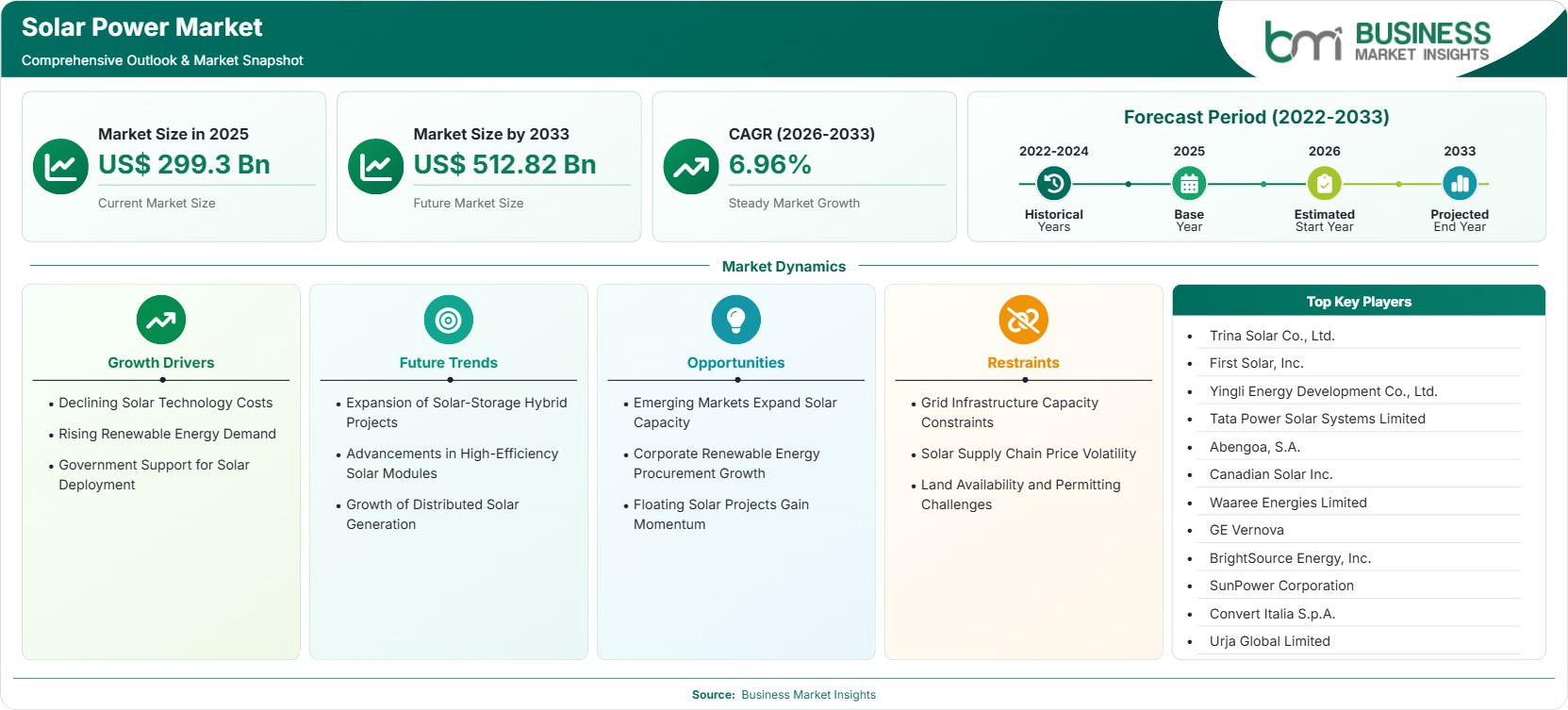
The Solar Power Market size was valued at US$ 299.3 Billion in 2025 and is projected to reach US$ 512.82 Billion by 2033, growing at a CAGR of 6.96% during 2026–2033. Market expansion is being driven by accelerated renewable energy deployment, declining photovoltaic system costs, supportive policy frameworks, increasing utility-scale installations, and rising corporate demand for clean electricity.

Report Coverage
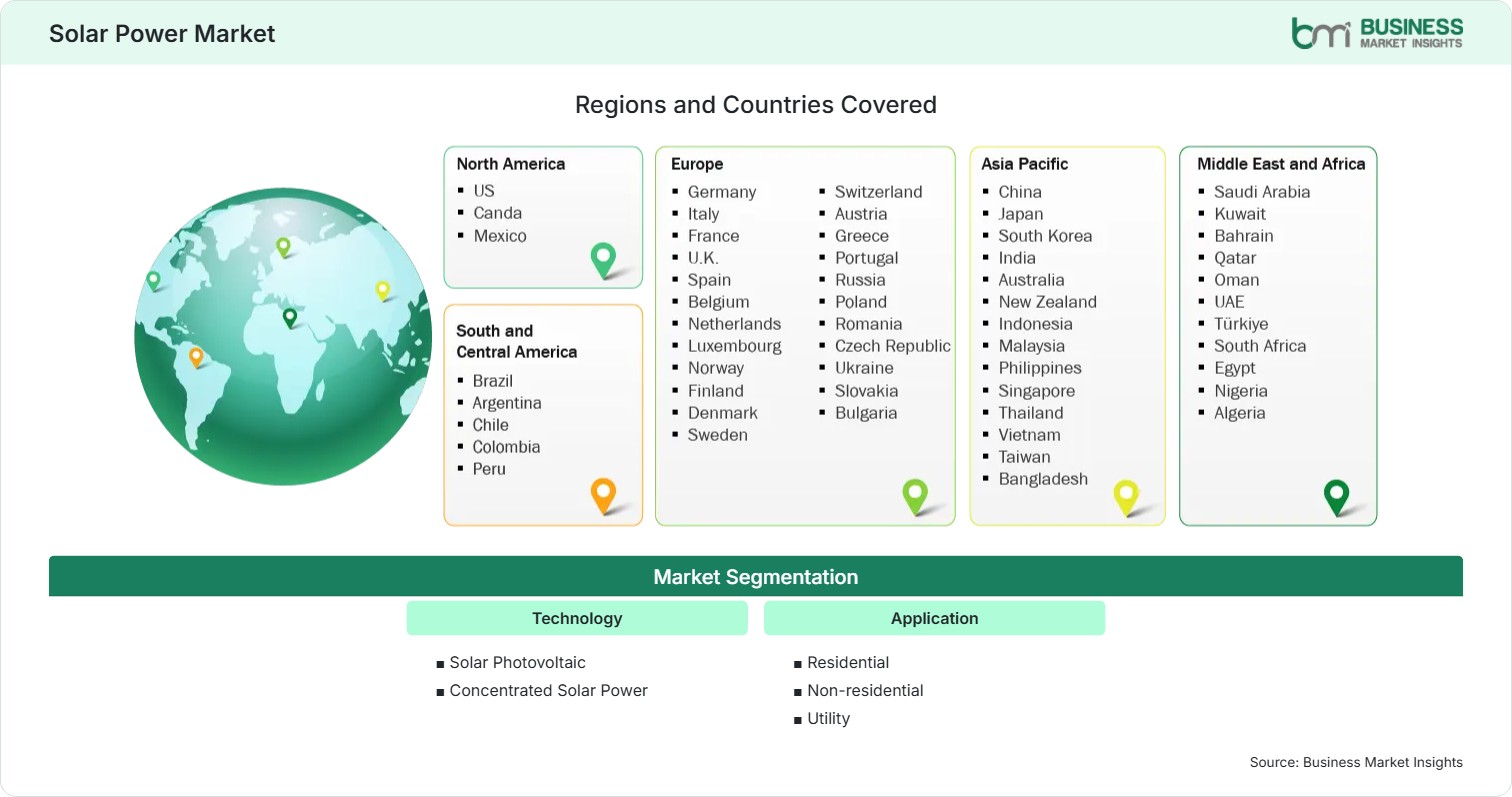
  • Technology: Solar Photovoltaic, Concentrated Solar Power
  • Application: Residential, Non-residential, Utility
US$ 299.3 Bn Market size in 2025
US$ 512.82 Bn Market Size by 2033
6.96% CAGR, 2026 - 2033
2026-2033 Forecast Period

AI Overview

Solar Power Market Summary

  • North America Region: North America holds 26%–29% share in 2025 and is projected to grow at a 6.2%–6.8% CAGR during 2026–2033. Key growth drivers include clean energy tax incentives, utility-scale procurement programs, battery integration, domestic manufacturing investments, transmission upgrades, and corporate renewable sourcing initiatives supporting energy security, resilience, and decarbonization objectives. The U.S. remains the regional growth engine, expanding at 6.3%–6.9% CAGR through strong utility procurement and manufacturing incentives.
  • Fastest Growing Region: Asia Pacific accounts for 39%–42% share in 2025 and is anticipated to expand at a 7.5%–8.2% CAGR during 2026–2033. Manufacturing leadership, electricity demand growth, renewable procurement targets, localization initiatives, competitive module pricing, and energy security strategies continue accelerating deployment across major economies.
  • Leading Segment: Solar Photovoltaic (PV) captures 87%–90% share in 2025 and advances at a 7.0%–7.6% CAGR. Strong installation flexibility, declining technology costs, large-scale manufacturing ecosystems, continuous efficiency improvements, and suitability across residential, commercial, and utility projects sustain segment dominance globally.
  • High Growth Segment: Utility application holds 47%–50% Solar Power Market share in 2025 and is expected to grow at a 7.4%–8.0% CAGR. Large procurement programs, competitive levelized costs, growing storage integration, renewable portfolio standards, and grid decarbonization objectives continue supporting extensive project pipelines.
  • Key Market Opportunity: Hybrid solar and battery storage projects are creating attractive investment opportunities by improving grid flexibility, supporting renewable integration, reducing curtailment risks, enhancing power reliability, and enabling participation in ancillary service markets.
  • Major Market Players: Trina Solar Co., Ltd.; First Solar, Inc.; Yingli Energy Development Co., Ltd.; Tata Power Solar Systems Limited; Abengoa, S.A.; Canadian Solar Inc.; Waaree Energies Limited; General Electric Company; BrightSource Energy, Inc.; SunPower Corporation; Convert Italia S.p.A.; Urja Global Limited; eSolar, Inc.
Strategic Insights

Solar Power Market: Strategic Insights

Solar Power Market Strategic Framework
FREE PDF
Request your free sample
Request free sample
Stakeholder View

Key Takeaways

  • Value chains in the industry are developing toward vertically integrated businesses where manufacturing, project development, engineering, procurement, construction, operations, maintenance, and energy management services come together. Businesses which are vertically integrated can handle pricing volatility much better and earn sustainable profits in the long term.
  • Revenue visibility is highest in large-scale utility projects because of the nature of their funding through long-term power purchase agreements, public procurement programs, and financing mechanisms. The integration of energy storage systems makes the projects more profitable and investor-friendly.
  • Innovation in technology still centers on high-efficiency photovoltaic modules, bifacial technology, advanced tracking systems, smart inverters, energy forecasting using artificial intelligence, and battery integration.
  • Various countries in the Asia-Pacific region, the Middle East, and Latin America are rapidly emerging as promising investment destinations thanks to rising electricity demand, favorable renewable energy policies, and improved project financing structures. Such markets are set to contribute a significant part of future capacity additions.
  • Institutional investors, sovereign wealth funds, and infrastructure experts keep adding more weightings into renewable energy investments. Solar projects receive cash flow predictability, falling costs for technology, and good government backing, all factors that make them appealing parts of long-term infrastructure investment.
  • Project success in the future will increasingly depend on the availability of transmission, storage, and smart grids. Markets undergoing rapid grid modernization will be characterized by higher levels of renewable integration and faster project delivery.
Geographic Outlook

Solar Power Market Regional Highlights

North America Solar Power Market

North America represents 26%–29% Solar Power Market share in 2025 and is expected to expand at a 6.2%–6.8% CAGR during 2026–2033. Regional expansion is propelled by federal government policies promoting the development of clean energy, increased corporate purchases of renewables, deployment of large-scale projects, and growth in storage capacity. The regional advantages include high levels of institutional investments, transparent regulatory environments, and major transmission infrastructure upgrading programs. Expansion continues to be highly focused on the U.S., though Canada is also developing its renewable capacities.

  • Federal clean-energy legislation and investment incentives continue improving project economics while strengthening domestic manufacturing capabilities across modules, components, and energy storage systems.
  • Corporate renewable energy procurement remains an important demand driver as major technology companies, industrial enterprises, and logistics operators pursue net-zero commitments and long-term electricity cost management strategies.
  • Utility operators increasingly deploy solar-plus-storage systems to enhance grid flexibility, improve renewable integration capabilities, and reduce dependence on fossil-fuel peaking generation assets.
  • Grid infrastructure modernization and transmission expansion programs are creating favorable conditions for connecting large-scale renewable energy projects while reducing curtailment risks.

US Solar Power Market

The United States accounts for approximately 78%–82% of regional installations within North America and is estimated to expand at a 6.3%–6.9% CAGR through 2033. Renewable energy procurement, manufacturing incentives, investments in grid modernization, and corporate sustainability efforts are still ensuring continued stable deployment. Utility companies are still investing heavily in solar systems and distributed generation is still increasing. Manufacturing facilities are being expanded to increase supply chain security and improve investor confidence.

  • Utility-scale projects continue representing the largest source of new installed capacity additions due to favorable economics and long-term electricity procurement contracts.
  • Domestic manufacturing investments are strengthening supply-chain resilience while supporting localization objectives and employment creation in renewable energy industries.
  • Data center expansion and digital infrastructure growth are increasing electricity demand, encouraging long-term renewable power purchase agreements across key states.
  • Battery storage adoption is improving system reliability and enabling higher renewable penetration levels within regional electricity markets.

Europe Solar Power Market

Europe holds 22%–25% Solar Power Market share in 2025 and is expected to advance at a 6.5%–7.1% CAGR through 2033. Growth in the region is driven by the goals of decarbonization, energy security, electrification, and renewable deployment. Germany remains the largest market in Europe, while Poland is among the fast-growing nations. Spain, Italy, and the Netherlands remain popular investment destinations owing to abundant solar resources and existing project development infrastructure.

  • Germany maintains market leadership through strong policy support, established financing mechanisms, and extensive renewable deployment experience.
  • Poland is emerging as a high-growth market, supported by industrial demand and increasing renewable energy investments.
  • Spain continues attracting utility-scale developments because of favorable irradiation conditions and strong project economics.
  • Corporate renewable procurement activity is expanding across manufacturing, telecommunications, retail, and technology sectors.

Asia Pacific Solar Power Market

Asia Pacific accounts for 39%–42% Solar Power Market share in 2025 and is projected to register the highest regional CAGR of 7.5%–8.2% through 2033. This region is the center of photovoltaic device manufacturing and the largest market for applications. China leads in the field of installation and manufacturing, and India is one of the fastest growing regions due to its renewable energy goals. According to IEA PVPS data, China was leading in solar power installations, underscoring the region's significance.

  • China remains the dominant market due to its manufacturing leadership, policy support mechanisms, and unparalleled deployment scale.
  • India is rapidly increasing installations through renewable procurement programs, domestic manufacturing incentives, and capacity expansion targets.
  • Southeast Asian economies are emerging as attractive markets due to increasing electricity demand and industrial growth.
  • Competitive manufacturing ecosystems continue reducing technology costs and improving deployment economics across regional markets.

Rest of World Solar Power Market

Rest of World accounts for approximately 10%–13% Solar Power Market share and is anticipated to expand at a 6.8%–7.5% CAGR during 2026–2033. The region encompasses attractive growth opportunities across the Middle East, Africa, and South & Central America. Utility-scale projects dominate investments due to abundant solar resources, favorable land availability, and government-backed procurement mechanisms. Saudi Arabia and the United Arab Emirates lead development activity in the Middle East, while Brazil continues driving regional growth within Latin America.

  • Saudi Arabia is rapidly expanding renewable capacity through large-scale procurement initiatives and long-term energy diversification objectives.
  • Brazil remains the leading Latin American market due to supportive power auction frameworks and increasing investor participation.
  • South Africa is investing in renewable infrastructure to address power security challenges and improve generation reliability.
  • Green hydrogen initiatives across the Middle East are creating additional demand for large-scale renewable electricity generation projects.
Global Market Geography
FREE PDF
Request your free sample
Request free sample
Segment Analysis

Solar Power Market Segmentation

Technology

The Technology segment remains the fundamental growth engine of the Market, with Solar Photovoltaic systems accounting for 87%–90% market share in 2025 and expanding at a 7.0%–7.6% CAGR through 2033. The Solar Power Market scope continues to widen as utilities, businesses, and households increasingly adopt photovoltaic technologies due to favorable economics, declining module costs, and deployment flexibility.

  • Solar Photovoltaic (PV): Continues dominating industry deployment due to falling manufacturing costs, improved module efficiencies, scalable installation capabilities, and applicability across residential, non-residential, and utility-scale energy generation environments.
  • Concentrated Solar Power (CSP): Maintains strategic importance in selected markets where thermal storage integration, dispatchable electricity generation, and high direct normal irradiation conditions support commercial project viability.

Application

Application demand is led by utility-scale deployment, which holds 47%–50% market share in 2025 and is expected to grow at a 7.4%–8.0% CAGR during the forecast period. The Solar Power Market trends increasingly emphasize large-scale projects paired with battery storage systems, enabling improved reliability and grid flexibility. Residential and non-residential installations continue benefiting from energy cost optimization, sustainability initiatives, and favorable policy support. Expanding electrification across transportation, industrial operations, and digital infrastructure is expected to support sustainable demand across all application categories.

  • Residential: Household adoption is supported by electricity bill reductions, improved energy independence, rooftop installation feasibility, and growing consumer interest in sustainable energy solutions.
  • Non-residential: Commercial and industrial users increasingly invest in solar systems to reduce operating expenses, achieve environmental targets, and enhance long-term energy price stability.
  • Utility: Large-scale renewable energy installations benefit from procurement scale, attractive project economics, long-term contracts, and increasing integration with battery storage systems.
Market Forces

Solar Power Market Dynamics

Key Market Drivers

Expansion of Renewable Energy Targets Worldwide

National governments continue establishing ambitious decarbonization and renewable energy targets, creating sustained demand for solar generation assets. The establishment of regulatory structures that favor clean energy production has been crucial to addressing energy security challenges, reducing carbon emissions, and improving affordability in the long run. The utilities have increased their portfolio of solar energy production as a way of fulfilling their obligations as well as minimizing their dependency on energy produced through fossil fuel. Additionally, companies' sustainability agendas have led to increased procurement activity in the manufacturing, technology, telecommunications, and logistics sectors.

Continuous Improvement in Photovoltaic Economics

Manufacturing scale expansion, technology innovation, and supply-chain efficiencies continue lowering the cost of photovoltaic deployment worldwide. Higher production volumes have led to greater accessibility in residential, commercial, and utility settings. There is an increase in the use of photovoltaic technology due to shorter construction times, cost-effective operation, and improved efficiency. This has been made possible through advancements in cell structure, bifacial panels, intelligent inverters, and improved tracking systems. Moreover, competitive pressures in the manufacturing sector have encouraged innovations.

Growing Electricity Demand and Electrification Trends

Rapid electrification across transportation, heating, industrial production, and digital infrastructure is increasing demand for reliable electricity generation. The creation of data centers, EV charging stations, and electrification of industry will require additional power capacity. Solar energy is an excellent alternative due to its scalability and its ability to help reduce the carbon footprint. Utilities are incorporating renewable energy sources into their generation systems to meet future power demand. Developing countries are also building up their generation capacity.

Key Market Opportunities

Hybrid Solar and Energy Storage Deployment

The integration of battery storage systems with solar generation assets is one of the most attractive investment opportunities in the renewable energy sector. Storage technologies increase dispatchability, minimize curtailment concerns, and allow access to ancillary services market. Storage technologies are being deployed by utilities as part of hybrid power plants to increase system flexibility and benefit commercial consumers by helping manage peak demand and increase energy resilience. Decreasing battery costs will further make storage technologies viable. This business case now goes beyond simply generating electricity to include reliability and grid-stabilizing services as well. There will be ample opportunities for developers, suppliers, and other infrastructure investors in such future renewable energy technologies. Favorable Solar Power Market Forecasts remain closely linked to ongoing storage deployment trends.

Emergence of Green Hydrogen Production

Green hydrogen initiatives are creating a new source of long-term electricity demand for renewable generation projects. Electrolysis facilities require significant amounts of low-cost electricity, creating favorable conditions for large-scale solar development in regions with abundant solar resources. Investment in hydrogen ecosystems is rapidly rising to facilitate the decarbonization of heavy industries and fuel generation. Hydrogen export projects are especially important for the Middle East, Australia, and some emerging markets. With the rise in hydrogen generation, there will be an increased need for renewable energy generation facilities. Development companies are currently looking into creating integrated projects that integrate both power generation facilities and hydrogen production plants.

Energy Access and Electrification in Emerging Markets

Many emerging economies continue facing challenges associated with reliable electricity access, grid expansion, and affordable energy supply. Solar technologies represent a practical solution because they can be deployed across centralized and distributed environments with relatively short implementation timelines. Governments, development institutions, and private investors are increasingly supporting renewable infrastructure projects aimed at improving energy access and economic development. Growing urbanization, population expansion, and industrial activity reinforce demand for additional generation capacity.

Market Restraints and Challenges

Grid Infrastructure Bottlenecks and Interconnection Delays

Factor: The rapid expansion of renewable energy capacity is outpacing transmission and distribution infrastructure upgrades in several major markets. Utility-scale projects frequently encounter congestion within existing networks, while interconnection queues continue to expand as developers seek project approvals.

Impact: Limited grid capacity delays commissioning timelines, increases development costs, and reduces project profitability. Developers often face longer approval cycles and additional investments in transmission connectivity, affecting project bankability. In markets with high renewable penetration, inadequate infrastructure may also lead to curtailment risks, reducing electricity generation efficiency and investor returns. As deployment volumes continue increasing, transmission modernization and smart-grid investments will become essential for sustaining capacity additions and preventing infrastructure constraints from limiting industry expansion.

Supply Chain Volatility and Trade Policy Uncertainty

Factor: Solar equipment supply chains remain heavily influenced by global manufacturing concentration, geopolitical developments, import tariffs, logistics disruptions, and fluctuations in raw material prices. Changes in trade policies and localization requirements can significantly alter procurement strategies and sourcing costs.

Impact: Volatile equipment pricing and regulatory uncertainty create planning challenges for developers, manufacturers, and investors. Unexpected increases in module, inverter, or component costs can reduce project margins and delay investment decisions. Import restrictions and compliance requirements may also lengthen procurement cycles, affecting project execution schedules. Although technological advancements continue improving cost competitiveness, ongoing supply-chain risks can weaken deployment momentum in price-sensitive markets and increase the financial risks associated with large-scale renewable infrastructure projects.

Company Analysis

Competitive Landscape

The Solar Power Market analysis highlights competition among photovoltaic manufacturers, utility developers, engineering providers, renewable infrastructure specialists, and solar thermal technology companies. Market participants focus on manufacturing efficiency, project execution capabilities, technology innovation, storage integration, and geographic expansion strategies to enhance competitiveness.

Company Name

Overview

Products and Services relevant to this market

Trina Solar Co., Ltd.

Global photovoltaic manufacturer with extensive international deployment experience and integrated solar solutions portfolio.

Solar modules, tracking systems, smart energy technologies, storage solutions, and project support services.

First Solar, Inc.

Leading U.S.-based solar manufacturer specializing in advanced thin-film photovoltaic technology.

Thin-film modules, utility-scale solar solutions, project development support, and energy technologies.

Yingli Energy Development Co., Ltd.

Established global photovoltaic company serving commercial and utility customers.

Solar panels, photovoltaic products, renewable energy systems, and installation support services.

Tata Power Solar Systems Limited

Leading Indian renewable energy company with strong EPC capabilities.

Solar modules, EPC services, rooftop solutions, and utility-scale project implementation.

Abengoa, S.A.

International infrastructure company recognized for solar thermal development expertise.

CSP facilities, engineering services, project management, and renewable infrastructure solutions.

Canadian Solar Inc.

Global renewable energy developer, manufacturer, and project operator.

Solar modules, battery storage systems, utility-scale projects, and energy management services.

Waaree Energies Limited

Major Indian solar manufacturer expanding domestic and export operations.

Photovoltaic modules, EPC services, solar power solutions, and renewable technologies.

General Electric Company

Diversified technology company supporting power and grid infrastructure modernization.

Grid technologies, transmission solutions, renewable integration systems, and energy services.

BrightSource Energy, Inc.

Specialized renewable technology provider focused on solar thermal applications.

Solar tower technologies, thermal generation systems, and project development expertise.

SunPower Corporation

Provider of high-efficiency photovoltaic solutions across multiple end-user markets.

Residential systems, commercial installations, solar panels, and energy management solutions.

Convert Italia S.p.A.

European renewable project developer and energy infrastructure operator.

Solar plant development, operation services, and renewable project management.

Urja Global Limited

Indian renewable energy company serving distributed generation segments.

Solar products, energy solutions, deployment services, and renewable project support.

eSolar, Inc.

Renewable energy technology developer focused on concentrated solar technologies.

Solar thermal systems, CSP technologies, and renewable energy generation solutions.

Trust & Transparency

Research Methodology

The market analysis combines proprietary research with secondary data from government agencies, company disclosures, regulatory filings, industry databases and expert interviews. Market estimates are validated through data triangulation, cross-market benchmarking and analyst review.

View Full Research Methodology

Questions Answered

Frequently Asked Questions

What are the most important challenges facing market participants?

Grid infrastructure constraints, transmission bottlenecks, trade policy uncertainty, and supply-chain volatility remain significant challenges influencing project execution timelines and investment decisions.

Which application segment offers the strongest growth prospects?

Utility-scale deployment provides the strongest growth outlook because of favorable project economics, procurement visibility, storage integration opportunities, and increasing demand from utilities pursuing decarbonization objectives.

What role does battery storage play in industry development?

Battery storage improves renewable integration, grid reliability, energy flexibility, and project economics. Hybrid solar-plus-storage projects are becoming increasingly important across utility and commercial applications.

Why is Asia Pacific the fastest-growing regional market?

According to the Solar Power Market Report, Asia Pacific is the fastest-growing regional market due to its manufacturing leadership, rising electricity demand, supportive renewable energy policies, industrial expansion, and extensive solar deployment programs. China and India are expected to remain major contributors to future solar capacity additions.

Which technology dominates the Solar Power Market?

Solar Photovoltaic (PV) represents the dominant technology segment due to declining costs, scalability, efficiency improvements, and suitability across residential, commercial, and utility applications. PV accounts for 87%–90% of the market in 2025.

Access the Full Solar Power Market Report

Get segment-level forecasts, regional estimates, competitive benchmarking, company profiles and downloadable Excel datasets.

Access the full Solar Power Market Report
350 pages PDF & Excel | 2026-09-03