
Power To Gas Market Outlook: Size, Share, Trends, Growth Analysis, Competitive Landscape & Forecast, 2026-2033

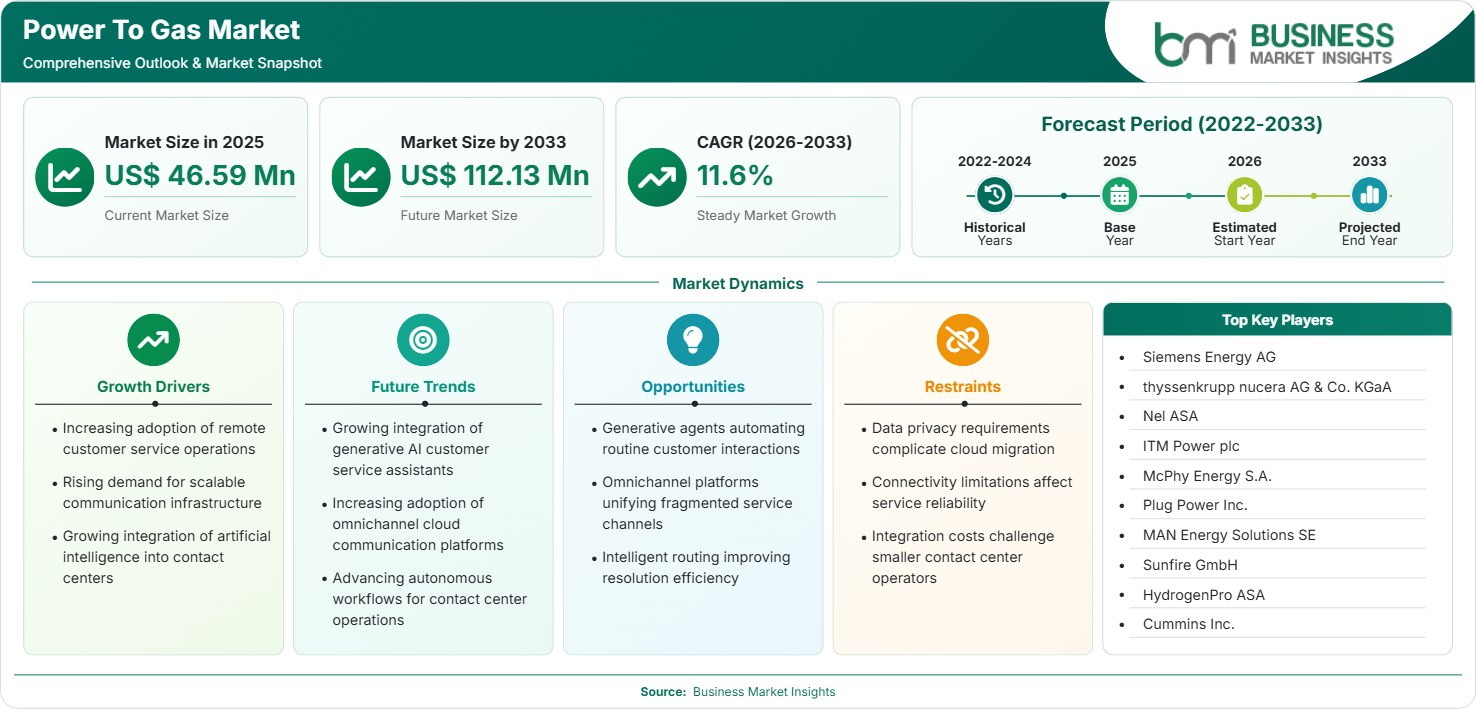
The Power To Gas Market size was valued at US$ 46.59 Million in 2025 and is projected to reach US$ 112.13 Million by 2033, growing at a CAGR of 11.6% during 2026–2033. Key drivers include hydrogen economy expansion, renewable integration needs, grid balancing requirements, and decarbonization mandates. Opportunities are emerging across synthetic methane production, industrial hydrogen substitution, and long-duration energy storage applications.

Report Coverage
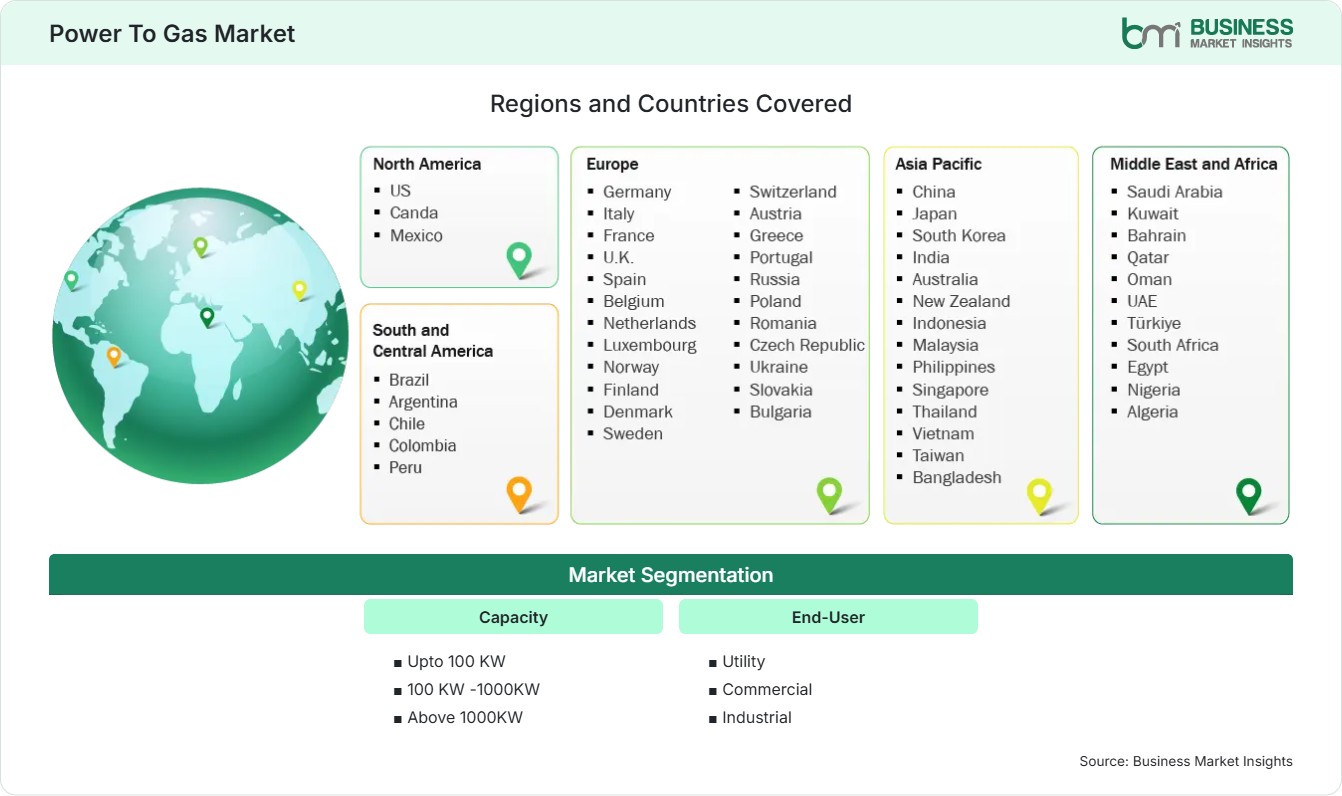
  • Capacity: Upto 100 KW, 100 KW -1000KW, Above 1000KW
  • End-User: Utility, Commercial, Industrial
US$ 46.59 Mn Market size in 2025
US$ 112.13 Mn Market Size by 2033
11.6% CAGR, 2026 - 2033
2026-2033 Forecast Period

AI Overview

Power To Gas Market Summary

  • North America Region: North America holds a market share of 32%–35% in 2025, growing with a CAGR of 10.5%–11.5% influenced by hydrogen investments, renewable integration, and clean energy incentives. The U.S. market benefits from federal hydrogen support and industrial decarbonization programs, advancing at an estimated 11.0%–12.0% CAGR.
  • Fastest Growing Region: Asia Pacific holds a market share of 24%–27% in 2025, growing with a CAGR of 13.0%–14.0% supported by green hydrogen strategies, expanding renewable capacity, industrial decarbonization goals, and government-backed clean fuel investments.
  • Leading Segment: Electrolysis holds a market share of 68%–72% in 2025, growing with a CAGR of 11.0%–12.0%, driven by falling electrolyzer costs, renewable electricity expansion, flexible operation capabilities, and growing hydrogen demand.
  • High Growth Segment: Above 1000KW holds a market share of 38%–42% in 2025, growing with a CAGR of 13.5%–14.5%, supported by utility-scale projects, industrial hydrogen demand, large renewable installations, and energy storage requirements.
  • Key Market Opportunity: Growing integration of renewable power with hydrogen production facilities creates opportunities for grid stabilization, synthetic fuel development, seasonal energy storage, and industrial decarbonization across multiple sectors.
  • Major Market Players: Siemens Energy AG, thyssenkrupp nucera AG & Co. KGaA, Nel ASA, ITM Power plc, McPhy Energy S.A., Plug Power Inc., MAN Energy Solutions SE, Sunfire GmbH, HydrogenPro ASA, Cummins Inc.
Strategic Insights

Power To Gas Market: Strategic Insights

Power To Gas Market Strategic Framework
FREE PDF
Request your free sample
Request free sample
Stakeholder View

Key Takeaways

  • The market ecosystem increasingly integrates renewable developers, electrolyzer manufacturers, utilities, gas network operators, and industrial hydrogen consumers into a connected value chain.
  • Large-scale facilities above 1000KW represent the strongest commercial opportunity due to superior economies of scale and rising industrial demand.
  • Innovation is shifting toward high-efficiency PEM and advanced alkaline electrolyzers, coupled with digital optimization and improved stack durability.
  • Asia Pacific offers an attractive investment case, supported by supportive hydrogen roadmaps, expanding renewable capacity, and industrial decarbonization commitments.
  • Strategic partnerships between utilities and hydrogen technology providers are becoming more common as project developers seek scale and financing certainty.
  • Synthetic methane production offers long-term potential by leveraging existing gas infrastructure and enabling renewable energy storage for extended periods.
Geographic Outlook

Power To Gas Market Regional Highlights

North America Power To Gas Market

North America accounts for 32%–35% of global revenue in 2025 and is projected to register a 10.5%–11.5% CAGR through 2033. Strong policy support for hydrogen infrastructure, rising renewable penetration, and investments in grid modernization support deployment. The region benefits from established natural gas infrastructure and industrial hydrogen demand. Power To Gas Market share remains concentrated in the United States and Canada, where clean hydrogen programs and utility-scale demonstration projects are accelerating commercialization.

  • Federal clean hydrogen initiatives support large-scale project deployment and improve investment visibility for developers.
  • Utilities are increasingly evaluating hydrogen-blending applications for grid balancing and seasonal storage.
  • Industrial decarbonization projects in refining, chemicals, and heavy manufacturing create sustained demand.
  • Gas network operators assess the integration of renewable hydrogen to reduce carbon intensity.

US Power To Gas Market

The United States represents 78%–82% of regional revenue and is expected to expand at a 11.0%–12.0% CAGR. Federal incentives, hydrogen hubs, and renewable energy investments support growth. Demand originates from industrial hydrogen consumption, energy storage projects, and utility decarbonization efforts. Technology developers continue expanding project pipelines through partnerships with major energy companies.

  • Hydrogen hubs strengthen domestic supply chains and improve commercialization pathways.
  • Industrial customers pursue low-carbon hydrogen to meet emissions reduction objectives.
  • Renewable generation growth creates demand for flexible storage technologies.
  • Public-private partnerships accelerate pilot and demonstration projects.

Europe Power To Gas Market

Europe holds 34%–37% Power To Gas Market share in 2025 and grows at 11.5%–12.5% CAGR. Germany leads regional deployment, while Spain and the Netherlands emerge as high-growth markets. European decarbonization targets, hydrogen strategies, and renewable energy expansion support adoption. The region benefits from mature regulatory frameworks and strong public funding programs aimed at achieving long-term climate objectives.

  • Germany remains the leading market, with extensive plans for hydrogen infrastructure.
  • Spain records one of the fastest growth rates due to its renewable resource advantages.
  • EU climate policies encourage electrolyzer deployment and hydrogen production.
  • Industrial decarbonization remains a key investment driver.
  • Cross-border hydrogen corridor initiatives support long-term demand.

Asia Pacific Power To Gas Market

Asia Pacific accounts for 24%–27% of global revenue and records the highest CAGR of 13.0%–14.0% through 2033. China leads regional investment, while India and Australia represent fast-growing opportunities. Renewable energy expansion, hydrogen strategies, and industrial demand support market development. Governments increasingly view hydrogen as a strategic component of energy security and export competitiveness.

  • China leads deployment through extensive investments in hydrogen and renewable energy.
  • India accelerates adoption under national green hydrogen initiatives.
  • Australia supports export-oriented hydrogen infrastructure projects.
  • Industrial users invest in clean hydrogen to reduce emissions.
  • Long-term energy security considerations encourage development.

Rest of World Power To Gas Market

The Rest of World region accounts for 8%–11% Power To Gas Market share and is projected to grow at 11.0%–12.0% CAGR. Middle Eastern countries leverage renewable resources to produce hydrogen, while South and Central America evaluate new export opportunities. Strategic investments continue increasing across selected energy-rich economies seeking diversification and sustainability targets.

  • Saudi Arabia advances large-scale hydrogen development initiatives.
  • The UAE is expanding the projects related to the production of hydrogen using renewable energy.
  • Brazil looks at hydrogen opportunities that come from its plentiful renewable electricity.
  • Chile attracts investment directed towards export-oriented hydrogen ecosystems.
  • The diversification of energy at the regional level helps ensure long-term project pipelines.
Global Market Geography
FREE PDF
Request your free sample
Request free sample
Segment Analysis

Power To Gas Market Segmentation

Technology

Technology segment adoption is driven by the integration of renewable energy, the expansion of the hydrogen economy, and decarbonization initiatives. The segment accounted for the largest revenue contribution, with Electrolysis representing approximately 68%–72% share in 2025 and advancing at 11.0%–12.0% CAGR. The Power To Gas Market scope continues expanding as efficiency improvements and scale advantages improve commercial viability.

  • Electrolysis: Dominant technology due to renewable hydrogen production capabilities, flexible grid response, improving efficiency, and broad adoption across industrial and utility applications.
  • Methanation: Gains traction through synthetic methane production, compatibility with gas infrastructure, and increasing demand for long-duration energy storage solutions.

Capacity

Capacity segmentation reflects varying deployment requirements across demonstration, commercial, and utility-scale projects. Larger installations increasingly attract investment due to operational efficiencies and growing industrial demand, with above 1000 kW emerging as the fastest-expanding category.

  • Upto 100 KW: Primarily used in pilot projects, research facilities, distributed energy systems, and small-scale hydrogen production applications.
  • 100 KW -1000KW: Supports commercial operations requiring moderate hydrogen output and enhanced grid flexibility.
  • Above 1000KW: Benefits from economies of scale, utility deployment, industrial consumption demand, and investment attractiveness.

End-User

End-user demand is shaped by decarbonization objectives, energy management needs, and hydrogen adoption strategies. Utility organizations hold a leading position due to the need for grid balancing and the integration of renewable energy.

  • Utility: Major adopters leveraging technology for renewable balancing, energy storage, and transmission network flexibility.
  • Commercial: Growth supported by sustainability targets, low-carbon energy initiatives, and distributed hydrogen applications.
  • Industrial: Adoption accelerates across refining, chemicals, steel, and manufacturing facilities seeking to reduce emissions.
Market Forces

Power To Gas Market Dynamics

Key Market Drivers

Expansion of Global Hydrogen Economy

Governments worldwide are continuing to prioritize the development of the hydrogen economy through dedicated national strategies, financial support, and clean-energy programs. The International Energy Agency has identified substantial growth in announced low-emission hydrogen projects globally, which is supporting demand for electrolyzer capacity and renewable hydrogen production. At the same time, industries are showing greater interest in hydrogen as a lower-carbon fuel and energy source, improving the commercial potential of power-to-gas technologies. Growing hydrogen consumption across chemicals, refining, transportation, and energy applications is directly supporting Power To Gas Market growth. As electrolyzer manufacturing capacity expands, technology availability can improve, and project costs may become more competitive. Investments in hydrogen infrastructure are also helping to develop a broader ecosystem that covers production, storage, transportation, and end-use applications.

Increasing Renewable Energy Curtailment Concerns

The rapid expansion of large-scale solar and wind power is creating periods when electricity generation exceeds immediate grid demand. This surplus electricity can pose challenges for grid operators and may lead to renewable energy curtailment when available power cannot be fully utilized. Power-to-gas technologies provide a potential solution by converting excess renewable electricity into hydrogen or other gas products that can be stored and used later. This makes hydrogen an attractive option for longer-duration or seasonal energy storage, complementing battery-based systems. As renewable energy penetration increases, utilities and energy companies are exploring integrated systems that can convert intermittent renewable generation into useful energy products. These Power To Gas Market trends are supporting long-term adoption by improving renewable asset utilization, providing greater flexibility to power systems, and creating additional value from surplus electricity.

Supportive Policy and Decarbonization Commitments

More governments and companies are setting bold net-zero and emissions-reduction goals, which in turn is leading to increased investment in low-carbon energy technologies. In Europe, North America, and Asia, policies are promoting the development of renewable hydrogen and urging industrial users to cut back on their use of fossil-based hydrogen. Through funding schemes, incentives for hydrogen, regulations aimed at clean energy, and other forms of government assistance, the economics of power-to-gas projects can be improved, and some of the financial obstacles linked with the initial stage of implementation can be reduced. Industries including steel, chemicals, refining, and heavy transport are also looking into hydrogen since they have major difficulties in cutting their emissions simply by using conventional electrification. With environmental requirements becoming more stringent, firms are under more pressure than ever to take up cleaner energy options. For this reason, ongoing policy support is still a key factor in promoting the commercialization, the development of infrastructure, and the broader adoption of power-to-gas technologies.

Key Market Opportunities

Utility-Scale Renewable Hydrogen Hubs

The development of large-scale hydrogen hubs is creating significant opportunities for power-to-gas technology providers, energy companies, and infrastructure developers. These hubs can bring together renewable electricity generation, electrolysis, hydrogen storage, transportation infrastructure, and industrial demand centers within a connected ecosystem. Such an approach can provide economies of scale while reducing infrastructure duplication and improving the overall utilization of energy assets. Hydrogen hubs can also support multiple sources of demand, including industrial facilities, utilities, transportation operators, and other energy users, helping diversify potential revenue streams. Government support for regional hydrogen ecosystems is encouraging more project development in several markets. Power To Gas Market Forecasts increasingly include large hydrogen hub projects as an important growth area because these developments can improve project economics, reduce hydrogen delivery costs, and encourage wider adoption across industrial, utility, and transportation applications.

Synthetic Methane Production Using Existing Infrastructure

Methanation technologies are enabling the conversion of renewable hydrogen and carbon dioxide into synthetic methane, which could then be used through the existing natural gas infrastructure. By doing so, energy suppliers will be able to use existing gas pipelines, storage facilities, and distribution networks rather than replacing the entire infrastructure. Synthetic methane can help advance decarbonization while also providing a means to store renewable energy in gaseous form for extended periods. This is especially beneficial for energy systems that need greater flexibility and resilience due to the year-round variation in renewable electricity generation. The existing infrastructure can also help to reduce a number of the costs and practical difficulties linked with setting up new energy distribution networks. With increasing interest in renewable gas and long-duration energy storage, technology suppliers and project developers are now finding new opportunities in producing synthetic methane for energy storage and as a low-carbon fuel.

Industrial Decarbonization and Green Feedstocks

The increasing demand for lower industrial emissions is creating considerable potential for power-to-gas technologies, as these can supply renewable hydrogen and other low-carbon feedstocks. Refineries, chemical manufacturers, steel producers, and other industrial establishments are now looking more closely at cleaner alternatives to fossil fuels and raw materials derived from them. Renewable hydrogen, produced using renewable electricity, can replace conventional hydrogen in a number of industrial processes, enabling firms to lower their total emissions. Power-to-gas systems can therefore play a significant role in industrial decarbonization strategies, especially in sectors where direct electrification is difficult. Moreover, tighter environmental regulations and corporate pledges regarding climate change are prompting industries to consider low-carbon hydrogen solutions. At the same time, investors are giving greater consideration to companies' sustainability performance and their emissions reduction plans. As a result, technology providers that can offer reliable, scalable, and cost-effective renewable hydrogen solutions for industrial customers have attractive opportunities.

Market Restraints and Challenges

High Capital Cost Requirements

The electrolysis process, together with the associated compression facilities, storage systems, and the integration of renewable energy, demands a large initial outlay. As a result, the payback period is lengthened, and smaller project developers are unable to adopt the technology. Even though the cost of the technology is still falling, a great many projects continue to rely on incentives or on advantageous financing arrangements. The commercial viability of such projects is affected by the price of electricity, their level of utilization, and local policy support. Because of these limitations, the rate of technology deployment is slower in areas that lack strong regulatory frameworks or dedicated funding mechanisms.

Infrastructure and Market Maturity Constraints

The infrastructure needed for the transportation, storage, and distribution of hydrogen is still not well developed in several areas. This lack of infrastructure increases project complexity and limits end-user access. Industrial customers could encounter logistical difficulties as a result, which in turn may delay their decisions to adopt the technology. For the market to develop, coordination among utilities, technology suppliers, regulators, and industrial consumers is necessary. Weaknesses in infrastructure can reduce project scalability and increase operating risks, especially in emerging economies where hydrogen systems are still in their early stages.

Company Analysis

Competitive Landscape

The following Power To Gas Market analysis highlights major participants shaping technology innovation and commercial deployment.

Company Name

Overview

Products and Services relevant to this market

Siemens Energy AG

Global energy technology provider active in hydrogen and electrolyzer solutions.

PEM electrolysis systems, hydrogen infrastructure solutions, grid integration services.

thyssenkrupp nucera AG & Co. KGaA

Leading electrolyzer manufacturer focused on industrial-scale hydrogen production.

Alkaline water electrolysis systems, engineering and project execution services.

Nel ASA

Hydrogen technology specialist with global deployment experience.

Alkaline and PEM electrolyzers, fueling solutions, hydrogen infrastructure.

ITM Power plc

UK-based provider focused on PEM electrolyzer technology development.

PEM electrolyzer systems, hydrogen production solutions, service support.

McPhy Energy S.A.

European hydrogen equipment supplier serving industrial and energy sectors.

Electrolyzers, hydrogen storage systems, related engineering services.

Plug Power Inc.

Integrated hydrogen ecosystem company with global operations.

Electrolyzers, hydrogen generation, fuel cell and infrastructure solutions.

MAN Energy Solutions SE

Industrial engineering provider engaged in decarbonization technologies.

Methanation technologies, power-to-gas systems, energy conversion solutions.

Sunfire GmbH

German clean hydrogen company specializing in advanced electrolysis.

Alkaline and SOEC electrolysis systems, industrial hydrogen technologies.

HydrogenPro ASA

Hydrogen technology company emphasizing large-scale production systems.

Alkaline electrolyzers, engineering support, project deployment services.

Cummins Inc.

Global power solutions provider with hydrogen technology capabilities.

Electrolyzer systems, hydrogen generation technologies, energy solutions.

Trust & Transparency

Research Methodology

The market analysis combines proprietary research with secondary data from government agencies, company disclosures, regulatory filings, industry databases and expert interviews. Market estimates are validated through data triangulation, cross-market benchmarking and analyst review.

View Full Research Methodology

Questions Answered

Frequently Asked Questions

What insights does a Power To Gas Market Report typically provide?

A comprehensive report covers market size, technology trends, competitive positioning, regional opportunities, investment activity, segmentation, regulatory developments, and strategic outlook.

How does electrolysis support energy transition goals?

Electrolysis converts renewable electricity into hydrogen, enabling storage of surplus energy, lowering emissions, and supporting industrial decarbonization initiatives.

Which region currently leads market revenue generation?

Europe and North America represent the largest revenue contributors due to supportive hydrogen policies, mature infrastructure, and strong industrial demand.

What are the major applications served by this industry?

Key applications include renewable energy storage, industrial hydrogen production, synthetic methane generation, grid balancing, and low-carbon fuel development.

What is driving adoption of power-to-gas technologies?

Growing renewable energy penetration, hydrogen economy expansion, decarbonization targets, and the need for long-duration energy storage are the primary adoption factors.

Access the Full Power To Gas Market Report

Get segment-level forecasts, regional estimates, competitive benchmarking, company profiles and downloadable Excel datasets.

Access the full Power To Gas Market Report
350 pages PDF & Excel | 2026-09-10
Similar Research

Related Market Reports