
Power Generation Market Outlook: Size, Share, Trends, Growth Analysis, Competitive Landscape & Forecast, 2026-2033

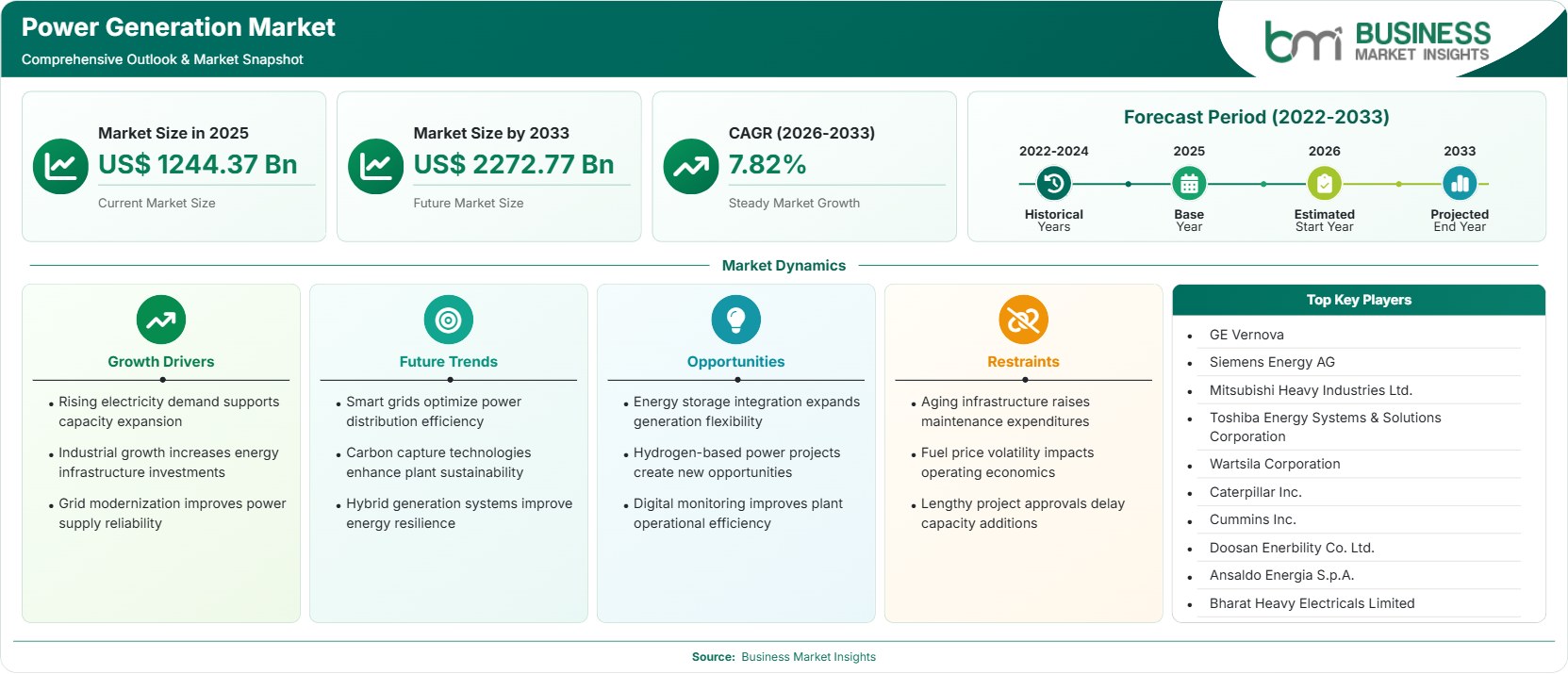
The Power Generation Market size was valued at US$ 1,244.37 billion in 2025 and is projected to reach US$ 2,272.77 billion by 2033, growing at a CAGR of 7.82% during 2026–2033. Rising electricity consumption, large-scale renewable energy deployment, grid modernization, and investments in flexible generation technologies continue strengthening long-term opportunities across global energy infrastructure.

Report Coverage
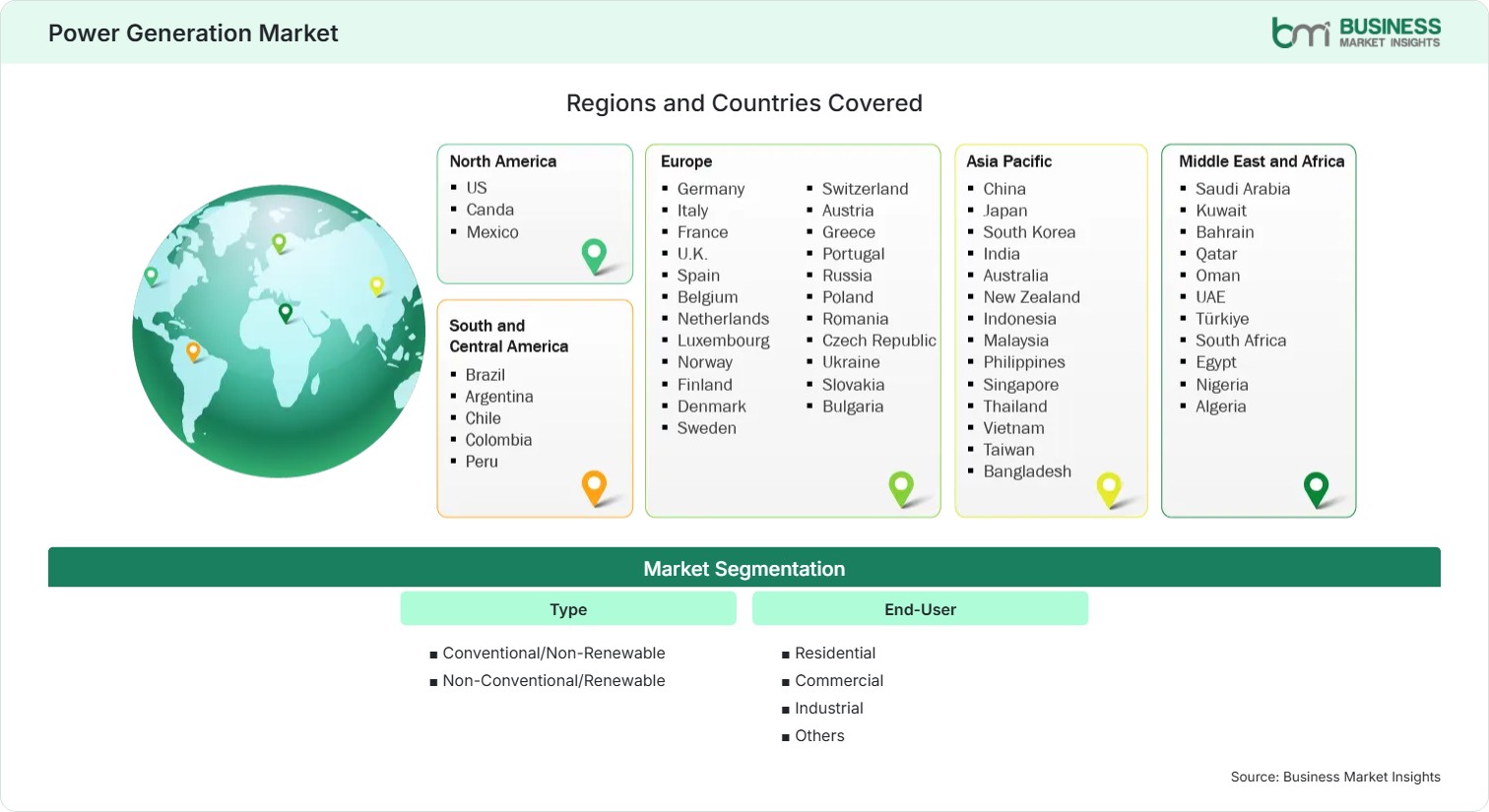
  • Type: Conventional/Non-Renewable, Non-Conventional/Renewable
  • End-User: Residential, Commercial, Industrial, Others
US$ 1244.37 Bn Market size in 2025
US$ 2272.77 Bn Market Size by 2033
7.82% CAGR, 2026 - 2033
2026-2033 Forecast Period

AI Overview

Power Generation Market Summary

  • North America Region: North America holds 24%–27% market share in 2025 and is expected to expand at a CAGR of 7.2%–7.7% during 2026–2033. Increasing renewable installations, grid modernization projects, and replacement of aging thermal assets continue supporting regional investment. The U.S. remains the largest contributor, growing at a CAGR of 7.3%–7.8% through expanding clean energy generation and transmission infrastructure.
  • Fastest Growing Region: Asia Pacific accounts for 41%–44% market share in 2025 and is projected to register the highest CAGR of 8.5%–9.0% during the forecast period. Rapid urbanization, industrialization, electricity demand, and government-backed renewable energy investments continue accelerating capacity additions.
  • Leading Segment: Conventional/Non-Renewable represents 52%–55% market share in 2025 and is anticipated to expand at a CAGR of 6.9%–7.4%, supported by established infrastructure, dependable baseload generation, and continued operation of fossil fuel and nuclear facilities.
  • High Growth Segment: Non-Conventional/Renewable captures 45%–48% market share in 2025 and is forecast to grow at a CAGR of 8.9%–9.5%, driven by expanding solar, wind, hydroelectric projects, supportive government policies, and declining renewable technology costs.
  • Key Market Opportunity: Growing investments in energy storage systems, hydrogen-powered electricity generation, digital grid management, and flexible generation technologies continue creating long-term opportunities for power producers worldwide.
  • Major Market Players: General Electric Company, Siemens Energy AG, Mitsubishi Heavy Industries, Ltd., Toshiba Energy Systems & Solutions Corporation, Wärtsilä Corporation, Caterpillar Inc., Cummins Inc., Doosan Enerbility Co., Ltd., Ansaldo Energia S.p.A., and Bharat Heavy Electricals Limited.
Strategic Insights

Power Generation Market: Strategic Insights

Power Generation Market Strategic Framework
FREE PDF
Request your free sample
Request free sample
Stakeholder View

Key Takeaways

  • Electricity demand continues rising across industrial, residential, and commercial sectors, encouraging utilities to diversify generation portfolios while strengthening long-term supply reliability.
  • Renewable energy technologies are attracting the largest capital investments as governments pursue decarbonization targets, energy security, and lower electricity generation costs.
  • Digital power plant technologies, predictive maintenance, and AI-enabled monitoring systems are improving operational efficiency and reducing maintenance expenditure.
  • Asia Pacific remains the strongest investment destination due to expanding electricity demand, industrial development, and large-scale renewable capacity additions.
  • Strategic collaborations between equipment manufacturers, utilities, and technology providers continue accelerating modernization of electricity generation infrastructure worldwide.
  • Investments in battery storage, hydrogen power generation, and flexible generation assets are expected to reshape future electricity markets over the forecast period.
Geographic Outlook

Power Generation Market Regional Highlights

North America Power Generation Market

North America accounts for 24%–27% Power Generation Market share in 2025 and is projected to register a CAGR of 7.2%–7.7% during 2026–2033. Utilities continue investing in renewable energy, flexible gas-fired generation, battery storage, and transmission upgrades to improve electricity reliability. Aging infrastructure replacement and increasing electrification of transportation further support long-term market expansion across the region.

  • Grid modernization investments continue improving electricity transmission efficiency and system resilience.
  • Utility-scale battery storage projects strengthen renewable energy integration across regional electricity networks.
  • Growing electricity demand from data centers supports additional generation capacity investments.
  • Modernization of conventional power plants improves operational efficiency and emissions performance.

US Power Generation Market

The United States contributes 80%–83% of regional revenue and is projected to expand at a CAGR of 7.3%–7.8% throughout the forecast period. Federal incentives supporting renewable energy deployment, energy storage investments, and modernization of transmission infrastructure continue strengthening long-term generation capacity expansion.

  • Utility investments in solar and wind generation continue accelerating nationwide.
  • Expansion of battery energy storage improves grid flexibility and renewable utilization.
  • Advanced gas turbine installations strengthen reliable dispatchable electricity generation.
  • Digital monitoring technologies improve operational performance across power generation facilities.

Europe Power Generation Market

Europe represents 22%–25% market share in 2025 and is anticipated to expand at a CAGR of 7.4%–7.9% through 2033. Ambitious decarbonization policies, renewable energy investments, and electricity market reforms continue reshaping regional generation infrastructure. Germany remains the leading market, while Spain records the fastest growth owing to significant renewable capacity expansion and supportive regulatory policies.

  • Offshore wind projects continue expanding electricity generation capacity across Northern Europe.
  • Grid modernization supports integration of distributed renewable energy resources.
  • Hydrogen-ready power generation projects strengthen long-term energy transition strategies.
  • Utilities continue investing in flexible generation assets to maintain electricity reliability.

Asia Pacific Power Generation Market

Asia Pacific holds 41%–44% market share in 2025 and is expected to record the fastest 8.5%–9.0% CAGR during the forecast period. Rising industrial activity, urbanization, expanding manufacturing sectors, and increasing electricity demand continue driving investment across conventional and renewable generation infrastructure. China leads regional capacity, while India registers the fastest growth due to accelerating renewable deployment and grid expansion.

  • Large-scale renewable projects continue increasing installed generation capacity.
  • Government investments strengthen electricity access and transmission infrastructure.
  • Industrial expansion drives sustained demand for reliable electricity generation.
  • Rapid urban development supports continuous additions to generation capacity.

Rest of World Power Generation Market

The Rest of World region accounts for 9%–12% market share in 2025 and is projected to grow at a CAGR of 7.8%–8.3% during 2026–2033. Expanding electricity access, infrastructure development, and renewable energy investments continue supporting growth across Latin America, the Middle East, and Africa. Brazil leads regional generation capacity, while Saudi Arabia records the fastest growth through renewable and gas-based power investments.

  • Renewable energy projects continue improving electricity access across emerging economies.
  • Natural gas generation remains an important source of flexible electricity supply.
  • Infrastructure modernization supports reliable power distribution and industrial development.
  • International investments continue expanding regional electricity generation capacity.
Global Market Geography
FREE PDF
Request your free sample
Request free sample
Segment Analysis

Power Generation Market Segmentation

Type

The type segment continues shaping the global electricity industry as countries maintain a balanced mix of conventional and renewable generation resources to ensure energy security and supply reliability. It accounted for 52%–55% market share in 2025 and is projected to register a CAGR of 6.9%–7.4% during 2026–2033. Expanding investments in cleaner technologies, modernization of existing power plants, and diversification of energy sources continue broadening the Power Generation Market scope across developed and emerging economies.

  • Conventional/Non-Renewable – Nuclear: Nuclear power remains an important baseload electricity source because of its high generation capacity, low operational emissions, and ability to provide continuous power for industrial, commercial, and residential consumers.
  • Conventional/Non-Renewable – Fossil Fuels: Coal and natural gas power plants continue supporting dependable electricity generation through established infrastructure, flexible dispatch capabilities, and stable energy supply despite increasing renewable energy deployment.
  • Non-Conventional/Renewable – Solar: Solar power continues expanding rapidly due to declining photovoltaic costs, supportive government policies, utility-scale investments, and growing rooftop installations across residential and commercial sectors.
  • Non-Conventional/Renewable – Wind: Wind energy remains one of the fastest-growing renewable sources, supported by onshore and offshore developments, improved turbine efficiency, and increasing investments in clean electricity infrastructure.
  • Non-Conventional/Renewable – Hydro: Hydropower continues providing reliable renewable electricity through established dam infrastructure, grid stability services, and long operational lifecycles that support national energy security objectives.

End-User

Demand across end-user industries continues expanding alongside economic development, urbanization, electrification, and industrial growth. The segment accounted for 46%–49% market share in 2025 and is expected to register a CAGR of 8.1%–8.6% during 2026–2033. Current Power Generation Market trends highlight increasing electricity consumption across residential communities, manufacturing industries, commercial buildings, and digital infrastructure requiring dependable and sustainable power supply.

  • Residential: Residential electricity demand continues increasing with urban expansion, higher appliance ownership, electrified heating systems, and growing adoption of electric vehicles supported by modern electricity networks.
  • Commercial: Commercial establishments require uninterrupted electricity for offices, retail facilities, hospitals, educational institutions, hotels, and data centers, encouraging utilities to strengthen generation capacity and supply reliability.
  • Industrial: Industrial users represent one of the largest electricity-consuming sectors, driven by manufacturing expansion, mining activities, chemical production, and heavy engineering operations requiring continuous high-capacity power availability.
Market Forces

Power Generation Market Dynamics

Key Market Drivers

Rising electricity demand supports capacity expansion

Global electricity demand continues to increase due to rapid urbanization, industrial development, electrification of transportation, and expanding digital infrastructure. According to the International Energy Agency (IEA), worldwide electricity consumption is rising steadily as data centers, electric vehicles, and industrial facilities require larger and more reliable power supplies. Utilities are responding by expanding generation capacity through both renewable and conventional energy sources while strengthening transmission networks. Large-scale investments in generation assets are improving energy availability across developed and emerging economies. These developments continue supporting Power Generation Market growth, encouraging governments and private investors to accelerate long-term electricity infrastructure expansion.

Industrial growth increases energy infrastructure investments

Industrial expansion across manufacturing, mining, chemicals, and heavy engineering sectors continues driving investment in electricity generation infrastructure. Developing economies are building new-generation facilities to meet the needs of growing industrial zones and rising electricity demand. In addition, developed nations are upgrading their aging facilities to make them more efficient and flexible. Combined-cycle gas turbines, renewable energy sources, and hybrid power stations continue to make the power supply system reliable. The industry is becoming more dependent on uninterrupted electricity supply because of automation and digital manufacturing.

Grid modernization improves power supply reliability

The power utility companies are spending much in grid modernization, which will help them enhance their services in terms of reliability and renewable energy integration. Through advanced digital substations, intelligent transmissions, real-time monitoring and grid management systems, power utility companies can be able to distribute electricity efficiently without any interruption in the process. Smart grids also ensure the integration of renewable energy in the electricity network. These infrastructure upgrades continue influencing Power Generation Market trends, supporting more efficient electricity generation, improved operational performance, and enhanced energy security across national power systems.

Key Market Opportunities

Energy storage integration expands generation flexibility

Battery energy storage systems are becoming an essential component of modern electricity generation by improving grid stability, balancing renewable energy output, and enhancing peak demand management. Utilities are increasingly deploying large-scale storage facilities alongside renewable generation assets to improve dispatch flexibility and reduce curtailment. Continued improvements in battery technologies, declining storage costs, and supportive regulatory frameworks are creating new commercial opportunities for equipment suppliers and power producers. Power Generation Market Forecasts indicate that energy storage integration will become a critical investment area supporting reliable, low-carbon electricity systems throughout the forecast period.

Hydrogen-based power projects create new opportunities

Hydrogen is emerging as an important alternative fuel for future electricity generation as governments pursue long-term decarbonization strategies. The power generators are considering hydrogen-compatible gas turbines and power plants that would enable lower carbon emissions while providing stable, flexible power generation. A lot of investment is being made in the production, storage, and transportation of green hydrogen, creating more opportunities for its commercialization. There are also technologies that can work on mixed hydrogen fuel.

Digital monitoring improves plant operational efficiency

Digital technologies are transforming plant operations through predictive maintenance, artificial intelligence, digital twins, and advanced analytics that improve equipment reliability and reduce operational costs. Modern utilities are using real-time monitoring tools that enable better management of their fuel usage, timely detection of equipment breakdowns, and greater efficiency in the process of power generation. Asset management tools and cloud computing technologies further improve efficiency through effective maintenance planning and improved employee productivity.

Market Restraints and Challenges

Aging infrastructure raises maintenance expenditures

Many electricity generation facilities worldwide continue operating beyond their original design life, increasing maintenance requirements and capital expenditure. Factor: Aging turbines, boilers, transmission equipment, and supporting infrastructure require extensive refurbishment, modernization, or replacement to maintain reliable electricity production. Impact: Higher maintenance costs, unexpected equipment failures, and longer plant outages increase operational expenses for utilities while delaying investment in next-generation generation technologies. Utilities are therefore balancing infrastructure upgrades with expansion of cleaner and more efficient generating assets.

Fuel price volatility impacts operating economics

Fluctuations in global prices for coal, natural gas, and petroleum products continue affecting electricity generation costs, particularly for thermal power plants. Factor: Volatile fuel markets create uncertainty in generation planning, long-term supply contracts, and operational budgeting for utilities and independent power producers. Impact: Higher fuel costs reduce profitability, increase electricity generation expenses, and may lead to higher power tariffs for industrial and residential consumers. Diversification toward renewable generation and hybrid energy systems is helping reduce long-term exposure to fuel price fluctuations.

Company Analysis

Competitive Landscape

The market remains highly competitive as established equipment manufacturers invest in advanced turbine technologies, digital power plant solutions, hydrogen-compatible generation systems, and grid modernization projects. Power Generation Market analysis shows that companies are expanding global manufacturing capabilities, strengthening service portfolios, and collaborating with utilities to support the transition toward cleaner, more efficient, and reliable electricity generation infrastructure.

Company Name

Overview

Products and Services Relevant to this Market

General Electric Company

Global energy technology company providing equipment and digital solutions for conventional and renewable power generation.

Gas turbines, steam turbines, wind turbines, generators, grid technologies, plant modernization, and digital power solutions.

Siemens Energy AG

Leading global supplier of power generation technologies with operations across conventional and renewable energy sectors.

Gas turbines, steam turbines, generators, hydrogen-ready technologies, transmission equipment, and digital energy services.

Mitsubishi Heavy Industries, Ltd.

Japanese engineering company delivering advanced power generation equipment and decarbonization technologies worldwide.

Gas turbines, steam turbines, hydrogen-capable systems, carbon capture technologies, and plant engineering services.

Toshiba Energy Systems & Solutions Corporation

Provides integrated power generation systems and advanced energy infrastructure solutions for utilities globally.

Steam turbines, hydroelectric equipment, nuclear systems, generators, transmission technologies, and plant maintenance services.

Wärtsilä Corporation

Technology company specializing in flexible power generation and energy storage solutions.

Engine-based power plants, hybrid energy systems, battery storage integration, lifecycle services, and digital optimization platforms.

Caterpillar Inc.

Global manufacturer supplying distributed power generation equipment for industrial and commercial applications.

Diesel generators, gas generators, microgrid solutions, backup power systems, and equipment support services.

Cummins Inc.

Develops diversified power solutions serving industrial, commercial, and utility customers worldwide.

Generator sets, gas-powered systems, hydrogen technologies, fuel cell solutions, and distributed energy equipment.

Doosan Enerbility Co., Ltd.

Engineering company providing large-scale power generation equipment and EPC services.

Steam turbines, nuclear power equipment, boilers, renewable energy technologies, and integrated power plant solutions.

Ansaldo Energia S.p.A.

Italian manufacturer specializing in advanced thermal power generation technologies.

Gas turbines, generators, power plant services, hydrogen-ready systems, and operational upgrade solutions.

Bharat Heavy Electricals Limited

India's leading manufacturer of power generation equipment serving domestic and international utilities.

Thermal power equipment, hydroelectric systems, generators, boilers, transformers, and EPC project execution services.

Trust & Transparency

Research Methodology

The market analysis combines proprietary research with secondary data from government agencies, company disclosures, regulatory filings, industry databases and expert interviews. Market estimates are validated through data triangulation, cross-market benchmarking and analyst review.

View Full Research Methodology

Questions Answered

Frequently Asked Questions

What does the Power Generation Market Report include?

The Market Report provides comprehensive insights into market dynamics, regional performance, competitive landscape, technology developments, segmentation analysis, investment opportunities, regulatory trends, and future industry outlook.

Which region offers the highest growth opportunities?

Asia Pacific is expected to register the fastest expansion due to rapid industrialization, urbanization, rising electricity consumption, manufacturing growth, and significant investments in renewable and conventional power generation capacity.

Why are renewable power projects expanding rapidly?

Declining technology costs, supportive government policies, decarbonization commitments, and increasing investment in clean energy infrastructure are accelerating the deployment of solar, wind, hydroelectric, and hybrid generation facilities.

Which generation type currently accounts for the largest market share?

Conventional power generation remains the leading segment because established thermal and nuclear infrastructure continues providing dependable baseload electricity while supporting grid stability across numerous countries.

What factors are driving the Power Generation Market?

Growing electricity demand, industrial expansion, renewable energy deployment, modernization of aging infrastructure, and investments in grid reliability continue driving long-term growth across global electricity generation industries.

Access the Full Power Generation Market Report

Get segment-level forecasts, regional estimates, competitive benchmarking, company profiles and downloadable Excel datasets.

Access the full Power Generation Market Report
350 pages PDF & Excel | 2026-08-17
Similar Research

Related Market Reports