Market Summary
Executive Summary and Global Market Analysis
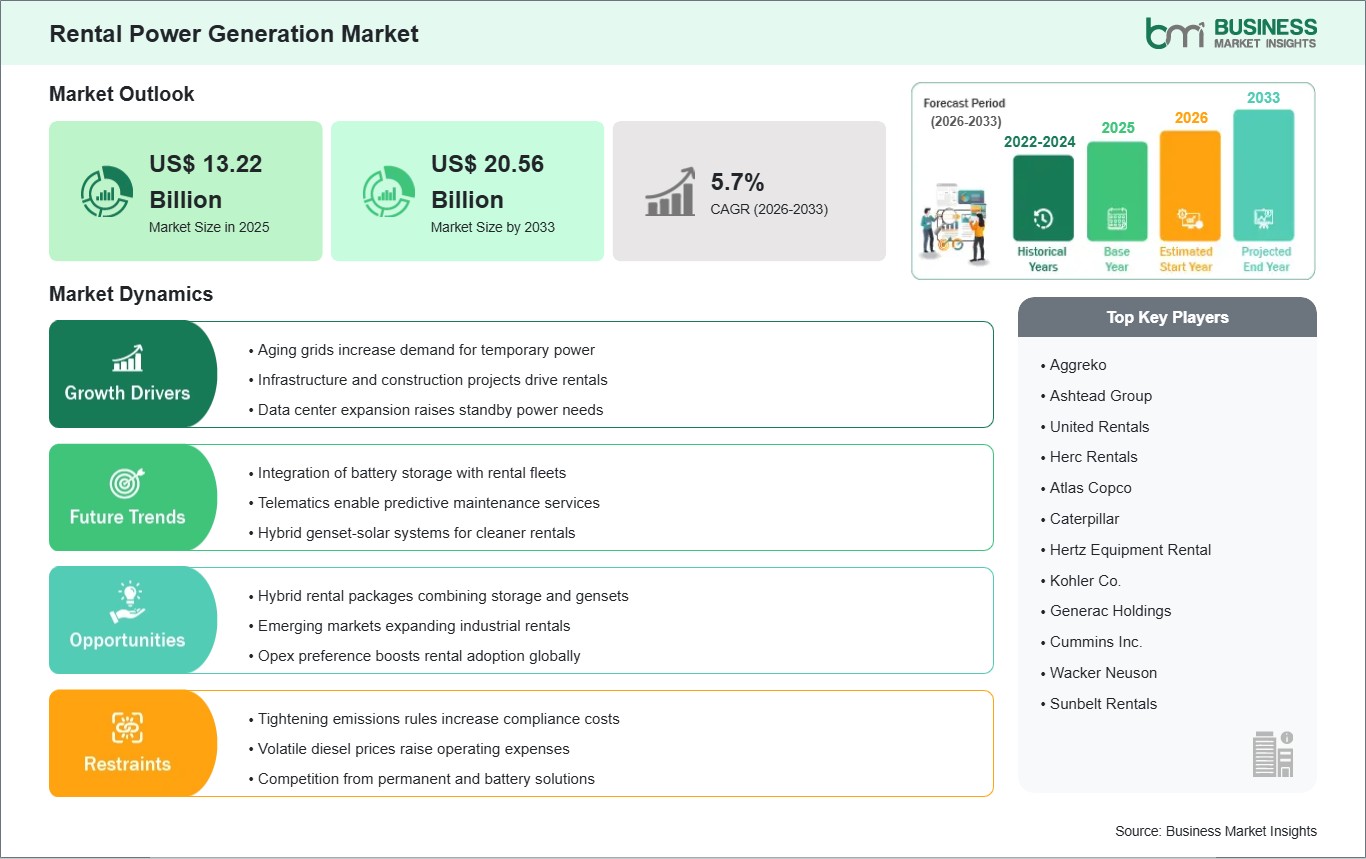
Temporary electricity supply solutions provided through short-term and long-term leasing help organizations keep running without the cost of permanent generation assets. Rental power systems are useful for projects, emergencies, maintenance shutdowns, and activities at remote sites where a constant electricity supply is crucial. Infrastructure growth, industrial development, and concerns about grid reliability continue to drive the use of rental power services. Organizations are increasingly choosing flexible power purchasing options that lower capital costs while maintaining operations. The ability to quickly set up equipment in various environments also boosts its importance in the industry. From a segmentation viewpoint, diesel-powered systems remain popular due to their ease of use and flexibility in deployment. Natural gas options are gaining interest where fuel availability and environmental factors affect equipment choices. Generators are the main component of rental fleets, while demand varies across construction, mining, utility, and data center applications. Technological improvements are changing fleet capabilities with digital monitoring, predictive maintenance tools, and better fuel management systems. Hybrid and battery-backed solutions are slowly being added to rental portfolios to meet efficiency needs and manage emissions. Upgraded control systems also allow for better load balancing and remote monitoring of assets. The competitive landscape features efforts to modernize fleets, expand geographically, and differentiate services. Companies are working on improving equipment availability, response times, and maintenance support. How well a company performs increasingly relies on operational reliability, equipment variety, and the ability to adapt to changing customer needs in different sectors.
Segment Analysis
Rental Power Generation Market Segmentation
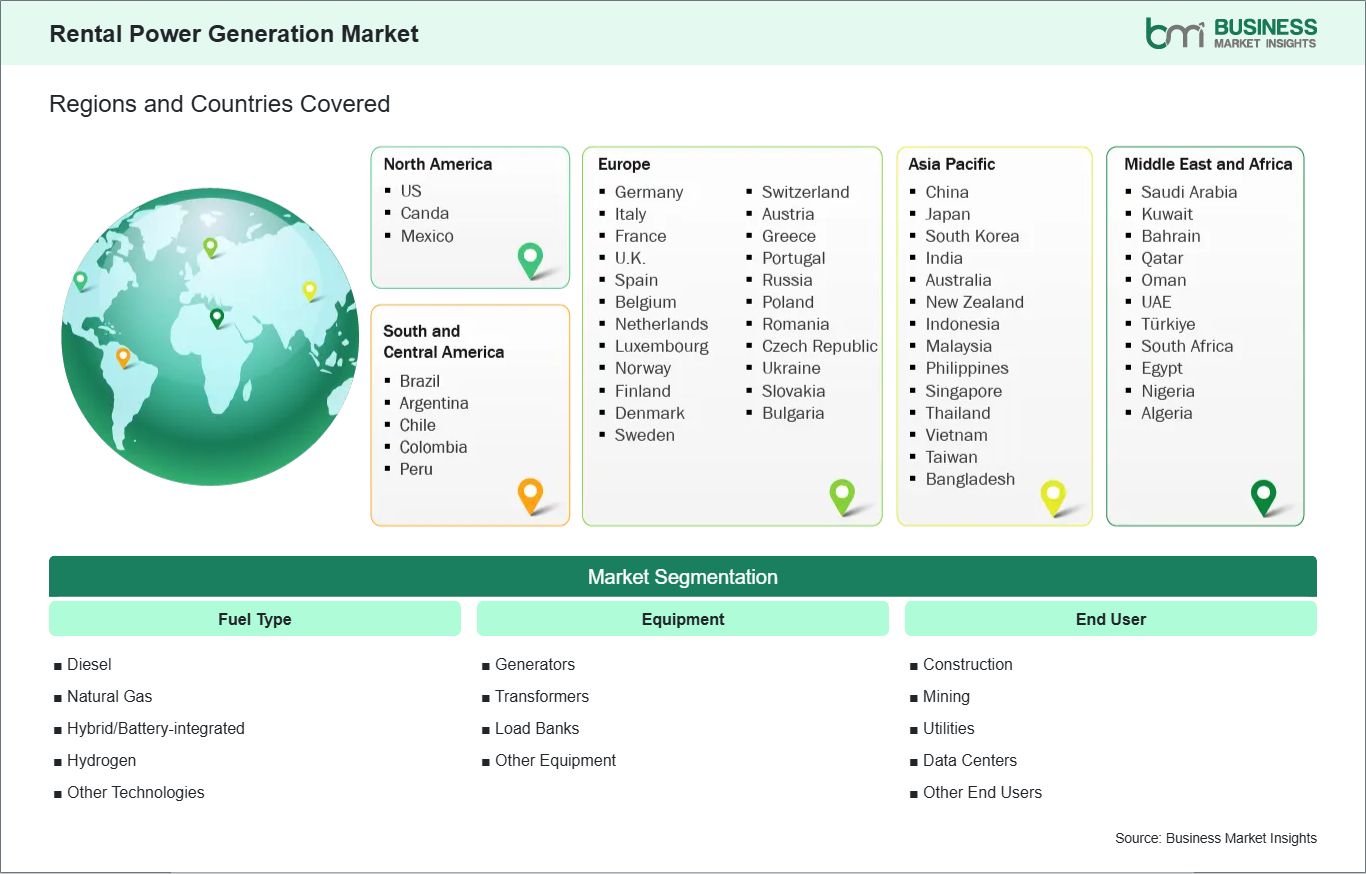
The market is segmented according to fuel type, equipment category, and end-user requirements across multiple operational environments.
By Fuel Type
- Diesel - Preferred for deployment flexibility and established fuel infrastructure
• Natural Gas - Favored where cleaner combustion requirements influence selection
• Hybrid/Battery-integrated - Supports fuel optimization and lower operating intensity
• Hydrogen - Emerging option for low-emission temporary power applications
• Other Technologies - Addresses specialized operational and environmental requirements
By Equipment
- Generators - Form the foundation of rental power deployments
• Transformers - Enable voltage adaptation for project-specific requirements
• Load Banks - Facilitate testing and performance verification processes
• Other Equipment - Complements temporary power infrastructure installations
By End User
- Construction - Utilized for mobile and temporary project power needs
• Mining - Supports operations across isolated extraction locations
• Utilities - Assists maintenance activities and grid continuity requirements
• Data Centers - Ensures backup capacity during critical infrastructure events
• Other End Users - Serves sector-specific temporary power applications
Market Forces
Rental Power Generation Market Drivers and Opportunities
Expanding Infrastructure and Industrial Project Activity
Large-scale infrastructure development needs reliable temporary electricity during construction and commissioning. Permanent grid connections are often unavailable while projects are in progress, so there’s a demand for deployable power solutions. Industrial facilities that are expanding, maintaining, or modernizing also rely on rental systems to keep operations going without long interruptions. This need has raised the importance of rental power providers in construction, mining, and utility sectors. Organizations are focusing more on operational flexibility and reducing upfront investment costs. As projects become more complex, rental solutions provide scalable capacity options that can adapt to changing energy needs throughout the project lifecycle.
Advancement of Hybrid and Low-Emission Rental Solutions
The shift to cleaner and more efficient temporary power systems is driving innovation in rental fleets. Hybrid setups that combine generators with battery storage improve fuel efficiency and lower noise levels. These systems are especially appealing for projects that face closer examination regarding their environmental impact. Future opportunities will arise from a wider adoption of energy management systems and alternative fuel technologies. Increasing the use of battery-supported rental assets can open up new applications in commercial and industrial sectors. Ongoing technological improvements are expected to enhance operational flexibility while supporting changing sustainability goals.
Size and Share Analysis
Rental Power Generation Market Size and Share Analysis
The rental power generation Market was valued at USD 13.22 Billion in 2025 and is projected to reach USD 20.56 Billion by 2033, expanding at a CAGR of 5.7% during the forecast period. The market shows steady growth, driven by a greater reliance on flexible power buying models. Temporary electricity solutions are becoming more important across industries that want to maintain operations without long-term infrastructure commitments. Diesel technology remains the top choice in the fuel type segment because of its versatility and widespread familiarity. Generators are the most common type of equipment since they are the main source of temporary electricity generation in various projects. Construction activities make up a significant portion of end users due to ongoing demand for mobile power systems. Utilities and data centers also use these solutions heavily, as organizations look for reliable backup and extra electricity during maintenance and unexpected issues.
Report Coverage
Rental Power Generation Market Report Coverage and Deliverables
The "Rental Power Generation Market Size and Forecast (2022-2033)" report provides a detailed analysis of the market covering below areas:
- The market size and forecast at global, regional, and country levels for all market segments covered under the scope
- The market trends, as well as drivers, restraints, and opportunities
- The market analysis covering key trends, global and regional framework, major players, regulations, and recent developments
- Industry landscape and competition analysis covering market concentration, heat map analysis, prominent players, and recent developments for the market
- Detailed company profiles, including SWOT analysis
Geographic Insights
Rental Power Generation Market Geographic Insights
The Rental Power Generation market shows diverse regional adoption patterns influenced by investment in infrastructure, levels of industrial activity, energy reliability needs, and project-based electricity use. Demand distribution varies based on economic development priorities and the availability of permanent power infrastructure in different countries. North America has a well-established rental power market supported by ongoing construction, utility maintenance programs, and essential infrastructure needs. Industrial operators often use temporary generation assets to ensure continuity during outages and planned maintenance. Service quality and the availability of rental fleets are important competitive factors in this region. Asia Pacific has significant market potential due to urban development, industrial growth, and large infrastructure projects. Temporary power solutions are widely used in remote areas where grid access is limited or unreliable. Ongoing investment in commercial and industrial facilities encourages broader deployment across various end-user segments. Europe, along with emerging markets in the Middle East, Africa, and South and Central America, shows varied operational needs. European users are increasingly focusing on efficiency and environmental performance, which boosts interest in modern rental technologies. Emerging economies prioritize flexibility in deployment and quick power availability, especially for industrial projects, energy developments, and infrastructure growth initiatives.
Industry Activity
Recent Developments
Recent industry developments reflect ongoing investments in fleet modernization and cleaner temporary power technologies. Market participants continue expanding capabilities to address evolving customer requirements.
- In October 2025:T&T Power Group, a Canadian leader in power generation, has acquired Gen-Tech, a U.S. provider of power generation systems and services. This acquisition enhances T&T’s operational footprint and service capabilities across North America. T&T Power Group, founded in 1980, specializes in custom-engineered energy systems, while Gen-Tech boasts over 125 years of experience in emergency and standby power solutions, with locations in Arizona, Colorado, Nevada, and New Mexico.
- In Aug 2024: Atlas Copco acquired Generator Rental Services, GRS, which is headquartered in Auckland, was founded in 1997. The company has 58 employees and revenues of 23 MEUR during the last fiscal year. The company provides specialty power and temperature control equipment, and the main customer groups can be found within power utility, general industry, and civil construction.
Trust & Transparency
Research Methodology
The market analysis combines proprietary research with secondary data from government agencies, company disclosures, regulatory filings, industry databases and expert interviews. Market estimates are validated through data triangulation, cross-market benchmarking and analyst
review.
View Full Research Methodology
Key Sources Referred:
International Energy Agency (IEA)U.S. Energy Information Administration (EIA)International Electrotechnical Commission (IEC)Institute of Electrical and Electronics Engineers (IEEE)National Fire Protection Association (NFPA)American National Standards Institute (ANSI)European Committee for Electrotechnical Standardization (CENELEC)International Organization for Standardization (ISO)Gas Technology Institute (GTI)World Bank (ESMAP)Electric Power Research Institute (EPRI)U.S. Department of Energy (DOE)