
Power Generation Equipment Market Outlook: Size, Share, Trends, Growth Analysis, Competitive Landscape & Forecast, 2026-2033

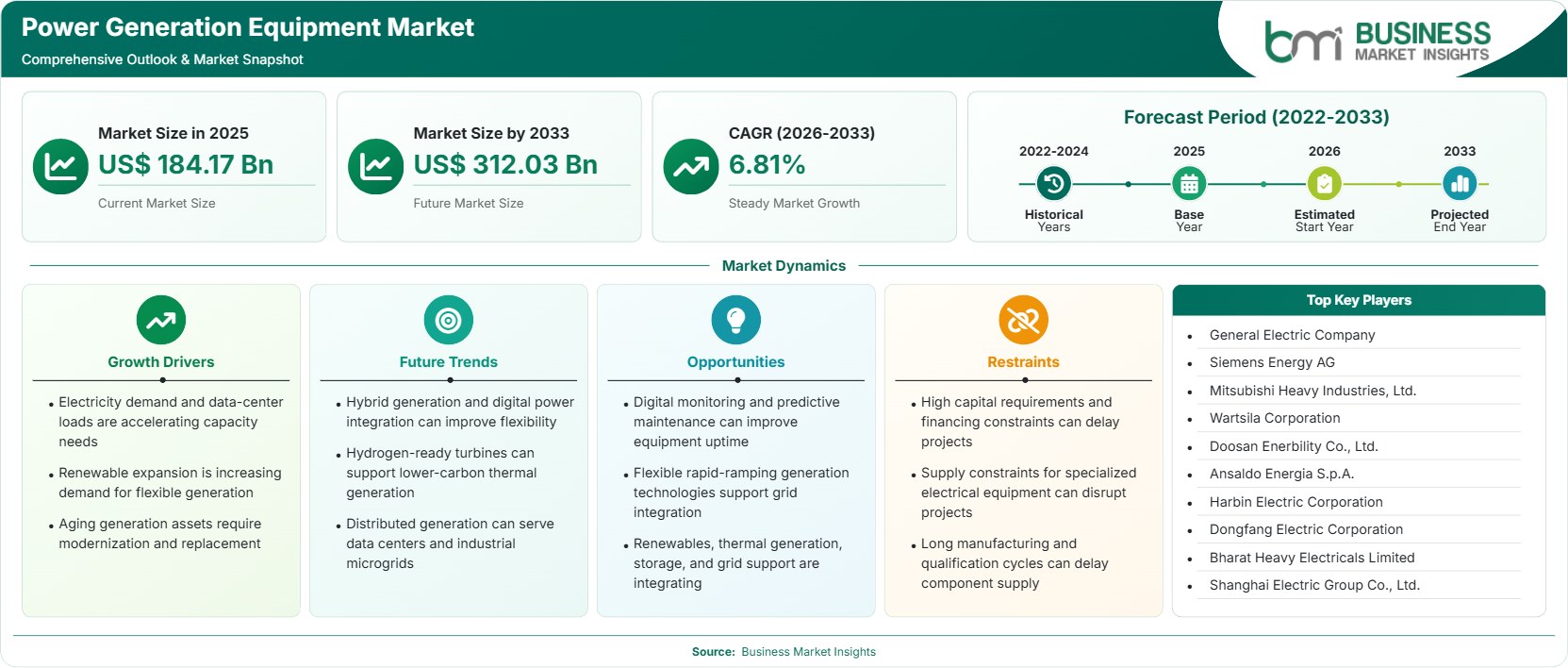
The Power Generation Equipment Market size was valued at US$ 184.17 Billion in 2025 and is projected to reach US$ 312.03 Billion by 2033, growing at a CAGR of 6.81% during 2026–2033, driven by electrification, renewable integration, grid modernization, data-center demand, replacement cycles, and flexible generation investments.

Report Coverage
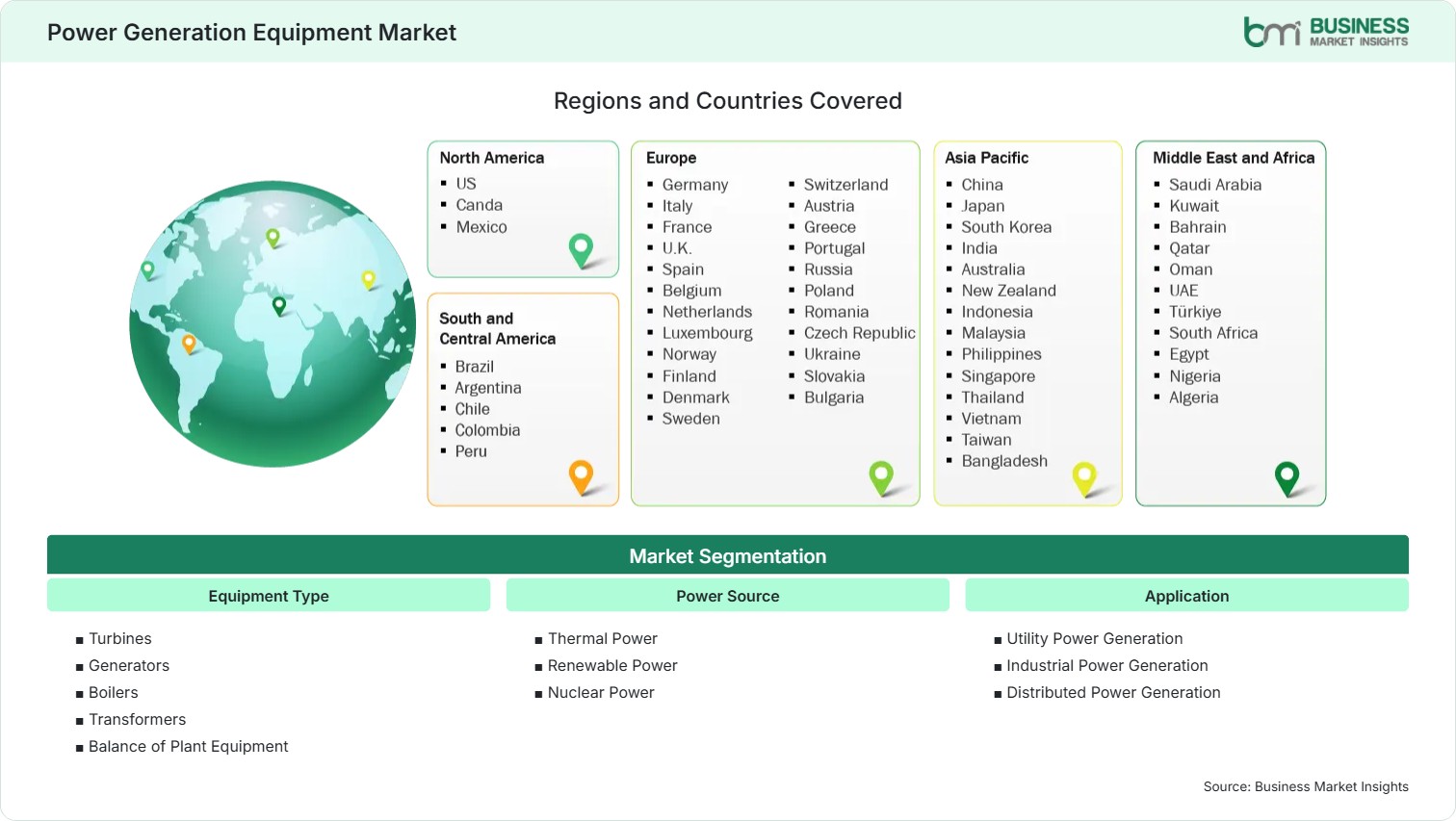
  • Equipment Type: Turbines, Generators, Boilers, Transformers, Balance of Plant Equipment
  • Power Source: Thermal Power, Renewable Power, Nuclear Power
  • Application: Utility Power Generation, Industrial Power Generation, Distributed Power Generation
US$ 184.17 Bn Market size in 2025
US$ 312.03 Bn Market Size by 2033
6.81% CAGR, 2026 - 2033
2026-2033 Forecast Period

AI Overview

Power Generation Equipment Market Summary

  • North America Region: North America holds a Power Generation Equipment Market share of 18%–21% in 2025, growing with a CAGR of 5.7%–6.2% influenced by data centers, grid upgrades, gas turbine demand, industrial electrification, and equipment modernization. US demand benefits from data centers, manufacturing expansion, electrification, and replacement of aging generation assets, supporting approximately 5.8%–6.3% CAGR through 2033.
  • Fastest Growing Region: Asia Pacific holds a market share of 39%–42% in 2025, expanding at a CAGR of 7.4%–8.0%, supported by industrialization, electricity-access expansion, renewable capacity additions, manufacturing investment, and accelerating demand for distributed generation.
  • Leading Segment: Turbines hold a market share of 34%–37% in 2025, growing at a CAGR of 6.5%–7.0%, supported by combined-cycle capacity, flexible generation, repowering, efficiency upgrades, renewable balancing, and replacement of aging thermal equipment.
  • High Growth Segment: Distributed Power Generation holds a Power Generation Equipment Market share of 15%–18% in 2025, advancing at a CAGR of 8.2%–8.8%, driven by data centers, industrial microgrids, energy resilience, remote loads, modular generation, and decentralized electrification.
  • Key Market Opportunity: Equipment suppliers can capture higher-value opportunities through hybrid generation, hydrogen-ready turbines, digital controls, modular systems, predictive maintenance, and solutions integrating renewables, storage, and flexible thermal assets.
  • Major Market Players: General Electric Company, Siemens Energy AG, Mitsubishi Heavy Industries, Ltd., Wärtsilä Corporation, Doosan Enerbility Co., Ltd., Ansaldo Energia S.p.A., Harbin Electric Corporation, Dongfang Electric Corporation, Bharat Heavy Electricals Limited, and Shanghai Electric Group Co., Ltd.
Strategic Insights

Power Generation Equipment Market: Strategic Insights

Power Generation Equipment Market Strategic Framework
FREE PDF
Request your free sample
Request free sample
Stakeholder View

Key Takeaways

  • The value chain is becoming more integrated, with turbine, generator, transformer, control, engineering, and lifecycle-service suppliers increasingly competing through complete plant packages rather than standalone equipment. Digital monitoring and long-term service contracts are strengthening recurring revenue potential.
  • Distributed generation and flexible gas-based generation offer strong upside where grid constraints, data-center loads, industrial reliability requirements, or remote electrification make centralized capacity insufficient. Equipment designed for rapid ramping can command premium positioning.
  • Manufacturers are prioritizing higher turbine efficiency, hydrogen-readiness, advanced cooling, predictive maintenance, modular generator architecture, and digital controls. These developments improve operational flexibility while supporting lower emissions and longer equipment operating lives.
  • Asia Pacific provides the broadest equipment deployment opportunity because industrial expansion and electricity demand growth are occurring alongside renewable capacity additions. India, China, Southeast Asia, and selected Middle Eastern economies provide attractive project pipelines.
  • Capital is increasingly directed toward generation technology, grid equipment, service capabilities, and digital energy platforms. Strategic transactions are likely to emphasize technology portfolios that improve equipment utilization and address power-system reliability.
  • Suppliers with manufacturing scale, localized service networks, financing capabilities, and engineering expertise should be better positioned to secure large infrastructure projects where customers prioritize lifecycle performance over initial equipment price.
Geographic Outlook

Power Generation Equipment Market Regional Highlights

North America Power Generation Equipment Market

North America represents 18%–21% share in 2025 and is projected to expand at a 5.7%–6.2% CAGR through 2033. The region benefits from data-center construction, industrial reshoring, grid reliability investments, and replacement of aging generators. The US dominates regional procurement, while Canada contributes through hydroelectric modernization and grid reinforcement. Equipment demand is increasingly concentrated around flexible gas generation, advanced generators, transformers, digital controls, and hybrid systems supporting renewable integration. Regional Power Generation Equipment Market share should remain resilient as utilities balance rising loads with decarbonization requirements.

  • Data-center expansion is strengthening demand for dispatchable generation, particularly fast-ramping gas turbines and generators capable of supporting large, continuous loads without compromising grid reliability.
  • Grid modernization is increasing demand for transformers, generators, controls, and balance-of-plant equipment as utilities upgrade aging infrastructure and connect larger volumes of renewable generation.
  • Industrial reshoring is creating localized power requirements across manufacturing, semiconductors, chemicals, and advanced materials, supporting investment in utility-scale and behind-the-meter generation.
  • Canada provides additional demand through hydroelectric refurbishment, transmission development, and modernization of aging generating assets, creating opportunities for turbine and generator suppliers.

US Power Generation Equipment Market

The US accounts for approximately 70%–75% of North American equipment demand and is projected to grow at 5.8%–6.3% CAGR through 2033. Data centers, semiconductor plants, manufacturing investment, and electrification are raising load requirements. IEA analysis indicates US electricity demand is being revised upward because of data centers and industrial activity. Consequently, Power Generation Equipment Market growth is increasingly linked to flexible generation, grid capacity, generator modernization, and rapidly deployable capacity.

  • Data-center demand is creating new procurement opportunities for gas turbines, generators, controls, and modular generation, particularly where transmission capacity cannot be expanded quickly enough.
  • Utility replacement programs are supporting turbine upgrades, generator refurbishment, emissions-control improvements, and digital monitoring, extending equipment lifecycles while improving operating efficiency.
  • Industrial electrification and manufacturing expansion are creating opportunities for distributed generation and microgrid equipment where customers require greater resilience and controllable power.

Europe Power Generation Equipment Market

Europe has a 23%-26% market share in 2025 and is expected to grow at a 6.2%-6.7% CAGR in the Power Generation Equipment Market through 2033. Germany, France, Italy, the UK, and Spain remain important equipment markets, whereas Poland and certain Nordic countries have high growth potential. In 2024, EU renewables accounted for 50% of electricity production, while future investments in the energy grid are estimated at more than US$70 billion for 2025. Equipment demand therefore increasingly centers on flexibility, modernization, nuclear support, and renewable integration.

  • Germany leads demand for grid-supporting equipment, industrial generation, and modernization as manufacturing electrification increases requirements for reliable electricity and flexible generation.
  • France provides opportunities associated with nuclear equipment, generator refurbishment, auxiliary systems, and grid reinforcement, supporting specialized suppliers with high technical qualification capabilities.
  • Spain offers attractive growth through renewable integration, flexible generation, grid reinforcement, and hybrid power systems designed to manage increasing solar penetration.
  • Poland and Nordic markets provide high-growth opportunities for generation modernization, industrial electrification, renewable integration, and flexible balancing equipment.

Asia Pacific Power Generation Equipment Market

Asia Pacific region has a 39%–42% market share and shows a regional CAGR of 7.4%–8.0% for the Power Generation Equipment Market. Demand from China, India, Japan, South Korea, and Southeast Asia drives regional growth, with India and Southeast Asia showing especially promising growth potential. The rapid growth in electricity consumption, manufacturing investments, renewables, nuclear, and industrial electrification drives sales of turbines, generators, boilers, transformers, and control equipment. In 2024, India allocated 83% of its power sector investment to renewable sources.

  • China remains a major manufacturing and deployment center, supporting domestic demand for turbines, generators, boilers, transformers, and renewable-power equipment across large infrastructure projects.
  • India combines rising electricity demand with manufacturing localization, renewable deployment, transmission investment, and expanding industrial capacity, strengthening opportunities for domestic and international equipment manufacturers.
  • Southeast Asia offers high growth as Indonesia, Vietnam, Thailand, Malaysia, and the Philippines expand industrial capacity and require reliable electricity alongside renewable integration.
  • Japan and South Korea emphasize efficiency, grid stability, nuclear support, and advanced generation technologies, creating demand for high-performance equipment and lifecycle services.

Rest of World Power Generation Equipment Market

Rest of World accounts for around a 14% to 17% share in 2025 and is forecast to grow at a 5.2% to 5.8% CAGR up to 2033. Latin America enjoys hydroelectric upgrades, renewable energy investments, and industrialization. Brazil and Mexico still dominate the Power Generation Equipment Market, while Chile and Colombia present fast-growing segments. The Middle East and Africa have desalination-based power projects, industrialization, energy access, and gas-fired power plants. UAE, Saudi Arabia, Egypt, and South Africa continue to be significant buyers of Power Generation Equipment.

Latin America will need more flexible Power Generation Equipment to supplement hydroelectric and intermittent renewable energy systems. The Middle East will require high-efficiency gas turbines and generators, while African countries will offer market opportunities for modular and distributed power generation.

  • Brazil offers equipment opportunities through hydro refurbishment, renewable integration, transmission expansion, and industrial electricity requirements, supporting turbine and generator modernization.
  • Mexico benefits from industrial development and nearshoring, creating demand for distributed generation, utility equipment, grid-support technologies, and reliable industrial power systems.
  • Gulf markets are investing in large combined-cycle plants, desalination-linked power capacity, and flexible generation, creating opportunities for advanced turbines and generators.
  • Africa provides long-term potential for modular generation, distributed power, and efficient thermal systems supporting industrialization and electricity-access expansion.
Global Market Geography
FREE PDF
Request your free sample
Request free sample
Segment Analysis

Power Generation Equipment Market Segmentation

Equipment Type

The Equipment Type will continue to dominate all other segmentation categories, with turbines holding a 34%-37% share in 2025 and a 6.5%-7.0% CAGR till 2034. Factors such as replacement cycles, balancing renewable energy, combined-cycle power plants, and industrial generation affect demand. The scope of the Power Generation Equipment Market is shifting toward integrated turbine-generator systems and flexible equipment.

  • Turbines: Turbines remain central to utility and industrial generation, with steam, gas, hydro, and wind technologies serving different operating profiles and supporting efficiency, flexibility, renewable expansion, and modernization.
    • Steam Turbines: Steam turbines support thermal and nuclear generation, with refurbishment, efficiency upgrades, and replacement projects sustaining demand across mature and emerging power systems.
    • Gas Turbines: Gas turbines benefit from flexible generation requirements, data-center loads, rapid ramping needs, combined-cycle development, and increasing interest in hydrogen-ready technology.
    • Hydro Turbines: Hydro turbines support renewable generation, refurbishment, capacity uprating, and improved operational flexibility, particularly in regions with established hydroelectric infrastructure.
    • Wind Turbines: Wind turbines remain important to renewable deployment, with larger machines, improved controls, and offshore applications increasing equipment complexity and service requirements.
  • Generators: Generators convert mechanical energy into electricity and remain essential across utility, industrial, distributed, and renewable applications, with efficiency and reliability shaping purchasing decisions.
  • Boilers: Boilers support steam-cycle generation and industrial applications, with demand influenced by modernization, efficiency requirements, emissions management, and replacement of aging thermal equipment.
  • Transformers: Transformers enable voltage conversion and grid connection, with renewable integration, transmission expansion, and replacement requirements strengthening demand for high-capacity and specialized units.
  • Balance of Plant (BOP) Equipment: BOP equipment includes supporting plant infrastructure, auxiliary systems, controls, and electrical equipment, benefiting from complete-project procurement and plant modernization.

Power Source

The Power Source Segmentation segment will be redefined due to the adoption of renewable energy, energy security concerns, and the need for dispatchable power capacity. The Thermal Power segment is essential for flexibility; the Renewable Power Segment offers the best growth pipeline in terms of capacity additions; and the Nuclear Power Segment is responsible for reliable power production.

  • Thermal Power: Thermal power equipment remains important for dispatchable electricity, balancing variable renewable generation, replacing inefficient assets, and supplying industrial or rapidly growing electricity loads.
  • Renewable Power: Renewable power equipment benefits from accelerating solar, wind, hydro, and associated grid investment, with the IEA projecting 4,600 GW of renewable capacity additions between 2025 and 2030.
  • Nuclear Power: Nuclear power equipment benefits from renewed interest in energy security and reliable low-carbon generation, supporting specialized turbines, generators, auxiliary systems, and modernization programs.

Application

The application segmentation indicates the new demands for where and how reliably electricity needs to be used. The demand segment that still accounts for the largest share is Utility Power Generation, whereas the Power Generation Equipment Market benefits from increased electrification of manufacturing and the rise of high-energy factories. The best growth perspective is in Distributed Power Generation, microgrids, remote facilities, and resilience-focused customers, who seek controllable local capacity.

  • Utility Power Generation: Utility projects require large turbines, generators, transformers, boilers, and BOP systems, with procurement increasingly linked to grid reliability, renewable integration, and replacement cycles.
  • Industrial Power Generation: Industrial generation supports chemicals, metals, manufacturing, refining, and processing facilities where reliable electricity and combined heat and power can improve operational continuity and energy economics.
  • Distributed Power Generation: Distributed generation is gaining traction through modular systems, microgrids, data centers, remote loads, and resilience applications requiring localized electricity with flexible operating characteristics.
Market Forces

Power Generation Equipment Market Dynamics

Key Market Drivers

Accelerating Electricity Demand and Data-Center Load Growth

Electricity consumption will increasingly influence equipment purchases due to higher loads from data centers, semiconductors, industrial automation, electric vehicles, and cooling. According to IEA estimates, global electricity demand will grow by 3.6% in 2026 and 3.8% in 2027, with data centers among the drivers of this growth. Data center expansions in the U.S. will drive utilities and developers to purchase flexible gas power generation equipment, generators, transformers, and control systems. These developments will fuel market growth through increased demand for both new installations and upgrades. Equipment that can start up quickly, operate efficiently, be digitally monitored, and be dispatched flexibly becomes strategically valuable. Requirements of this kind also impact Power Generation Equipment Market trends, as consumers evaluate equipment in terms of its response capabilities, lifecycle costs, and nameplate capacities.

Renewable Expansion and Requirements for Flexible Generation

Renewable capacity expansion is increasing the need for complementary generation technologies, controls, and balancing equipment. The IEA projects almost 4,600 GW of renewable power capacity additions between 2025 and 2030, with solar representing nearly 80% of the increase. Variable generation imposes demands on flexible operations, such as quick turbine ramping, quick-response generators, control technology, and support equipment. Hence, the Power Generation Equipment Market stands to gain not only from purchases of renewable equipment but also from technologies that enable the seamless integration of variable generation. Combined-cycle power generation, hydropower plants, ready-to-store facilities, and control platforms offer flexibility during periods of low renewable generation. Consequently, manufacturers are focusing on ramp rate, part-load efficiency, remote monitoring, and grid-operation requirements.

Aging Generation Assets and Modernization Requirements

Aging power plants present constant opportunities for equipment replacement and upgrades. An upgrade package can help improve production capabilities and energy efficiency, reduce emissions, and make equipment operation more flexible without having to build anything from scratch. Siemens Energy had an outstanding order intake in early 2026, with notable orders related to gas technologies and grids. This indicates the high demand for equipment and the need for service contracts. This tendency helps explain the development of Power Generation Equipment Market trends, in which companies focus on upgrade packages, predictive maintenance, diagnostics, replacements, and other forms of service contracts. It is beneficial for asset owners to choose solutions that extend the life cycle and improve dispatch capabilities. Suppliers with installed-base knowledge can therefore create recurring revenue through maintenance, retrofit, modernization, and performance-enhancement programs.

Key Market Opportunities

Hybrid Generation and Digital Power-System Integration

A hybrid generation that combines renewable assets, flexible thermal generation, storage, advanced controls, and digital energy management systems creates a substantial equipment opportunity. An integrated solution is increasingly necessary, particularly when the use of renewables causes supply fluctuations. Grid expansion and energy storage have been identified by the IEA as essential preconditions to the revolution of power systems. For vendors, differentiation can be achieved through optimization at the power plant level, automated dispatching, forecasting, and equipment capable of operating across a range of load conditions. In such a scenario, Power Generation Equipment Market forecasts can begin to account for the value generated by digital controls, software, service contracts, and engineering. Such an opportunity is appealing, since software-based equipment can generate revenue through services while increasing the asset's availability. Suppliers that combine hardware with operational intelligence can strengthen customer retention and increase their share of project value.

Hydrogen-Ready Turbines and Lower-Carbon Thermal Generation

Hydrogen-ready gas turbines offer a route towards the continued provision of flexible power generation while ensuring the system is ready for future lower-carbon fuels. The latest turbine designs are being manufactured to be flexible, have good ramp-up capabilities, and be future-proof for decarbonization strategies. The Mitsubishi Power solutions brand, belonging to Mitsubishi Heavy Industries, Ltd., ordered hydrogen-ready M701JAC gas turbines for its Qatar Facility E project in 2026, adding 2.4 GW of capacity. This is one example among many in which equipment manufacturing and design are being improved to accommodate future fuel options. It would be a good idea for suppliers to provide burners, generators, controls, and upgradable life-cycle services.

Distributed Generation for Data Centers and Industrial Microgrids

There is increasing emphasis on distributed generation due to issues such as grid connection delays, reliability problems, and rising energy demand among large electricity consumers. Data centers, hospitals, industrial parks, logistics hubs, and remote installations require local power plants capable of meeting their critical power requirements. In January 2026, Wärtsilä announced an order for a 123 MW power plant in Texas, including a 10-year operation and maintenance contract. This has shown that flexible generation, along with lifecycle services, has become increasingly important. It is possible to design modules for controls and maintenance of distributed generation systems tailored to the requirements of large commercial loads. The situation offers particular promise when there is insufficient capacity to expand the grid to meet customer needs. Suppliers that can reduce deployment times and deliver predictable performance will command premium contracts.

Market Restraints and Challenges

High Capital Requirements and Project Financing Constraints

Factor: Power-generation equipment projects often require substantial upfront investment, particularly for nuclear, large thermal, hydroelectric, and utility-scale infrastructure. Financing conditions therefore influence procurement schedules and technology selection.

Impact: Higher interest rates, currency volatility, and financing uncertainty can delay final investment decisions, especially in emerging markets where borrowing costs are elevated. The IEA reports that geopolitical disruption and financial-market volatility are increasing financing pressures for capital-intensive energy projects. Suppliers may face longer sales cycles, postponed orders, and increased customer demands for financing support. Equipment manufacturers can mitigate this challenge through phased delivery, performance guarantees, service-based commercial structures, and partnerships with engineering contractors or development-finance institutions. However, financing risk remains an important constraint for large projects where equipment represents a substantial share of total capital expenditure.

Supply-Chain Constraints for Specialized Electrical Equipment

Factor: Power projects depend on specialized transformers, generators, turbines, electrical components, advanced materials, and control equipment with long manufacturing and qualification cycles.

Impact: Shortages or extended lead times can delay project commissioning, increase inventory requirements, and encourage customers to place orders earlier than required. The IEA has identified tight transformer and cable supply chains as a constraint on the pace of electricity-system investment. Equipment manufacturers therefore face pressure to expand factory capacity while maintaining quality and engineering standards. Localization can reduce logistical exposure but may increase manufacturing costs and require additional supplier qualification. Companies with diversified sourcing, standardized product architectures, and strong production planning can reduce disruption. Nevertheless, specialized component availability remains a structural challenge for complex generation projects.

Company Analysis

Competitive Landscape

The Power Generation Equipment Market analysis indicates a competitive environment shaped by technology breadth, manufacturing capacity, project execution, installed-base strength, service networks, and ability to integrate generation equipment with digital and grid systems. Global suppliers increasingly compete through complete equipment packages and long-term service contracts, while regional manufacturers benefit from localization policies and large domestic project pipelines.

Company Name

Overview

Products and Services relevant to this market

General Electric Company

Major US energy technology provider with extensive generation equipment capabilities and a large installed base across global power systems.

Gas turbines, steam turbines, generators, controls, upgrades, lifecycle services, and power-generation modernization solutions.

Siemens Energy AG

Global energy technology company serving generation, grids, and industrial customers with advanced equipment and lifecycle services.

Gas and steam turbines, generators, controls, transformers, grid technologies, digital solutions, and maintenance services.

Mitsubishi Heavy Industries, Ltd.

Japanese industrial group with strong capabilities in thermal generation and advanced power-generation technologies.

Gas turbines, steam turbines, generators, hydrogen-ready systems, services, upgrades, and integrated power solutions.

Wärtsilä Corporation

Finnish technology company specializing in flexible power generation and distributed energy solutions.

Engine-based generating sets, flexible power plants, energy-management systems, services, upgrades, and lifecycle agreements.

Doosan Enerbility Co., Ltd.

South Korean engineering company supplying major power-generation equipment and project execution capabilities.

Steam turbines, generators, boilers, nuclear equipment, gas turbines, BOP systems, and maintenance services.

Ansaldo Energia S.p.A.

Italian power technology supplier with capabilities spanning thermal generation equipment and service activities.

Gas turbines, steam turbines, generators, power plants, modernization packages, and lifecycle support.

Harbin Electric Corporation

Chinese power equipment manufacturer serving utility-scale generation and major infrastructure projects.

Turbines, generators, boilers, hydroelectric equipment, nuclear equipment, and power-generation engineering services.

Dongfang Electric Corporation

Chinese equipment manufacturer with broad generation technology capabilities across conventional and renewable power.

Steam turbines, gas turbines, hydro turbines, generators, nuclear equipment, wind equipment, and BOP solutions.

Bharat Heavy Electricals Limited

Indian state-owned engineering company with extensive domestic power-generation equipment manufacturing capabilities.

Steam turbines, generators, boilers, transformers, nuclear equipment, hydro equipment, and plant services.

Shanghai Electric Group Co., Ltd.

Chinese industrial technology group active in power equipment and large infrastructure projects.

Turbines, generators, boilers, transformers, renewable equipment, engineering services, and power-plant solutions.

Trust & Transparency

Research Methodology

The market analysis combines proprietary research with secondary data from government agencies, company disclosures, regulatory filings, industry databases and expert interviews. Market estimates are validated through data triangulation, cross-market benchmarking and analyst review.

View Full Research Methodology

Questions Answered

Frequently Asked Questions

Why is lifecycle service becoming strategically important?

Lifecycle service helps operators improve equipment availability, efficiency, and operating life while reducing unexpected outages. It also provides manufacturers with recurring revenue and installed-base visibility. Siemens Energy and Wärtsilä are examples of suppliers combining equipment delivery with long-term service models.

How can manufacturers improve profitability in a competitive equipment environment?

Manufacturers can increase value capture through modular product architectures, digital monitoring, long-term service agreements, retrofit packages, financing partnerships, localized production, and integrated engineering. Service revenue can provide more stable returns than one-time equipment sales while strengthening relationships with asset owners.

Which equipment technologies are gaining importance alongside renewable generation?

Gas turbines, hydro turbines, generators, transformers, digital controls, and grid-support equipment are gaining importance because renewable expansion increases requirements for flexibility, balancing, and transmission connectivity. Renewable generation itself is also driving demand for specialized wind and hydro equipment.

How are data centers influencing generation equipment demand?

Data centers require high availability and large quantities of electricity, creating opportunities for gas turbines, generators, distributed systems, microgrids, and backup generation. In the US, the IEA identifies data-center expansion as a major contributor to revised electricity-demand forecasts.

What factors are changing equipment procurement decisions among utilities?

Utilities increasingly evaluate flexibility, efficiency, lifecycle cost, emissions performance, digital monitoring, and grid compatibility alongside installed capacity. The growing contribution of variable renewable generation makes fast-ramping and responsive equipment more valuable, while aging assets create demand for modernization rather than complete replacement.

Access the Full Power Generation Equipment Market Report

Get segment-level forecasts, regional estimates, competitive benchmarking, company profiles and downloadable Excel datasets.

Access the full Power Generation Equipment Market Report
350 pages PDF & Excel | 2026-09-02