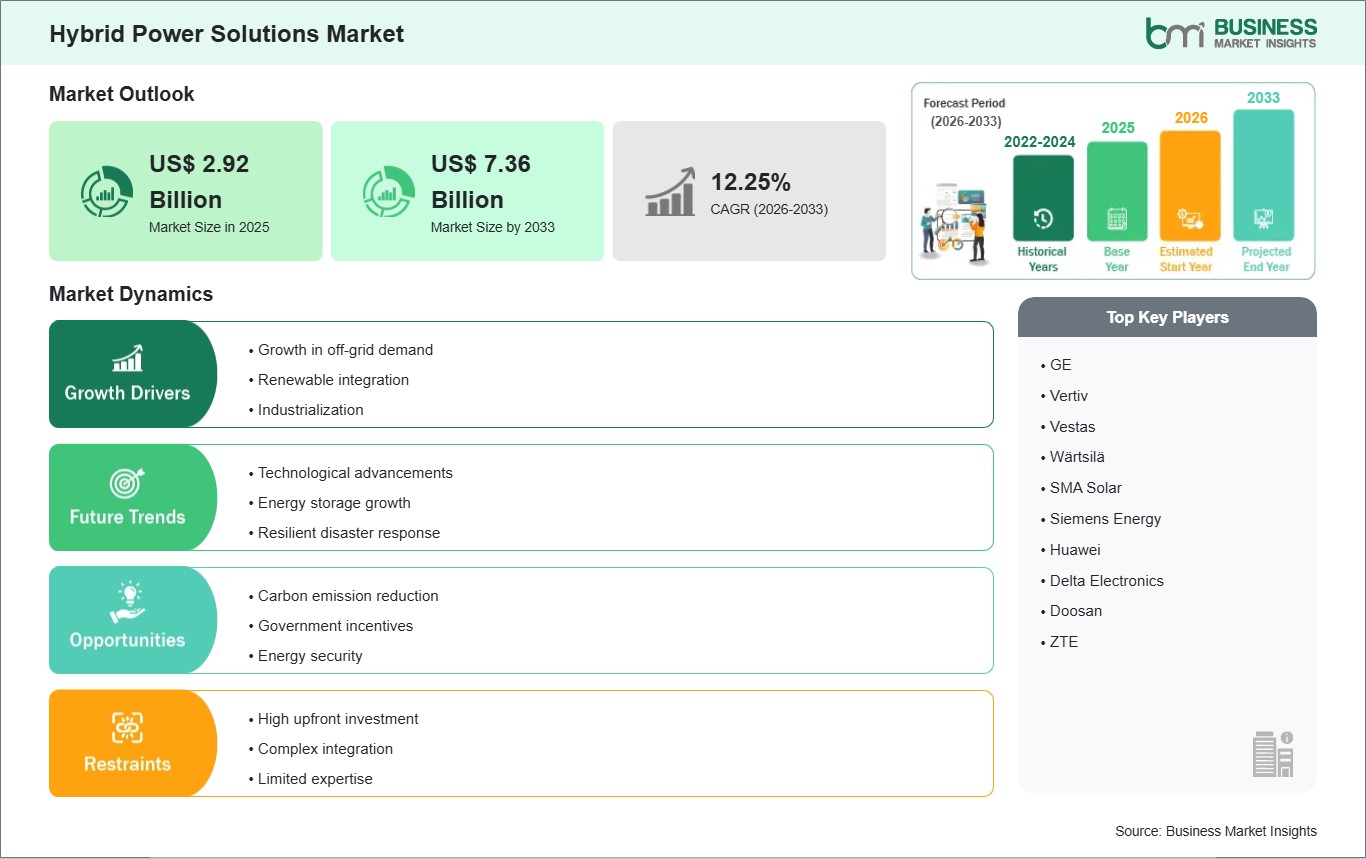
The Hybrid Power Solutions Market size is expected to reach US$ 7.36 Billion by 2033 from US$ 2.92 Billion in 2025.The market is estimated to record a CAGR of 12.25% from 2026 to 2033.
Hybrid power solutions combine several electricity generation technologies to improve energy reliability, operational flexibility, and fuel efficiency in industrial, commercial, and remote settings. These systems often integrate renewable sources with traditional generation infrastructure. This setup allows for consistent power delivery under different environmental and load conditions. Their use supports energy optimization strategies in areas facing grid instability or growing fuel dependency. Concerns about energy security and the need for decarbonization continue to change investment patterns in the power infrastructure sector. Utilities, mining companies, telecom facilities, and remote industrial sites are increasingly looking for reliable energy setups that can reduce operational interruptions and manage energy costs. Hybrid systems also support electrification efforts in remote areas where expanding the conventional grid is economically difficult. The market shows varied adoption trends based on system design and connectivity models. Solar and fossil fuel combinations remain important commercially because of their established familiarity and operational ease. Off-grid setups are common in remote environments, while larger systems are becoming more popular in utility-scale and industrial applications that need steady electricity availability. Improvements in energy management software, battery integration, and smart load-balancing technologies are changing system performance standards. Digital monitoring platforms now allow for predictive maintenance, remote diagnostics, and real-time energy optimization across integrated generation assets. The merging of renewable generation and storage technologies also boosts operational efficiency during fluctuating demand. Competition in the industry involves a mix of engineering expertise, partnerships, and integrated service offerings. Market players increasingly focus on complete deployment models, long-term maintenance agreements, and customizable systems to enhance customer loyalty. Collaborations among energy technology providers, equipment makers, and infrastructure developers continue to shape market positioning and regional growth strategies.

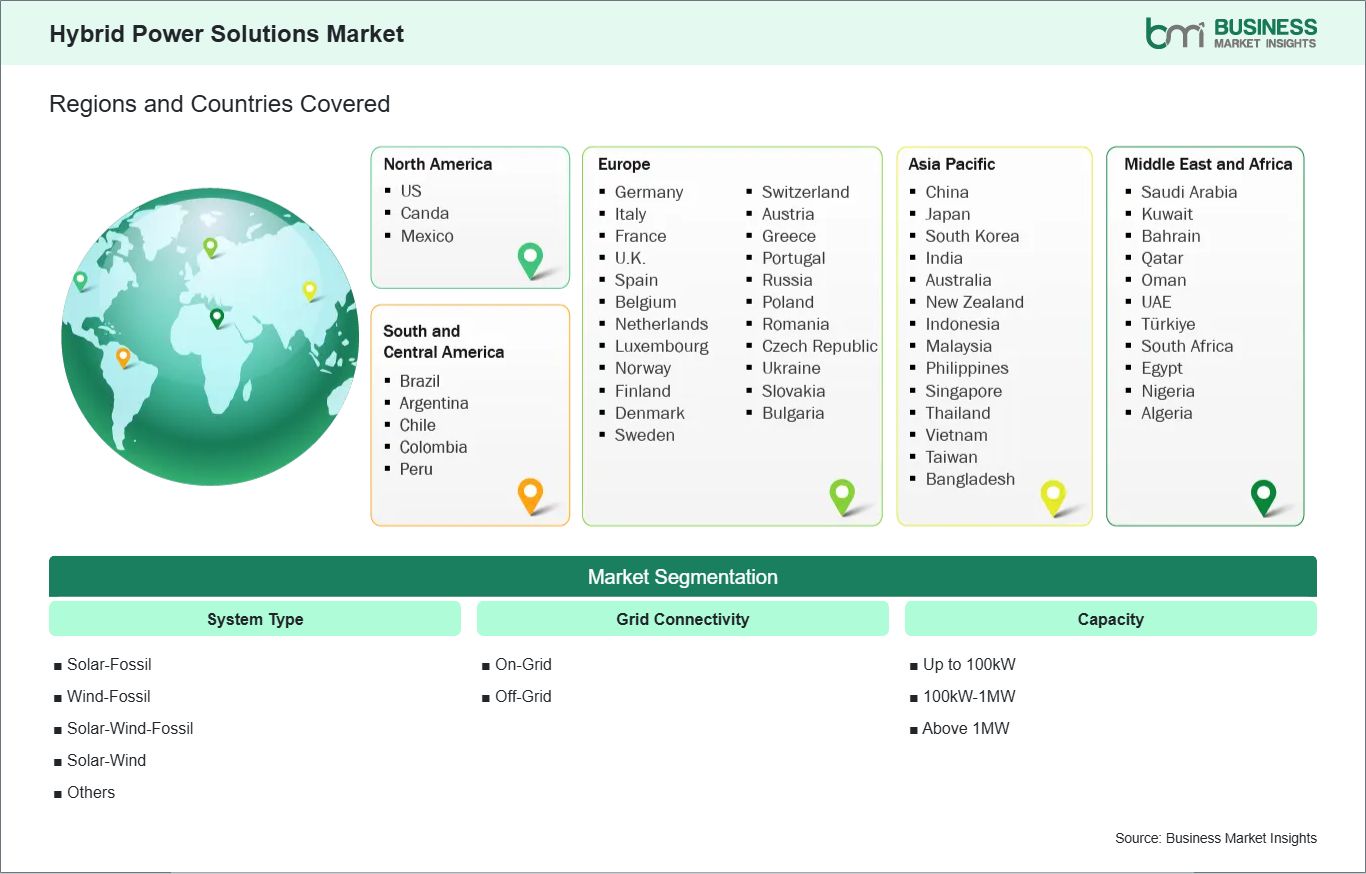
The hybrid power solutions market is categorized based on system configuration, grid integration structure, and installed capacity requirements across industrial and commercial operations.
The shift to decentralized energy systems is speeding up in industrial and commercial sectors looking for operational resilience. Remote facilities, manufacturing plants, and infrastructure operators are focusing more on hybrid power setups. This helps them rely less on unstable central grids. These systems keep electricity flowing while improving fuel use through renewable generation and smart energy management. The flexibility of hybrid setups makes them more important in areas facing energy reliability issues and changing fuel costs. Industrial operators are also looking at long-term energy diversification strategies to keep production going amid changing environmental regulations. As distributed energy models receive institutional support, hybrid systems are being adopted more widely in sectors that require a lot of infrastructure.
Advancements in battery storage technology are opening up new chances for hybrid power solutions in variable-load environments. Modern storage systems improve the use of renewable energy and support smooth transitions between different generation sources. These features are especially important for telecom operations, remote industrial sites, and community electrification programs that need reliable electricity. In the future, we expect to see more deployment opportunities from smart energy management platforms and modular hybrid designs. Technology providers are increasingly creating scalable systems suited for industrial growth and microgrid applications. Better storage integration also leads to lower operational volatility, which fosters good conditions for long-term infrastructure upgrades in both developed and emerging economies.
The Hybrid Power Solutions Market is projected to grow from US$ 2.92 Billion in 2025 to US$ 7.36 Billion by 2033 , registering a CAGR of 12.25% from 2026 to 2033. Market expansion shows a closer connection between renewable energy technologies and traditional power systems in industrial, commercial, and decentralized energy uses. Goals for operational resilience and fuel efficiency continue to support long-term growth in the industry. Solar-fossil systems hold a strong market position because they work well with existing infrastructure and are practical to deploy. Off-grid connectivity models are increasingly popular for mining operations, telecom infrastructure, and industrial sites in remote areas. Larger systems are becoming more relevant for utility connections and energy-heavy applications. Industrial uses represent a large portion of deployment activity due to ongoing energy needs and the focus on reliability. Telecom infrastructure, electrification of remote communities, and commercial buildings also drive wider adoption. The market benefits from modernization efforts that highlight energy diversity, operational efficiency, and lasting infrastructure sustainability.
| Report Attribute | Details |
|---|---|
| Market size in 2025 | US$ 2.92 Billion |
| Market Size by 2033 | US$ 7.36 Billion |
| Global CAGR (2026 - 2033) | 12.25% |
| Historical Data | 2022-2024 |
| Forecast period | 2026-2033 |
| Segments Covered | By System Type
|
|
Regions and Countries Covered
| |
| North America | US, Canada, Mexico |
| Europe | Germany, Italy, France, U.K., Spain, Belgium, Netherlands, Luxembourg, Norway, Finland, Denmark, Sweden, Switzerland, Austria, Greece, Portugal, Russia, Poland, Romania, Czech Republic, Ukraine, Slovakia, Bulgaria |
| Asia-Pacific | China, Japan, South Korea, India, Australia, New Zealand, Indonesia, Malaysia, Philippines, Singapore, Thailand, Vietnam, Taiwan, Bangladesh |
| South and Central America | Brazil, Argentina, Chile, Colombia, Peru |
| Middle East and Africa | Saudi Arabia, United Arab Emirates, Kuwait, Bahrain, Qatar, Oman, Turkiye, South Africa, Egypt, Nigeria, Algeria |
| Market leaders and key company profiles |
|
The "Hybrid Power Solutions Market Size and Forecast (2022-2033)" report provides a detailed analysis of the market covering below areas:
The hybrid power solution market shows different patterns of adoption across regions. These patterns depend on the maturity of infrastructure, priorities for renewable integration, energy security strategies, and the need for industrial electrification. The intensity of deployment varies based on grid accessibility, fuel costs, and government efforts for energy transition. Industrial modernization programs and decentralized electrification initiatives continue to shape investment decisions in both developed and emerging economies. North America shows strong momentum in implementation. This is supported by microgrid modernization programs and resilient energy infrastructure planning. Commercial facilities, telecom networks, and remote industrial operations increasingly use hybrid systems to improve electricity reliability and optimize operations. The focus on renewable integration and grid flexibility further boosts opportunities for deployment in both utility-linked and decentralized applications. Asia Pacific is a significant area for growth due to increasing industrialization, rising electricity demand, and rural electrification initiatives. Countries in this region are looking at hybrid systems as practical options for remote power access and energy diversification. Ongoing infrastructure development and renewable energy initiatives encourage more installations of integrated power generation setups in commercial and industrial sectors. Europe is making steady progress in the market through energy frameworks focused on sustainability and upgrading distributed energy systems. Hybrid deployments help meet carbon reduction goals while improving operational reliability for commercial infrastructure and localized energy networks. Emerging markets in the Middle East, Africa, and South and Central America are also seeing greater adoption. Governments and private operators are prioritizing reliable electricity access in areas that are underserved and resource-intensive.

The Hybrid Power Solutions market is evaluated by gathering qualitative and quantitative data post primary and secondary research, which includes important corporate publications, association data, and databases. A few of the key developments in the Hybrid Power Solutions market are:
The Hybrid Power Solutions Market is valued at US$ 2.92 Billion in 2025, it is projected to reach US$ 7.36 Billion by 2033.
As per our report Hybrid Power Solutions Market, the market size is valued at US$ 2.92 Billion in 2025, projecting it to reach US$ 7.36 Billion by 2033. This translates to a CAGR of approximately 12.25% during the forecast period.
The Hybrid Power Solutions Market report typically cover these key segments-
The historic period, base year, and forecast period can vary slightly depending on the specific market research report. However, for the Hybrid Power Solutions Market report:
The Hybrid Power Solutions Market is populated by several key players, each contributing to its growth and innovation. Some of the major players include:
The Hybrid Power Solutions Market report is valuable for diverse stakeholders, including:
Essentially, anyone involved in or considering involvement in the Hybrid Power Solutions Market value chain can benefit from the information contained in a comprehensive market report.
Please tell us your area of interest
(Market Segments/ Regions and Countries/ Companies)