Market Summary
Executive Summary and Global Market Analysis
Natural gas power plants convert chemical energy from gas into electricity using turbines. These facilities stabilize the grid, provide operational flexibility, and emit less than coal-fired plants. Utilities and industries are increasing gas-fired capacity to ensure reliable power, particularly when renewable output varies. As urbanization and industrialization advance, demand for dependable electricity rises. Energy producers seek technologies that respond quickly to demand changes and operate efficiently. Natural gas plants address these requirements and support carbon reduction efforts while maintaining a consistent electricity supply.
Technology choices in the market reflect operational priorities and regional fuel availability. Combined cycle systems are preferred for large-scale utilities due to higher thermal efficiency and lower costs. Open cycle installations support peak-load management and emergency backup. Pipeline natural gas is the primary fuel in established markets, while liquified natural gas serves regions with limited pipeline access.
Ongoing engineering advancements are improving plant performance and operational efficiency. Turbine manufacturers focus on digital monitoring, efficiency optimization, and flexible combustion technologies to manage variable energy demand. Integration with hybrid systems and grid modernization expands opportunities in commercial and industrial sectors seeking resilient power infrastructure. Technology, service capabilities, and infrastructure investment shape industry competition. Companies prioritize efficiency, cost reduction, and modernization to enhance competitiveness. Strategic partnerships among utilities, suppliers, and developers drive project execution in both emerging and established markets.
Segment Analysis
Natural Gas Power Generation Market Segmentation
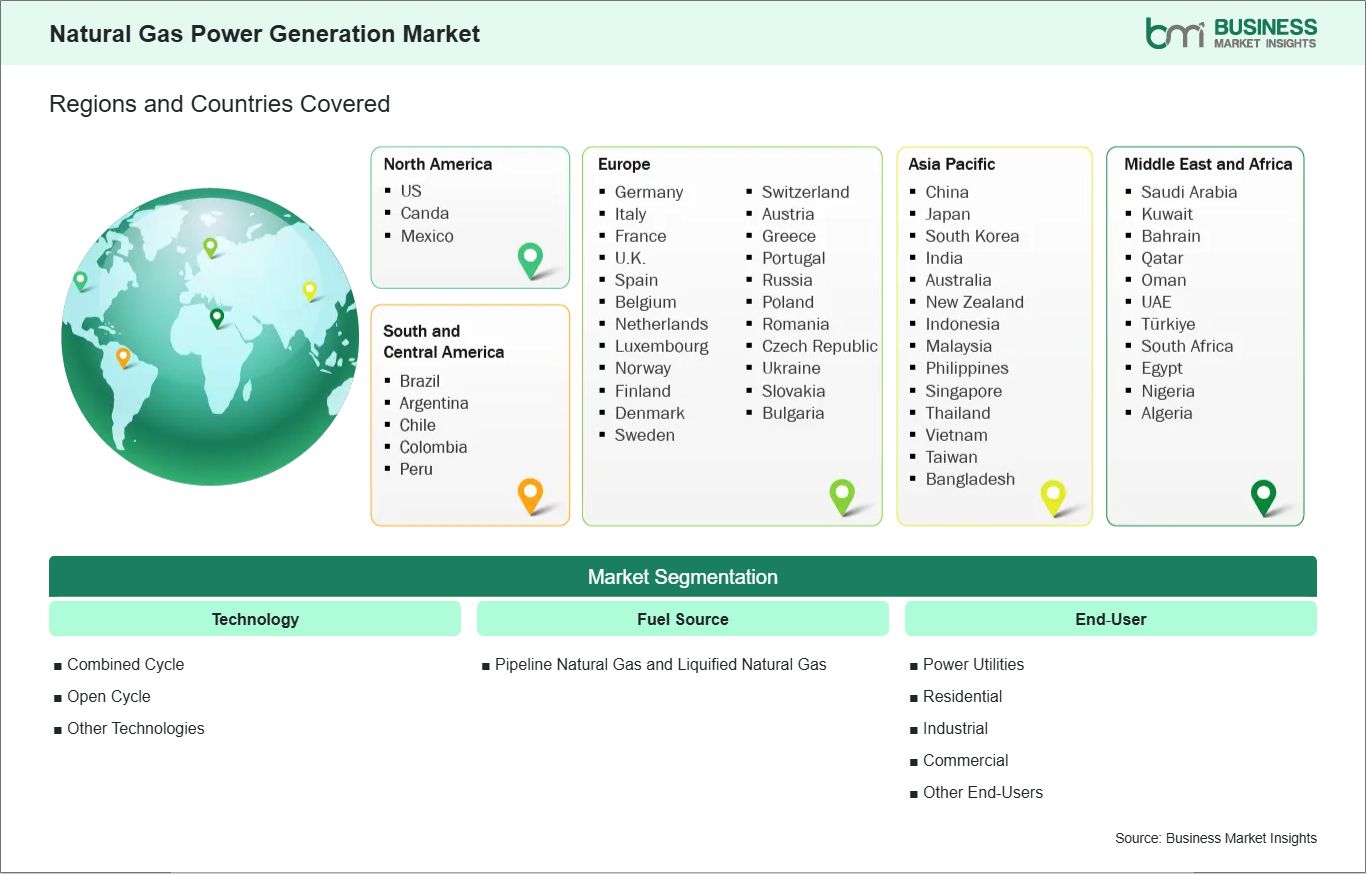
The Natural Gas Power Generation market is segmented based on technology, fuel source, and end-user, demonstrating diversified deployment patterns across metal chemistry, voltage capacity, and end-use environments.
By Technology
- Combined Cycle – Preferred for efficient baseload electricity production across utility-scale installations.
- Open Cycle – Utilized for rapid-response peak demand and standby generation applications.
- Other Technologies – Supports specialized operational environments requiring flexible power configurations.
By Fuel Source
- Pipeline Natural Gas – Dominates regions with established transmission and distribution infrastructure.
- Liquified Natural Gas – Expands deployment across isolated and import-dependent electricity markets.
By End-User
- Power Utilities – Operate large-scale generation assets supporting national grid stability.
- Residential – Supports distributed energy systems and localized backup electricity requirements.
- Industrial – Maintains uninterrupted operations across manufacturing and processing facilities.
- Commercial – Powers energy-intensive commercial buildings and institutional infrastructure.
- Other End-Users – Serves remote operations and specialized energy consumption environments.
Market Forces
Natural Gas Power Generation Market Drivers and Opportunities
Expansion of Flexible Power Infrastructure Requirements
Electricity networks increasingly need flexible generation assets to respond to variable renewable output. Natural gas facilities offer rapid ramping, quick startup, and operational stability during demand fluctuations. Utilities are adopting gas-fired systems to maintain grid reliability, modernize aging infrastructure, and ensure a continuous electricity supply in industrial and urban areas.
The shift to lower-emission electricity has increased investment in efficient gas turbine technologies. Regulatory pressure on coal generation encourages the adoption of cleaner alternatives with better performance. This transition enhances market relevance for countries balancing energy security, environmental compliance, and infrastructure modernization.
Integration of Advanced Turbine and Digital Optimization Technologies
Manufacturers are developing advanced turbines with digital monitoring and predictive maintenance systems. These innovations increase fuel efficiency, reduce downtime, and optimize power output under varying loads. Industrial operators and utilities are adopting intelligent energy management systems to enhance operational visibility and maximize long-term asset use.
Opportunities are growing for hybrid power systems that combine natural gas with renewables and energy storage. Expanding liquified natural gas infrastructure and cross-border energy projects are opening new markets in developing economies. These trends are expected to broaden applications and improve resilience in both decentralized and utility-scale power networks.
Size and Share Analysis
Natural Gas Power Generation Market Size and Share Analysis
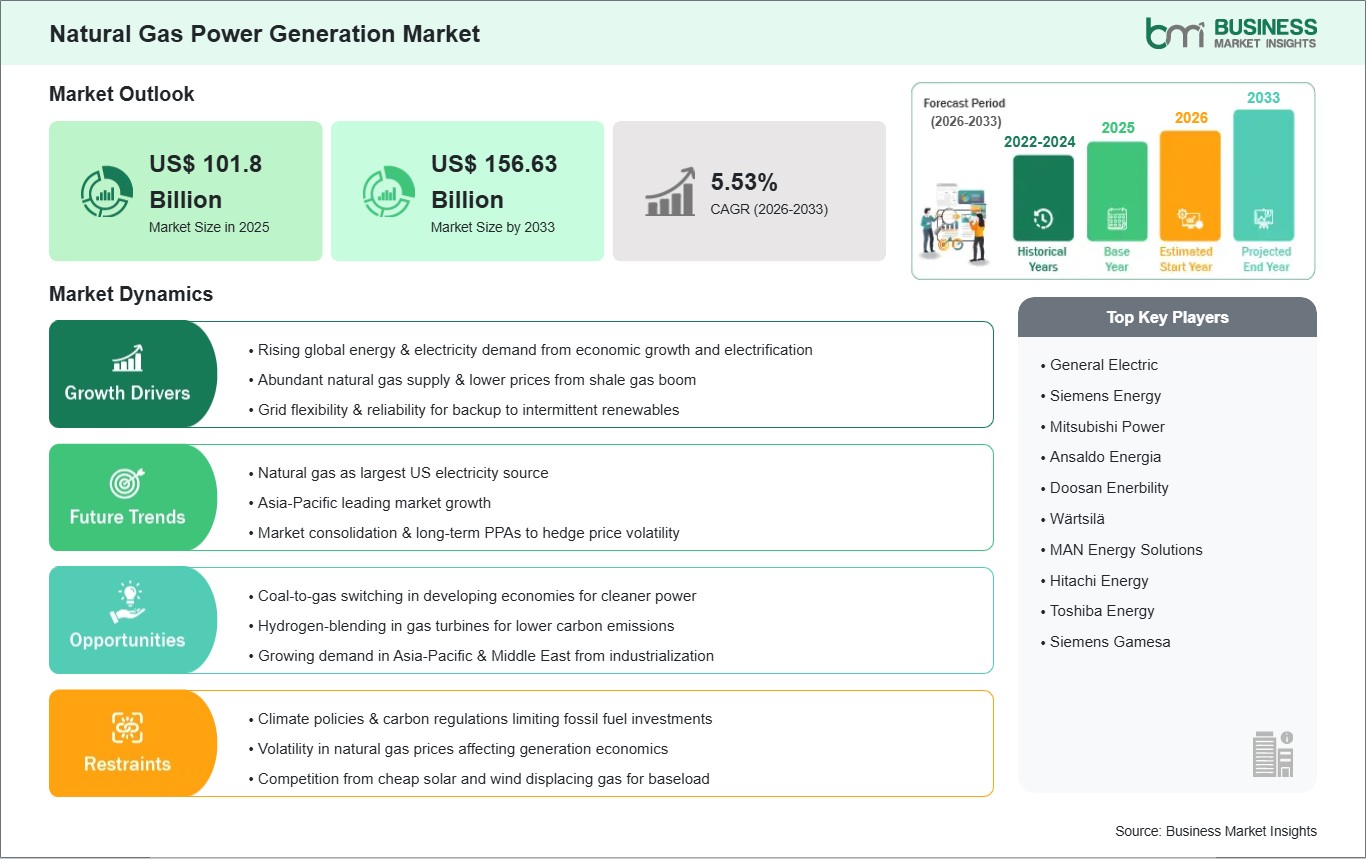
The Natural Gas Power Generation Market is projected to grow from US$ 101.8 Billion in 2025 to US$ 156.63 Billion by 2033 , registering a CAGR of 5.53% from 2026 to 2033. This growth reflects continued reliance on gas-fired generation to balance renewable variability and ensure reliable power in both developed and developing economies.
Combined cycle technology holds a significant market share due to its high efficiency and suitability for continuous power production. Pipeline natural gas remains the main fuel source, supported by established infrastructure and reliable supply in major regions.
Power utilities lead in market share as national grids prioritize stable and dispatchable generation assets. Industrial facilities are also key users, especially in energy-intensive operations that require uninterrupted power and operational continuity.
Report Coverage
Natural Gas Power Generation Market Report Coverage and Deliverables
The " Natural Gas Power Generation Market Size and Forecast (2022-2033)" report provides a detailed analysis of the market covering the following areas:
- Market size and forecast at global, regional, and country levels for all market segments covered under the scope
- Market trends, as well as drivers, restraints, and opportunities
- Market analysis covering key trends, global and regional framework, major players, regulations, and recent developments
- Industry landscape and competition analysis covering market concentration, heat map analysis, prominent players, and recent developments for the Natural Gas Power Generation market
- Detailed company profiles, including SWOT analysis
Geographic Insights
Natural Gas Power Generation Market Geographic Insights
The Natural Gas Power Generation market displays varied regional adoption, shaped by infrastructure maturity, fuel access, regulations, and electricity demand. Global energy transition strategies are shifting investments toward efficient thermal generation that supports renewable integration and grid stability.
North America has a mature market, supported by extensive pipeline infrastructure and utility modernization. Providers are replacing aging coal plants with efficient gas-fired facilities to enhance flexibility and environmental performance. Growing industrial demand and digital infrastructure investments further support market growth.
Asia Pacific shows strong market growth driven by urbanization, industrial development, and rising electricity demand. Many countries are expanding liquefied natural gas import infrastructure to diversify fuel sources and enhance energy security. Governments are prioritizing advanced generation technologies to address grid reliability as renewable integration increases.
Europe focuses on efficient gas-fired generation to support renewables and maintain stable electricity during intermittent periods. Emerging markets in the Middle East, Africa, and the Americas are expanding gas power infrastructure to drive industrialization and electrification. Cross-border partnerships and infrastructure projects are boosting long-term investment potential.
Industry Activity
Recent Developments
The Natural Gas Power Generation market is evaluated by gathering qualitative and quantitative data post-primary and secondary research, which includes important corporate publications, association data, and databases. A few of the key developments in the Natural Gas Power Generation market are:
- In February 2026, Georgia regulators approved a significant expansion of natural gas power plants, which is expected to greatly increase climate pollution in the state greatly. This decision, made by the Public Service Commission, involves nine facilities owned or supported by Georgia Power and is primarily intended to accommodate the rapid growth of data centers. Environmental advocates have condemned the plan as an unnecessary reliance on fossil fuels that could lead to prolonged emissions for decades.
- In May 2026, Chevron's local partners, NewMed Energy LP and Ratio Energies LP, signed a 20-year agreement with Dalia Energy Companies Ltd to provide natural gas from the Leviathan gas field in Israel to two new power plants. The contract will initially supply approximately 1.3 billion cubic meters (45.91 billion cubic feet) of gas per year, with NewMed responsible for 75.14 percent of this volume.
Trust & Transparency
Research Methodology
The market analysis combines proprietary research with secondary data from government agencies, company disclosures, regulatory filings, industry databases and expert interviews. Market estimates are validated through data triangulation, cross-market benchmarking and analyst
review.
View Full Research Methodology
Key Sources Referred:
European Commission
US Department of Energy
International Energy Agency
Company Websites
Company Annual Reports
Company Investor Presentations