Market Summary
Executive Summary and Global Market Analysis
Utility markers are physical and electronic tools that show the location of underground and above-ground infrastructure assets. These products help with tracking assets, ensuring safety during excavation, planning maintenance, and documenting networks in utility systems like power, telecommunications, water, and gas distribution. Programs aimed at modernizing infrastructure are putting more focus on asset visibility and preventing damage. Utility owners are improving their network mapping practices to lower the risk of accidental strikes during construction and to enhance maintenance efficiency. The need to clearly identify buried assets has led to wider use of permanent marking systems that support long-term infrastructure management. From a market perspective, the industry includes traditional marker posts, warning tapes, and high-tech electronic marking solutions.
Different utility environments require specific identification methods based on factors like asset depth, terrain, maintenance frequency, and regulations. Utility operators and construction contractors are the main users due to their roles in network installation and lifecycle management. Technological advancements are changing product capabilities across the industry. Electronic markers and RFID-enabled markers are increasingly supporting digital asset management by allowing location verification and information retrieval during fieldwork.
At the same time, magnetic and resonance-based detection systems are enhancing identification accuracy in crowded utility areas where multiple underground assets are present. The competitive landscape shows a mix of established infrastructure suppliers and specialized asset identification companies. Market players are focusing on product durability, detection performance, integration with geographic information systems, and operational reliability. Product development is increasingly aimed at making tools compatible with digital infrastructure management platforms, reflecting the ongoing shift toward data-driven utility operations.
Segment Analysis
Utility Markers Market Segmentation
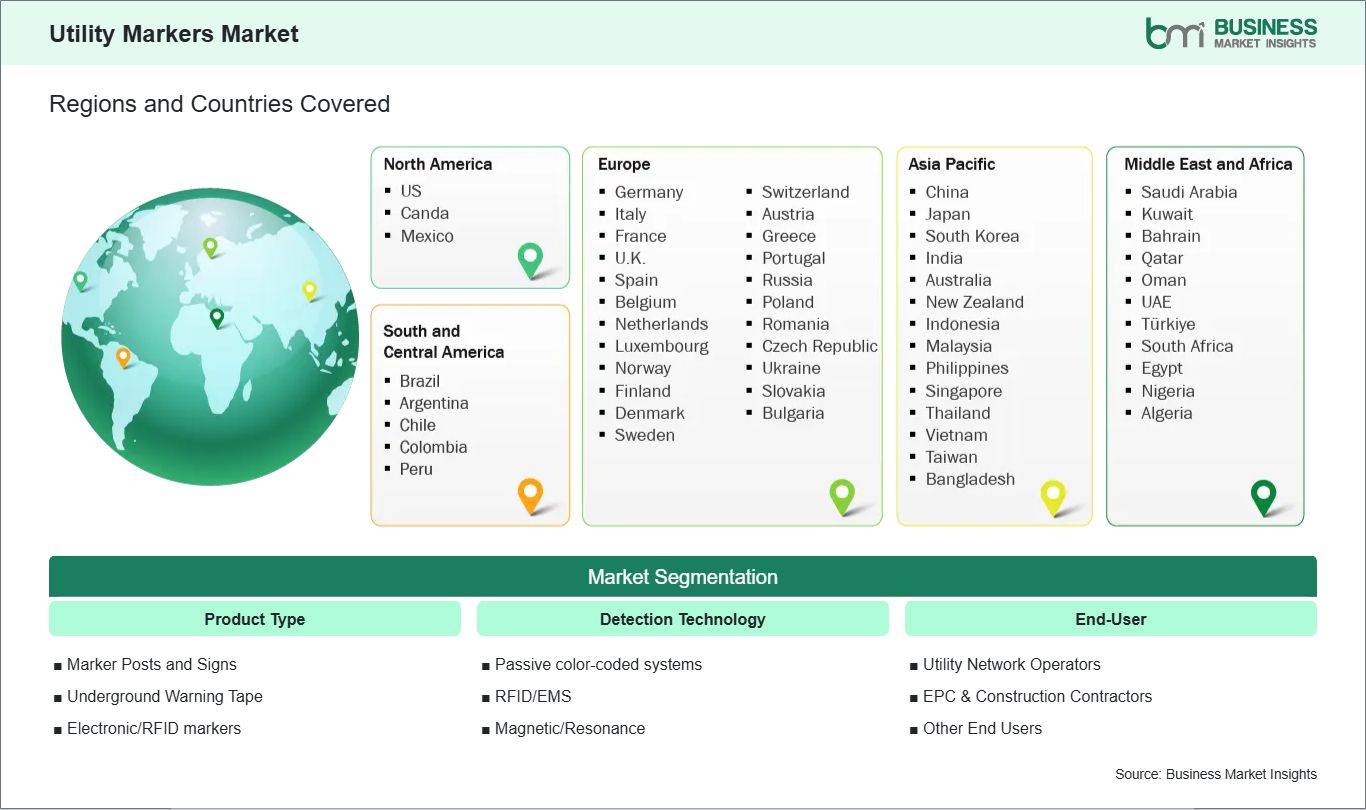
The market is divided based on product configuration, detection technology, and end-user requirements.
By Product Type
- Marker Posts and Signs - preferred for easy asset identification and route marking
- Underground Warning Tape - improves excavation awareness before asset exposure
- Electronic/RFID markers - allow precise underground asset tracking and verification
By Detection Technology
- Passive color-coded systems - provide simple identification without electronic equipment
- RFID/EMS - supports digital asset records and accurate field locating
- Magnetic/Resonance - works well in complex underground utility environments
By End User
- Utility Network Operators - focus on asset integrity and maintenance efficiency
- EPC & Construction Contractors - use markers to minimize excavation-related disruptions
- Other End Users - apply marking systems for facility management and infrastructure projects
Market Forces
Utility Markers Market Drivers and Opportunities
Expansion of Underground Utility Infrastructure Networks
The ongoing installation of underground power cables, telecommunications networks, water pipelines, and gas distribution systems has increased the need for reliable asset identification solutions. As infrastructure becomes denser, utility owners look for permanent marking systems that make asset location easier and reduce uncertainty during maintenance and construction activities. This need has led to more use of systems in both new and existing utility corridors.
Clear utility identification improves operational planning and lowers risks linked to accidental damage to infrastructure. Utility operators are adding marking solutions into asset management practices to boost network visibility and field efficiency. The importance of utility markers has grown as organizations focus on making infrastructure more resilient, ensuring workforce safety, and maintaining detailed asset records across large service areas.
Integration of Digital Asset Management with RFID-Based Markers
The shift toward digitally connected infrastructure is creating new opportunities for marker technologies. RFID-enabled solutions allow field workers to access asset-specific information directly from buried markers. This supports maintenance records, inspection tasks, and network validation. These features support wider utility digitization efforts aimed at improving data access and operational transparency.
Future opportunities will likely come from tighter integration between marker technologies and geographic information systems, digital twins, and smart utility platforms. Widespread use of intelligent infrastructure management practices may lead to greater adoption of programmable marking systems. These advancements could improve how assets are tracked, support predictive maintenance plans, and enhance long-term infrastructure planning.
Size and Share Analysis
Utility Markers Market Size and Share Analysis
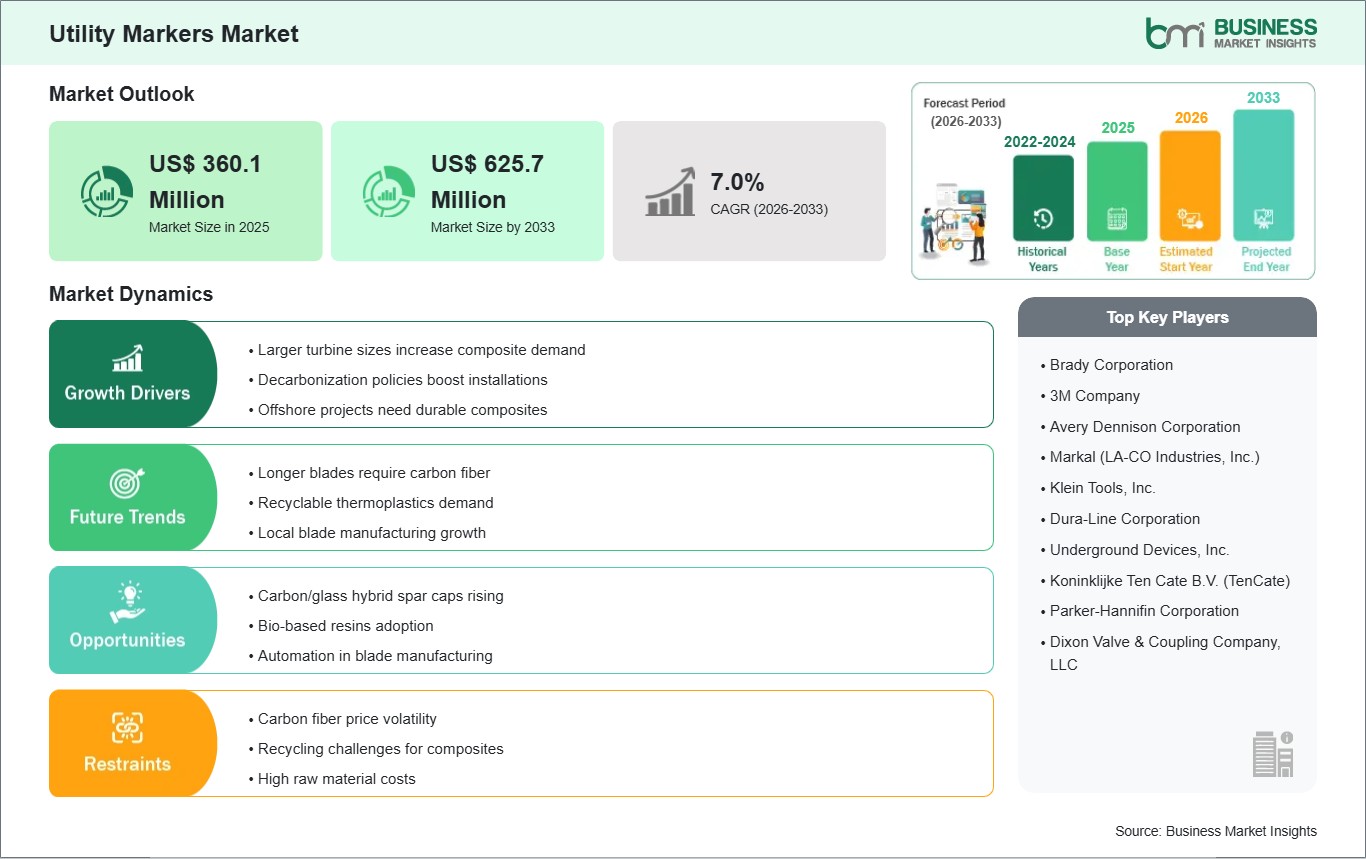
The utility markers market size is expected to reach US$ 0.62 billion by 2033, up from US$ 0.36 billion in 2025. The market is projected to grow at a rate of 7.0% from 2026 to 2033.
This growth shows ongoing investment in managing utility infrastructure and increasing focus on effective asset identification practices. Industry players are concentrating on solutions that provide long-term asset visibility and better operational control. Among product types, electronic and RFID-based markers are becoming more popular due to their ability to help with asset tracking and information retrieval.
Traditional marker posts, signs, and warning tapes continue to be important where visible identification and cost-effective deployment are essential. From an application standpoint, utility network operators make up a large portion of marker use because they are responsible for maintaining extensive infrastructure assets. Construction and engineering contractors are also a key user group since reliable utility marking helps ensure safer excavation activities and better project execution.
Report Coverage
Utility Markers Market Report Coverage and Deliverables
The "Utility Markers Market Size and Forecast (2022-2033)" report provides a detailed analysis of the market covering below areas:
- The market size and forecast at global, regional, and country levels for all market segments covered under the scope
- The market trends, as well as drivers, restraints, and opportunities
- The market analysis covering key trends, global and regional framework, major players, regulations, and recent developments
- Industry landscape and competition analysis covering market concentration, heat map analysis, prominent players, and recent developments for the market
- Detailed company profiles, including SWOT analysis
Geographic Insights
Utility Markers Market Geographic Insights
The utility markers market shows varied regional usage patterns based on infrastructure maturity, utility asset density, regulations, and digital asset management priorities. Organizations around the world are putting more focus on infrastructure visibility, network documentation, and excavation safety. These priorities are leading to wider adoption of utility identification systems in both established and newly built utility corridors.
North America is an important market due to its extensive underground utility networks and organized damage-prevention programs. Utility operators are increasingly combining modern marking technologies with asset management systems to improve infrastructure traceability. The region also shows strong demand for electronic marker solutions that aid in long-term maintenance planning and field verification tasks.
Asia Pacific benefits from significant urban development, utility expansion projects, and upgrades to crucial infrastructure services. Expanding telecommunications networks, electricity distribution systems, and municipal utility projects are creating favorable conditions for deploying utility markers. Market players are focusing more on solutions that enhance efficient infrastructure installation and future maintenance needs.
Europe maintains steady use, supported by infrastructure rehabilitation efforts and established utility management practices. Meanwhile, emerging markets in the Middle East, Africa, and South and Central America are seeing broader deployment of utility identification systems along with increasing infrastructure investments. These regions are recognizing the operational advantages of reliable asset marking as utility networks grow larger and more complex.
Industry Activity
Recent Developments
The utility markers market is evaluated by gathering qualitative and quantitative data post primary and secondary research, which includes important corporate publications, association data, and databases. Recent developments and news in the market include:
- In April 2026, Tempo Communications launched the EML250-ID Electronic RFID Marker Locator and OmniMarker-ID electronic RFID-enabled marker system. These products are designed for effective management of buried assets and integration with GIS-based utility mapping platforms.
- In January 2026, NXP Semiconductors introduced the UCODE X RFID platform. This platform enhances high-performance RFID capabilities, supporting wider use of improved identification and tracking applications in infrastructure-related settings.
Trust & Transparency
Research Methodology
The market analysis combines proprietary research with secondary data from government agencies, company disclosures, regulatory filings, industry databases and expert interviews. Market estimates are validated through data triangulation, cross-market benchmarking and analyst
review.
View Full Research Methodology
Key Sources Referred:
Common Ground Alliance American Public Works Association Utility Strike Avoidance Group International Facility Management Association Company Websites Company Annual Reports Company Investor Presentations