
HVDC Cables Market Outlook: Size, Share, Trends, Growth Analysis, Competitive Landscape & Forecast, 2026-2033

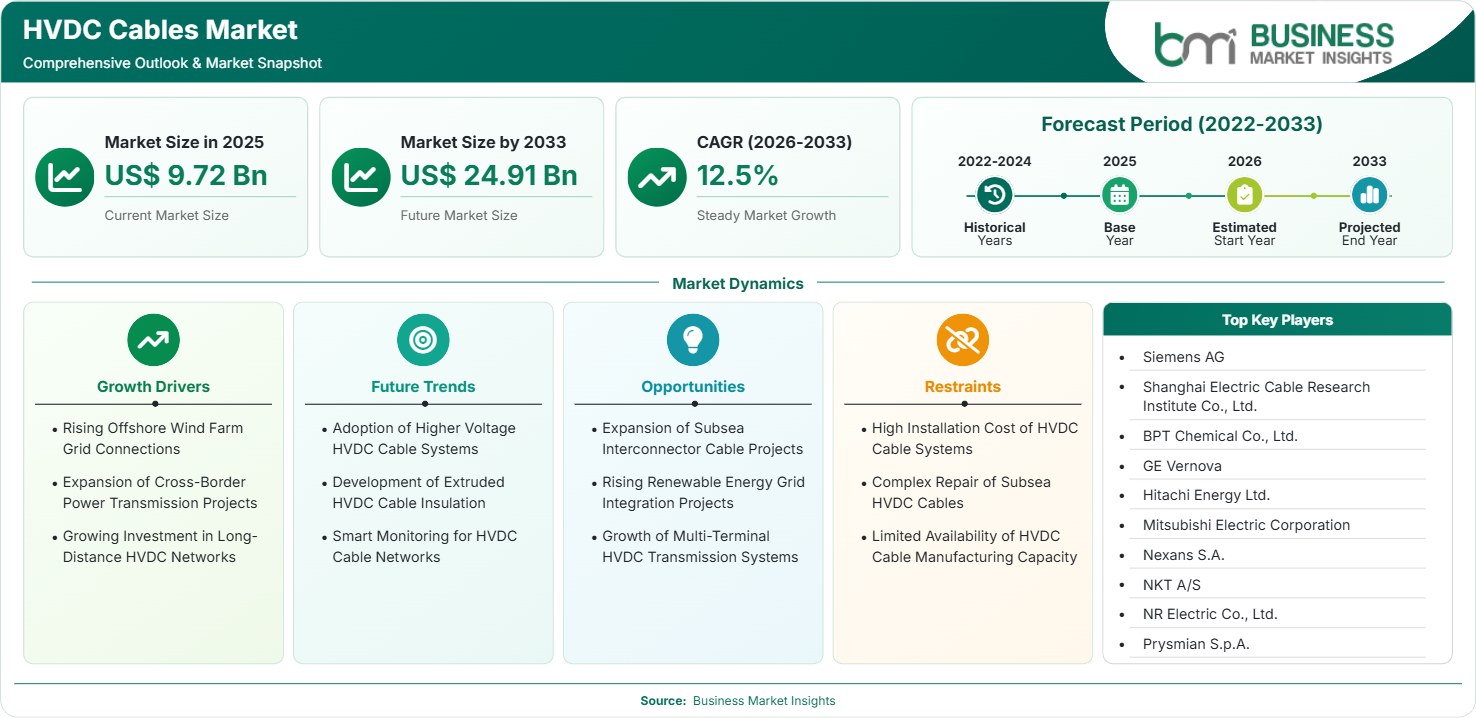
The HVDC Cables Market size was valued at US$ 9.72 Billion in 2025 and is projected to reach US$ 24.91 Billion by 2033, growing at a CAGR of 12.5% during 2026–2033. Growth is driven by increasing offshore wind investments, rising cross-border power transmission projects, expanding renewable energy integration, growing demand for long-distance electricity transmission, and modernization of grid infrastructure across developed and emerging economies.

Report Coverage
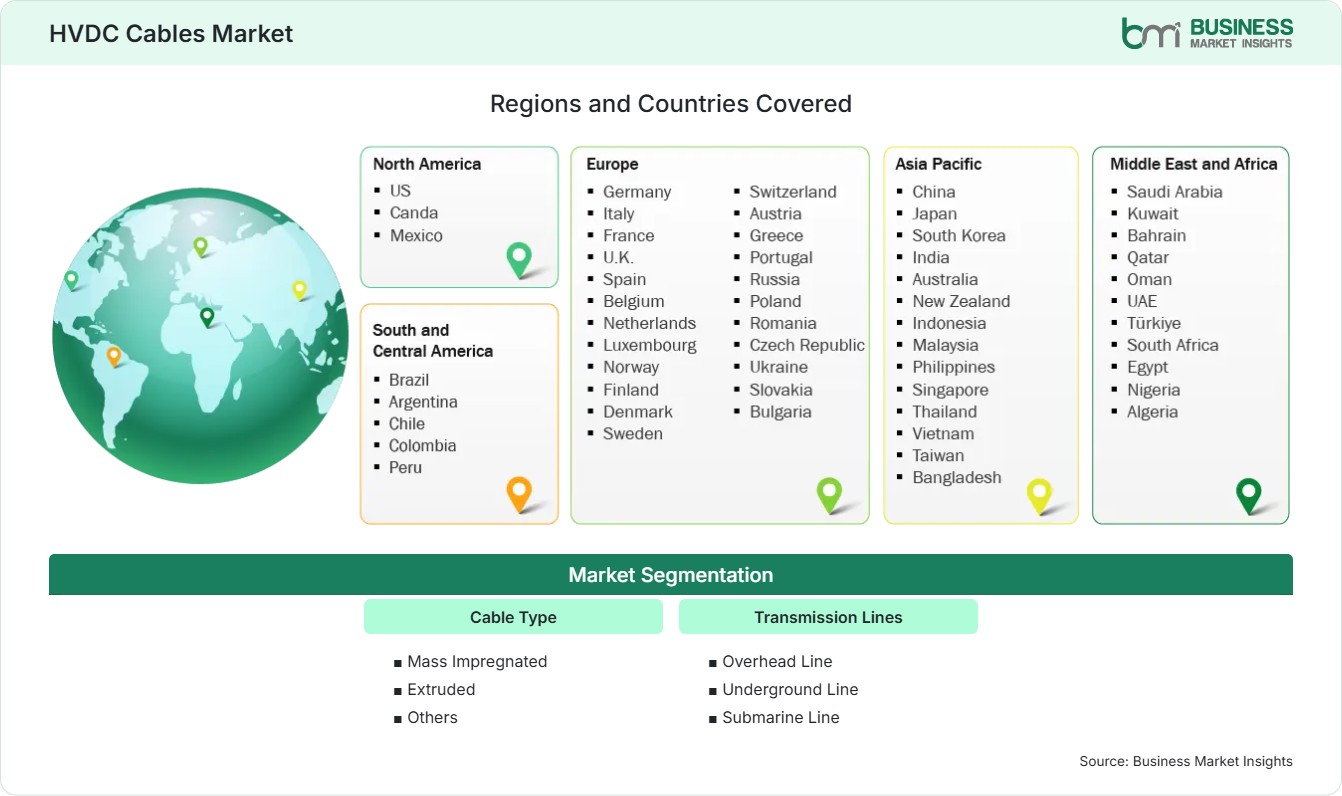
  • Cable Type: Mass Impregnated, Extruded, Others
  • Transmission Lines: Overhead Line, Underground Line, Submarine Line
US$ 9.72 Bn Market size in 2025
US$ 24.91 Bn Market Size by 2033
12.5% CAGR, 2026 - 2033
2026-2033 Forecast Period

01 AI Overview

HVDC Cables Market Summary

  • North America Region: North America holds a market share of 26%–29% in 2025, growing at a CAGR of 11.4%–12.1% during 2026–2033. Demand is supported by renewable energy integration, grid modernization programs, and increasing interregional transmission investments. The U.S. remains the dominant market, advancing at a CAGR of 11.6%–12.3%.
  • Fastest Growing Region: Europe accounts for 34%–37% of revenue in 2025 and is projected to register a CAGR of 13.0%–13.8% through 2033. Expanding offshore wind infrastructure, cross-border electricity networks, and decarbonization investments continue supporting market development.
  • Leading Segment: Extruded cables hold a market share of 54%–58% in 2025 and are expected to grow at a CAGR of 12.8%–13.5%. Demand is driven by technological advancements, higher transmission efficiency, and increasing adoption in renewable energy transmission projects.
  • High Growth Segment: Submarine Line accounts for 39%–43% of market revenue in 2025 and is projected to register a CAGR of 13.5%–14.2% during the forecast period. Rising offshore wind development and international grid interconnection projects continue supporting expansion.
  • Key Market Opportunity: Growing deployment of offshore renewable energy projects and international power transmission corridors is creating significant opportunities for HVDC cable manufacturers and power infrastructure developers.
  • Major Market Players: Siemens AG, Shanghai Electric Cable Research Institute Co., Ltd., BPT Chemical Co., Ltd., GE Vernova, Hitachi Energy Ltd., Mitsubishi Electric Corporation, Nexans S.A., NKT A/S, NR Electric Co., Ltd., and Prysmian S.p.A.
02 Strategic Insights

HVDC Cables Market: Strategic Insights

hvdc-cables-market-market-strategic-framework
FREE PDF
Request your free sample
Request free sample
03 Stakeholder View

Key Takeaways

  • The market ecosystem includes cable manufacturers, transmission operators, utilities, EPC contractors, renewable energy developers, and grid infrastructure providers.
  • Extruded cables remain among the most attractive opportunities due to superior performance, flexibility, and growing utilization in modern transmission projects.
  • Product innovation increasingly focuses on higher voltage ratings, advanced insulation materials, and enhanced transmission efficiency.
  • Europe provides the strongest growth potential supported by offshore wind expansion, interconnector investments, and energy transition strategies.
  • Cross-border electricity transmission projects continue transforming market dynamics by increasing demand for high-capacity power infrastructure.
  • Offshore wind farms, renewable integration projects, and long-distance transmission corridors remain key demand generators across global markets.
  • A key HVDC cables market trend is the increasing deployment of high-voltage, extruded HVDC cable systems for offshore wind integration, cross-border interconnections, and long-distance renewable power transmission, supporting global energy transition initiatives.
04 Geographic Outlook

HVDC Cables Market Regional Highlights

North America HVDC Cables Market

North America accounted for 26%–29% of global revenue in 2025 and is projected to expand at a CAGR of 11.4%–12.1% through 2033. Growth is supported by grid modernization initiatives, increasing renewable energy integration, and rising investments in long-distance electricity transmission infrastructure. The HVDC Cables Market share in the region continues benefiting from growing demand for reliable power transfer systems connecting renewable generation facilities with major consumption centers.

  • Utilities continue investing in HVDC transmission projects to improve grid stability and reduce transmission losses across large geographic areas.
  • Renewable energy integration initiatives are driving deployment of advanced transmission corridors connecting remote generation assets.
  • Cross-state power transmission projects continue supporting demand for high-capacity cable systems.
  • Grid resilience programs are encouraging modernization of aging electricity infrastructure.
  • Investments in clean energy transitions continue creating opportunities for large-scale HVDC deployments.

US HVDC Cables Market

The United States represented 21%–24% of global revenue in 2025 and is anticipated to register a CAGR of 11.6%–12.3% during the forecast period. Demand is driven by renewable energy expansion, interregional electricity transmission projects, and increasing efforts to modernize the national power grid. Growing adoption of advanced transmission technologies continues supporting HVDC Cables industry growth.

  • Large-scale wind and solar projects are increasing the requirement for efficient long-distance power transmission systems.
  • Federal and state investments continue supporting grid modernization and energy infrastructure improvements.
  • Utilities are prioritizing transmission technologies that minimize energy losses over extended distances.
  • Interconnection projects between power generation hubs and urban centers continue driving market demand.

Europe HVDC Cables Market

Europe held 34%–37% of global revenue in 2025 and is projected to grow at a CAGR of 13.0%–13.8% through 2033. Expansion of offshore wind capacity, cross-border electricity transmission, and ambitious decarbonization targets continue supporting market growth. Germany remains the leading market with a CAGR of 13.1%–13.9%, while the United Kingdom is the fastest-growing country, expanding at a CAGR of 13.8%–14.5%.

  • Offshore wind developments continue generating substantial demand for submarine HVDC cable installations.
  • Interconnector projects are strengthening electricity exchange among European countries.
  • Germany maintains leadership through large renewable energy investments and advanced transmission infrastructure programs.
  • The United Kingdom is accelerating offshore transmission projects supporting energy transition objectives.
  • Carbon reduction and energy security goals continue encouraging investments in HVDC technologies.

Asia Pacific HVDC Cables Market

Asia Pacific accounted for 29%–32% of global revenue in 2025 and is expected to register a CAGR of 12.8%–13.6% through 2033. Rapid industrialization, increasing electricity demand, and expansion of renewable energy projects continue driving market growth. China remains the largest regional market with a CAGR of 12.7%–13.4%, while India records the highest growth at 13.4%–14.1%.

  • Large-scale renewable energy installations continue increasing demand for long-distance transmission solutions.
  • China benefits from extensive investment in ultra-high-voltage power infrastructure and grid expansion projects.
  • India is witnessing accelerated deployment of transmission networks supporting rising power consumption requirements.
  • Government-backed clean energy initiatives continue supporting HVDC infrastructure development.
  • Expansion of industrial and urban electricity demand is strengthening long-term market opportunities.

Rest of World HVDC Cables Market

The Rest of World region accounted for 7%–10% of global revenue in 2025 and is expected to register a CAGR of 11.5%–12.2% through 2033. HVDC cables market forecast is supported by increasing investments in power transmission infrastructure, renewable energy integration, and electricity network expansion. Demand remains particularly strong for interconnection projects and utility-scale energy developments.

Brazil is the leading market in South & Central America and is forecast to grow at a CAGR of 11.7%–12.4%. In the Middle East & Africa, Saudi Arabia is expected to be the fastest-growing country with a CAGR of 12.0%–12.7%.

  • Brazil continues benefiting from transmission investments supporting hydropower and renewable energy integration.
  • Saudi Arabia is expanding electricity infrastructure to support industrial growth and clean energy projects.
  • Increasing grid connectivity requirements are driving adoption of advanced transmission technologies.
  • Utility modernization initiatives continue supporting demand for HVDC systems across emerging economies.
  • Large-scale renewable energy developments are creating new opportunities for cable manufacturers and infrastructure providers.
global-market-geography
FREE PDF
Request your free sample
Request free sample
05 Segment Analysis

HVDC Cables Market Segmentation

Cable Type

Cable type remains a key factor influencing transmission efficiency, voltage capability, installation flexibility, and project economics. Extruded cables lead the segment with a 54%–58% share in 2025 and are projected to grow at a CAGR of 12.8%–13.5% through 2033. The HVDC cables industry scope continues expanding as transmission operators increasingly adopt advanced cable technologies for renewable energy integration, offshore wind connectivity, and long-distance electricity transmission projects.

  • Mass Impregnated: Widely utilized in high-capacity submarine and underground transmission projects requiring proven long-term operational reliability.
  • Extruded: Dominates market demand due to easier installation, higher operational flexibility, superior environmental performance, and growing suitability for modern HVDC applications.
  • Others: Includes specialized cable technologies developed for niche transmission projects and unique operating environments.

Transmission Lines

Transmission line deployment plays a significant role in determining project feasibility and network architecture. Submarine Line accounts for 39%–43% market share in 2025 and is projected to register the fastest growth at a CAGR of 13.5%–14.2% through 2033. HVDC Cables Market trends indicate growing investment in offshore wind connections, island electrification projects, and cross-border interconnector developments.

  • Overhead Line: Continues serving long-distance power transmission requirements where land availability and project economics support deployment.
  • Underground Line: Increasingly adopted in urban areas and environmentally sensitive regions where visual impact and land-use considerations are important.
  • Submarine Line: Benefits from rising offshore renewable energy development, international interconnection projects, and subsea power transmission requirements.
06 Market Forces

HVDC Cables Market Dynamics

Key Market Drivers

Rising Offshore Wind Farm Grid Connections

The rapid expansion of offshore wind energy projects is significantly increasing demand for HVDC cable systems worldwide. Offshore wind farms are often located far from coastal demand centers, making efficient long-distance electricity transmission essential. HVDC technology minimizes transmission losses while supporting high-capacity power transfer across subsea environments. Governments and utilities continue prioritizing offshore renewable energy investments to achieve decarbonization goals and improve energy security. As offshore wind installations expand across Europe, Asia Pacific, and North America, demand for advanced HVDC cable infrastructure is expected to strengthen substantially throughout the forecast period.

Expansion of Cross-Border Power Transmission Projects

Countries are increasingly investing in cross-border electricity transmission infrastructure to improve grid resilience, strengthen energy security, and facilitate power trading. HVDC cable systems play a critical role in connecting national grids with differing operating characteristics while enabling efficient energy exchange. Growing demand for regional energy connectivity is encouraging governments and transmission operators to deploy large-scale interconnector projects. These initiatives help optimize electricity supply, support renewable energy integration, and improve network stability. Continued investments in international transmission links remain a major growth driver for the HVDC cables market.

Growing Investment in Long-Distance HVDC Networks

Increasing electricity demand and growth in renewable energy generation are creating strong demand for long-distance transmission infrastructure. HVDC networks allow utilities to transfer large amounts of electricity over extensive distances while minimizing power losses compared with conventional AC systems. Governments are investing heavily in grid modernization projects to support industrial development, urbanization, and clean energy transitions. Long-distance transmission systems are becoming increasingly important for connecting remote renewable energy resources to population centers. These developments continue driving demand for advanced HVDC cable solutions worldwide.

Key Market Opportunities

Expansion of Subsea Interconnector Cable Projects

Subsea interconnector projects are becoming increasingly important as countries seek greater energy security and enhanced grid flexibility. These projects facilitate electricity exchange between neighboring nations while improving reliability and renewable energy utilization. HVDC technology remains the preferred solution for long-distance subsea transmission due to its efficiency advantages. Governments and utilities are actively developing new interconnector networks to strengthen regional energy cooperation. The growing pipeline of international subsea transmission projects presents substantial opportunities for cable manufacturers, engineering firms, and transmission infrastructure developers.

Rising Renewable Energy Grid Integration Projects

The increasing deployment of renewable energy generation facilities is creating significant opportunities for HVDC cable suppliers. Wind, solar, and hybrid renewable energy projects often require advanced transmission systems capable of delivering power efficiently across long distances. HVDC infrastructure supports the integration of variable renewable resources into existing grids while improving system reliability. Growing investment in clean energy development is accelerating demand for transmission technologies that facilitate large-scale renewable deployment. This trend is expected to remain a major opportunity throughout the forecast period.

Growth of Multi-Terminal HVDC Transmission Systems

Multi-terminal HVDC systems are gaining attention as power networks become more interconnected and complex. These systems enable electricity transfer between multiple generation and consumption points while supporting greater operational flexibility. Utilities are exploring multi-terminal configurations to optimize renewable energy integration and improve grid management capabilities. Advances in power electronics and digital control technologies are making such projects increasingly feasible. As transmission networks evolve toward more interconnected architectures, demand for advanced HVDC cable infrastructure supporting multi-terminal systems is expected to increase significantly.

Market Restraints and Challenges

High Installation Cost of HVDC Cable Systems

Factor: HVDC cable systems require significant capital investment for cable manufacturing, converter stations, installation, and supporting transmission infrastructure. Compared to conventional HVAC systems, HVDC projects rely on advanced converter technology, specialized engineering expertise, and complex installation processes, increasing overall costs. Underground and subsea installations further raise expenses due to specialized laying equipment, route surveys, environmental compliance, and labor-intensive construction. Impact: High upfront costs can delay project approvals and limit deployment, particularly in cost-sensitive and developing markets with constrained infrastructure budgets. Utilities and governments must assess long-term benefits, such as lower transmission losses and higher efficiency, before investing. Lengthy planning, permitting, financing, and regulatory approval processes also increase project timelines and costs. These financial challenges may reduce new project development and restrain overall HVDC cables market growth despite the technology's long-term advantages.

Complex Repair of Subsea HVDC Cables

Factor: Subsea HVDC cable systems operate in harsh marine environments where locating, accessing, and repairing damaged cable sections is technically challenging. They face risks from seabed movement, fishing activities, ship anchors, underwater currents, and extreme environmental conditions that can cause physical damage or operational faults. Fault detection requires advanced monitoring and diagnostic technologies, while repairs depend on specialized vessels, remotely operated vehicles (ROVs), skilled engineering teams, and favorable weather, increasing maintenance complexity. Impact: Repair operations involve extended downtime, specialized equipment, and high operational costs, increasing the total lifecycle cost of HVDC projects. Unexpected cable failures can disrupt power transmission, reduce grid reliability, and delay electricity delivery. As a result, utilities and transmission operators invest in predictive monitoring, preventive maintenance, and advanced cable technologies to enhance system reliability, minimize outage risks, and improve long-term operational performance.

07 Company Analysis

Competitive Landscape

The market remains competitive with the presence of global power transmission technology providers, cable manufacturers, grid infrastructure companies, and high-voltage engineering specialists. Companies are focusing on offshore transmission projects, advanced cable insulation systems, submarine cable technology, and renewable energy integration solutions. Rising investments in large-scale interconnection projects continue shaping HVDC Cables Market analysis and competitive strategies across the global power transmission value chain.

Company Name

Overview

Products and Services Relevant to this Market

Siemens AG

Global technology company with extensive expertise in power transmission and grid infrastructure solutions.

HVDC transmission solutions, grid technologies, power system integration services.

Shanghai Electric Cable Research Institute Co., Ltd.

Research and engineering organization supporting cable technology development and testing.

HVDC cable technologies, transmission cable research, testing solutions.

BPT Chemical Co., Ltd.

Industrial materials company supporting specialty cable and insulation applications.

Cable insulation materials, specialty compounds, transmission cable inputs.

GE Vernova

Energy technology company providing transmission, grid modernization, and power solutions.

HVDC systems, grid infrastructure solutions, transmission technologies.

Hitachi Energy Ltd.

Global leader in high-voltage transmission and power grid solutions.

HVDC cable systems, converter stations, grid integration technologies.

Mitsubishi Electric Corporation

Advanced electrical equipment manufacturer serving utility and transmission markets.

Power transmission systems, HVDC technologies, grid automation solutions.

Nexans S.A.

Global cable manufacturer specializing in energy transmission infrastructure.

Submarine cables, underground cables, HVDC cable solutions.

NKT A/S

High-voltage cable specialist serving renewable energy and transmission sectors.

HVDC power cables, offshore grid connections, high-voltage transmission systems.

NR Electric Co., Ltd.

Power automation and energy infrastructure company supporting utility operations.

Grid automation systems, HVDC control technologies, power management solutions.

Prysmian S.p.A.

Global cable manufacturer with extensive expertise in submarine and underground transmission projects.

HVDC submarine cables, underground cables, interconnector transmission solutions.

08 Industry Activity

Recent Developments

July 2026

Sumitomo Electric and Van Oord announced a framework agreement with SSEN Transmission for the proposed Shetland 2 HVDC link, covering the engineering, supply, and installation of 525 kV HVDC cables to strengthen Scotland’s renewable energy and power transmission infrastructure.

July 2026

Sumitomo Electric Industries, Ltd. signed a long-term HVDC Framework Agreement alongside its consortium partner Van Oord with SSEN Transmission. The strategic partnership involves initial design and engineering works for the proposed 525kV Shetland 2 HVDC subsea link to support Scotland's clean power infrastructure.

June 2026

Hitachi Energy, Hydro‑Québec, and Transmission Developers announced the start of commercial operations of the 1,250 MW Champlain Hudson Power Express (CHPE), an HVDC transmission link connecting Canadian hydropower to New York City and supplying enough clean electricity to power about one million homes.

April 2026

Hitachi Energy partnered with Adani Energy Solutions Ltd. to successfully commission one of the world's largest high-voltage direct current (HVDC) city center infeeds in Mumbai. The newly commissioned Kudus-Aarey connection injects up to 1,000 megawatts (MW) of clean power directly into the urban grid, boosting external electricity supply to the megacity by 50 percent.

10 Trust & Transparency

Research Methodology

The market analysis combines proprietary research with secondary data from government agencies, company disclosures, regulatory filings, industry databases and expert interviews. Market estimates are validated through data triangulation, cross-market benchmarking and analyst review.

View Full Research Methodology

11 Questions Answered

Frequently Asked Questions

What challenge has the greatest long-term impact on the industry?

High installation costs remain a major challenge because HVDC projects require significant investment in cables, converter stations, marine installation, and grid infrastructure systems.

Why are submarine HVDC cables witnessing strong growth?

Submarine cables are essential for offshore wind farm connections, island electrification projects, and international power transmission networks requiring efficient long-distance electricity transfer.

Why is Europe the fastest-growing region?

The region benefits from large-scale offshore wind investments, increasing interconnector development, ambitious decarbonization targets, and strong renewable energy integration initiatives.

Which cable type segment leads the market?

Extruded cables lead the market due to their flexibility, improved operational performance, environmental advantages, and suitability for modern transmission applications.

What is driving growth in the HVDC cables market report?

Increasing offshore wind deployment, expansion of cross-border power transmission projects, rising renewable energy integration, and growing investment in long-distance electricity networks are the primary growth drivers.

Access the Full HVDC Cables Market Report

Get segment-level forecasts, regional estimates, competitive benchmarking, company profiles and downloadable Excel datasets.

Access the full HVDC Cables Market Report
350 pages PDF & Excel | 2026-07-30