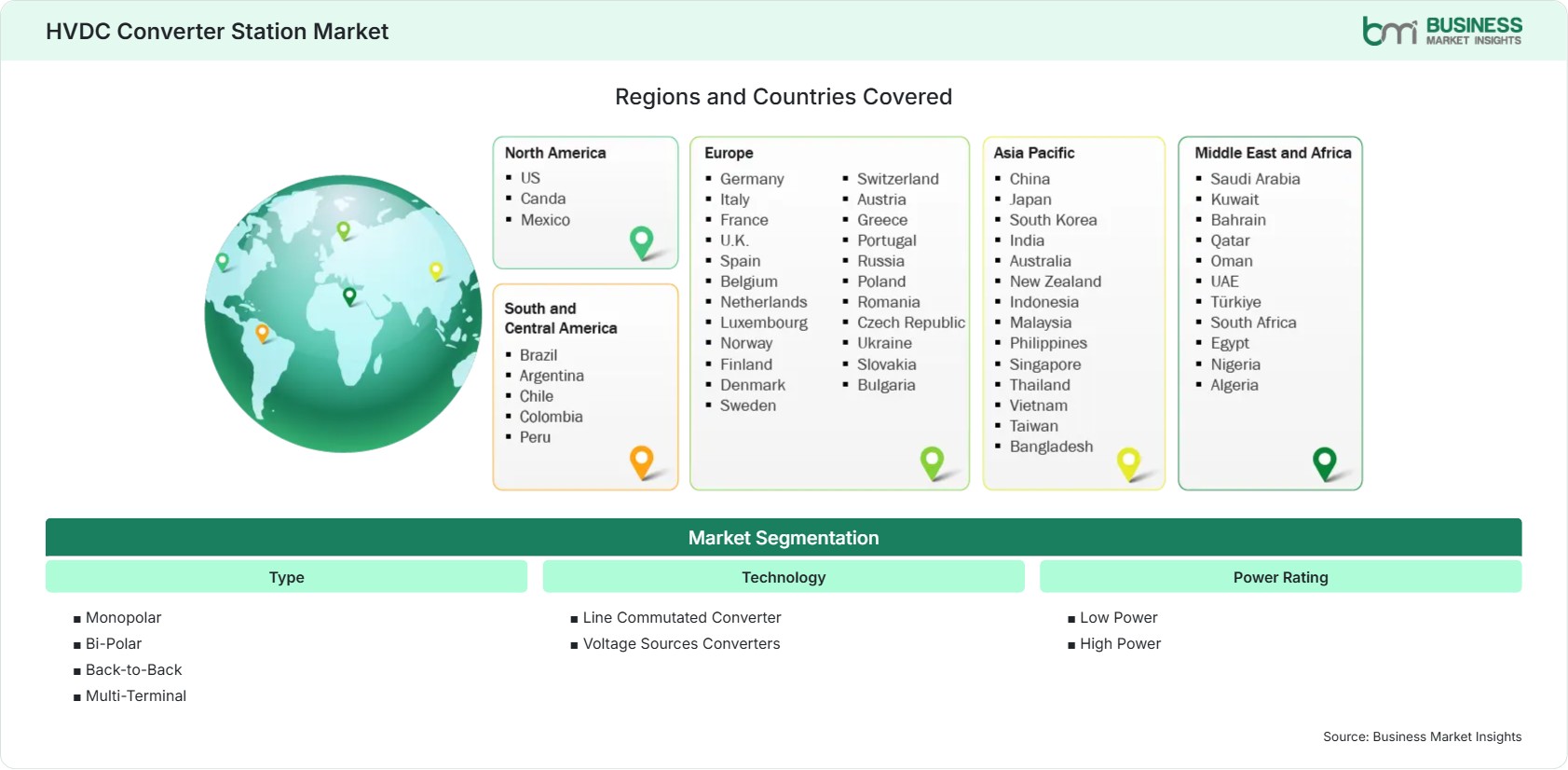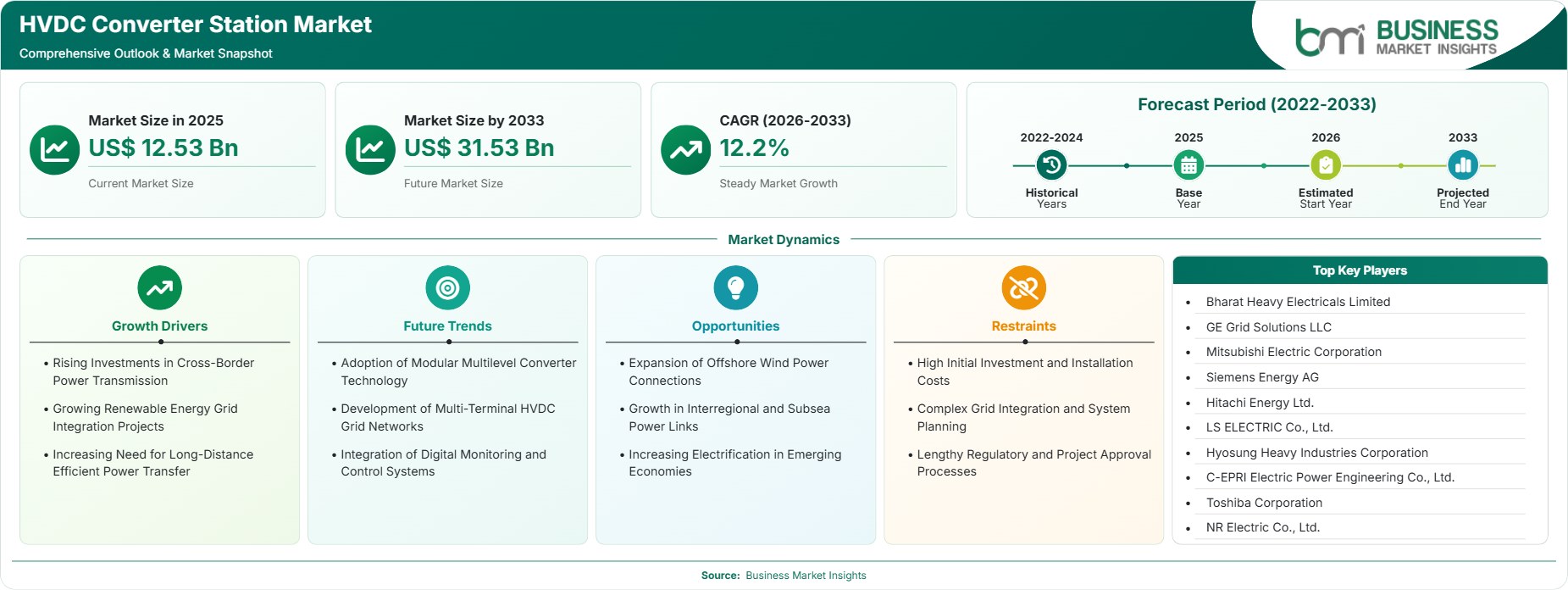
HVDC Converter Station Market Regional Highlights
North America HVDC Converter Station Market
North America accounts for 34%–37% of the global market in 2025 and is projected to register a CAGR of 11.2%–11.8% during 2026–2033. The HVDC Converter Station Market share within the region will be enhanced through extensive transmission upgrades, offshore wind projects, and increased investment in interregional transmission infrastructure. The utilities will upgrade their aging transmission system and integrate their renewable energy sources and battery systems to enhance the resilience of the grid.
- Federal funding and transmission planning initiatives encourage utilities to deploy high-capacity converter stations for renewable integration, long-distance electricity transfer, improved grid reliability, and reduced transmission losses.
- Atlantic offshore wind projects are increasing demand for Voltage Source Converter technology due to compact installation, operational flexibility, and efficient offshore grid integration.
- Rising electricity demand from industries, data centers, and electrification programs is driving investments in high-capacity transmission infrastructure for reliable, efficient long-distance power delivery.
- Digital substations, AI-enabled asset monitoring, and predictive maintenance improve operational efficiency, reduce downtime, extend asset life, and lower lifecycle costs for transmission operators.
- Cross-border electricity exchange between the United States and Canada supports investments in high-capacity transmission infrastructure, enhancing grid flexibility, energy security, and renewable electricity utilization.
US HVDC Converter Station Market
The United States represents 27%–30% of the global HVDC Converter Station Market analysis in 2025 and is expected to expand at a CAGR of 11.3%–11.9% through 2033. Large investments in grid resilience, renewable integration, offshore wind projects, and interregional transmission networks continue supporting deployment of advanced converter stations. Utilities increasingly prioritize efficient long-distance transmission to meet rising electricity demand while improving operational flexibility and system reliability.
- Federal clean energy initiatives support transmission expansion connecting renewable generation with major demand centers through efficient long-distance HVDC infrastructure.
- Rapid growth of hyperscale data centers and industrial electrification increases electricity demand, driving investments in high-capacity transmission corridors and grid modernization.
- East Coast offshore wind projects boost demand for advanced converter technologies enabling reliable offshore grid connections and future multi-terminal networks.
- Utilities deploy intelligent monitoring, digital control, and cybersecurity solutions to improve operational performance while reducing maintenance costs across critical transmission infrastructure.
Europe HVDC Converter Station Market
Europe holds 25%–28% of the HVDC Converter Station market in 2025 and is projected to grow at a CAGR of 11.7%–12.3% during the forecast period. Decarbonization goals, offshore renewables generation, and electricity trade across borders keep providing impetus for infrastructure spending. Germany stays the largest national market, while the UK showcases the most rapid growth due to offshore wind build-out and grid upgrades.
- European transmission operators are investing in cross-border interconnections to improve electricity market integration, renewable balancing, and regional energy security.
- Germany leads deployment through renewable integration, high-capacity transmission corridors, and continued grid modernization for long-distance power transfer.
- The United Kingdom records the fastest growth as expanding offshore wind capacity drives demand for advanced converter stations connecting remote generation to national grids.
- Digital grid technologies, intelligent converter controls, and advanced protection systems improve transmission efficiency, while long-term climate policies accelerate deployment of next-generation low-carbon transmission infrastructure.
Asia Pacific HVDC Converter Station Market
Asia Pacific captures 28%–31% of the market in 2025 while registering the fastest CAGR of 13.3%–13.9% through 2033. Rapid urbanization, industrialization, renewable energy investments, and ultra-high-voltage transmission development continue driving regional expansion. China dominates regional revenue, whereas India records the fastest growth supported by large-scale transmission investments and renewable capacity additions.
- China continues investing in ultra-high-voltage transmission corridors linking renewable-rich western provinces with eastern demand centers, driving deployment of advanced converter stations.
- India records the fastest regional growth through transmission planning, renewable integration, and rising electricity demand from industrialization and urbanization.
- Southeast Asian countries are strengthening regional electricity interconnections, creating opportunities for converter station suppliers supporting cross-border energy exchange.
- Expanding manufacturing in Japan, South Korea, and China, alongside government investments in smart grids, energy transition, and renewable projects, strengthens regional transmission infrastructure and supply chains.
Rest of World HVDC Converter Station Market
The Rest of World accounts for 9%–12% of the global market in 2025 and is forecast to grow at a CAGR of 11.8%–12.5% through 2033.
South & Central America continues expanding transmission infrastructure to integrate hydropower resources and improve national grid connectivity. Brazil remains the leading regional market, while Chile records the fastest growth supported by renewable energy expansion and long-distance transmission investments.
The Middle East & Africa is witnessing increasing investments in grid modernization, renewable integration, and electricity interconnections. Saudi Arabia leads regional deployment through utility-scale infrastructure projects, while the United Arab Emirates demonstrates the strongest growth supported by smart grid investments and clean energy initiatives.
- Brazil continues expanding long-distance transmission infrastructure linking hydroelectric generation with major urban demand centers, improving grid reliability and transmission efficiency.
- Chile is accelerating renewable integration through high-capacity transmission corridors connecting solar and wind projects with industrial and metropolitan markets.
- Saudi Arabia is strengthening transmission infrastructure under energy diversification programs supporting grid modernization and renewable integration.
- The United Arab Emirates invests in digital transmission systems and intelligent converter technologies, while cross-border interconnection initiatives across the Middle East and Africa create long-term opportunities for advanced converter stations and regional energy security.