
HVDC Transmission System Market Outlook: Size, Share, Trends, Growth Analysis, Competitive Landscape & Forecast, 2026-2033

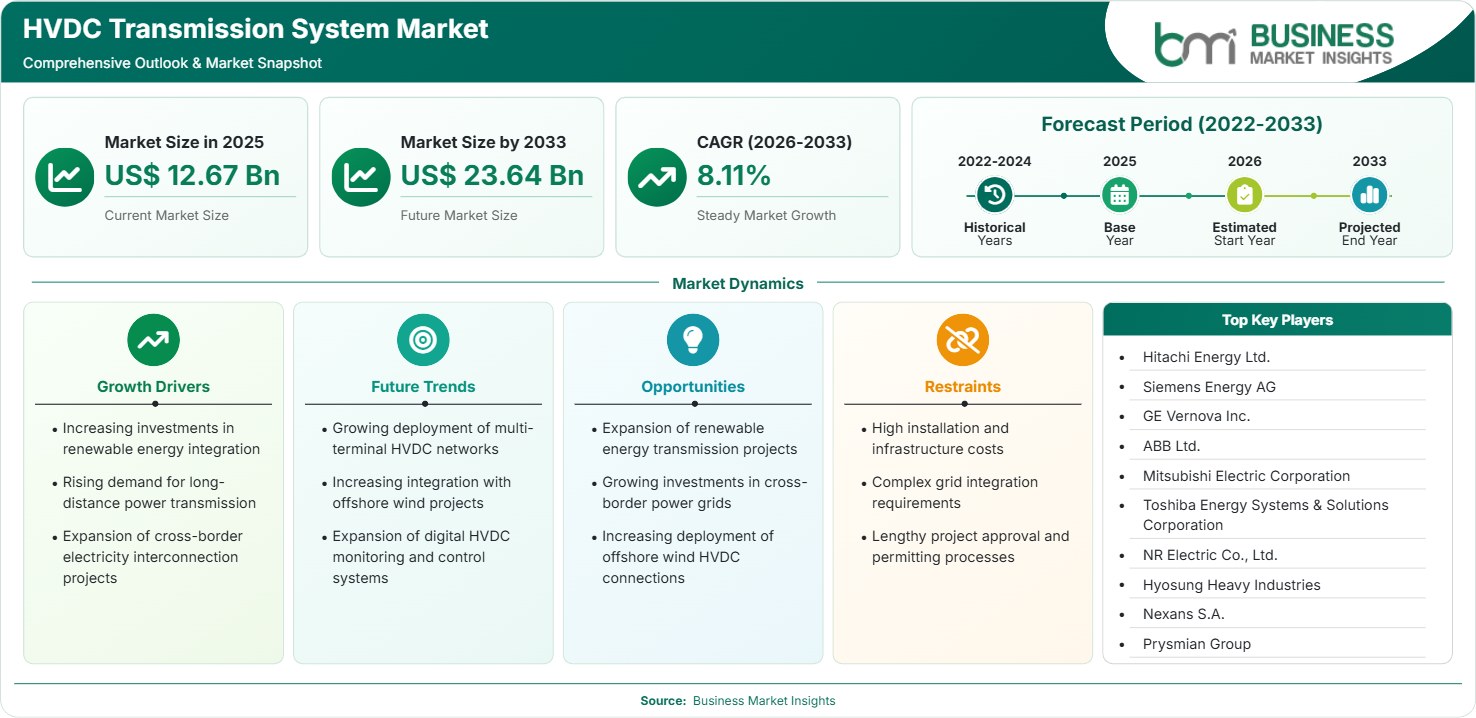
The HVDC Transmission System Market size was valued at US$ 12.67 Billion in 2025 and is projected to reach US$ 23.64 Billion by 2033, growing at a CAGR of 8.11% from 2026 to 2033, driven by renewable energy integration, long-distance transmission demand, cross-border grid expansion, and offshore wind connectivity projects.

Report Coverage
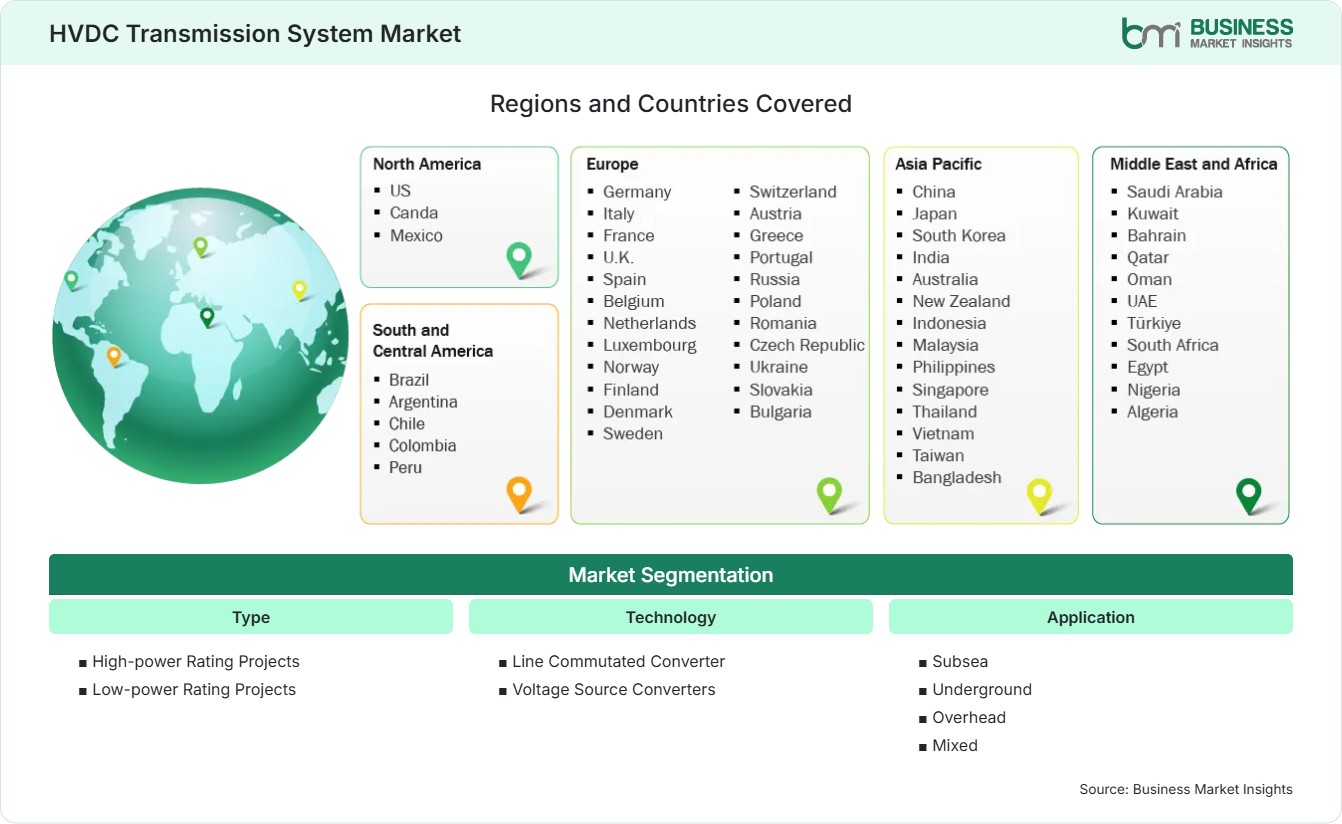
  • Type: High-power Rating Projects, Low-power Rating Projects
  • Technology: Line Commutated Converter, Voltage Source Converters
  • Application: Subsea, Underground, Overhead, Mixed
US$ 12.67 Bn Market size in 2025
US$ 23.64 Bn Market Size by 2033
8.11% CAGR, 2026 - 2033
2026-2033 Forecast Period

AI Overview

HVDC Transmission System Market Summary

  • North America Region: Market share of North America was estimated to be 26%–29% in 2025 and is expected to register a 7.2%–7.8% CAGR through 2026-2033. Factors contributing to growth include rise in renewable energy generation, efforts towards grid modernization, development of offshore wind turbines, and need for long-distance transmission of electricity. The market in the United States is anticipated to register a 7.4%–8.0% CAGR in 2026–2033 due to various projects.
  • Fastest-Growing Region: Asia-Pacific is expected to account for about 38%–42% of the market share in 2025 and is anticipated to expand at an 8.8%–9.5% CAGR over 2026–2033. The growth will be facilitated by large-scale renewable energy projects, high electricity demand, power interconnections between countries, and infrastructure development in China, India, and Southeast Asian nations.
  • Leading Segment: The High-power Rating projects held about 64%-68% of the market share in 2025 and are experiencing CAGR of 8.4%-9.0% between 2026 and 2033. This growth will be driven by the utility-scale transmission projects and renewable energy corridors.
  • High Growth Segment: Voltage Source Converters (VSC) captured a market share of 42%–46% in 2025 and is expected to increase at a CAGR of 9.1%–9.7% till 2033. The factors affecting growth are offshore wind integration, flexible grid use, and improved control.
  • Key Market Opportunity: Expansion of renewable energy transmission projects, offshore wind HVDC connections, and international power grid networks are creating investment opportunities for technology providers.
  • Major Market Players: Hitachi Energy Ltd., Siemens Energy AG, GE Vernova Inc., ABB Ltd., Mitsubishi Electric Corporation, Toshiba Energy Systems & Solutions Corporation, NR Electric Co., Ltd., Hyosung Heavy Industries, Nexans S.A., and Prysmian Group.
Strategic Insights

HVDC Transmission System Market: Strategic Insights

HVDC Transmission System Market Strategic Framework
FREE PDF
Request your free sample
Request free sample
Stakeholder View

Key Takeaways

  • HVDC systems are becoming critical components of modern power networks as utilities expand renewable energy integration and require efficient transmission over extended distances.
  • High-power transmission projects provide significant growth opportunities due to increasing investments in renewable energy corridors, interregional grids, and large-scale electricity infrastructure.
  • Technology advancement is shifting toward VSC-based systems because of improved flexibility, offshore wind compatibility, and enhanced grid management capabilities.
  • Asia Pacific presents strong investment potential due to rapid renewable energy expansion, electricity demand growth, and government-backed transmission infrastructure projects.
  • Strategic collaborations among energy equipment manufacturers, utilities, and grid operators are increasing to develop large-scale HVDC infrastructure solutions.
  • Offshore wind transmission represents an emerging opportunity as countries invest in marine renewable energy projects requiring reliable subsea electricity connections.
Geographic Outlook

HVDC Transmission System Market Regional Highlights

North America HVDC Transmission System Market

North America accounted for approximately 26%–29% of global revenue in 2025 and is projected to expand at a 7.2%–7.8% CAGR during 2026–2033. The region benefits from renewable energy investments, grid modernization programs, offshore wind development, and increasing demand for efficient electricity transmission. The HVDC Transmission System Market share in North America is supported by the United States, where utilities are upgrading transmission infrastructure to accommodate renewable generation and improve grid reliability.

  • The United States remains the largest contributor due to renewable integration projects, aging grid replacement requirements, and increasing investment in high-capacity transmission networks.
  • Canada is developing HVDC opportunities through renewable energy expansion, long-distance transmission requirements, and interprovincial electricity connectivity projects.
  • Offshore wind development along coastal regions is creating demand for subsea HVDC systems capable of transferring power efficiently over long distances.
  • Grid operators are investing in modernization initiatives to improve resilience, reliability, and renewable energy transmission capabilities.

US HVDC Transmission System Market

The United States represented approximately 78%–82% of North American revenue in 2025 and is expected to grow at a 7.4%–8.0% CAGR during 2026–2033. Growth is supported by renewable energy expansion, transmission infrastructure upgrades, and increasing requirements for moving electricity from remote generation areas to high-demand regions. Federal and regional energy initiatives are encouraging investments in advanced transmission technologies that improve grid flexibility and support clean energy integration in HVDC Transmission System Market.

  • Renewable energy zones are increasing demand for high-voltage transmission systems connecting remote wind and solar projects with population centers.
  • Offshore wind projects are creating opportunities for HVDC suppliers through subsea cable systems and converter station deployments.
  • Utilities are modernizing aging infrastructure to improve electricity reliability and accommodate changing generation patterns.
  • Cross-regional transmission projects are supporting demand for advanced HVDC technologies across major power markets.

Europe HVDC Transmission System Market

Europe accounted for approximately 27%–30% of global revenue in 2025 and is forecast to register a 7.6%–8.3% CAGR from 2026–2033. The region benefits from renewable energy targets, offshore wind expansion, and cross-border electricity exchange initiatives. Germany represents the leading HVDC Transmission System market due to energy transition programs, while the United Kingdom and Norway demonstrate strong growth through offshore renewable projects and interconnected power networks.

  • Germany leads regional demand for HVDC systems due to its ambitious renewable energy integration targets, ongoing grid expansion requirements, and increasing need for flexible transmission solutions. The country is investing in advanced transmission networks to connect offshore wind generation in northern regions with industrial and population centers in the south while improving overall grid stability and efficiency.
  • The United Kingdom is expanding HVDC deployment through large-scale offshore wind connections, subsea transmission projects, and international electricity interconnection initiatives. These developments are supporting energy security, renewable power integration, and greater flexibility in electricity exchange with neighboring markets.
  • Norway contributes significantly to regional HVDC growth through its renewable hydropower resources, electricity export capabilities, and cross-border transmission links supporting European energy cooperation. HVDC interconnections help optimize renewable power utilization and strengthen regional energy resilience.
  • European grid operators are increasing investments in HVDC infrastructure to improve renewable energy utilization, reduce transmission bottlenecks, and enhance grid reliability across interconnected power systems.
  • The expansion of offshore wind projects across Northern Europe is creating substantial demand for subsea HVDC connection systems, converter stations, and advanced transmission technologies to support future clean energy networks.

Asia Pacific HVDC Transmission System Market

Asia Pacific represented approximately 38%–42% of global revenue in 2025 and is projected to achieve the fastest growth at a 8.8%–9.5% CAGR during 2026–2033. The region benefits from large-scale renewable projects, rising electricity consumption, expanding industrialization, and government-supported grid development. China remains the largest HVDC Transmission System market, while India, Japan, and Southeast Asian countries provide additional opportunities through renewable integration and cross-border electricity initiatives.

  • China dominates regional HVDC demand due to extensive ultra-high-voltage transmission projects, rapid renewable energy expansion, and increasing requirements for large-scale electricity transfer across geographically dispersed regions. The country continues to invest in advanced grid infrastructure to connect remote renewable generation areas with major consumption centers.
  • India is increasing HVDC investments through renewable energy corridors, interstate transmission networks, and rising electricity demand driven by industrial and economic growth. These projects support efficient power distribution and renewable integration.
  • Japan is developing advanced transmission solutions to enhance renewable energy utilization, improve grid flexibility, and strengthen energy security.
  • Southeast Asian countries are exploring cross-border electricity networks to improve regional energy cooperation and enable efficient power exchange.
  • Renewable energy expansion across Asia Pacific is creating long-term growth opportunities for HVDC equipment manufacturers, technology providers, and infrastructure developers.

Rest of World HVDC Transmission System Market

The Rest of World region accounted for approximately 5%–8% of global revenue in 2025 and is expected to grow at a 6.5%–7.2% CAGR during 2026–2033. Latin America is supported by renewable energy development, hydropower resources, and expanding electricity networks. The Middle East and Africa region is gaining attention through renewable projects and grid infrastructure investments. Brazil, Chile, South Africa, and Gulf countries represent important markets.

  • Brazil contributes to HVDC Transmission System market growth through expanding renewable power generation capacity, particularly hydropower and wind energy projects, along with increasing demand for efficient electricity transmission networks. The country is investing in advanced grid infrastructure to transfer power from remote generation areas to major urban and industrial regions while improving system reliability.
  • Chile is developing transmission projects to connect renewable energy resources, including solar and wind power facilities, with major electricity consumption centers. These initiatives are supporting clean energy integration and creating demand for advanced transmission technologies.
  • Middle Eastern countries are investing in renewable energy infrastructure, including large-scale solar projects, which require efficient and reliable transmission solutions to support future electricity networks.
  • South Africa is upgrading its electricity infrastructure to improve grid reliability, address transmission challenges, and integrate additional renewable generation capacity into the national power system.
  • Regional electricity cooperation initiatives are creating new opportunities for HVDC interconnection projects by enabling cross-border power exchange, strengthening energy security, and supporting the development of interconnected regional grids.
Global Market Geography
FREE PDF
Request your free sample
Request free sample
Segment Analysis

HVDC Transmission System Market Segmentation

Type

The type segment represents a major classification of HVDC transmission projects, influenced by electricity demand, renewable integration requirements, and grid expansion strategies. High-power Rating Projects accounted for approximately 64%–68% share in 2025 and are projected to grow at a 8.4%–9.0% CAGR during 2026–2033. Growth is supported by utility-scale renewable energy transmission, long-distance electricity transfer, and large interconnection projects requiring high-capacity solutions. Low-power rating projects continue serving regional grid applications where moderate transmission requirements are prioritized.

  • High-power Rating Projects: High-power rating projects dominate due to their suitability for large renewable energy corridors, long-distance transmission networks, and bulk electricity transfer between regions.
  • Low-power Rating Projects: Low-power rating projects support smaller grid applications, regional connections, and specialized transmission requirements where lower capacity solutions provide operational efficiency.

Technology

The technology segment is shaped by advancements in converter systems, grid flexibility requirements, and renewable energy integration needs. Voltage Source Converters (VSC) accounted for approximately 42%–46% share in 2025 and are expected to grow at a 9.1%–9.7% CAGR during 2026–2033. Adoption is supported by offshore wind connections, improved controllability, and suitability for weak grid environments. Line Commutated Converter technology remains important for high-capacity applications due to established performance and cost advantages.

  • Line Commutated Converter (LCC): LCC technology remains widely used in high-capacity transmission projects due to proven reliability, efficient bulk power transfer, and extensive operational experience.
  • Voltage Source Converters (VSC): VSC technology is expanding through flexible grid applications, offshore wind projects, improved voltage control, and compatibility with renewable energy systems.

Application

The application segment reflects increasing demand for reliable electricity transmission across diverse environments, including marine and terrestrial infrastructure. Overhead transmission accounted for approximately 48%–52% share in 2025 and is projected to grow at a 7.6%–8.2% CAGR during 2026–2033. Growth is supported by cost efficiency, large-scale grid expansion, and suitability for long-distance power transfer. Subsea applications are gaining momentum due to offshore wind development and cross-border electricity connections.

  • Subsea: Subsea HVDC systems are expanding through offshore wind projects and international power connections requiring efficient underwater electricity transmission solutions.
  • Underground: Underground HVDC applications support urban areas and environmentally sensitive locations where traditional overhead transmission is challenging.
  • Overhead: Overhead HVDC systems remain dominant due to cost advantages, long-distance capability, and suitability for large transmission infrastructure projects.
  • Mixed: Mixed HVDC applications combine multiple transmission approaches to address complex geographic conditions and improve overall grid connectivity.
Market Forces

HVDC Transmission System Market Dynamics

Key Market Drivers

Increasing investments in renewable energy integration

Growing renewable energy deployment is increasing the need for advanced transmission infrastructure capable of connecting remote generation sources with consumption centers. Wind, solar, and offshore renewable projects often require efficient long-distance electricity transfer, making HVDC systems a preferred solution for minimizing losses and improving grid stability. The HVDC Transmission System Market trends indicate that utilities and governments are prioritizing flexible transmission networks to support decarbonization targets. Large-scale renewable energy corridors across Asia Pacific, Europe, and North America are creating demand for converter stations, HVDC cables, and advanced grid management solutions. Manufacturers are focusing on technologies that improve reliability, capacity, and integration of variable renewable power sources.

Rising demand for long-distance power transmission

The rise in electricity demand, together with the distance between production plants and areas of consumption, is driving the use of HVDC transmission systems. High-voltage direct current transmission systems effectively transmit electricity from one place to another with lower energy losses than other transmission systems. Industrialization, urbanization, and the development of renewable energy sources have increased the strain on the current electricity network. The utilities have begun constructing transmission lines to improve power transmission efficiency and enhance energy security. Advancements in converter technology have facilitated better management of electricity.

Expansion of cross-border electricity interconnection projects

Cross-border electricity networks are becoming increasingly important as countries seek energy diversification, regional cooperation, and improved power reliability. HVDC systems enable efficient electricity exchange between interconnected grids operating under different technical conditions. The HVDC Transmission System Market growth is supported by increasing investments in international power links, especially across Europe, Asia, and the Middle East. These projects help balance electricity supply, integrate renewable resources, and improve energy resilience. Governments are developing interconnection strategies to enhance regional energy security and optimize available generation resources. Equipment suppliers are benefiting from rising demand for HVDC cables, converter stations, and grid control technologies required for large-scale transmission projects.

Key Market Opportunities

Expansion of renewable energy transmission projects

Expansion of renewable energy projects is creating significant opportunities for HVDC technology providers as countries accelerate clean energy development. Large offshore wind farms, remote solar installations, and renewable energy zones require advanced transmission solutions to deliver electricity efficiently. The HVDC Transmission System Market forecast remains supported by increasing infrastructure investments aimed at connecting renewable generation with major consumption areas. Equipment manufacturers can benefit by developing high-capacity cables, efficient converter systems, and integrated grid solutions. Emerging renewable markets are also creating opportunities for suppliers to establish partnerships with utilities and governments involved in clean energy transition programs.

Growing investments in cross-border power grids

Growing emphasis on regional cooperation in electricity generation is providing new business opportunities for HVDC equipment suppliers through the development of cross border transmission lines. Countries are building regional power systems that will provide better security and help them balance supply and demand, besides facilitating the trade in renewable energy. Such projects need sophisticated HVDC equipment that can facilitate power transfer between nations. Investments in regional power grids in Europe, Asia, and developing countries have encouraged equipment suppliers to upgrade their offerings. Firms that have experience in converter technology and cabling are set to benefit from such investments.

Increasing deployment of offshore wind HVDC connections

Offshore wind expansion is creating strong opportunities for HVDC technology because subsea transmission is required to connect distant marine energy projects with mainland grids. HVDC systems offer advantages for long-distance offshore connections by reducing transmission losses and supporting high-capacity electricity transfer. There is an increasing tendency among governments to invest in offshore renewable energy sources as part of the energy transition, resulting in the need for specialized cables and converter stations. Cable manufacturers are developing technologies to enhance the performance and installation of subsea cables. The development of offshore wind farms in Europe, Asia Pacific, and North America will be beneficial in the future.

Market Restraints and Challenges

High installation and infrastructure costs

Factor: HVDC projects require significant investment in converter stations, specialized cables, engineering services, and supporting transmission infrastructure. Impact: Higher upfront costs might result in delays in approval of the projects, financing difficulties, and restricted adoption in areas where budget of infrastructure is limited. It is necessary to cope with complicated planning process, lengthy construction period, and capital-intensive nature of such projects. Even though HVDC systems are efficient in the long run, upfront cost is still an important factor. Companies are addressing this challenge through improved project execution methods, technological advancements, and cost optimization strategies.

Complex grid integration requirements

Factor: Integrating HVDC systems into existing power networks requires advanced planning, technical expertise, and coordination between multiple grid operators. Impact: Complex integration processes can increase project timelines, create operational challenges, and require significant investments in grid management technologies. Different grid standards, control requirements, and system compatibility issues may complicate deployment. Utilities need advanced simulation tools and skilled technical teams to ensure stable operation. Manufacturers are developing improved control systems and digital monitoring solutions to simplify integration and enhance reliability across interconnected electricity networks.

Company Analysis

Competitive Landscape

The competitive landscape is shaped by technology innovation, project execution capabilities, cable manufacturing expertise, and partnerships with utilities and renewable energy developers. The HVDC Transmission System Market analysis highlights that leading companies are focusing on converter technology advancements, high-capacity transmission solutions, offshore wind applications, and digital grid management systems to strengthen their market position.

Company Name

Overview

Products and Services relevant to this market

Hitachi Energy Ltd.

Global power technology company specializing in grid infrastructure solutions.

Provides HVDC systems, converter stations, cables, and grid integration technologies.

Siemens Energy AG

Energy technology provider focused on transmission and power infrastructure.

Offers HVDC transmission systems, converters, and grid stabilization solutions.

GE Vernova Inc.

Energy technology company supporting electricity generation and transmission markets.

Develops HVDC equipment, power transmission technologies, and grid solutions.

ABB Ltd.

Power and automation company with extensive transmission expertise.

Provides HVDC systems, converter technology, and electrical infrastructure solutions.

Mitsubishi Electric Corporation

Technology company supplying advanced electrical and automation systems.

Offers HVDC converters, power electronics, and transmission equipment.

Toshiba Energy Systems & Solutions Corporation

Energy solutions provider focused on power infrastructure development.

Supplies HVDC systems, converter equipment, and grid technologies.

NR Electric Co., Ltd.

Chinese company specializing in power automation and protection systems.

Provides grid control systems, HVDC protection, and transmission solutions.

Hyosung Heavy Industries

Industrial company producing electrical infrastructure equipment.

Manufactures power equipment, transmission systems, and grid solutions.

xans S.A.

Cable manufacturer specializing in energy transmission solutions.

Provides HVDC cables and subsea transmission cable systems.

Prysmian Group

Global cable manufacturer serving power transmission industries.

Supplies HVDC cables, submarine cables, and electricity transmission solutions.

Trust & Transparency

Research Methodology

The market analysis combines proprietary research with secondary data from government agencies, company disclosures, regulatory filings, industry databases and expert interviews. Market estimates are validated through data triangulation, cross-market benchmarking and analyst review.

View Full Research Methodology

Questions Answered

Frequently Asked Questions

How does this HVDC Transmission System Market report support industry decisions?

This report provides insights into market dynamics, regional opportunities, technology trends, competitive strategies, and investment areas for energy infrastructure stakeholders.

What role do offshore wind projects play in HVDC adoption?

Offshore wind projects require reliable subsea transmission systems to transfer electricity from marine generation sites to mainland grids, creating demand for HVDC cables and converter technologies.

Which region has strong growth potential for HVDC systems?

Asia Pacific offers strong growth potential due to renewable energy investments, expanding electricity demand, cross-border grid projects, and large-scale transmission infrastructure development.

How does HVDC technology support renewable energy integration?

HVDC systems enable efficient transmission of electricity from offshore wind farms, solar projects, and remote renewable sources while reducing losses and improving grid stability across long distances.

What factors are increasing demand for HVDC transmission system market?

Demand is increasing due to renewable energy expansion, long-distance electricity transmission requirements, grid modernization initiatives, and the need for efficient power transfer between remote generation areas and consumption centers.

Access the Full HVDC Transmission System Market Report

Get segment-level forecasts, regional estimates, competitive benchmarking, company profiles and downloadable Excel datasets.

Access the full HVDC Transmission System Market Report
350 pages PDF & Excel | 2026-08-07
Similar Research

Related Market Reports