
Electrolyzer Market Outlook: Size, Share, Trends, Growth Analysis, Competitive Landscape & Forecast, 2026-2033

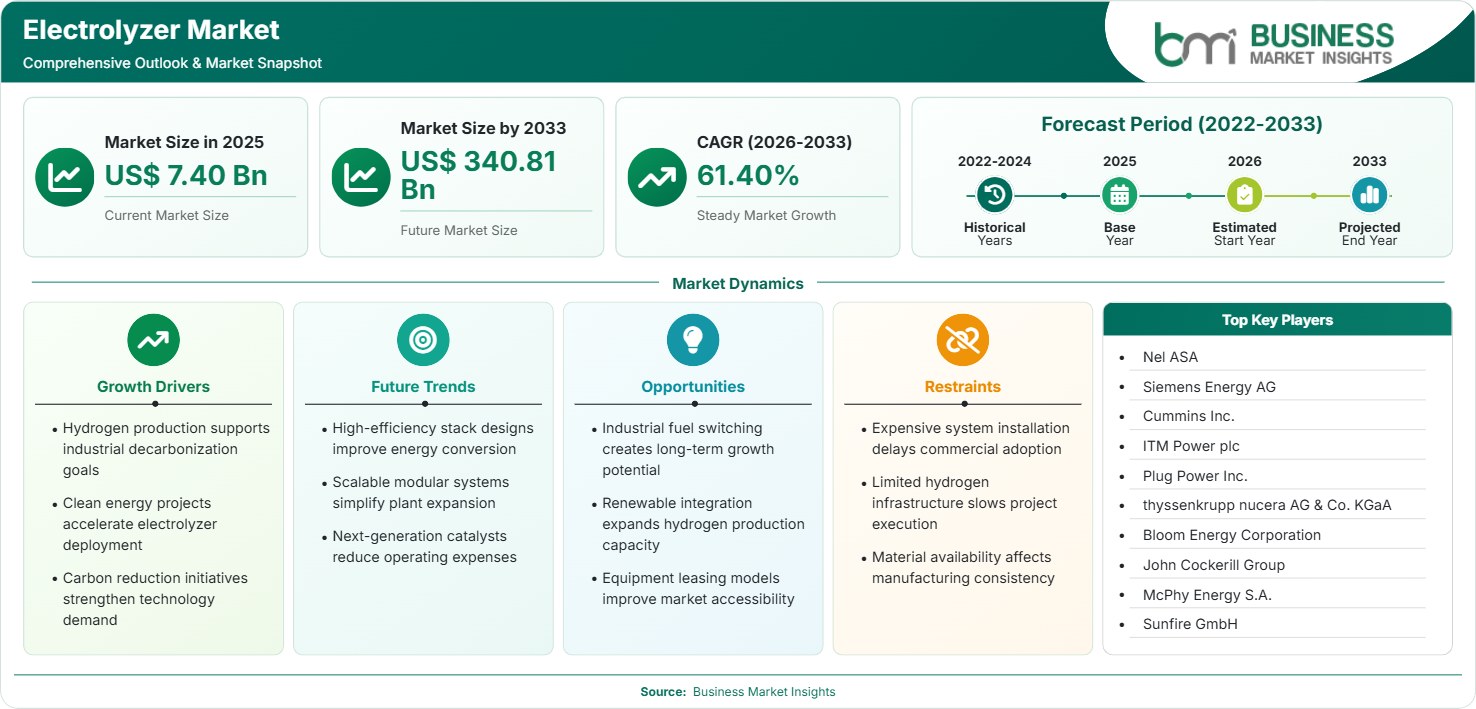
The Electrolyzer Market size was valued at US$ 7.40 billion in 2025 and is projected to reach US$ 340.81 billion by 2033, growing at a CAGR of 61.40% during 2026–2033. Accelerating green hydrogen investments, expanding renewable energy integration, supportive decarbonization policies, and industrial demand for low-carbon hydrogen continue creating strong opportunities for electrolyzer manufacturers worldwide.

Report Coverage
  • Type: PEM Electrolyzer, Traditional Alkaline Electrolyzer, Others
  • Application: Power Plants, Steel Plant, Electronics and Photovoltaics, Industrial Gases, Energy Storage or Fueling for FCEV, Power to Gas, Others
US$ 7.40 Bn Market size in 2025
US$ 340.81 Bn Market Size by 2033
61.40% CAGR, 2026 - 2033
2026-2033 Forecast Period

AI Overview

Electrolyzer Market Summary

  • North America Region: North America holds 24%–27% market share in 2025 and is projected to register a CAGR of 59.0%–61.5% during 2026–2033. Government incentives, hydrogen hub investments, and expanding renewable energy capacity continue supporting commercial deployment. The U.S. remains the regional leader with a CAGR of 60.2%–62.4%, driven by federal clean hydrogen initiatives, industrial decarbonization projects, and private-sector investments.
  • Fastest Growing Region: Europe accounts for 34%–37% market share in 2025 and is anticipated to expand at a CAGR of 63.5%–66.2%, supported by ambitious hydrogen strategies, renewable energy expansion, and large-scale industrial decarbonization programs.
  • Leading Segment: Traditional Alkaline Electrolyzer represents 48%–51% market share in 2025 and is expected to grow at a CAGR of 58.4%–60.8%, owing to commercial maturity, lower capital costs, and broad industrial adoption.
  • High Growth Segment: Energy Storage or Fueling for FCEV captures 19%–22% market share in 2025 and is forecast to record a CAGR of 67.0%–70.5%, supported by expanding hydrogen mobility infrastructure and energy storage investments.
  • Key Market Opportunity: Rising investment in renewable hydrogen production, industrial decarbonization, and integrated clean energy infrastructure continues creating significant long-term opportunities for electrolyzer manufacturers and technology providers.
  • Major Market Players: Nel ASA, Siemens Energy AG, Cummins Inc., ITM Power plc, Plug Power Inc., thyssenkrupp nucera AG & Co. KGaA, Bloom Energy Corporation, John Cockerill Group, McPhy Energy S.A., and Sunfire GmbH.
Strategic Insights

Electrolyzer Market: Strategic Insights

Electrolyzer Market Strategic Framework
FREE PDF
Request your free sample
Request free sample
Stakeholder View

Key Takeaways

  • Strong policy support for green hydrogen production is accelerating investment across the electrolyzer value chain, creating opportunities for equipment manufacturers, engineering companies, and renewable energy developers.
  • Heavy industries including steel, refining, chemicals, and fertilizers are expected to remain the largest adopters of electrolyzer systems as carbon reduction commitments intensify.
  • Continuous innovation in PEM and alkaline technologies is improving efficiency, reducing operational costs, and increasing commercial competitiveness for large-scale hydrogen production projects.
  • Europe offers the strongest investment environment due to ambitious hydrogen strategies, renewable energy expansion, and supportive regulatory frameworks encouraging industrial decarbonization.
  • Strategic partnerships, manufacturing capacity expansion, and technology licensing agreements continue shaping competitive dynamics as companies prepare for rapidly growing hydrogen demand.
  • Integrated renewable energy projects combining solar, wind, battery storage, and electrolyzers are expected to become increasingly important for long-term hydrogen production economics.
Geographic Outlook

Electrolyzer Market Regional Highlights

North America Electrolyzer Market

North America accounts for 24%–27% Electrolyzer Market share in 2025 and is projected to expand at a CAGR of 59.0%–61.5% during 2026–2033. Federal funding, hydrogen hub development, renewable energy investments, and industrial decarbonization programs continue supporting commercial deployment. Technology providers are expanding manufacturing capacity while energy companies increasingly invest in integrated green hydrogen production projects across the United States and Canada.

  • Government incentives continue supporting large-scale hydrogen production facilities and clean energy infrastructure investments.
  • Industrial decarbonization initiatives encourage adoption across refining, chemicals, steel, and heavy manufacturing sectors.
  • Renewable electricity expansion improves project economics for commercial electrolyzer installations.
  • Strategic collaborations between utilities and technology providers accelerate project commercialization.

US Electrolyzer Market

The United States contributes 84%–87% of North American revenue and is projected to register a CAGR of 60.2%–62.4% throughout the forecast period. Strong federal incentives, expanding hydrogen hubs, and increasing renewable electricity capacity continue strengthening domestic demand for advanced electrolyzer systems.

  • Federal clean hydrogen funding accelerates deployment of commercial-scale production facilities.
  • Renewable energy developers increasingly integrate electrolyzers with solar and wind power projects.
  • Industrial users continue investing in hydrogen production to reduce carbon emissions.
  • Private capital supports manufacturing expansion and technology commercialization.

Europe Electrolyzer Market

Europe represents 34%–37% market share in 2025 and is expected to record the fastest 63.5%–66.2% CAGR during 2026–2033. Aggressive hydrogen strategies, renewable energy deployment, and industrial decarbonization policies continue driving equipment demand. Germany remains the largest regional market, while Spain records the fastest growth through renewable hydrogen investments and expanding electrolyzer manufacturing capacity.

  • European hydrogen strategies encourage large-scale renewable hydrogen deployment.
  • Cross-border hydrogen infrastructure projects strengthen long-term market development.
  • Industrial manufacturers increasingly replace fossil-based hydrogen with renewable alternatives.
  • Public funding accelerates commercialization of advanced electrolyzer technologies.

Asia Pacific Electrolyzer Market

Asia Pacific holds 29%–32% market share in 2025 and is anticipated to grow at a CAGR of 61.8%–64.5% through 2026–2033. Expanding renewable power generation, industrial decarbonization, and government hydrogen roadmaps continue supporting regional growth. China leads electrolyzer manufacturing and deployment, while India records the fastest expansion through large-scale green hydrogen initiatives and supportive industrial policies.

  • Massive renewable energy investments improve hydrogen production economics.
  • National hydrogen strategies continue encouraging commercial-scale electrolyzer deployment.
  • Heavy industrial sectors increase investments in low-carbon production technologies.
  • Domestic manufacturing expansion improves regional equipment availability and competitiveness.

Rest of World Electrolyzer Market

The Rest of World region accounts for 7%–10% market share in 2025 and is projected to expand at a CAGR of 60.5%–63.1% during 2026–2033. Investments in renewable energy, industrial diversification, and hydrogen export infrastructure continue supporting market expansion across Latin America, the Middle East, and Africa.

  • Saudi Arabia continues investing in large-scale renewable hydrogen production projects.
  • Brazil expands renewable energy resources supporting future hydrogen production capacity.
  • Mining and industrial sectors increasingly evaluate green hydrogen for decarbonization.
  • International partnerships strengthen hydrogen infrastructure development and technology deployment.
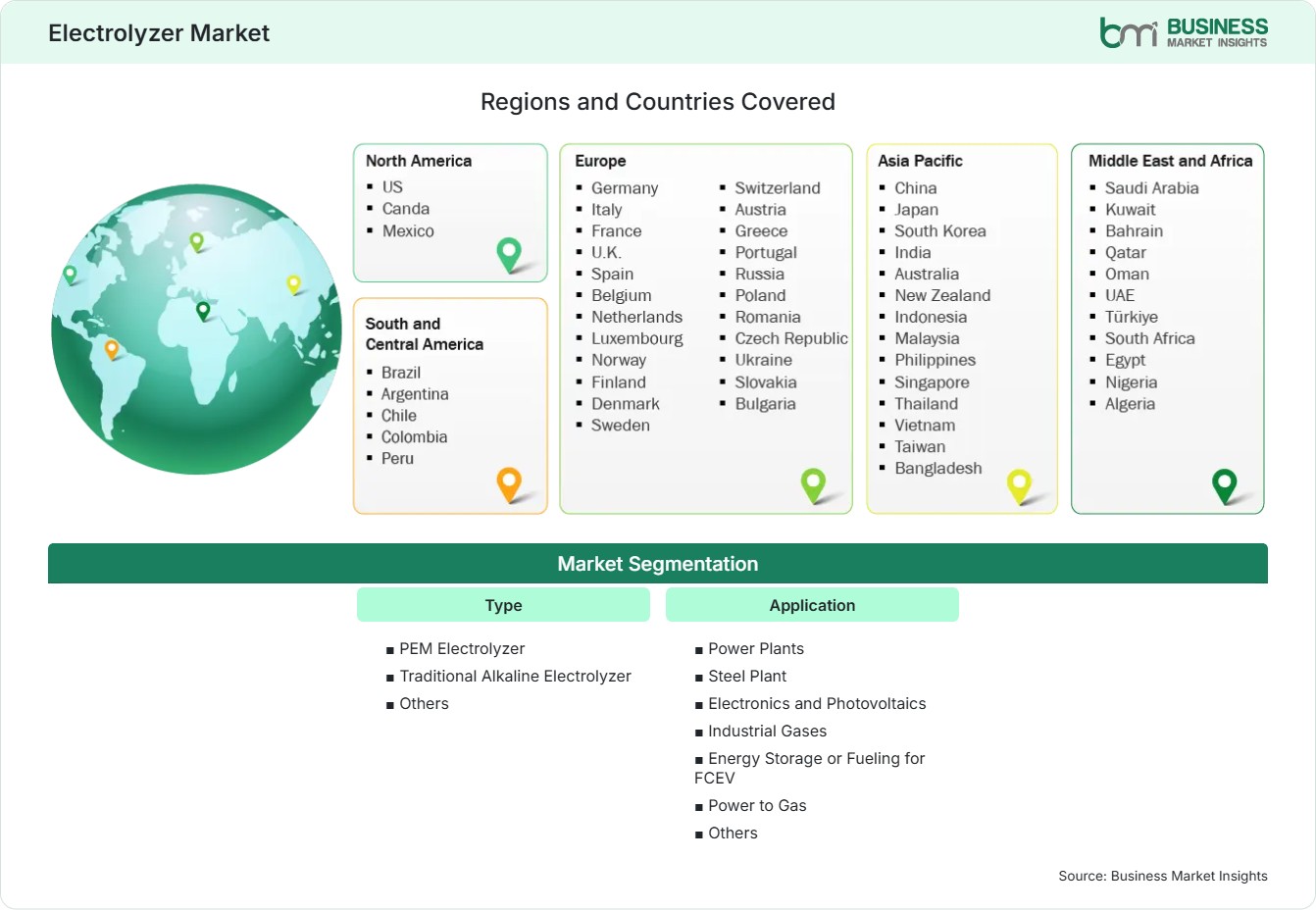
Global Market Geography
FREE PDF
Request your free sample
Request free sample
Segment Analysis

Electrolyzer Market Segmentation

Type

The type segment remains the foundation of industry development as different electrolyzer technologies address varying efficiency, capital cost, operating conditions, and large-scale hydrogen production requirements. It accounted for 48%–51% market share in 2025 and is expected to register a CAGR of 58.4%–60.8% during 2026–2033. Continuous technological improvements, manufacturing scale-up, and cost optimization continue expanding the Electrolyzer Market scope across industrial decarbonization, renewable hydrogen production, and clean energy infrastructure projects.

  • PEM Electrolyzer: Experiences rapid adoption owing to high current density, compact system design, fast operational response, and compatibility with variable renewable electricity generated from wind and solar resources.
  • Traditional Alkaline Electrolyzer: Maintains market leadership through proven commercial reliability, lower capital investment, established manufacturing processes, and suitability for continuous large-scale industrial hydrogen production applications.

Application

Application diversity continues expanding as industries increasingly adopt electrolyzers to reduce carbon emissions while improving energy security and operational sustainability. This segment accounted for 19%–22% market share in 2025 and is projected to register a CAGR of 67.0%–70.5% during 2026–2033. Current Electrolyzer Market trends highlight increasing deployment across renewable hydrogen production, industrial decarbonization, clean mobility, and grid balancing applications worldwide.

  • Power Plants: Utilities increasingly integrate electrolyzers with renewable electricity generation to produce green hydrogen, improve grid flexibility, store surplus renewable energy, and support long-duration energy storage strategies.
  • Steel Plant: Steel manufacturers are adopting renewable hydrogen to replace coal-based reduction processes, helping reduce carbon emissions while supporting low-carbon steel production and compliance with environmental regulations.
  • Electronics and Photovoltaics: High-purity hydrogen produced through electrolyzers supports semiconductor manufacturing, photovoltaic cell production, and advanced electronics fabrication requiring ultra-clean industrial gases.
  • Industrial Gases: Industrial gas producers continue investing in electrolyzers to supply renewable hydrogen for chemical manufacturing, refining, food processing, and other industrial applications requiring reliable hydrogen availability.
  • Energy Storage or Fueling for FCEV: Represents the fastest-growing application as investments increase in hydrogen refueling infrastructure, fuel cell electric vehicles, heavy-duty transportation, and integrated renewable energy storage systems.
  • Power to Gas: Growing renewable electricity generation encourages utilities to convert excess power into hydrogen, improving energy storage capability and supporting long-term grid stability through Power-to-Gas infrastructure.
Market Forces

Electrolyzer Market Dynamics

Key Market Drivers

Hydrogen production supports industrial decarbonization goals

Industries such as steel, refinery, chemical, fertilizer, and cement have been increasingly embracing green hydrogen to cut down their carbon footprint and comply with the climate regulation laws. Electrolyzers allow for hydrogen generation that is less carbon-intensive via renewable energy as opposed to fossil fuels-based hydrogen production. Governments are offering incentives, tax credits, and financing to compel industries to accelerate their decarbonization. These developments continue supporting Electrolyzer Market growth, encouraging equipment manufacturers to expand production capacity and improve electrolyzer efficiency for large-scale industrial applications.

Clean energy projects accelerate electrolyzer deployment

Large-scale renewable energy developments are creating favorable conditions for commercial electrolyzer deployment worldwide. The wind and solar farms are now increasingly incorporating hydrogen-producing systems to take advantage of surplus renewable energy and boost energy efficiency. Public power companies, IPPs, and energy firms are now building green hydrogen plants to help with long-term energy storage and supply fuels to industries. With declining costs of renewable energy production and increasing electrolyzer efficiency, green hydrogen projects are becoming increasingly attractive. As investment in renewable energy projects increases, the need for electrolyzer systems will also rise.

Carbon reduction initiatives strengthen technology demand

Climate policies to reduce GHG emissions from heavy industry and the transportation sector have been reinforced by governments worldwide. The development of national hydrogen policies, renewable energy initiatives, and pledges of carbon neutrality have encouraged the commercial deployment of electrolyzer technology. Government funding initiatives and industry collaborations have supported demonstration projects and large-scale hydrogen production plants. System improvements continue to enhance the durability and efficiency of electrolyzers. These developments are also shaping Electrolyzer Market trends, creating favorable conditions for long-term commercialization across multiple industrial sectors.

Key Market Opportunities

Industrial fuel switching creates long-term growth potential

Heavy industries are gradually considering renewable hydrogen as an alternative to fossil fuels for their high-temperature processes. The steel making industry, chemical industry, cement works, and refineries are using hydrogen fuel in order to cut their carbon emissions and comply with future regulations. There is potential for electrolyzer companies to manufacture high-capacity hydrogen electrolyzers. Electrolyzer Market Forecasts indicate that industrial fuel switching will remain one of the strongest long-term growth opportunities as companies pursue sustainable production methods and lower operational emissions.

Renewable integration expands hydrogen production capacity

Rapid expansion of solar and wind power generation is creating substantial opportunities for integrated renewable hydrogen projects. Electrolyzers enable excess renewable energy to be transformed into hydrogen, contributing to balance on the power grid, seasonal storage of energy, and supplying fuel for industry. Governments and utilities are still investing in renewable energy corridors that will ensure optimal use of renewable energy sources for hydrogen production. This energy integration system optimizes renewable projects and boosts future demand for electrolyzer technology worldwide.

Equipment leasing models improve market accessibility

Flexible financing options are becoming increasingly important as project developers seek to reduce upfront capital requirements for hydrogen production facilities. Leasing of equipment, long-term service contracts, and performance financing allow industrial consumers to install electrolyzers without a major initial capital expense. The commercial models make electrolyzers more accessible to small and medium sized businesses and facilitate faster deployment. In addition, manufacturers are increasingly adopting service-oriented business models that include maintenance and operations support.

Market Restraints and Challenges

Expensive system installation delays commercial adoption

Although electrolyzer technologies continue advancing, large-scale installations require substantial capital investment for equipment, renewable power integration, hydrogen compression systems, storage facilities, and supporting infrastructure. Factor: The initial cost incurred during the installation process results in financial difficulties for the project developers and the industry users, especially when there are no policies supporting such activities. Impact: The approval process may be slow due to this factor even as the interest for the production of green hydrogen increases. There have been efforts by manufacturers to lower the cost of the equipment.

Limited hydrogen infrastructure slows project execution

Hydrogen production alone is insufficient without adequate transportation, storage, distribution, and refueling infrastructure to support commercial operations. Factor: Limited pipe systems, storage, hydrogen filling stations, and logistical infrastructure hinder the effective use of hydrogen that is generated through electrolysis. Impact: The delay in building infrastructures would pose risks, elongate commercialization periods, and diminish investor confidence within new hydrogen markets. More collaboration between private-public sectors is needed to build infrastructures to expedite electrolyser implementation.

Company Analysis

Competitive Landscape

The market remains highly competitive as manufacturers expand production capacity, improve electrolyzer efficiency, and strengthen global project execution capabilities. Electrolyzer Market analysis shows that leading companies are investing in large-scale manufacturing facilities, strategic partnerships, and next-generation hydrogen technologies to meet rising demand from industrial decarbonization, renewable energy integration, and clean mobility applications.

Company Name

Overview

Products and Services Relevant to this Market

Nel ASA

Norwegian hydrogen technology company specializing in hydrogen production equipment and fueling infrastructure for industrial and mobility applications.

PEM electrolyzers, alkaline electrolyzers, hydrogen fueling stations, engineering services, maintenance, and integrated hydrogen production solutions.

Siemens Energy AG

Global energy technology company delivering hydrogen production systems for utility-scale and industrial decarbonization projects.

PEM electrolyzers, hydrogen production plants, power-to-X solutions, digital energy systems, and engineering services.

Cummins Inc.

Diversified power technology company expanding its hydrogen business through advanced electrolyzer technologies and clean energy solutions.

PEM electrolyzers, hydrogen generation systems, fuel cell technologies, engineering services, and integrated clean energy solutions.

ITM Power plc

UK-based manufacturer focused on PEM electrolyzer technology for green hydrogen production across industrial and energy sectors.

PEM electrolyzer systems, modular hydrogen production units, hydrogen refueling solutions, and project engineering services.

Plug Power Inc.

Clean hydrogen solutions provider serving industrial, logistics, mobility, and renewable energy markets worldwide.

PEM electrolyzers, hydrogen generation systems, liquefaction technologies, fuel cells, storage solutions, and maintenance services.

thyssenkrupp nucera AG & Co. KGaA

Leading supplier of industrial-scale electrolysis technologies supporting large green hydrogen production facilities.

Alkaline water electrolyzers, chlor-alkali technologies, engineering, hydrogen production plants, and EPC solutions.

Bloom Energy Corporation

Energy technology company expanding into high-efficiency hydrogen production through advanced solid oxide electrolysis systems.

Solid oxide electrolyzers, hydrogen generation technologies, distributed energy systems, and industrial decarbonization solutions.

John Cockerill Group

Industrial engineering company supplying large-capacity alkaline electrolyzers for renewable hydrogen projects globally.

Alkaline electrolyzers, hydrogen production systems, EPC services, industrial engineering, and project integration solutions.

McPhy Energy S.A.

French hydrogen technology company focused on renewable hydrogen production and industrial decarbonization projects.

Alkaline electrolyzers, hydrogen refueling stations, hydrogen production equipment, engineering, and maintenance services.

Sunfire GmbH

German clean energy company specializing in advanced electrolysis technologies for industrial hydrogen production.

Solid oxide electrolyzers, alkaline electrolyzers, renewable hydrogen systems, industrial decarbonization technologies, and engineering services.

Trust & Transparency

Research Methodology

The market analysis combines proprietary research with secondary data from government agencies, company disclosures, regulatory filings, industry databases and expert interviews. Market estimates are validated through data triangulation, cross-market benchmarking and analyst review.

View Full Research Methodology

Questions Answered

Frequently Asked Questions

What does the Electrolyzer Market Report include?

The Market Report provides comprehensive insights into market dynamics, technology trends, competitive landscape, regional outlook, segmentation, investment opportunities, policy developments, and future growth strategies across the global hydrogen industry.

Which region is expected to grow the fastest during the forecast period?

Europe is projected to record the highest growth due to ambitious hydrogen strategies, extensive renewable energy deployment, industrial decarbonization policies, and strong financial support for commercial hydrogen projects.

Why is green hydrogen becoming increasingly important?

Green hydrogen enables industries to reduce greenhouse gas emissions by replacing fossil fuel-based hydrogen with renewable hydrogen produced through water electrolysis powered by renewable electricity sources.

Which electrolyzer technology currently leads the market?

Traditional alkaline electrolyzers hold the largest market share because they offer commercial maturity, lower installation costs, reliable long-term operation, and suitability for large-scale industrial hydrogen production.

What factors are driving the Electrolyzer Market?

The market is expanding due to increasing investments in green hydrogen production, industrial decarbonization initiatives, renewable energy integration, supportive government policies, and growing adoption of hydrogen across transportation and heavy industries.

Access the Full Electrolyzer Market Report

Get segment-level forecasts, regional estimates, competitive benchmarking, company profiles and downloadable Excel datasets.

Access the full Electrolyzer Market Report
350 pages PDF & Excel | 2026-08-25