
PEM Electrolyzer Market Outlook: Size, Share, Trends, Growth Analysis, Competitive Landscape & Forecast, 2026-2033

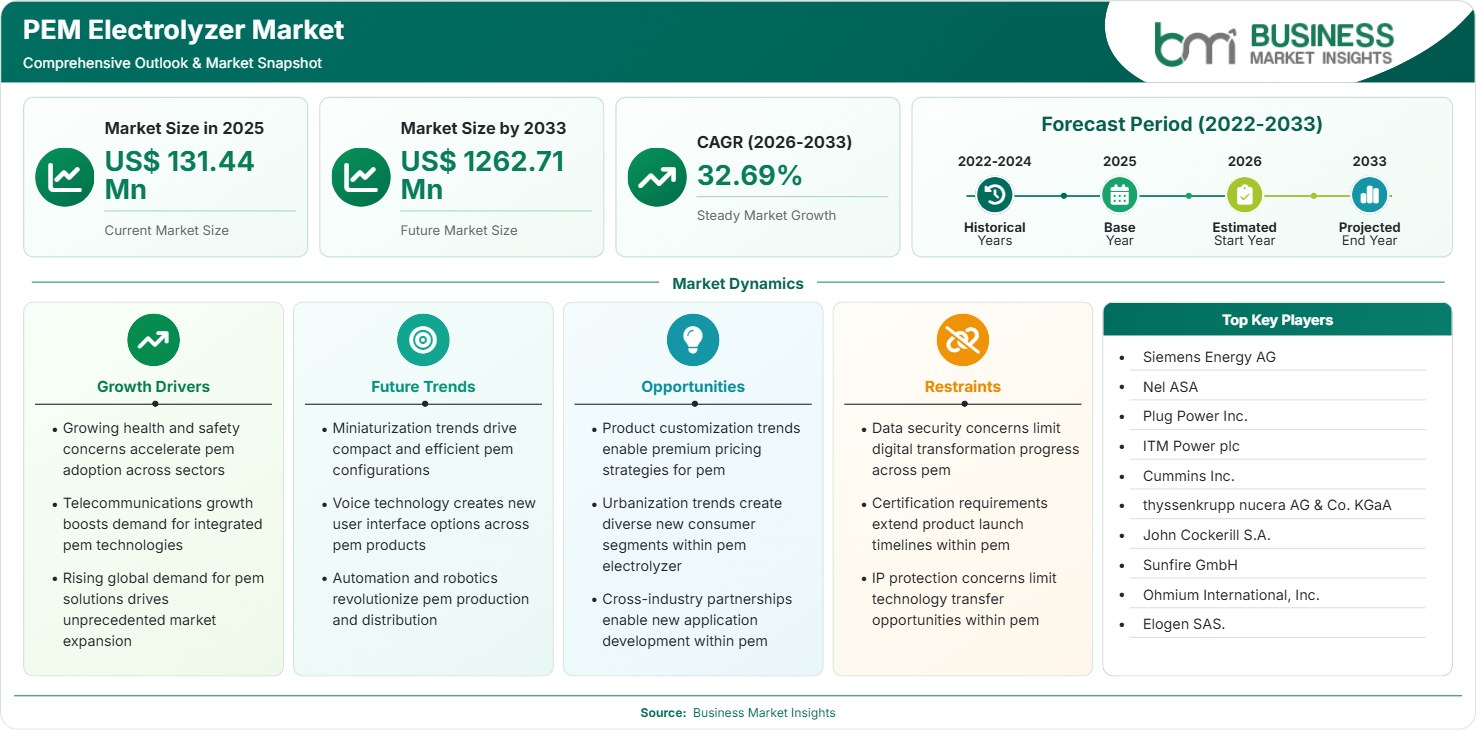
The PEM Electrolyzer Market size was valued at US$ 131.44 Million in 2025 and is projected to reach US$ 1262.71 Million by 2033, growing at a CAGR of 32.69% during 2026–2033. Key drivers include green hydrogen investments, industrial decarbonization mandates, renewable integration, declining electrolyzer costs, and strategic capacity expansions. Opportunities are supported by energy storage applications, hydrogen mobility, and emerging export-oriented hydrogen hubs.

Report Coverage
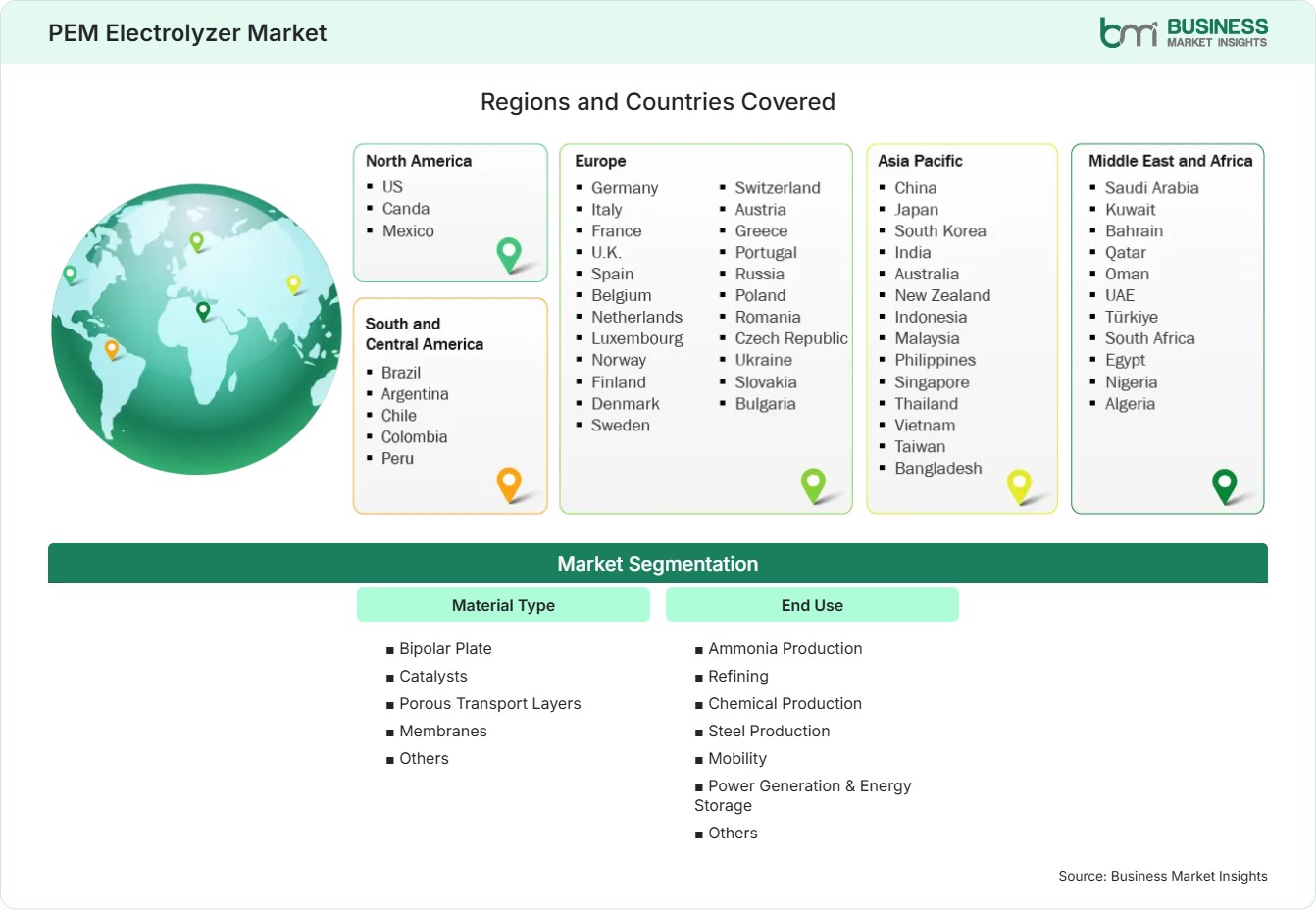
  • Material Type: Bipolar Plate, Catalysts, Porous Transport Layers, Membranes, Others
  • End Use: Ammonia Production, Refining, Chemical Production, Steel Production, Mobility, Power Generation & Energy Storage, Others
US$ 131.44 Mn Market size in 2025
US$ 1262.71 Mn Market Size by 2033
32.69% CAGR, 2026 - 2033
2026-2033 Forecast Period

AI Overview

PEM Electrolyzer Market Summary

  • North America Region: Holds a market share of 34%–37% in 2025, growing at a CAGR of 31%–34% during 2026–2033. Growth is supported by hydrogen tax incentives, industrial decarbonization projects, renewable energy deployment, manufacturing localization, infrastructure investment, utility participation, export ambitions, and large-scale electrolyzer procurement programs. US market benefits from federal hydrogen incentives, accelerating clean-energy deployment and growing at approximately 31%–34% CAGR.
  • Fastest Growing Region: Asia Pacific holds a market share of 25%–28% in 2025, growing at a CAGR of 35%–38% during 2026–2033. Expansion is driven by green hydrogen strategies, electrolysis manufacturing investments, renewable capacity additions, industrial demand, energy security priorities, public funding mechanisms, export opportunities, and large-scale demonstration facilities.
  • Leading Segment: Catalysts account for 31%–34% share in 2025 and expand at 31%–34% CAGR. Demand benefits from efficiency improvements, higher current density operation, durability optimization, precious-metal innovation, stack performance enhancement, commercialization efforts, investment programs, and scaling of hydrogen production capacity.
  • High Growth Segment: Steel Production holds 12%–15% share in 2025 and records 36%–39% CAGR. Expansion is supported by low-carbon steel initiatives, emissions targets, hydrogen-reduction technologies, industrial decarbonization funding, renewable hydrogen availability, pilot deployments, technology validation, and production-scale transformation projects.
  • Key Market Opportunity: Utility-scale green hydrogen ecosystems linked with renewable generation, energy storage, industrial clusters, transportation applications, export infrastructure, and government-backed hydrogen corridors are creating long-term commercial deployment pathways across multiple regions.
  • Major Market Players: Siemens Energy AG, Nel ASA, Plug Power Inc., ITM Power plc, Cummins Inc., thyssenkrupp nucera AG & Co. KGaA, John Cockerill S.A., Sunfire GmbH, Ohmium International, Inc., Elogen SAS.
Strategic Insights

PEM Electrolyzer Market: Strategic Insights

PEM Electrolyzer Market Strategic Framework
FREE PDF
Request your free sample
Request free sample
Stakeholder View

Key Takeaways

  • The ecosystem increasingly integrates catalyst suppliers, membrane manufacturers, stack producers, EPC partners, and hydrogen offtakers, creating vertically coordinated value chains.
  • Steelmaking, ammonia, and long-duration energy storage applications offer the strongest incremental demand potential as decarbonization targets tighten globally.
  • R&D priorities are shifting toward iridium reduction, higher efficiency stacks, longer operating life, modular deployment, and digital system optimization.
  • Asia Pacific presents a compelling investment case due to manufacturing scale-up, renewable energy expansion, and government-backed hydrogen roadmaps.
  • Strategic partnerships, project financing arrangements, and technology collaborations continue influencing competitive positioning more than standalone equipment sales.
  • Localization of critical component manufacturing is emerging as a differentiating factor for supply-chain resilience and cost competitiveness.
Geographic Outlook

PEM Electrolyzer Market Regional Highlights

North America PEM Electrolyzer Market

North America represents approximately 34%–37% of global demand in 2025 and is projected to record a CAGR of 31%–34% through 2033. Strong policy support, renewable integration initiatives, and industrial decarbonization programs sustain adoption. The region leads deployment of commercial hydrogen projects and attracts substantial investment in manufacturing facilities. PEM Electrolyzer Market share remains strengthened by utility participation, clean-energy incentives, and strategic hydrogen infrastructure development supporting long-term commercialization.

  • Federal hydrogen incentives continue improving project economics across industrial and energy applications.
  • Utility-backed hydrogen projects support grid balancing and renewable integration objectives.
  • Manufacturing investments strengthen domestic supply chains for key electrolysis components.
  • Industrial clusters accelerate deployment within refining, chemicals, and transportation sectors.

US PEM Electrolyzer Market

The United States contributes around 72% to 76% of regional demand, with a growth rate of 31% to 34%. Programs funded by the federal government, hydrogen hubs, and renewable energy will help with commercialization. Large industrial installations will continue to improve technology uptake. Corporate commitment and investment in green hydrogen production will boost the market environment while encouraging capacity additions and technological innovation.

  • Hydrogen hub initiatives support development of integrated production and consumption ecosystems.
  • Renewable generation growth creates favorable conditions for electrolytic hydrogen production.
  • Industrial decarbonization strategies increase participation from energy-intensive sectors.
  • Private-sector funding supports demonstration plants and commercial facility expansion.

Europe PEM Electrolyzer Market

Europe’s market share is estimated at 30%–33%, with the region anticipated to see CAGR at 32%–35% through 2033. Strong climate targets, renewables, and policies on hydrogen development drive growth in market demand. Germany is the dominant market player in the region, while Spain shows robust growth. Investments in regional manufacturing and hydrogen corridors further strengthen commercialization efforts. The PEM Electrolyzer Market growth in Europe is driven by regulation and industrial transformation.

  • Germany leads deployment through industrial decarbonization and hydrogen infrastructure investments.
  • Spain emerges as a high-growth market supported by renewable-energy resources.
  • EU funding mechanisms strengthen project financing and commercialization pathways.
  • Industrial hydrogen demand from chemicals and steel sectors continues expanding.

Asia Pacific PEM Electrolyzer Market

The Asia-Pacific region has a 25%-28% market share in 2025 and also shows the highest CAGR of 35%-38% in 2033. The region is headed by China because of its manufacturing capability and investments in green energy technologies. India shows great potential for growth because of its hydrogen programs. Rapid industrialization, energy security priorities, and export-oriented hydrogen strategies contribute to demand growth and infrastructure expansion across the region.

  • China strengthens manufacturing leadership through large-scale production investments.
  • India accelerates deployment through green hydrogen missions and industrial projects.
  • Renewable energy additions improve economics for power-to-hydrogen applications.
  • Export-focused hydrogen strategies enhance long-term investment attractiveness.
  • Strategic partnerships encourage technology transfer and commercialization.

Rest of World PEM Electrolyzer Market

The Rest of World region accounts for 9% to 12% of market share and grows at a 33% to 36% CAGR through 2033. The Middle East is blessed with renewable energy sources and aspirations to export them. South and Central America can leverage their renewable energy potential to produce green hydrogen. Leading countries, including Saudi Arabia and Brazil, demonstrate strong growth prospects through industrial and energy-sector applications.

  • Gulf countries invest in export-oriented hydrogen production infrastructure.
  • Brazil advances renewable-powered electrolysis opportunities and industrial adoption.
  • International partnerships support project financing and technology deployment.
  • Growing export demand improves business cases for large-scale facilities.
  • Energy diversification strategies increase government support across emerging markets.
Global Market Geography
FREE PDF
Request your free sample
Request free sample
Segment Analysis

PEM Electrolyzer Market Segmentation

Material Type

Material Type is estimated to hold around 58%-61% market share in 2025 and to grow at a 31%-34% CAGR. The scope of the PEM Electrolyzer Market is further expanding owing to technological advancements, including improved efficiency, effectiveness, and longevity through materials. Supply-chain localization, cost-reduction efforts, and increased production volumes support adoption in commercial applications.

  • Bipolar Plate: Essential for current distribution and operational durability, with ongoing material advancements improving conductivity, corrosion resistance, and stack longevity across industrial-scale installations.
  • Catalysts: Largest component category benefiting from performance requirements and ongoing efforts to reduce precious-metal intensity while maintaining efficiency and operating stability.
  • Porous Transport Layers: Support gas diffusion and water management, enabling higher operational efficiency and performance in demanding electrolysis environments.
  • Membranes: Critical to system efficiency and proton conductivity, driving continuous innovation focused on durability and reduced operating costs.

End Use

The end-use application holds the major demand driver, fueled by industrial decarbonization and hydrogen usage. The PEM Electrolyzer Market trends highlight growing penetration in heavy-duty energy industries. This market segment holds a share of about 39%–42% in 2025 and is set to grow at a 33%–36% CAGR during the forecast period.

  • Ammonia Production: Green hydrogen integration supports low-carbon fertilizer manufacturing and helps producers address sustainability requirements and emissions targets.
  • Refining: Hydrogen demand within desulfurization and refinery operations drives ongoing interest in renewable hydrogen alternatives.
  • Chemical Production: Chemical producers adopt green hydrogen to reduce emissions and improve sustainability credentials across production processes.
  • Steel Production: Rising investment in direct-reduced iron pathways supports significant long-term hydrogen demand potential.
  • Mobility: Fuel-cell transportation adoption encourages deployment across heavy-duty vehicles, buses, and logistics applications.
  • Power Generation & Energy Storage: Electrolytic hydrogen provides flexibility for renewable integration, seasonal storage, and grid-balancing requirements.
Market Forces

PEM Electrolyzer Market Dynamics

Key Market Drivers

Industrial Decarbonization Commitments Accelerating Adoption

Sectors such as refining, chemicals, ammonia, and steel manufacturing face growing pressure to reduce emissions. Governments are still rolling out climate goals aligned with more comprehensive net-zero pathways, whereas companies are making decarbonization pledges. Green hydrogen produced via electrolysis can serve as an alternative to fossil-fuel hydrogen in industrial applications. Carbon pricing and sustainability reporting systems add value from the business standpoint. It results in better project pipelines and adoption of electrolysis solutions.

Expansion of Renewable Energy Capacity

The rapid deployment of solar and wind capacity is essential to enhancing the availability of affordable electricity needed for hydrogen production. Higher levels of renewable power integration will enable the use of surplus power for electrolysis. More project developers are incorporating renewables into hydrogen operations to enhance economic performance. The grid operators have also come to appreciate the role of hydrogen in balancing variable power output. All these factors boost the prospects for growth in the PEM Electrolyzer Market.

Supportive Hydrogen Policies and Incentives

The national hydrogen policies, production incentives, financing, and investment programs are continuously propelling progress. Countries have adopted initiatives to build their hydrogen industries and improve their energy security. Government funding helps mitigate initial project risks and encourages the localization of manufacturing processes. Investments in strategic infrastructure will help ensure the preparedness of the supply chain and market. The implementation of such policies will foster the development of projects and technologies.

Key Market Opportunities

Hydrogen-Based Low-Carbon Steel Production

More and more steel producers are considering hydrogen-based processes to cut their emissions intensity. The rise in investment in demonstration and commercial plants is creating new opportunities for demand. With the tightening of environmental regulations, the use of hydrogen could spread from pilot-scale applications to industrial-scale applications. According to the PEM Electrolyzer Market Forecasts, investment is increasing in the green steel value chain, renewable energy, and hydrogen infrastructure. This is a great opportunity for revenue for technology vendors and project developers.

Utility-Scale Energy Storage Integration

The long-term storage capacity of hydrogen opens possibilities that extend beyond its industrial use. Power-to-hydrogen is being tested by utilities as a way to achieve grid stability and integrate renewables, with seasonal storage. Increased renewable generation capacity is fueling greater interest in storage technologies to address intermittency. Electrolysis technologies positioned within integrated energy systems may benefit from evolving grid requirements and broader clean-energy transition strategies.

Emerging Export-Oriented Hydrogen Hubs

Nations with abundant renewable resources are building hydrogen facilities in large numbers for export. Such projects would require substantial electrolysis capacity and other investments. Cooperation between power utilities, governments, technologists, and industrial users can increase the possibility of such projects. Long-term purchase contracts and international business programs will drive development and create many opportunities for equipment suppliers.

Market Restraints and Challenges

High Capital Costs and Project Economics

Factor: Electrolysis facilities require substantial capital investments in electrolyzer stacks, power electronics, renewable energy integration systems, hydrogen storage, and supporting infrastructure. The cost-intensive nature of these projects is particularly challenging in regions where financing mechanisms and policy support remain limited. Impact: Elevated capital expenditure continues to be a major barrier to large-scale deployment, often delaying project approvals and investment decisions. Developers in cost-sensitive markets may struggle to justify project economics, especially when competing against conventional hydrogen production methods. Although technological advancements and manufacturing scale are gradually reducing equipment costs, many projects still rely on subsidies, grants, or favorable financing arrangements to achieve economic viability. In addition, fluctuations in electricity prices can significantly impact operating expenses and overall project competitiveness, making cost reduction a critical requirement for widespread commercialization.

Critical Material Supply Constraints

Factor: Several electrolysis technologies rely on specialized and scarce materials, including iridium-based catalysts and advanced membrane components, which are essential for system performance and efficiency. The availability of these materials is constrained by concentrated supply chains and limited global production capacity. Impact: Dependence on critical materials exposes manufacturers and project developers to supply shortages, procurement risks, and price volatility, which can negatively affect production economics and deployment timelines. As electrolyzer installations continue to expand globally, increasing demand for these materials is expected to place further pressure on existing supply chains. This may limit manufacturing scalability and slow project execution, particularly for large-scale installations. While industry participants are investing in catalyst optimization, material recycling programs, and alternative technology pathways to reduce reliance on scarce resources, supply-chain constraints remain a significant challenge that could hinder long-term market expansion and commercialization efforts.

Company Analysis

Competitive Landscape

The PEM Electrolyzer Market analysis highlights increasing competition focused on scale, efficiency, localization, and strategic partnerships.

Company Name

Overview

Products and Services relevant to this market

Siemens Energy AG

Global energy technology company with strong hydrogen project participation and industrial partnerships.

PEM electrolyzer systems, hydrogen solutions, energy integration services.

Nel ASA

Specialized hydrogen technology provider with global electrolysis deployment experience.

PEM electrolyzers, hydrogen fueling technologies, engineering services.

Plug Power Inc.

Hydrogen ecosystem developer serving industrial and mobility sectors.

PEM electrolyzers, fueling systems, hydrogen generation solutions.

ITM Power plc

UK-based specialist focused on electrolysis innovation and scale-up.

PEM stacks, electrolyzer units, integrated hydrogen systems.

Cummins Inc.

Industrial technology leader active through hydrogen and fuel-cell operations.

PEM electrolyzers, hydrogen generation infrastructure, engineering support.

thyssenkrupp nucera AG & Co. KGaA

Large-scale electrolysis provider focused on industrial applications.

Electrolysis plants, hydrogen production systems, project services.

John Cockerill S.A.

Engineering company expanding presence in hydrogen technologies.

Electrolyzer equipment, project integration, industrial hydrogen solutions.

Sunfire GmbH

Hydrogen technology developer targeting decarbonization markets.

Electrolysis systems, industrial hydrogen technologies.

Ohmium International, Inc.

Modular electrolyzer supplier focused on scalable deployment.

PEM electrolyzer modules, hydrogen production solutions.

Elogen SAS

French electrolyzer manufacturer serving clean hydrogen projects.

PEM electrolyzers, stack technologies, hydrogen systems.

Trust & Transparency

Research Methodology

The market analysis combines proprietary research with secondary data from government agencies, company disclosures, regulatory filings, industry databases and expert interviews. Market estimates are validated through data triangulation, cross-market benchmarking and analyst review.

View Full Research Methodology

Questions Answered

Frequently Asked Questions

What does the PEM Electrolyzer Market Report evaluate?

The Market Report evaluates technology developments, regional demand patterns, competitive positioning, end-use adoption, investment activity, and future growth opportunities across the value chain.

Which region offers the strongest investment potential?

Asia Pacific presents a compelling opportunity due to manufacturing expansion, policy support, renewable energy growth, and increasing industrial hydrogen requirements.

How does PEM technology differ from other electrolysis technologies?

PEM systems provide rapid response, compact design, and compatibility with variable renewable energy sources, making them suitable for dynamic operating environments.

Which end-use industry offers the strongest future demand potential?

Steel production is expected to generate significant long-term demand as hydrogen-based reduction technologies gain commercial acceptance and emissions regulations tighten.

What factors are accelerating adoption of PEM electrolyzers?

Government incentives, renewable-energy expansion, industrial decarbonization goals, and growing demand for green hydrogen are the primary factors improving deployment economics and commercial adoption.

Access the Full PEM Electrolyzer Market Report

Get segment-level forecasts, regional estimates, competitive benchmarking, company profiles and downloadable Excel datasets.

Access the full PEM Electrolyzer Market Report
350 pages PDF & Excel | 2026-08-31
Similar Research

Related Market Reports