
Decarbonization Market Outlook: Size, Share, Trends, Growth Analysis, Competitive Landscape & Forecast, 2026-2033

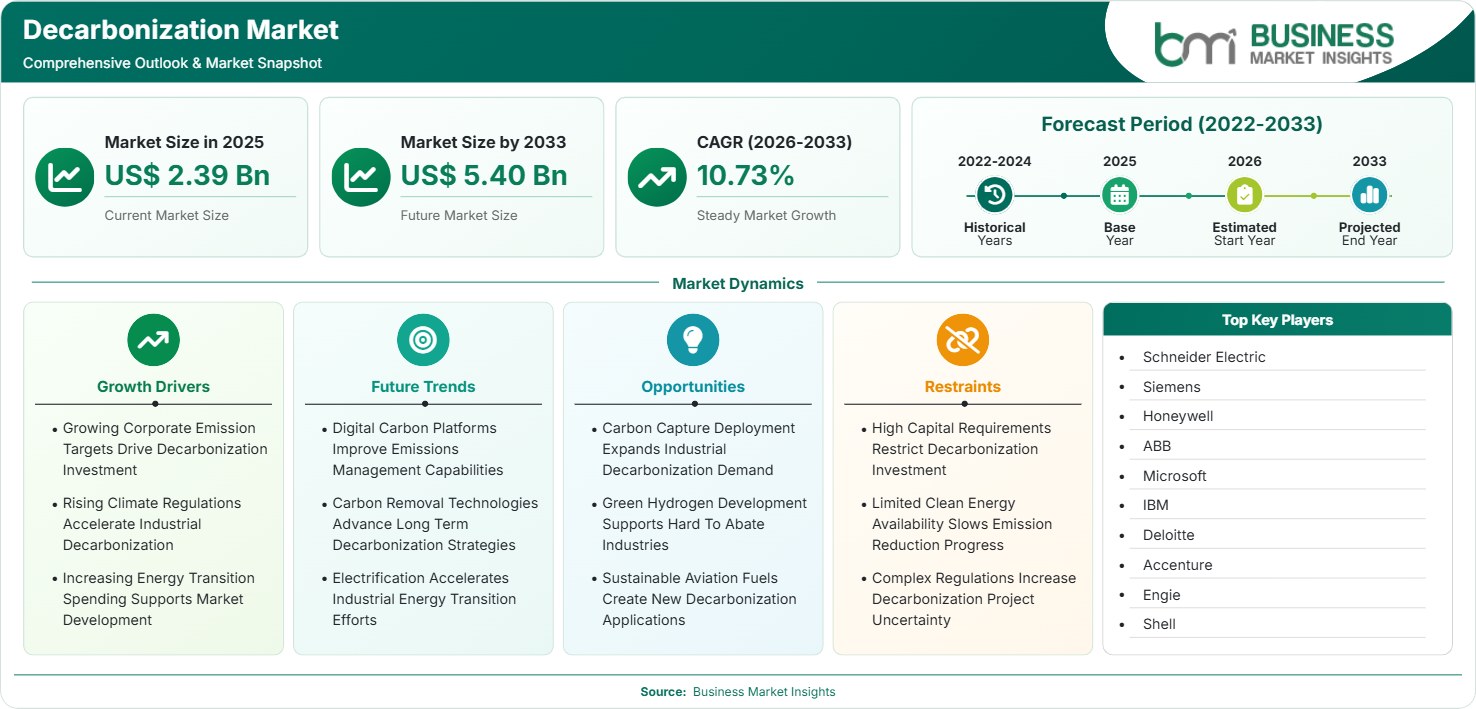
The Decarbonization Market size was valued at US$ 2.39 billion in 2025 and is projected to reach US$ 5.40 billion by 2033, growing at a CAGR of 10.73% during 2026–2033. Increasing corporate emission targets, climate regulations, energy transition investments, carbon management initiatives, and sustainable technology adoption are creating opportunities across industrial, commercial, and energy sectors.

Report Coverage
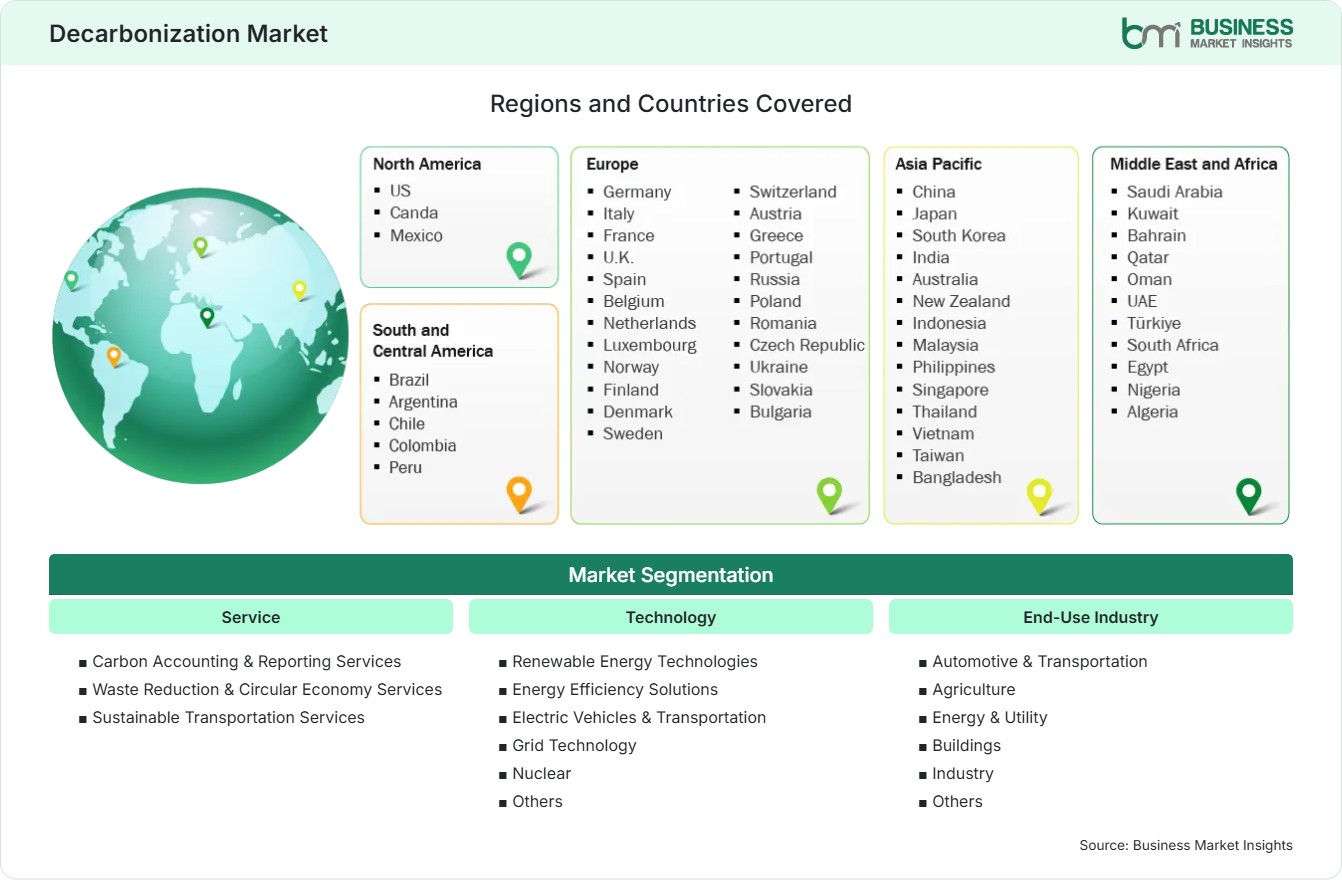
  • Service: Carbon Accounting & Reporting Services, Waste Reduction & Circular Economy Services, Sustainable Transportation Services
  • Technology: Renewable Energy Technologies, Energy Efficiency Solutions, Electric Vehicles & Transportation, Grid Technology, Nuclear, Others
  • End-Use Industry: Automotive & Transportation, Agriculture, Energy & Utility, Buildings, Industry, Others
US$ 2.39 Bn Market size in 2025
US$ 5.40 Bn Market Size by 2033
10.73% CAGR, 2026 - 2033
2026-2033 Forecast Period

01 AI Overview

Decarbonization Market Summary

  • North America Region: North America holds a prominent position with a share ranging between 34%–37% in 2025 and is projected to grow at a CAGR of 10.0%–10.6% during 2026–2033. The region benefits from corporate sustainability commitments, clean energy deployment, industrial emission reduction programs, and digital carbon management adoption. The United States remains a major contributor due to renewable energy investments, corporate climate strategies, and low-carbon technology development. The U.S. market is projected to grow at a CAGR of 10.2%–10.8% through 2033.
  • Fastest Growing Region: Asia Pacific represents the fastest-growing region with a share ranging between 28%–31% in 2025 and is expected to expand at a CAGR of 11.2%–11.8% during 2026–2033. Industrial transformation, renewable energy expansion, government sustainability initiatives, and growing adoption of emission monitoring solutions are accelerating market development.
  • Leading Segment: Renewable Energy Technologies represent the leading technology segment with a share ranging between 30%–33% in 2025 and are projected to grow at a CAGR of 10.5%–11.1% through 2033. Increasing investments in solar, wind, clean power systems, and energy transition projects support segment expansion.
  • High Growth Segment: Carbon Accounting & Reporting Services represent a high-growth service segment with a share ranging between 22%–25% in 2025 and are expected to grow at a CAGR of 11.5%–12.1%. Increasing reporting obligations, sustainability disclosures, and corporate emissions tracking requirements are supporting adoption.
  • Key Market Opportunity: Carbon capture, green hydrogen, sustainable fuels, renewable technologies, and digital emissions management solutions are creating opportunities for companies developing integrated decarbonization strategies across hard-to-abate industries.
  • Major Market Players: Schneider Electric, Siemens, Honeywell, ABB, Microsoft, IBM, Deloitte, Accenture, Engie, and Shell.
02 Strategic Insights

Decarbonization Market: Strategic Insights

Decarbonization Market Strategic Framework
FREE PDF
Request your free sample
Request free sample
03 Stakeholder View

Key Takeaways

  • The Decarbonization Market ecosystems are expanding through collaboration between technology providers, energy companies, consultants, and industrial users developing integrated emission reduction strategies.
  • Renewable energy, carbon management services, sustainable transportation, and energy efficiency solutions represent important growth areas as organizations pursue long-term climate objectives.
  • Technology innovation is focused on digital emissions monitoring, artificial intelligence-based sustainability platforms, advanced energy systems, and solutions designed for complex industrial applications.
  • Asia Pacific provides significant investment potential due to industrial expansion, increasing renewable energy deployment, and growing government commitment toward cleaner economic development.
  • Strategic partnerships and acquisitions among technology firms, consulting organizations, and energy companies are improving solution capabilities and accelerating market adoption.
  • Organizations are increasingly prioritizing measurable sustainability outcomes, encouraging demand for platforms and services that support carbon reduction planning and implementation.
04 Geographic Outlook

Decarbonization Market Regional Highlights

North America Decarbonization Market

North America accounted for approximately 34%–37% of global revenue in 2025 and is expected to expand at a CAGR of 10.0%–10.6% through 2033. The region benefits from established renewable energy infrastructure, corporate climate commitments, government support programs, and industrial sustainability investments. The Decarbonization Market share in North America is strengthened by adoption across energy, manufacturing, transportation, and commercial sectors seeking emission reduction solutions.

  • The United States remains the largest regional contributor due to strong corporate sustainability programs, renewable energy investments, and industrial transition initiatives.
  • Organizations are deploying carbon accounting platforms to improve emissions measurement, reporting accuracy, and sustainability planning.
  • Energy providers are expanding clean energy portfolios to support changing consumer and industrial requirements.
  • Industrial companies are implementing efficiency solutions to reduce energy consumption and improve environmental performance.

US Decarbonization Market

The United States represents the leading contributor within North America, supported by corporate climate commitments, renewable energy development, and increasing adoption of sustainability technologies. The market is projected to grow at a CAGR of 10.2%–10.8% through 2033 as organizations invest in solutions supporting emission reduction goals. Increasing demand for measurable sustainability performance is strengthening technology adoption.

  • Companies are increasing investments in carbon monitoring and reporting systems to improve environmental transparency.
  • Energy organizations are expanding renewable generation and low-carbon technology deployment.
  • Industrial facilities are adopting efficiency solutions to optimize energy usage and reduce emissions.

Europe Decarbonization Market

Europe represented approximately 27%–30% of global revenue in 2025 and is projected to grow at a CAGR of 10.3%–10.9% through 2033. The region benefits from strong climate policies, industrial sustainability initiatives, and ambitious renewable energy targets. Germany leads regional adoption, while the United Kingdom and France are expanding investments in clean technologies and emission reduction programs.

  • Germany maintains a strong position through industrial decarbonization projects and renewable energy integration.
  • The United Kingdom is supporting carbon management initiatives and clean energy investments.
  • France is expanding sustainable technology adoption across industrial and energy sectors.
  • Regulatory frameworks are encouraging companies to improve emissions management capabilities.

Asia Pacific Decarbonization Market

Asia Pacific accounted for approximately 28%–31% of global revenue in 2025 and is expected to register the fastest CAGR of 11.2%–11.8% through 2033. The region is supported by industrial growth, renewable energy expansion, infrastructure modernization, and increasing sustainability commitments. China leads regional adoption, while India, Japan, and South Korea are advancing clean technology investments.

  • China is expanding renewable energy capacity and industrial emission reduction initiatives across major sectors.
  • India is increasing investments in sustainable infrastructure, clean energy projects, and efficiency improvement programs.
  • Japan is developing advanced energy transition technologies supporting industrial sustainability goals.
  • South Korea is investing in hydrogen, renewable energy, and low-carbon industrial solutions.

Rest of World Decarbonization Market

Rest of World regions contribute approximately 5%–8% of global revenue in 2025 and are projected to grow at a CAGR of 10.5%–11.1% through 2033. Middle Eastern, Latin American, and African markets are increasingly adopting decarbonization solutions through renewable energy expansion, industrial modernization, and sustainability initiatives. Growing focus on energy diversification is creating opportunities for technology providers.

  • Middle Eastern countries are investing in renewable energy, hydrogen development, and industrial emission reduction projects.
  • Latin American markets are expanding clean energy deployment and sustainable infrastructure development.
  • African economies are exploring renewable solutions to improve energy access and sustainability outcomes.
  • Industrial modernization programs are increasing demand for technologies supporting measurable carbon reduction.
Global Market Geography
FREE PDF
Request your free sample
Request free sample
05 Segment Analysis

Decarbonization Market Segmentation

Service

The Service segment plays a critical role in enabling organizations to measure emissions, improve sustainability performance, and implement reduction strategies. Demand is increasing as businesses require structured approaches for environmental reporting, operational efficiency, and circular economy implementation. The segment benefits from rising compliance requirements and corporate climate commitments. The Decarbonization Market scope is expanding through professional services supporting carbon management and sustainable business transformation.

  • Carbon Accounting & Reporting Services: These services support organizations in tracking emissions, preparing sustainability disclosures, and improving transparency through structured carbon measurement frameworks.
  • Waste Reduction & Circular Economy Services: Solutions focus on minimizing waste generation, improving resource utilization, and enabling sustainable production models across industrial and commercial sectors.
  • Sustainable Transportation Services: These services assist organizations in reducing transport-related emissions through fleet optimization, alternative fuels, and cleaner mobility strategies.

Technology

The Technology segment represents a major growth area as organizations adopt advanced solutions to reduce emissions and improve energy efficiency. Renewable energy technologies, electric mobility, grid modernization, and energy optimization systems are becoming essential components of transition strategies. The Decarbonization Market trend reflects increasing integration of digital technologies with clean energy solutions to improve sustainability outcomes and operational performance.

  • Renewable Energy Technologies: Renewable solutions enable organizations to replace conventional energy sources with cleaner alternatives, supporting emission reduction and energy transition objectives.
  • Energy Efficiency Solutions: These technologies improve energy utilization through advanced monitoring, automation, and optimization systems across buildings and industrial facilities.
  • Electric Vehicles (EVs) & Transportation: EV technologies support transportation decarbonization by reducing dependence on fossil fuels and enabling cleaner mobility ecosystems.
  • Grid Technology: Advanced grid solutions improve renewable energy integration, electricity management, and reliability within evolving energy networks.
  • Nuclear: Nuclear technologies contribute to low-carbon energy generation by providing stable power with reduced operational emissions compared with conventional sources.

End-Use Industry

The End-Use Industry segment includes sectors implementing emission reduction strategies through technology adoption, operational improvements, and sustainable practices. Industries are investing in cleaner energy systems, efficiency solutions, and carbon management platforms to meet environmental objectives. The Decarbonization Market analysis highlights increasing adoption across transportation, energy, manufacturing, and commercial sectors seeking long-term sustainability improvements.

  • Automotive & Transportation: The sector is adopting electric mobility, alternative fuels, and efficiency solutions to reduce transportation-related emissions and improve sustainability.
  • Agriculture: Agricultural organizations are implementing sustainable practices, resource optimization, and emission monitoring solutions to reduce environmental impact.
  • Energy & Utility: Energy providers are investing in renewable generation, grid modernization, and carbon reduction technologies to support energy transition goals.
  • Buildings: Building operators are adopting energy management systems, efficient technologies, and sustainable infrastructure solutions to lower operational emissions.
  • Industry: Industrial organizations are deploying decarbonization technologies to improve efficiency, reduce process emissions, and support cleaner manufacturing operations.
06 Market Forces

Decarbonization Market Dynamics

Key Market Drivers

Growing Corporate Emission Targets Drive Decarbonization Investment

Corporate sustainability commitments are becoming a major driver as organizations establish emission reduction goals and invest in solutions that support measurable progress. Companies are adopting carbon management platforms, renewable energy systems, and efficiency technologies to align operations with environmental objectives. Increasing stakeholder expectations and sustainability reporting requirements are encouraging businesses to develop structured climate strategies. The Decarbonization Market growth is supported by rising demand for solutions that enable organizations to monitor emissions, improve resource utilization, and implement long-term reduction plans. Technology providers are focusing on integrated platforms that combine data analytics, reporting capabilities, and operational insights.

Rising Climate Regulations Accelerate Industrial Decarbonization

With increased regulations related to climate change, companies are becoming more inclined to adopt technologies to reduce their emissions and strengthen their environmental compliance efforts. There has been an increasing number of policies implemented by governments around the world to promote the use of renewables, reduce carbon emissions, and develop industry sustainably. This is affecting how investments are made in areas such as manufacturing, transport, and utilities. Organizations are implementing carbon accounting tools and renewable energy initiatives to comply with new regulations. This is creating a need for products that deliver environmental benefits while remaining efficient.

Increasing Energy Transition Spending Supports Market Development

With rising funding for energy transition programs, the deployment of technologies enabling low-carbon practices is gaining momentum. Public and private bodies have begun investing more in renewable energy, grid modernization, and sustainable infrastructure projects. Such investments have increased the need for technologies that enhance energy efficiency and help make processes cleaner. Businesses have begun to integrate digital solutions with energy management systems to optimize energy consumption. Energy transition programs in the industrial and commercial sectors provide more business opportunities to technology companies.

Key Market Opportunities

Carbon Capture Deployment Expands Industrial Decarbonization Demand

The rise in implementation of carbon capture technologies presents opportunities to firms providing solutions that will help industries reduce their emissions. Some industries whose processes produce emissions are considering implementing carbon capture to ensure they meet their sustainability goals without compromising production. Technologies such as monitoring, storage, and carbon management have become important in this respect. Investment in carbon capture systems is likely to present further opportunities for technology firms, engineering firms, and other service providers. Greater emphasis on reducing unavoidable emissions is boosting demand for a combination of capture, measurement, and management systems.

Green Hydrogen Development Supports Hard To Abate Industries

Green hydrogen development is creating new opportunities for decarbonization solutions across sectors where direct electrification remains challenging. Industries such as steel, chemicals, shipping, and heavy transportation are exploring hydrogen-based pathways to reduce emissions. Expanding renewable energy capacity and improving hydrogen production technologies are supporting broader adoption. Companies developing hydrogen infrastructure, storage systems, and integration solutions are positioned to benefit from increasing investment. The Decarbonization Market forecast indicates continued opportunities as industries pursue alternative energy sources and develop strategies for reducing carbon-intensive processes.

Sustainable Aviation Fuels Create New Decarbonization Applications

Advances in sustainable aviation fuels have created opportunities for technologies to reduce aviation emissions. Airlines, fuel companies, and even governments are now investing in alternative fuel production methods to reduce carbon emissions in the aviation industry. Decarbonization technologies that support fuel production and delivery, as well as emissions monitoring, have become increasingly relevant. With the increase in sustainability goals by transportation companies, there is growth in aviation technologies. This will be a growing opportunity space, as the aviation industry continues to find solutions to reducing their carbon footprint in order to remain connected worldwide.

Market Restraints and Challenges

High Capital Requirements Restrict Decarbonization Investment

Factor: Large upfront investments required for renewable infrastructure, carbon management systems, and industrial transition technologies can create financial barriers for organizations. Impact: High capital requirements can hinder the adoption of new technology in smaller firms and industries that lack adequate investment capital. Organizations are seeking ways to finance technology, enter into partnerships, and implement in phases. Nevertheless, costs remain an important factor in technology adoption, especially in developing countries with limited investment funds.

Limited Clean Energy Availability Slows Emission Reduction Progress

Factor: Insufficient availability of renewable energy infrastructure and clean power resources can restrict the implementation of decarbonization initiatives. Impact: It is possible that limited clean energy could delay the reduction of emissions, as well as any transitions into new technologies within industries that utilize a lot of energy. Businesses are focusing on improving their energy acquisition strategies, forming alliances, and exploring alternative options. Nevertheless, disparities in energy infrastructure development between regions still affect the speed of technology adoption.

07 Company Analysis

Competitive Landscape

The competitive landscape consists of technology providers, consulting organizations, energy companies, and digital solution developers focusing on sustainability transformation. The Decarbonization Market forecast is influenced by strategic investments in renewable technologies, carbon management platforms, energy efficiency solutions, and integrated sustainability services. Leading companies are strengthening capabilities through innovation, partnerships, and expansion into emerging decarbonization applications.

Company Name

Overview

Products and Services relevant to this market

Schneider Electric

Global energy management and automation company providing sustainability-focused solutions for businesses and infrastructure.

Energy efficiency solutions, digital sustainability platforms, carbon management tools, renewable energy integration, and industrial automation technologies.

Siemens

Technology company delivering industrial digitalization, automation, and energy transition solutions across global markets.

Smart energy systems, grid technologies, industrial efficiency solutions, digital monitoring platforms, and sustainable infrastructure solutions.

Honeywell

Industrial technology provider supporting energy transition, automation, and sustainability initiatives across multiple industries.

Emissions monitoring solutions, energy optimization technologies, carbon management systems, and industrial sustainability solutions.

ABB

Electrification and automation company focused on improving energy efficiency and sustainable industrial operations.

Renewable energy integration, grid technology solutions, electrification systems, automation platforms, and energy management technologies.

Microsoft

Technology company developing digital solutions supporting sustainability measurement and environmental initiatives.

Cloud-based sustainability platforms, carbon tracking solutions, artificial intelligence tools, and environmental data management technologies.

IBM

Technology and consulting company providing digital transformation and sustainability solutions.

Sustainability software platforms, environmental analytics, artificial intelligence solutions, and carbon management capabilities.

Deloitte

Global consulting organization supporting businesses with sustainability strategy and climate transformation services.

Carbon advisory services, sustainability reporting, climate risk assessment, and decarbonization strategy consulting.

Accenture

Consulting and technology services company helping organizations implement digital sustainability initiatives.

Sustainability consulting, emissions management solutions, digital transformation services, and energy transition strategies.

Engie

Energy company focused on renewable energy, energy efficiency, and low-carbon solutions.

Renewable energy projects, energy management services, low-carbon infrastructure, and sustainable energy solutions.

Shell

Global energy company investing in energy transition and lower-carbon technologies.

Renewable energy solutions, carbon management initiatives, hydrogen projects, and sustainable energy services.

10 Trust & Transparency

Research Methodology

The market analysis combines proprietary research with secondary data from government agencies, company disclosures, regulatory filings, industry databases and expert interviews. Market estimates are validated through data triangulation, cross-market benchmarking and analyst review.

View Full Research Methodology

11 Questions Answered

Frequently Asked Questions

What challenges affect the expansion of decarbonization solutions?

High investment requirements, infrastructure limitations, technology integration complexity, and clean energy availability challenges can influence adoption. Organizations are addressing these barriers through partnerships, innovation, and phased implementation approaches.

What industries are investing heavily in decarbonization?

Energy, industrial manufacturing, transportation, buildings, agriculture, and automotive sectors are investing in decarbonization solutions. These industries are adopting cleaner technologies and sustainability practices to reduce emissions and improve operational efficiency.

Which technologies are important for decarbonization strategies?

Renewable energy technologies, energy efficiency systems, carbon accounting platforms, electric mobility solutions, grid technologies, and carbon capture solutions are important components of decarbonization strategies. Organizations are combining multiple technologies to achieve measurable emission reductions.

How does the Decarbonization Market report support business decisions?

The report provides insights into technology adoption, industry applications, regional opportunities, competitive strategies, and emerging trends. It helps stakeholders understand investment areas and market developments influencing future sustainability initiatives.

What factors are increasing adoption of decarbonization solutions?

Growing climate commitments, regulatory requirements, renewable energy investments, and corporate sustainability goals are increasing demand for decarbonization solutions. Organizations are adopting technologies that support emission measurement, energy efficiency improvement, and long-term carbon reduction strategies.

Access the Full Decarbonization Market Report

Get segment-level forecasts, regional estimates, competitive benchmarking, company profiles and downloadable Excel datasets.

Access the full Decarbonization Market Report
350 pages PDF & Excel | 2026-08-07