
AI in Energy Market Outlook: Size, Share, Trends, Growth Analysis, Competitive Landscape & Forecast, 2026-2033

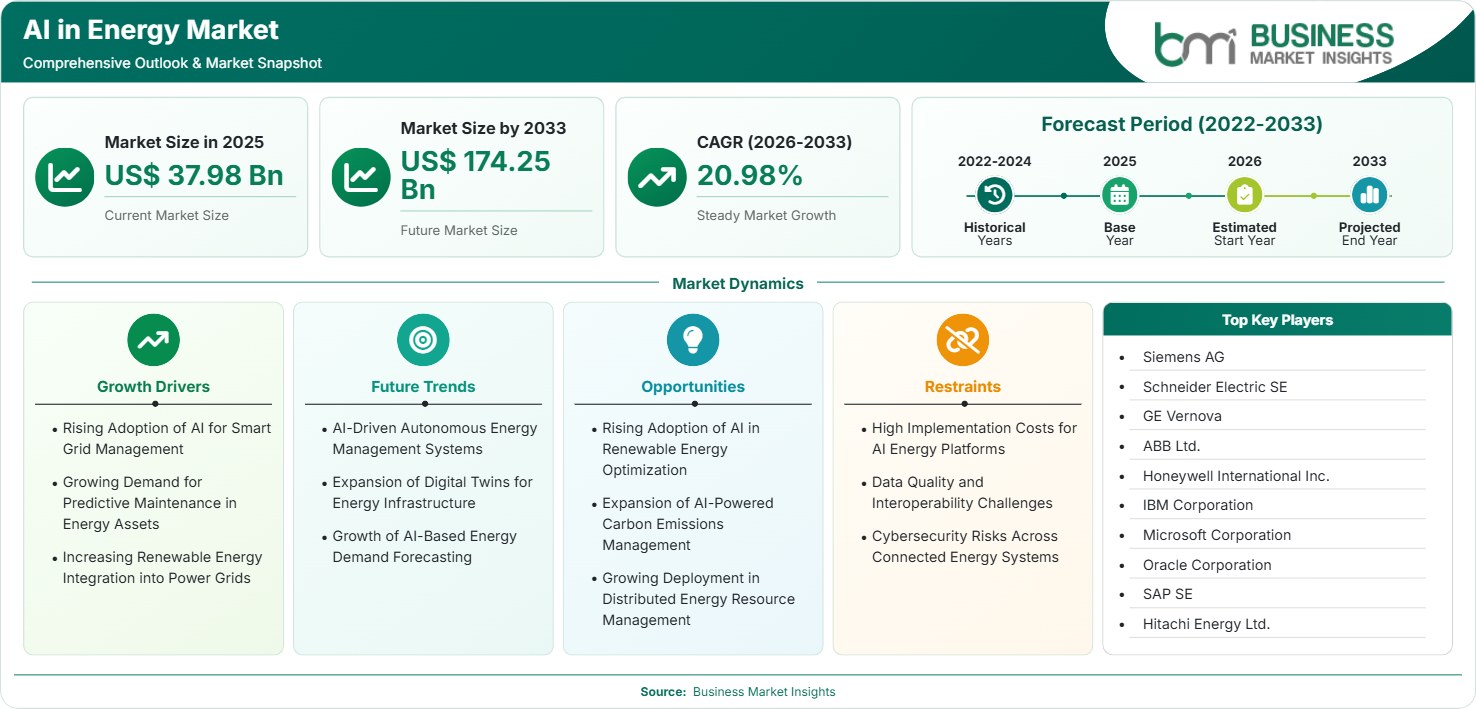
The AI in Energy Market size was valued at US$ 37.98 Billion in 2025 and is projected to reach US$ 174.25 Billion by 2033, growing at a CAGR of 20.98% during 2026–2033. Rising digitalization across energy infrastructure, growing demand for predictive asset management, increasing integration of renewable energy resources, and expanding deployment of intelligent grid management solutions are supporting market growth globally.

Report Coverage
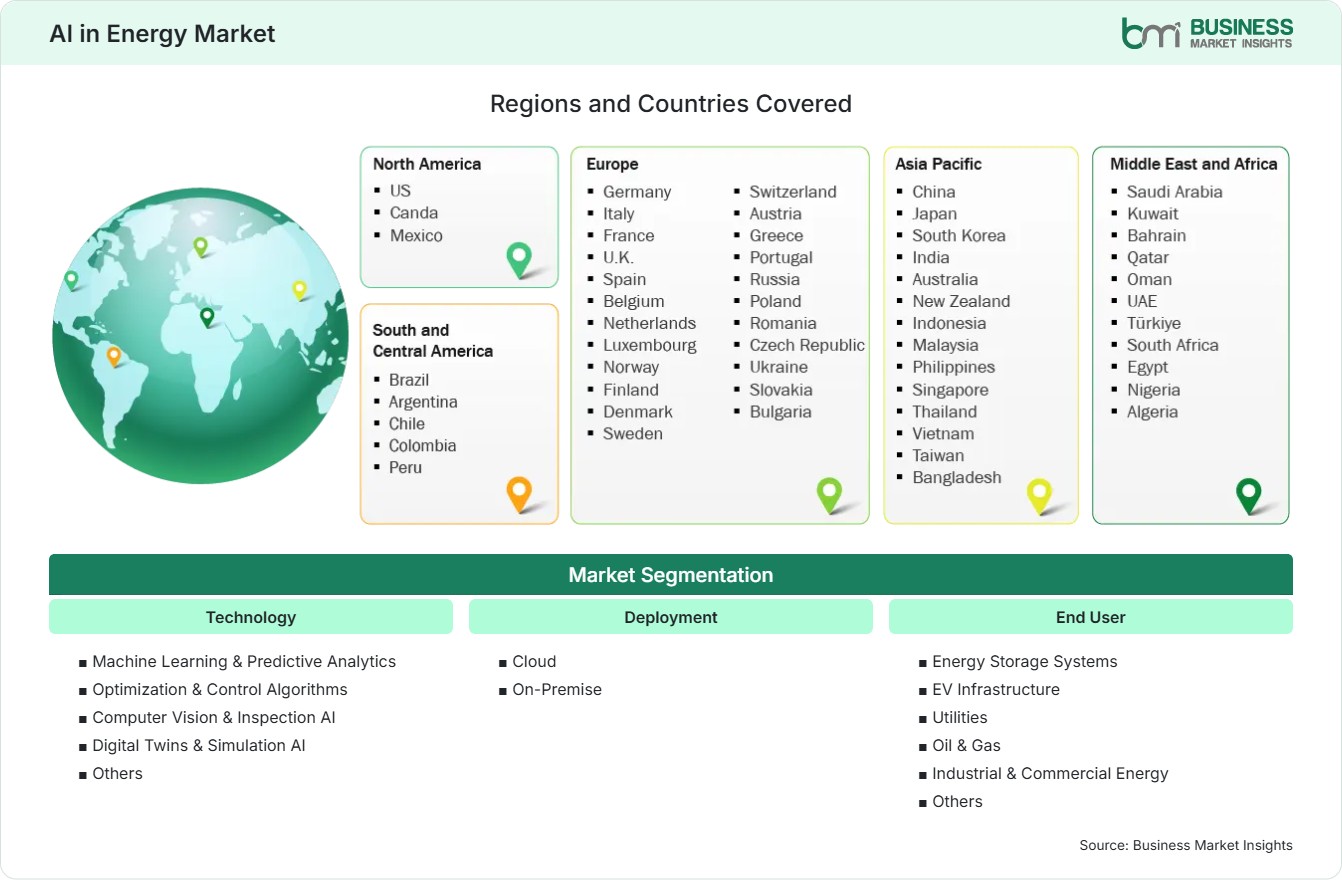
  • Technology: Machine Learning & Predictive Analytics, Optimization & Control Algorithms, Computer Vision & Inspection AI, Digital Twins & Simulation AI, Others
  • Deployment: Cloud, On-Premise
  • End User: Energy Storage Systems, EV Infrastructure, Utilities, Oil & Gas, Industrial & Commercial Energy, Others
US$ 37.98 Bn Market size in 2025
US$ 174.25 Bn Market Size by 2033
20.98% CAGR, 2026 - 2033
2026-2033 Forecast Period

01 AI Overview

AI in Energy Market Summary

  • North America Region: North America holds a AI in energy market share of 37%–40% in 2025, growing with a CAGR of 19.8%–20.6% during 2026–2033. Strong investments in grid modernization, smart utilities, renewable integration technologies, and cloud-based energy analytics continue supporting regional leadership. The U.S. market is expected to register a CAGR of 20.0%–20.8%.
  • Fastest Growing Region: Asia Pacific accounts for 24%–27% share in 2025 and is projected to grow at a CAGR of 22.5%–23.4% through 2033. Rapid expansion of renewable energy projects, smart city investments, EV ecosystem development, and utility digital transformation initiatives continue driving regional demand.
  • Leading Segment: Machine Learning & Predictive Analytics represents 31%–34% share in 2025 and is expected to grow at a CAGR of 21.1%–22.0% through 2033. Increasing deployment for demand forecasting, predictive maintenance, and energy optimization continues supporting segment dominance.
  • High Growth Segment: Digital Twins & Simulation AI accounts for 11%–14% share in 2025 and is forecast to grow at a CAGR of 24.8%–25.7% during 2026–2033. Rising adoption of virtual asset modeling, operational simulations, and real-time performance monitoring is accelerating growth.
  • Key Market Opportunity: Expansion of AI-driven renewable energy forecasting, autonomous energy management platforms, and intelligent grid optimization solutions is creating substantial growth opportunities.
  • Major Market Players: Siemens AG, Schneider Electric SE, GE Vernova, ABB Ltd., Honeywell International Inc., IBM Corporation, Microsoft Corporation, Oracle Corporation, SAP SE, Hitachi Energy Ltd.
02 Strategic Insights

AI in Energy Market: Strategic Insights

AI in Energy Market Strategic Framework
FREE PDF
Request your free sample
Request free sample
03 Stakeholder View

Key Takeaways

  • Artificial intelligence is becoming a critical enabler of efficient, resilient, and sustainable energy systems worldwide.
  • Machine learning and predictive analytics remain the largest technology segment due to broad deployment across energy operations.
  • Digital twins represent a major innovation area for improving planning, simulation, and operational performance.
  • Utilities remain among the largest adopters as grid modernization programs accelerate globally.
  • Renewable energy integration continues creating strong demand for forecasting and optimization solutions.
  • Cloud-based deployment models are expanding rapidly due to scalability, flexibility, and lower infrastructure requirements.
04 Geographic Outlook

AI in Energy Market Regional Highlights

North America AI in Energy Market

North America accounts for 37%–40% AI in Energy Market share in 2025 and is projected to grow at a CAGR of 19.8%–20.6% through 2033. Strong investments in utility modernization, advanced grid infrastructure, renewable energy integration, and digital transformation initiatives continue supporting regional leadership. Energy companies across the region are increasingly deploying artificial intelligence solutions to improve operational efficiency, strengthen grid resilience, enhance asset utilization, and accelerate decarbonization objectives.

  • Utilities are increasingly leveraging machine learning and predictive analytics platforms to optimize load forecasting, demand response programs, and power generation planning.
  • Renewable energy operators are adopting AI technologies to improve solar and wind forecasting accuracy, resulting in more efficient energy production and grid balancing.
  • Growing deployment of smart grids and intelligent distribution networks continues creating demand for advanced AI-driven monitoring and automation solutions.
  • Energy storage operators are utilizing artificial intelligence to optimize battery performance, enhance lifecycle management, and improve dispatch efficiency.
  • Industrial energy consumers are increasingly integrating AI-based energy management systems to reduce operational costs and improve sustainability performance.

US AI in Energy Market

The United States contributes approximately 85%–89% of North American revenue and is expected to register a CAGR of 20.0%–20.8% through 2033. Large-scale investments in grid modernization, renewable energy deployment, energy storage expansion, and intelligent infrastructure modernization continue supporting AI in energy market leadership. Utility providers and energy companies are aggressively investing in AI technologies to improve operational efficiency and support growing electricity demand from electrification trends.

  • Utilities continue deploying AI-driven predictive maintenance systems to reduce outages and improve reliability across transmission and distribution networks.
  • Renewable energy developers increasingly utilize advanced forecasting algorithms to maximize energy generation performance and improve asset productivity.
  • AI-powered digital twins are gaining adoption to simulate grid operations, improve infrastructure planning, and optimize maintenance schedules.
  • Energy companies are implementing intelligent automation solutions to streamline operational workflows and improve resource utilization.
  • Growing development of EV charging networks is creating opportunities for AI-driven demand management and charging optimization platforms.

Europe AI in Energy Market

Europe represents 25%–28% of global revenue in 2025 and is anticipated to expand at a CAGR of 20.5%–21.3% through 2033. Strong regulatory support for clean energy adoption, ambitious carbon reduction goals, increasing renewable capacity additions, and widespread smart grid deployment continue driving regional growth. Germany remains the leading market while Poland exhibits stronger growth momentum.

  • Germany maintains regional leadership through significant investments in smart energy systems, energy automation technologies, and industrial digitalization initiatives.
  • Poland is among the fastest-growing countries and is estimated to record a CAGR of 22.0%–22.8% during the forecast period.
  • Utilities are increasingly utilizing AI to improve renewable integration, transmission optimization, and power quality management.
  • Growing deployment of distributed energy resources is strengthening demand for intelligent grid management platforms.
  • Industrial organizations are implementing AI-driven energy optimization solutions to reduce emissions and achieve sustainability targets.

Asia Pacific AI in Energy Market

Asia Pacific accounts for 24%–27% of global revenue in 2025 and is expected to achieve the fastest CAGR of 22.5%–23.4% through 2033. Expanding energy demand, large-scale renewable energy investments, rapid industrialization, growing electric vehicle adoption, and increasing smart city initiatives continue supporting strong regional growth.

  • China remains the largest regional AI in energy market due to massive renewable energy deployment, utility digitalization efforts, and smart grid infrastructure expansion.
  • India is projected to achieve approximately 23.8%–24.6% CAGR, supported by renewable energy investments, smart metering projects, and utility modernization initiatives.
  • Utilities are increasingly adopting AI solutions to improve demand forecasting, outage management, and grid reliability.
  • Rapid deployment of solar and wind energy assets is generating substantial demand for intelligent forecasting and optimization systems.
  • Industrial facilities are implementing AI-powered energy management platforms to improve efficiency and reduce energy expenditures.
  • Expansion of electric vehicle infrastructure is strengthening market demand for intelligent charging and energy balancing solutions.

Rest of World AI in Energy Market

Rest of World accounts for 8%–11% of global revenue in 2025 and is projected to expand at a CAGR of 20.7%–21.5% through 2033. Growing investments in energy diversification, renewable energy projects, digital infrastructure modernization, and utility efficiency improvements continue supporting market development.

  • Brazil continues generating demand through modernization of electricity infrastructure and growing deployment of renewable energy resources.
  • The UAE is witnessing increasing adoption of AI-driven utility management systems as part of broader smart city and sustainability initiatives.
  • Saudi Arabia is expected to achieve approximately 22.2%–23.0% CAGR through 2033, supported by energy sector digitalization and diversification programs.
  • Utility providers are implementing predictive maintenance technologies to improve reliability and reduce operational downtime.
  • Renewable energy developers are leveraging AI-driven forecasting tools to optimize generation performance and grid integration.
  • Increasing investments in smart energy infrastructure are creating long-term opportunities for AI technology providers across emerging economies.
Global Market Geography
FREE PDF
Request your free sample
Request free sample
05 Segment Analysis

AI in Energy Market Segmentation

Technology

Technology remains the foundation of artificial intelligence adoption across the energy value chain, enabling utilities, renewable energy operators, industrial facilities, and energy service providers to improve efficiency, reliability, forecasting accuracy, and asset performance. The segment accounts for approximately 31%–34% share in 2025 and is projected to grow at a CAGR of 21.5%–22.4% through 2033. The expanding AI in Energy Market scope is supported by increasing grid digitalization, rising renewable energy integration, growing investments in smart infrastructure, and the need for real-time operational intelligence across energy systems.

  • Machine Learning & Predictive Analytics: This represents the largest segment due to widespread deployment across demand forecasting, load balancing, predictive maintenance, energy trading, and fault detection applications.
  • Optimization & Control Algorithms: These technologies help energy operators optimize generation schedules, transmission efficiency, storage utilization, and overall resource allocation across complex energy networks.
  • Computer Vision & Inspection AI: Utilities and energy companies increasingly use computer vision solutions for infrastructure inspections, equipment monitoring, transmission line assessment, and safety compliance management.
  • Digital Twins & Simulation AI: Digital twins are rapidly expanding as operators seek virtual representations of assets and networks to improve planning, predictive maintenance, operational performance, and investment decision-making.
  • Others: Additional technologies include natural language processing, intelligent automation, generative AI, advanced robotics integration, and autonomous energy management platforms.

Deployment

Deployment preferences continue evolving as energy companies balance scalability, cybersecurity, infrastructure requirements, and operational flexibility. This segment accounts for approximately 57%–60% share in 2025 and is expected to register a CAGR of 21.0%–21.9% through 2033. Current AI in Energy Market trends indicate accelerating migration toward cloud-based architectures for analytics, forecasting, and energy optimization applications.

  • Cloud: Cloud deployment dominates the market due to scalability, faster implementation, lower infrastructure costs, advanced analytics capabilities, and ease of integration across distributed energy assets.
  • On-Premise: On-premise deployments remain important for organizations handling highly sensitive operational data, critical infrastructure systems, and strict cybersecurity requirements.

End User

End-user adoption continues expanding as artificial intelligence delivers measurable operational and financial benefits across multiple energy segments. This segment accounts for approximately 39%–42% share in 2025 and is projected to grow at a CAGR of 21.2%–22.0% through 2033.

  • Energy Storage Systems: Energy storage operators leverage AI to optimize charging cycles, battery performance, demand response participation, and lifecycle management.
  • EV Infrastructure: Artificial intelligence supports intelligent charging management, energy balancing, utilization forecasting, and charging network optimization.
  • Utilities: Utilities remain the dominant end-user segment due to growing investments in grid modernization, predictive maintenance, outage management, renewable integration, and intelligent network operations.
  • Oil & Gas: Oil and gas companies increasingly utilize AI for asset monitoring, production optimization, predictive maintenance, emissions tracking, and operational automation.
  • Industrial & Commercial Energy: Industrial facilities adopt AI to improve energy efficiency, reduce operational costs, monitor consumption patterns, and enhance sustainability performance.
  • Others: Additional applications include smart cities, district energy systems, renewable project developers, independent power producers, and microgrid operators.
06 Market Forces

AI in Energy Market Dynamics

Key Market Drivers

Rising Adoption of AI for Smart Grid Management

The modernization of electricity grids is driving strong adoption of artificial intelligence technologies across global utility markets. AI-powered smart grid solutions help utilities analyze real-time operational data, forecast electricity demand, optimize power distribution, detect equipment faults, and improve grid reliability. These systems also support automated decision-making, enabling faster responses to network disruptions and changing energy requirements. Growing investments in grid modernization, renewable energy integration, and digital infrastructure continue accelerating demand for AI-based smart grid management solutions.

Growing Demand for Predictive Maintenance in Energy Assets

The technology of predictive maintenance has proved to be among the most useful implementations of artificial intelligence within the energy industry. Using information from sensors, performance statistics of machinery, historic data, and operating conditions, artificial intelligence algorithms can spot any upcoming faults to prevent failures. Predictive maintenance helps utilities cut down on maintenance expenses, minimize equipment downtime, increase reliability of assets, extend life of infrastructure, and increase efficiency.

Increasing Renewable Energy Integration into Power Grids

The global transition toward renewable energy is increasing demand for artificial intelligence solutions capable of managing complex power systems. AI enables accurate forecasting of solar and wind generation, optimizes energy storage utilization, balances electricity supply and demand, and enhances overall grid stability. These technologies also support efficient integration of distributed energy resources, including rooftop solar installations and battery storage systems. As renewable energy capacity continues expanding, AI will play an increasingly important role in ensuring reliable and efficient grid operations.

Key Market Opportunities

Rising Adoption of AI in Renewable Energy Optimization

Renewable energy optimization represents one of the most promising growth opportunities within the AI in Energy Market. Operators of solar farms, wind parks, hydroelectric facilities, and hybrid renewable projects are increasingly utilizing artificial intelligence to improve generation efficiency and maximize returns on investment. AI-powered forecasting solutions help predict generation output using weather data, historical performance records, and environmental conditions. These systems also support energy storage management, asset performance monitoring, and operational planning activities. As renewable energy investments continue expanding globally, demand for optimization solutions is expected to increase significantly.

Expansion of AI-Powered Carbon Emissions Management

Organizations across industries are facing increasing pressure to reduce emissions and achieve sustainability targets. Artificial intelligence is becoming an important tool for monitoring, measuring, and managing carbon emissions throughout energy operations. AI platforms help organizations identify inefficiencies, optimize energy utilization, forecast emissions performance, and improve reporting accuracy. Utilities and industrial operators are increasingly deploying intelligent systems that support environmental compliance and sustainability initiatives. Carbon management is also becoming strategically important due to growing investor expectations and evolving climate regulations. These factors are creating substantial opportunities for AI providers specializing in emissions optimization and sustainability intelligence solutions.

Growing Deployment in Distributed Energy Resource Management

Distributed energy resources such as rooftop solar systems, battery storage solutions, electric vehicle charging networks, and microgrids are becoming increasingly important components of modern energy systems. Managing these decentralized assets requires sophisticated analytical and operational capabilities that traditional management systems often cannot provide efficiently. AI-powered distributed energy resource management platforms enable real-time monitoring, forecasting, optimization, and coordination of multiple energy assets across diverse locations. These technologies improve grid flexibility, enhance renewable utilization, and support more efficient energy distribution. Long-term AI in Energy Market Forecasts remain highly favorable as distributed energy ecosystems continue expanding worldwide.

Market Restraints and Challenges

High Implementation Costs for AI Energy Platforms

Factor: Deploying artificial intelligence solutions within the energy sector often requires substantial investment in digital infrastructure, cloud platforms, advanced analytics software, sensor networks, cybersecurity systems, data integration frameworks, and workforce training programs. Energy operators may also incur significant expenses when modernizing legacy systems to support AI functionality. For smaller organizations, these costs can create barriers to adoption. Impact: High implementation expenses may delay investment decisions and limit large-scale deployment among financially constrained organizations. Although long-term operational savings often justify adoption, upfront expenditure remains a key challenge affecting market growth in certain regions and sectors.

Data Quality and Interoperability Challenges

Factor: Effective AI systems depend on large volumes of accurate, consistent, and high-quality data. However, many energy organizations manage data across diverse legacy platforms, operational technologies, and proprietary systems that may not easily communicate with one another. Data inconsistencies, incomplete datasets, and integration limitations can reduce AI model effectiveness and complicate deployment efforts. Impact: Poor data quality and interoperability issues can delay implementation timelines, increase project costs, and reduce expected performance benefits. Organizations must invest in data governance, system standardization, and infrastructure modernization to fully leverage artificial intelligence capabilities across increasingly complex energy environments.

07 Company Analysis

Competitive Landscape

The AI in Energy Market analysis is characterized by strong competition among industrial automation providers, enterprise software companies, grid technology specialists, cloud computing providers, and digital transformation firms. Market participants are investing significantly in predictive analytics, digital twins, intelligent asset management, renewable energy forecasting, autonomous grid operations, and energy optimization platforms. Strategic partnerships between utilities, technology providers, cloud platform vendors, and industrial operators continue accelerating innovation and deployment of next-generation AI applications.

Company Name

Overview

Products and Services relevant to this market

Siemens AG

Industrial technology company providing digitalization, automation, and intelligent infrastructure solutions for the energy sector.

AI-powered grid management systems, predictive maintenance platforms, digital twins, energy analytics solutions, and intelligent automation technologies.

Schneider Electric SE

Energy management and automation company focused on digital transformation and sustainability solutions.

Smart energy platforms, AI-based energy optimization solutions, intelligent grid technologies, building energy management systems, and predictive analytics tools.

GE Vernova

Energy technology company serving power generation, transmission, and grid modernization applications.

AI-enabled grid solutions, renewable energy forecasting platforms, predictive maintenance systems, digital asset management tools, and power optimization technologies.

ABB Ltd.

Electrification and automation company supporting utilities, industrial operators, and energy infrastructure providers.

Intelligent energy management systems, AI-based automation platforms, smart grid technologies, industrial energy analytics, and digital operations solutions.

Honeywell International Inc.

Technology and industrial solutions provider focused on operational efficiency, automation, and energy management.

AI-driven process optimization systems, predictive maintenance solutions, digital energy platforms, industrial automation technologies, and operational analytics tools.

IBM Corporation

Enterprise technology company specializing in artificial intelligence, automation, analytics, and cloud solutions.

AI platforms, predictive analytics software, utility optimization solutions, intelligent asset management systems, and energy data analytics technologies.

Microsoft Corporation

Cloud computing and artificial intelligence provider supporting utility and energy sector digital transformation.

AI services, cloud-based energy management platforms, digital twin solutions, predictive maintenance applications, and energy optimization technologies.

Oracle Corporation

Enterprise software company providing analytics, cloud infrastructure, and intelligent business applications.

Energy analytics platforms, AI-enabled operational management systems, utility software solutions, forecasting tools, and cloud-based optimization technologies.

SAP SE

Enterprise application provider serving energy companies through digital transformation and business intelligence solutions.

AI-driven asset management systems, energy analytics solutions, operational intelligence platforms, sustainability management software, and enterprise digital solutions.

Hitachi Energy Ltd.

Energy technology company specializing in grid infrastructure, power systems, and digital energy solutions.

Intelligent grid management platforms, AI-based forecasting systems, digital substations, predictive maintenance solutions, and power network optimization technologies.

10 Trust & Transparency

Research Methodology

The market analysis combines proprietary research with secondary data from government agencies, company disclosures, regulatory filings, industry databases and expert interviews. Market estimates are validated through data triangulation, cross-market benchmarking and analyst review.

View Full Research Methodology

11 Questions Answered

Frequently Asked Questions

How is AI improving renewable energy operations?

AI solutions enhance renewable energy operations by improving solar and wind forecasting accuracy, optimizing battery storage utilization, enabling intelligent energy dispatch, reducing curtailment losses, and supporting more reliable integration of renewable resources into power grids.

What does this AI in Energy Market Report cover?

This report covers technology analysis, deployment model evaluation, end-user assessments, regional trends, competitive landscape analysis, market dynamics, growth opportunities, restraints, and future prospects through 2033.

Why is Digital Twins & Simulation AI growing rapidly?

Digital twin technologies enable operators to create virtual models of physical assets and energy systems, allowing real-time monitoring, scenario simulation, predictive maintenance, operational optimization, and infrastructure planning with improved accuracy.

Which technology segment dominates the market?

Machine Learning & Predictive Analytics represents the leading segment due to its extensive use in energy forecasting, predictive maintenance, demand management, asset monitoring, and operational optimization applications.

What is driving growth in the AI in Energy market?

Rising adoption of AI for smart grid management, increasing demand for predictive maintenance in energy infrastructure, growing renewable energy integration, and expanding deployment of intelligent energy optimization solutions are the primary factors driving market growth.

Access the Full AI in Energy Market Report

Get segment-level forecasts, regional estimates, competitive benchmarking, company profiles and downloadable Excel datasets.

Access the full AI in Energy Market Report
350 pages PDF & Excel | 2026-08-12