
Energy Transition Market Outlook: Size, Share, Trends, Growth Analysis, Competitive Landscape & Forecast, 2026-2033

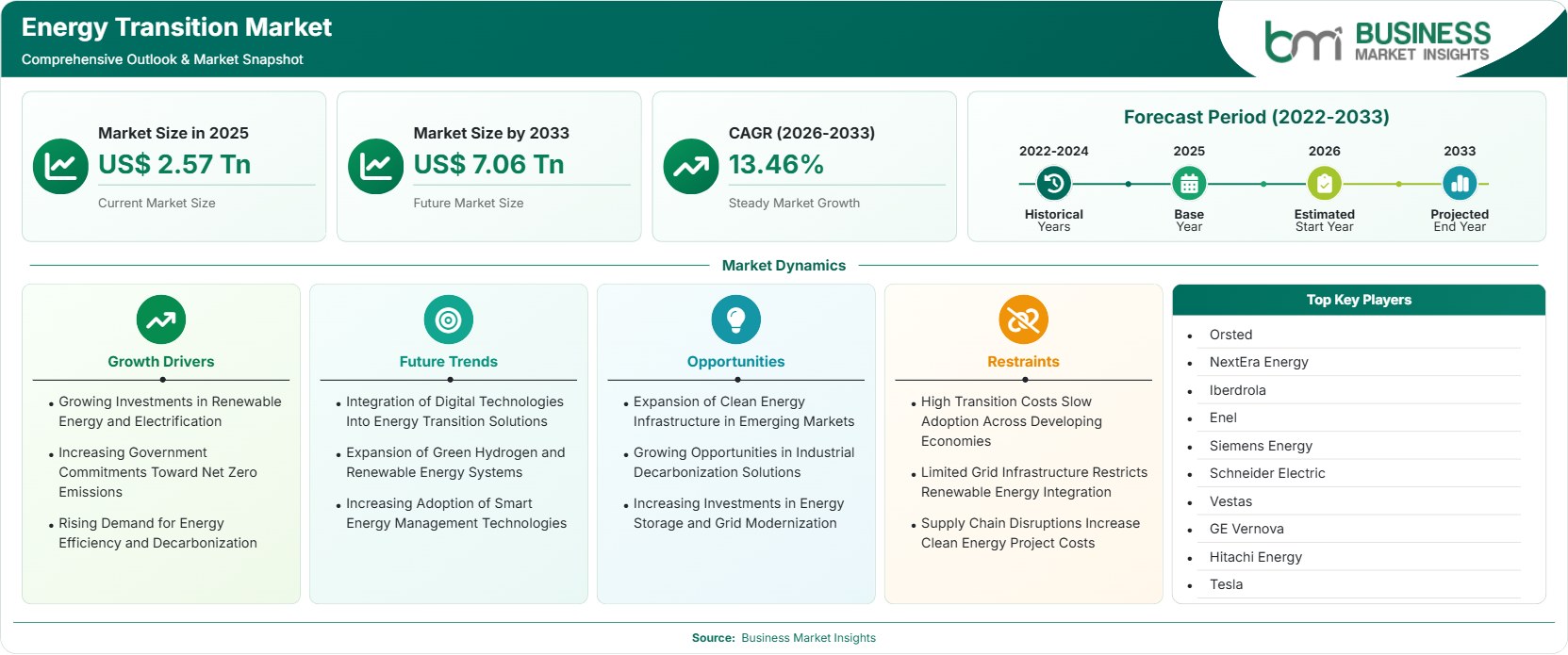
The Energy Transition Market size was valued at US$ 2.57 trillion in 2025 and is projected to reach US$ 7.06 trillion by 2033, growing at a CAGR of 13.46% during 2026–2033, supported by renewable energy investment, electrification, grid modernization, energy storage, industrial decarbonization, and net-zero commitments.

Report Coverage
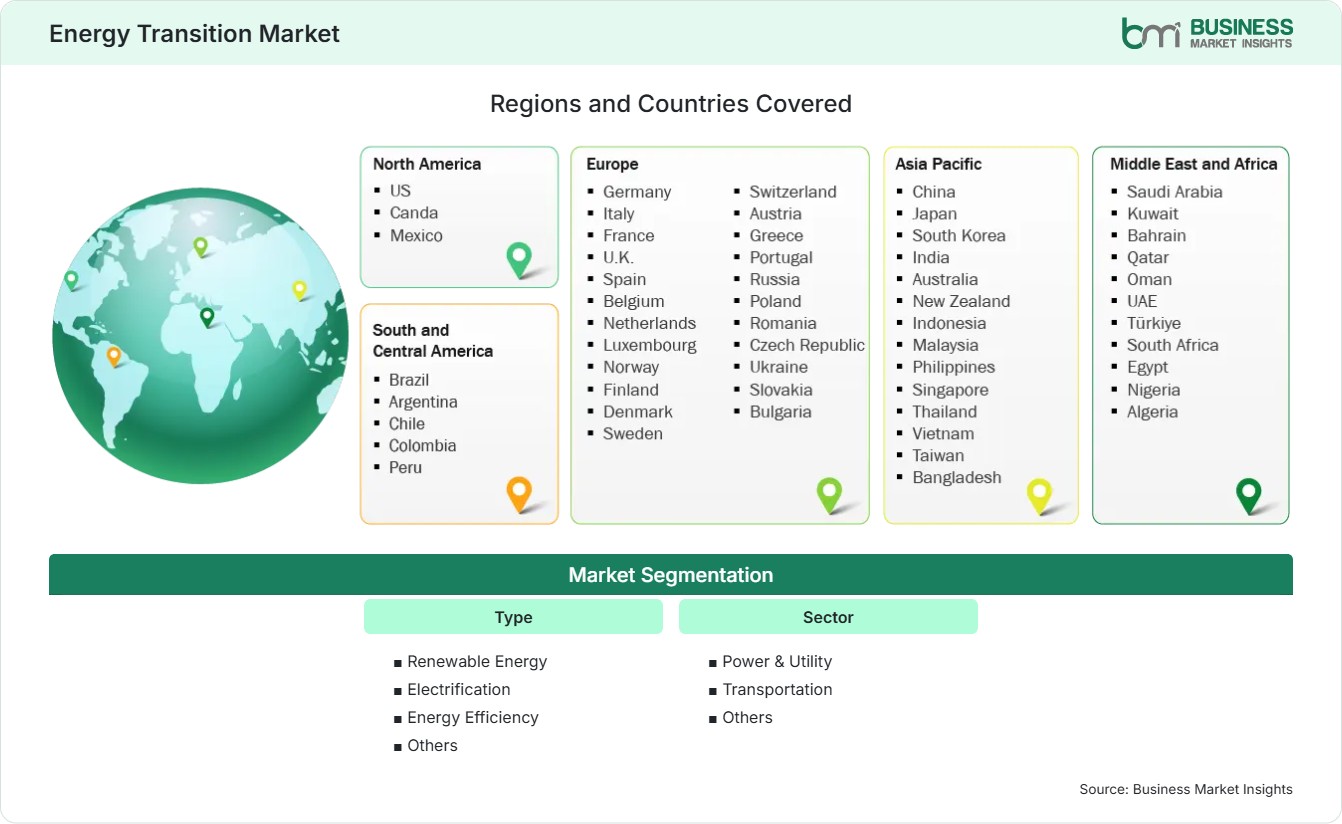
  • Type: Renewable Energy, Electrification, Energy Efficiency, Others
  • Sector: Power & Utility, Transportation, Others
US$ 2.57 Tn Market size in 2025
US$ 7.06 Tn Market Size by 2033
13.46% CAGR, 2026 - 2033
2026-2033 Forecast Period

01 AI Overview

Energy Transition Market Summary

  • North America: North America holds a 24%–28% share in 2025, growing at a CAGR of 12.5%–13.5% during 2026–2033, supported by renewable deployment, electrification, grid modernization, energy storage, and industrial decarbonization. The US Energy Transition Market is projected to expand at a 12.8%–13.8% CAGR, supported by clean-energy investment, transmission upgrades, and expanding electrification across transportation and industry.
  • Fastest Growing Region: Asia Pacific accounts for a 35%–39% share in 2025 and is advancing at a CAGR of 14.5%–15.5% through 2033, supported by large-scale renewable deployment, electricity demand growth, manufacturing expansion, electrification, battery investments, and government-backed decarbonization programs.
  • Leading Segment: Renewable Energy holds a 42%–46% share in 2025 and records a CAGR of 14.0%–15.0%, supported by solar and wind capacity additions, declining technology costs, energy security priorities, and increasing corporate demand for low-carbon electricity.
  • High Growth Segment: Electrification represents a 24%–28% share in 2025 and is growing at a CAGR of 15.0%–16.0%, driven by electric mobility, industrial electrification, heat pumps, digital infrastructure, and expanding electricity consumption.
  • Key Market Opportunity: Grid modernization and energy storage create strong opportunities as renewable penetration increases, requiring flexible networks, battery systems, advanced power electronics, transmission upgrades, and digital technologies for reliable electricity management.
  • Major Market Players: Ørsted, NextEra Energy, Iberdrola, Enel, Siemens Energy, Schneider Electric, Vestas, GE Vernova, Hitachi Energy, and Tesla.
02 Strategic Insights

Energy Transition Market: Strategic Insights

Energy Transition Market Strategic Framework
FREE PDF
Request your free sample
Request free sample
03 Stakeholder View

Key Takeaways

  • The value chain for the energy transition is becoming more interdependent, connecting renewable energy developers, utilities, grid operators, equipment suppliers, battery suppliers, software suppliers, and energy consumers. Competitive advantage will be gained through the capability to integrate generation, storage, electrification, and digital energy management systems.
  • Renewables remain the largest opportunity, but electrification is creating more opportunities in transportation, buildings, industry, and digital technologies. Businesses that can offer renewable energy and flexible power generation have an advantage.
  • The strategic importance of battery storage, power electronics, smart grids, and energy management systems is growing due to the variability of renewable energy sources. Resources are being invested in solutions that have the potential to enhance grid flexibility and balance supply and demand.
  • Asia Pacific presents a compelling investment case because electricity demand growth, manufacturing expansion, renewable deployment, and government-led infrastructure programs are increasing clean-energy investment. Local partnerships can help international companies navigate regulatory and supply-chain conditions.
  • Investments and alliances are becoming more oriented towards renewable generation, transmission, energy storage, grid technology, and electrification. Companies are developing competencies across adjacent technologies to solidify their foothold within integrated energy ecosystems.
04 Geographic Outlook

Energy Transition Market Regional Highlights

North America Energy Transition Market

North America represents a 24%–28% share in 2025 and is projected to grow at a CAGR of 12.5%–13.5% through 2033. Strong renewable investment, electric vehicle adoption, battery deployment, transmission upgrades, and industrial decarbonization support demand. The Energy Transition Market share reflects a mature investment ecosystem combining utilities, technology providers, renewable developers, and energy-intensive customers pursuing lower-carbon energy systems.

  • The US is the dominant regional market, owing to the development of renewable projects, clean-energy manufacturing, battery investment, transmission capacity additions, and rising electrification in the transportation and industrial sectors.
  • Canada presents business opportunities in hydropower and renewable power generation, grid modernization, and clean energy infrastructure, due to the abundance of natural resources and rising electricity demand.
  • There is growing investment in battery storage alongside rising renewable energy production, opening up prospects for developers and innovators of balancing and power management technologies.
  • The need for carbon reduction is spurring interest in electrification and energy efficiency, as well as clean energy procurement by industry sectors.

US Energy Transition Market

The US accounts for a 20%–23% share in 2025 and is expected to register a 12.8%–13.8% CAGR during 2026–2033. Renewable capacity expansion, clean-energy manufacturing, grid investment, electric mobility, and battery storage support growth. Federal and state-level initiatives are encouraging capital deployment across power generation, transmission, storage, electrification, and energy efficiency, creating a broad technology opportunity.

  • Utility-scale solar and wind development continues to drive investment, while hybrid projects increasingly combine renewable generation with battery storage to improve dispatchability.
  • Grid modernization is becoming increasingly important as renewable penetration rises, creating demand for transmission expansion, advanced substations, power electronics, and digital monitoring.
  • Electric vehicle adoption is increasing electricity demand and strengthening investment opportunities across charging infrastructure, distribution networks, and integrated energy management.

Europe Energy Transition Market

Europe holds a 26%–30% share in 2025 and is projected to grow at a CAGR of 12.0%–13.0%. Germany leads regional demand with a 12.5%–13.5% CAGR, while Spain and the UK remain important growth markets. Renewable deployment, energy security, electrification, efficiency measures, and industrial decarbonization are reinforcing investment across the regional energy ecosystem.

  • Germany's industrial base and energy transition policies support demand for renewable power, electrification, energy efficiency, storage, and grid modernization technologies.
  • Spain benefits from strong solar and wind resources, supporting renewable generation expansion and opportunities in storage, transmission, and flexible power management.
  • The UK is investing in offshore wind, grid infrastructure, and electrification, creating opportunities for renewable developers, equipment suppliers, and energy technology companies.
  • European industries are increasingly pursuing low-carbon electricity and efficiency solutions to address emissions targets, energy costs, and long-term competitiveness.

Asia Pacific Energy Transition Market

Asia Pacific represents a 35%–39% share in 2025 and is projected to expand at a 14.5%–15.5% CAGR. China remains the leading market, while India records a faster 15.0%–16.0% CAGR as electricity demand, renewable deployment, manufacturing, and electrification accelerate. The region's scale creates substantial opportunities for generation, storage, transmission, and energy-efficiency technologies.

  • China's large renewable capacity additions and manufacturing ecosystem support extensive investment across solar, wind, batteries, power electronics, and grid infrastructure.
  • India's expanding electricity demand and clean-energy ambitions are creating opportunities for renewable generation, storage, transmission, distributed energy, and industrial electrification.
  • Japan and South Korea are advancing energy storage, hydrogen-related technologies, grid modernization, and efficiency solutions while addressing energy security and decarbonization priorities.
  • Southeast Asian economies are attracting clean-energy investment as industrialization and urbanization increase electricity demand and create requirements for modern energy infrastructure.

Rest of World Energy Transition Market

South and Central America account for a 6%–9% share in 2025 and are projected to grow at a 11.5%–12.5% CAGR, supported by renewable resources and electrification. Brazil leads regional demand, while Chile offers strong growth potential. The Middle East and Africa represent a 8%–11% share and grow at a 12.0%–13.0% CAGR, supported by solar, grid, and energy diversification investments.

  • Brazil's renewable generation base and expanding electrification create opportunities across solar, wind, storage, transmission, and energy-efficiency technologies.
  • Chile benefits from strong solar resources and growing clean-energy investment, creating opportunities for renewable generation, storage, and grid flexibility solutions.
  • Gulf countries are diversifying energy systems through renewable projects and grid investments, creating opportunities for solar generation, storage, and electrification technologies.
  • African markets offer long-term potential through distributed renewable systems, mini-grids, storage, and electrification solutions designed to improve energy access and reliability.
Global Market Geography
FREE PDF
Request your free sample
Request free sample
05 Segment Analysis

Energy Transition Market Segmentation

Type

Type includes Renewable Energy, Electrification, Energy Efficiency, and Others. Renewable Energy leads with a 42%–46% share in 2025 and a 14.0%–15.0% CAGR through 2034, supported by solar and wind expansion. Electrification represents a 24%–28% share and records a 15.0%–16.0% CAGR, reflecting rising electricity demand across transport, buildings, and industry. The Energy Transition Market scope is broadening as these technologies increasingly operate as interconnected systems.

  • Renewable Energy: Solar, wind, and other clean-generation technologies are expanding as governments, utilities, and corporations seek lower-carbon electricity and greater energy security.
  • Electrification: Electric mobility, industrial equipment, heating, and buildings are increasing electricity demand while creating opportunities for charging, distribution, power electronics, and flexible energy systems.
  • Energy Efficiency: Digital controls, efficient equipment, building technologies, and industrial optimization help reduce energy consumption, operating costs, and emissions across diverse applications.

Sector

Sector includes Power & Utility, Transportation, and Others. Power & Utility represents the leading demand center, supported by renewable generation, grid modernization, storage, and transmission investment. Transportation is expanding rapidly as electric vehicles and charging infrastructure increase electricity consumption. The Energy Transition Market trends increasingly connect utility investment with transportation and industrial electrification, requiring coordinated planning across generation, networks, storage, and end-use technologies.

  • Power & Utility: Renewable generation, transmission, distribution, storage, and digital grid technologies are transforming electricity systems and supporting higher shares of low-carbon power.
  • Transportation: Electric vehicles, charging networks, fleet electrification, and associated grid upgrades are accelerating the shift from petroleum-based mobility toward electricity.
06 Market Forces

Energy Transition Market Dynamics

Key Market Drivers

Growing Investments in Renewable Energy and Electrification

There is increased investment in renewable energy production and electrification, driven by heightened efforts to address rising greenhouse gas emissions and enhance energy security. There is increased investment in solar and wind power production, batteries, and transmission. At the same time, there is increased use of electricity to replace fossil fuels in the transport sector, in buildings, and for industrial uses. The Energy Transition Market growth is driven by the diversity of investment across many technology segments, not simply electricity production. Companies are increasingly seeking integrated solutions involving the production of renewable energy, storage, and consumption/controls.

Increasing Government Commitments Toward Net Zero Emissions

Government climate commitments are influencing investments in the power generation sector, transport, buildings, and industry. The net-zero emissions objectives push for more renewables, energy-efficiency initiatives, electrification, and infrastructure renewal. In addition, they provide a regulatory framework for clean energy solutions. Policies and incentives can positively influence the economics of such projects and attract more private capital. This is especially true if they are supported by the long-term procurement arrangements. Consequently, the Energy Transition Market's prospects depend heavily on governments' ability to maintain consistent policies and implement them successfully. At the same time, governments pay much attention to energy security and resilient supply chains.

Rising Demand for Energy Efficiency and Decarbonization

Companies are increasingly making moves towards energy efficiency and decarbonization to control operating costs, reduce emissions, and build a resilient future. Efficient machinery, digitalization, electrification, and process optimization are some of the measures being taken by industrial facilities, and intelligent building controls and energy management systems are used by commercial buildings. All these measures supplement renewable energy production by lowering energy demand and increasing energy-use flexibility. The Energy Transition Market Trends extend beyond just renewable energy generation to include the technologies that help produce, distribute, and utilize energy. Companies that can bring together solutions for energy efficiency, renewable energy production, and management can cater to diverse client needs and improve program economics.

Key Market Opportunities

Expansion of Clean Energy Infrastructure in Emerging Markets

There are many chances within emerging economies as electricity demand increases with industrialization, urbanization, and growth in population. Renewable power production can contribute to addressing this increased demand without becoming overly dependent on foreign sources of energy. There are different technologies that can be applied depending on the state of infrastructure in different regions. The Energy Transition Market forecast is favorable for countries that pursue not only energy access but also decarbonization strategies. It is possible for international companies and technology providers to profit by partnering with local companies and offering flexible financing solutions. However, grid development is crucial since otherwise there will be integration problems.

Growing Opportunities in Industrial Decarbonization Solutions

Decarbonization of industry constitutes a huge opportunity, since the sector consumes high amounts of energy and faces mounting pressure to cut down its carbon footprint. Energy efficiency, electrification, renewable energy procurement, energy storage, and digital optimization will help achieve low-carbon business operations. Technology vendors can offer tailor-made solutions for energy-consuming industries, such as manufacturing, chemicals, mining, and other process industries. Increasingly, customers look for technologies that help them reduce their emissions without affecting production availability. Thus, there are opportunities for vendors who offer solutions that include renewables, electrification, and energy storage.

Increasing Investments in Energy Storage and Grid Modernization

There is a growing need for energy storage and smart grid development due to the increasing share of renewable power. Storage solutions can assist in regulating variable power, offering balancing capabilities, and enhancing system reliability, while smart grid technology can facilitate more visibility and optimal power flows. There are also investments being made in transmission, substation infrastructure, power electronics, controls, and distributed energy management. Those businesses that combine storage, renewable power, and smart grid technology will be able to tackle the challenges associated with increased use of renewables. Smart grid technologies are likely to be a priority for utilities and governments, as they can adapt to shifting demand trends.

Market Restraints and Challenges

High Transition Costs Slow Adoption Across Developing Economies

Factor: Renewable generation, electrification, storage, transmission, and energy-efficiency projects often require substantial upfront capital, while financing costs can be elevated in developing economies. Impact: A high initial investment cost will delay the implementation of such projects, especially when governments and private enterprises lack easy access to low-cost, long-term financing. Cost considerations might further delay the replacement of fossil fuel infrastructure systems and the process of industrial electrification. However, these methods will help increase the viability of the projects. Affordability will still remain a significant challenge for markets with large energy infrastructure demands and small amounts of investment capital.

Limited Grid Infrastructure Restricts Renewable Energy Integration

Factor: Aging transmission networks, insufficient distribution capacity, and limited grid flexibility can restrict the integration of rapidly expanding renewable generation. Impact: Project execution could be hampered by delays, cuts, or the need for more robust infrastructure to support the additional power supply when networks cannot cope with the new addition. Infrastructure shortcomings might also undermine the value of renewable energy projects while increasing the need for storage or backup facilities. Modernizing infrastructure is costly and calls for a considerable amount of time for planning purposes. However, advancements in transmission, smart grids, storage capabilities, and planning processes can alleviate some of these constraints.

07 Company Analysis

Competitive Landscape

The Energy Transition Market analysis indicates that competition is increasingly shaped by renewable-generation capabilities, electrification expertise, grid technologies, storage, digital energy management, and global project execution. Leading participants are expanding beyond individual technologies to offer integrated solutions spanning generation, transmission, distribution, storage, and energy consumption.

Company Name

Overview

Products and Services relevant to this market

Ørsted

Renewable energy company with strong expertise in offshore wind and clean-energy development.

Offshore wind, renewable energy development, energy solutions, and clean-energy infrastructure.

NextEra Energy

Major energy company with extensive renewable generation and utility operations.

Wind, solar, battery storage, electricity generation, and energy infrastructure.

Iberdrola

Global utility focused strongly on renewable generation and electricity networks.

Wind, solar, hydroelectric power, grids, storage, and electrification solutions.

Enel

Global energy company operating across renewable generation and electricity distribution.

Renewable power, smart grids, storage, electrification, and digital energy services.

Siemens Energy

Energy technology company serving generation, transmission, and grid infrastructure markets.

Power generation, grid technologies, transmission, storage, and energy transition solutions.

Schneider Electric

Energy management and automation specialist supporting efficient and connected energy systems.

Energy management, electrification, automation, digital systems, and efficiency technologies.

Vestas

Wind energy technology company specializing in turbine manufacturing and services.

Wind turbines, renewable energy solutions, monitoring, maintenance, and lifecycle services.

GE Vernova

Energy technology company focused on power generation, grids, and electrification.

Wind, gas power, grid technologies, electrification, and digital energy solutions.

Hitachi Energy

Global power technology provider supporting grids and renewable integration.

Transmission, substations, grid automation, power electronics, and energy storage technologies.

Tesla

Technology company with major capabilities in electric vehicles and battery energy storage.

Battery storage, energy management, electric vehicles, charging, and renewable energy integration.

10 Trust & Transparency

Research Methodology

The market analysis combines proprietary research with secondary data from government agencies, company disclosures, regulatory filings, industry databases and expert interviews. Market estimates are validated through data triangulation, cross-market benchmarking and analyst review.

View Full Research Methodology

11 Questions Answered

Frequently Asked Questions

What does the Energy Transition Market report cover?

The report provides insights into market dynamics, technology segments, sector opportunities, regional developments, competitive positioning, growth drivers, restraints, and emerging investment areas across the evolving global energy ecosystem.

How does electrification support decarbonization?

Electrification enables transportation, buildings, and industrial processes to shift away from direct fossil-fuel consumption. When electricity comes increasingly from renewable sources, electrification can reduce emissions while creating new demand for grid infrastructure.

Which regions offer strong transition opportunities?

Asia Pacific offers strong opportunities because of rapid electricity demand growth, renewable deployment, industrialization, and infrastructure investment. North America and Europe also provide substantial opportunities through grid modernization and electrification.

Why is energy storage important for the transition?

Storage helps balance variable renewable generation, improve grid flexibility, shift electricity availability across time periods, and provide resilience. Its importance increases as solar and wind represent larger portions of electricity generation.

What is driving the energy transition?

Renewable energy investment, electrification, government net-zero commitments, energy security priorities, energy efficiency, and industrial decarbonization are key factors accelerating the transition toward lower-carbon energy systems.

Access the Full Energy Transition Market Report

Get segment-level forecasts, regional estimates, competitive benchmarking, company profiles and downloadable Excel datasets.

Access the full Energy Transition Market Report
350 pages PDF & Excel | 2026-08-05