
Geothermal Energy Market Outlook: Size, Share, Trends, Growth Analysis, Competitive Landscape & Forecast, 2026-2033

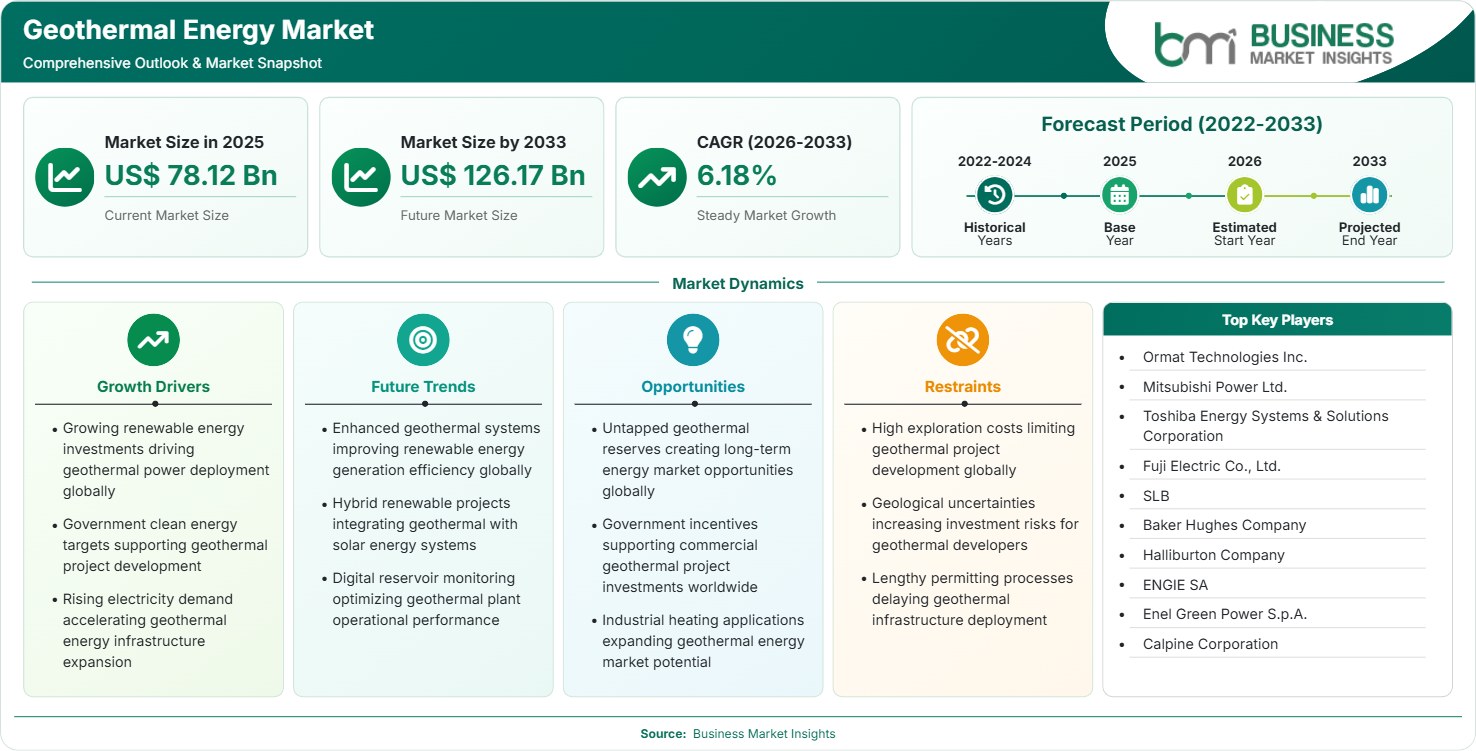
The Geothermal Energy Market size was valued at US$ 78.12 billion in 2025 and is projected to reach US$ 126.17 billion by 2033, growing at a CAGR of 6.18% during 2026–2033. The market growth is driven by increasing renewable energy investments, government decarbonization initiatives, rising electricity demand, and growing adoption of reliable clean power generation technologies.

Report Coverage
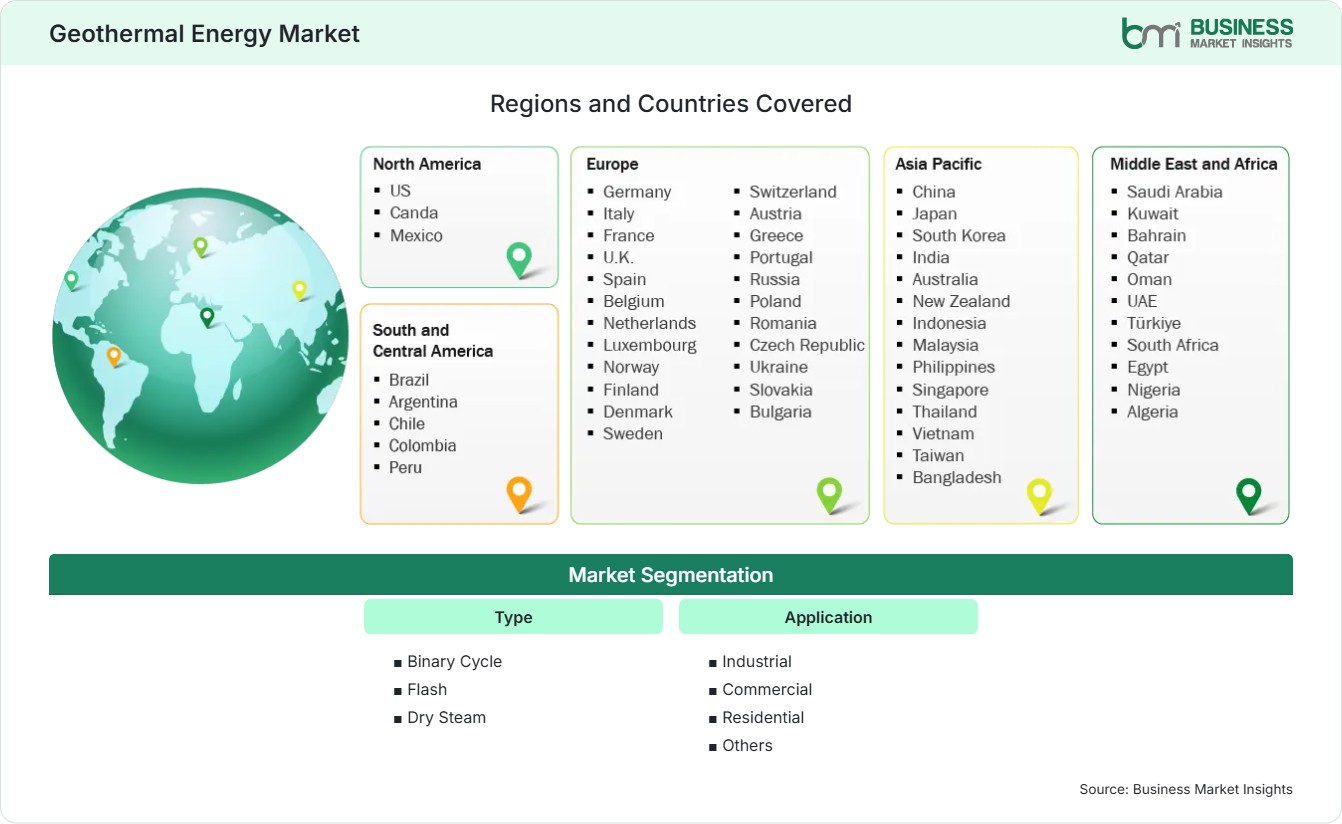
  • Type: Binary Cycle, Flash, Dry Steam
  • Application: Industrial, Commercial, Residential, Others
US$ 78.12 Bn Market size in 2025
US$ 126.17 Bn Market Size by 2033
6.18% CAGR, 2026 - 2033
2026-2033 Forecast Period

AI Overview

Geothermal Energy Market Summary

  • North America Region: North America holds a market share of 32%–35% in 2025, growing at a CAGR of 5.5%–6.2% during 2026–2033. The region benefits from established geothermal infrastructure, advanced drilling technologies, supportive renewable energy policies, and increasing investment in clean energy projects. The United States remains the leading contributor due to strong geothermal power generation capacity, especially across western states.
  • Fastest Growing Region: Asia Pacific represents 28%–31% market share in 2025 and is projected to expand at a CAGR of 7.0%–7.8% during 2026–2033. Growth is supported by rising electricity consumption, expanding renewable energy programs, geothermal resource availability, and increasing investments in countries including Indonesia, the Philippines, Japan, and China.
  • Leading Segment: Flash geothermal systems account for approximately 45%–48% geothermal energy market share in 2025 and are expected to grow at a CAGR of 5.8%–6.4%. Their dominance is supported by established deployment, suitability for high-temperature geothermal resources, and widespread use in utility-scale electricity generation projects.
  • High Growth Segment: Binary Cycle systems represent 30%–33% market share in 2025 and are projected to expand at a CAGR of 7.2%–8.0%. Growth is supported by technological improvements, utilization of lower-temperature geothermal resources, and increasing deployment flexibility across emerging markets.
  • Key Market Opportunity: Development of untapped geothermal resources, enhanced geothermal systems, industrial heating applications, and government-supported renewable energy investments create significant opportunities for long-term industry expansion.
  • Major Market Players: Ormat Technologies Inc., Mitsubishi Power Ltd., Toshiba Energy Systems & Solutions Corporation, Fuji Electric Co., Ltd., SLB, Baker Hughes Company, Halliburton Company, ENGIE SA, Enel Green Power S.p.A., and Calpine Corporation.
Strategic Insights

Geothermal Energy Market: Strategic Insights

Geothermal Energy Market Strategic Framework
FREE PDF
Request your free sample
Request free sample
Stakeholder View

Key Takeaways

  • The geothermal energy ecosystem includes exploration companies, drilling service providers, equipment manufacturers, power developers, utilities, and government agencies. Collaboration across these stakeholders is improving project execution and reducing operational challenges.
  • Utility-scale electricity generation remains the primary application area, while industrial heating and direct-use applications represent high-growth opportunities due to increasing demand for low-carbon energy solutions.
  • Technological innovation in enhanced geothermal systems, advanced drilling methods, reservoir monitoring, and binary cycle technologies is improving resource utilization and expanding geothermal deployment possibilities.
  • Asia Pacific offers strong investment potential due to abundant geothermal resources, increasing electricity demand, government renewable energy programs, and growing participation from international energy companies.
  • Strategic partnerships, project acquisitions, and investments in geothermal technology providers are increasing as energy companies diversify portfolios and strengthen renewable energy capabilities.
  • Integration of geothermal energy with hybrid renewable systems, district heating networks, and industrial applications is creating new opportunities for improving energy security and reducing carbon emissions.
Geographic Outlook

Geothermal Energy Market Regional Highlights

North America Geothermal Energy Market

North America accounted for 32%–35% of the global market in 2025 and is projected to expand at a CAGR of 5.5%–6.2% during 2026–2033. The region maintains a strong position due to established geothermal power facilities, advanced exploration capabilities, supportive renewable energy policies, and increasing investments in clean energy infrastructure. The United States represents the dominant regional market, supported by significant geothermal resources in western states, technological expertise, and rising demand for reliable renewable electricity generation.

  • The United States leads regional development due to extensive geothermal resources, established power generation facilities, and increasing investments in advanced geothermal exploration technologies.
  • Government incentives and clean energy programs are encouraging utilities and developers to expand geothermal projects as part of broader renewable energy transition strategies.
  • Advanced drilling technologies and improved reservoir management techniques are enhancing project feasibility by reducing operational challenges and improving resource utilization efficiency.
  • Industrial users are increasingly exploring geothermal heat applications to reduce dependence on conventional energy sources and improve sustainability performance.

US Geothermal Energy Market

The United States represented approximately 85%–88% of the North American market in 2025 and is forecast to grow at a CAGR of 5.7%–6.4% between 2026 and 2033. Strong government support, extensive geothermal resources, and increasing renewable energy investments continue strengthening domestic development. The country remains a key innovation center for enhanced geothermal systems, drilling technologies, and geothermal power generation solutions, particularly across western states with favorable geological conditions.

  • California remains a leading geothermal power region due to significant installed capacity, favorable geological conditions, and long-term renewable energy commitments.
  • Nevada and other western states are increasing geothermal exploration activities through private investment and government-supported clean energy initiatives.
  • Advanced geothermal technologies are improving access to previously inaccessible resources and expanding potential project locations across the country.
  • Growing electricity demand from industrial facilities and data centers is encouraging interest in dependable renewable power sources.

Europe Geothermal Energy Market

Europe accounted for approximately 22%–25% of global demand in 2025 and is expected to grow at a CAGR of 5.8%–6.6% through 2033. Regional expansion is supported by climate targets, renewable energy policies, district heating adoption, and increasing interest in reducing fossil fuel dependence. Germany, France, Iceland, and Italy represent important markets due to geothermal resource availability, established infrastructure, and government initiatives supporting renewable heating and electricity generation.

  • Iceland maintains a leading position due to extensive geothermal utilization for electricity generation and district heating applications.
  • Germany is expanding geothermal projects through investments in deep geothermal systems and sustainable heating solutions for urban areas.
  • France is increasing geothermal adoption through district heating networks and government-supported renewable energy development programs.
  • Italy remains a significant geothermal market due to its long operating history and established geothermal power generation infrastructure.
  • European developers are increasingly focusing on integrating geothermal systems into low-carbon heating networks and renewable energy strategies.

Asia Pacific Geothermal Energy Market

Asia Pacific accounted for approximately 28%–31% of global demand in 2025 and is projected to register the fastest growth at a CAGR of 7.0%–7.8% during 2026–2033. The region benefits from abundant geothermal resources, increasing electricity consumption, rapid industrialization, and government renewable energy targets. Indonesia, the Philippines, Japan, and China are key contributors due to large geothermal potential and ongoing investments in clean power generation infrastructure.

  • Indonesia represents one of the largest geothermal opportunity markets due to substantial geothermal reserves and government initiatives supporting renewable electricity expansion.
  • The Philippines continues developing geothermal capacity through established projects and policies promoting renewable energy diversification.
  • Japan is advancing geothermal development through improved technologies, regulatory support, and increasing interest in clean energy alternatives.
  • China is exploring geothermal applications for electricity generation, district heating, and industrial energy requirements as part of energy transition goals.
  • Southeast Asian countries are attracting investment through favorable policies and increasing demand for reliable renewable electricity sources.

Rest of World Geothermal Energy Market

The Rest of World region accounted for approximately 15%–18% of global demand in 2025 and is projected to grow at a CAGR of 6.2%–7.0% during 2026–2033. Latin America, the Middle East, and Africa are gradually expanding geothermal utilization due to renewable energy goals, energy security requirements, and increasing electricity demand. Countries including Kenya, Mexico, Turkey, and Chile are emerging as important geothermal development markets.

Latin America is benefiting from significant geothermal potential, while African markets are focusing on geothermal projects to improve energy access and reduce reliance on conventional power sources.

  • Kenya is a leading African geothermal market due to strong resource availability and continued investment in geothermal electricity generation projects.
  • Mexico is expanding geothermal activities through established infrastructure and renewable energy development initiatives.
  • Turkey is increasing geothermal capacity through private sector participation and government support for renewable power generation.
  • Chile is exploring geothermal resources to diversify its energy mix and strengthen renewable energy availability.
  • Middle Eastern and African countries are evaluating geothermal applications for electricity generation, heating, and industrial energy requirements.
Global Market Geography
FREE PDF
Request your free sample
Request free sample
Segment Analysis

Geothermal Energy Market Segmentation

Type

The Type segment represents the technological foundation of geothermal energy generation, with Flash systems accounting for the largest share at 45%–48% in 2025 and expanding at a CAGR of 5.8%–6.4% during 2026–2033. The Geothermal Energy Market scope continues expanding as developers adopt efficient geothermal technologies capable of utilizing diverse underground heat resources and supporting reliable renewable power generation.

  • Binary Cycle: Binary cycle systems are gaining adoption due to their ability to utilize lower-temperature geothermal resources, improved operational flexibility, and suitability for regions with moderate geothermal conditions.
  • Flash: Flash systems dominate utility-scale geothermal generation because of their efficiency in high-temperature reservoirs, established technology base, and extensive deployment across major geothermal power-producing countries.
  • Dry Steam: Dry steam systems remain important in regions with naturally occurring steam reservoirs, providing efficient electricity generation through direct steam utilization and long-term operational reliability.

By Application

The Application segment includes industrial, commercial, residential, and other uses, with industrial applications accounting for a significant portion of demand due to increasing adoption of geothermal heat for sustainable energy solutions. The segment is expected to grow at a CAGR of 6.0%–6.8% during 2026–2033 as organizations seek low-carbon alternatives for heating and power requirements. Current Geothermal Energy Market trends indicate increasing deployment beyond electricity generation.

  • Industrial: Industrial applications are expanding through geothermal process heating, manufacturing operations, and direct thermal energy utilization that reduces dependence on fossil fuel-based heating systems.
  • Commercial: Commercial adoption is increasing through geothermal heating and cooling systems in offices, hotels, educational facilities, and large buildings seeking energy efficiency improvements.
  • Residential: Residential geothermal applications are growing through ground-source heat pump adoption, offering efficient heating and cooling solutions for households in suitable climatic regions.
  • Others: Other applications include agricultural heating, greenhouse operations, aquaculture, and district heating networks that utilize geothermal resources for specialized energy requirements.
Market Forces

Geothermal Energy Market Dynamics

Key Market Drivers

Growing renewable energy investments driving geothermal power deployment globally

Renewable energy infrastructure is gaining increased investment and leading to the creation of more geothermal projects as nations search for dependable sources of power that are low on carbon emissions. Contrary to other renewable energy technologies that cannot guarantee consistent production, geothermal power generates consistent baseload power. In its report, the International Energy Agency (IEA) states that renewable energy development is crucial in efforts to reduce carbon emissions. Rising funding for exploration, drilling technologies, and geothermal power plants is strengthening the Geothermal Energy Market growth. Additionally, advancements in reservoir assessment and enhanced geothermal systems are improving resource accessibility, allowing developers to consider locations previously viewed as commercially challenging.

Government clean energy targets supporting geothermal project development

Governments that have enacted renewable energy policies and climate change policies in favor of carbon reductions are fostering an environment that is conducive to the growth of geothermal projects across the world. Clean energy policy measures, incentives for renewable energy, and climate change policies are motivating energy firms and private investors to develop more geothermal plants. The United States, Indonesia, Kenya, and countries in the European Union are some of the nations that are pursuing measures that foster geothermal developments. The increasing alignment between energy security objectives and climate strategies is strengthening Geothermal Energy Market trends by encouraging long-term investment in sustainable power infrastructure and resource development.

Rising electricity demand accelerating geothermal energy infrastructure expansion

The increase in the use of electricity due to processes like industrialization, urbanization, and construction of digital infrastructures is increasing the need for stable and renewable sources of energy. Geothermal energy gives a steady supply of electricity and emits fewer greenhouse gases as compared to non-renewable sources, which makes it favorable in those areas where there is an urgent need for stable sources of energy. The increase in industrial production and the need for energy for activities like manufacturing and construction of data centers is increasing the installation of geothermal plants.

Key Market Opportunities

Untapped geothermal reserves creating long-term energy market opportunities globally

The abundant geothermal potential in many Asian Pacific, African, and Latin American countries represents an attractive possibility for future market growth. There is plenty of underground heat potential that has not been explored yet because of low levels of exploration, poor funding, and technical limitations. More advanced drilling, enhanced geothermal systems, and new technologies in geothermal mapping are making it easier to use deeper geothermal wells. Companies exploring geothermal potential in their operations will be able to take advantage of new opportunities. Geothermal Energy Market Forecasts indicate that resource-rich developing regions will become increasingly important contributors to future capacity additions and clean energy investments.

Government incentives supporting commercial geothermal project investments worldwide

Government funding, incentives for renewables, and friendly policies have set up a promising environment for the establishment of geothermal power plants. Tax breaks, subsidies, and renewable energy purchases are some examples of how to overcome high initial barriers of exploration and building infrastructure. Partnerships between governments and the private sector are also becoming more common due to the necessity to deploy geothermal energy on an accelerated basis. Such measures not only boost economic feasibility but also ensure the involvement of energy firms, technology suppliers, and institutions. Policy support will be required for further growth in geothermal capacity and competitive advantage over other renewable sources of energy.

Industrial heating applications expanding geothermal energy market potential

Geothermal heating applications present a significant potential for further development of geothermal energy outside its conventional use in electricity generation. Companies that require consistent heat energy, such as food production industries, manufacturing sectors, agriculture, and chemical production, are considering the use of geothermal heat as an environmentally friendly replacement for conventional heating systems fueled by fossil fuels. Direct geothermal heating applications will allow companies to minimize their environmental impact while increasing the energy efficiency of their operations. The commitment to sustainability on the part of companies will increase the number of opportunities for geothermal companies.

Market Restraints and Challenges

High exploration costs limiting geothermal project development globally

Factor: Geothermal projects require substantial upfront investment for geological surveys, drilling activities, resource assessment, and infrastructure development before commercial viability can be confirmed.

Impact: High initial costs increase financial risks for developers and may delay project approvals, particularly in regions with limited access to financing. Exploration uncertainty can discourage smaller companies from entering the market and may slow geothermal capacity expansion compared with other renewable technologies. Developers must manage significant capital requirements before generating revenue, creating challenges in attracting investment. Advances in exploration technologies, government support mechanisms, and risk-sharing frameworks are becoming increasingly important to improve project feasibility and encourage wider geothermal deployment.

Geological uncertainties increasing investment risks for geothermal developers

Factor: Geothermal resources depend heavily on underground geological conditions, including reservoir temperature, permeability, fluid availability, and long-term resource sustainability.

Impact: Uncertainty regarding resource quality can increase project development risks, resulting in potential cost overruns, delayed timelines, or reduced expected energy output. Developers may face challenges in accurately predicting reservoir performance before drilling activities are completed. These risks can influence investor confidence and affect financing availability for geothermal projects. Improved geological modeling, advanced exploration techniques, and enhanced reservoir monitoring are helping reduce uncertainty, but geological complexity remains a significant challenge for large-scale geothermal development.

Company Analysis

Competitive Landscape

The Geothermal Energy Market analysis indicates a competitive landscape shaped by technology providers, geothermal developers, engineering companies, and energy organizations focusing on advanced systems, project development, equipment innovation, and renewable energy expansion strategies.

Company Name

Overview

Products and Services relevant to this market

Ormat Technologies Inc.

Global geothermal technology company specializing in geothermal power development, equipment manufacturing, and renewable energy solutions.

Geothermal power plants, binary cycle systems, energy services, project development, and geothermal equipment solutions.

Mitsubishi Power Ltd.

Energy technology company providing power generation solutions and supporting renewable energy infrastructure development worldwide.

Geothermal turbines, power generation equipment, engineering services, and renewable energy technologies.

Toshiba Energy Systems & Solutions Corporation

Energy solutions provider offering advanced power generation technologies and geothermal system expertise.

Geothermal turbines, generators, engineering solutions, and renewable energy equipment.

Fuji Electric Co., Ltd.

Industrial technology company with extensive experience in geothermal power generation equipment and energy systems.

Geothermal turbines, generators, power electronics, and geothermal plant equipment.

SLB

Global energy technology company providing subsurface expertise and solutions for energy development projects.

Geothermal exploration technologies, drilling services, reservoir management solutions, and energy technologies.

Baker Hughes Company

Energy technology company supporting geothermal development through advanced drilling and energy solutions.

Geothermal drilling technologies, equipment, subsurface services, and project support solutions.

Halliburton Company

Global oilfield services company providing engineering and technology solutions applicable to geothermal projects.

Drilling services, completion technologies, reservoir evaluation, and geothermal development support.

ENGIE SA

International energy company investing in renewable energy generation and sustainable infrastructure projects.

Geothermal power projects, renewable energy solutions, energy management, and sustainable infrastructure services.

Enel Green Power S.p.A.

Renewable energy company developing geothermal power projects and clean energy generation assets globally.

Geothermal electricity generation, renewable project development, and energy solutions.

Calpine Corporation

Independent power producer operating geothermal facilities and renewable energy assets in North America.

Geothermal power generation, electricity production, energy management, and renewable energy operations.

Trust & Transparency

Research Methodology

The market analysis combines proprietary research with secondary data from government agencies, company disclosures, regulatory filings, industry databases and expert interviews. Market estimates are validated through data triangulation, cross-market benchmarking and analyst review.

View Full Research Methodology

Questions Answered

Frequently Asked Questions

What information is included in a Geothermal Energy Market Report?

A Geothermal Energy Market Report includes market size, growth projections, regional analysis, technology segmentation, application insights, competitive landscape, industry developments, investment opportunities, and strategic market trends.

What are the major challenges affecting geothermal project investments?

High exploration costs, geological uncertainties, long development timelines, and complex resource assessment processes can increase financial risks and influence investment decisions for geothermal developers worldwide.

How does geothermal energy support global energy transition goals?

Geothermal energy provides stable renewable electricity and direct heating solutions with lower carbon emissions, helping countries diversify energy portfolios, improve grid reliability, and reduce dependence on fossil fuel-based power generation.

Which geothermal technology segment holds the largest market position?

Flash geothermal systems represent the leading technology segment due to their established deployment, suitability for high-temperature geothermal resources, proven operational performance, and extensive utilization in utility-scale electricity generation facilities.

What factors are driving the market growth?

Increasing renewable energy investments, government clean energy targets, rising electricity demand, technological improvements in drilling, and growing adoption of sustainable heating and power solutions are supporting global geothermal industry expansion.

Access the Full Geothermal Energy Market Report

Get segment-level forecasts, regional estimates, competitive benchmarking, company profiles and downloadable Excel datasets.

Access the full Geothermal Energy Market Report
350 pages PDF & Excel | 2026-08-10
Similar Research

Related Market Reports