Market Summary
Executive Summary and Global Market Analysis
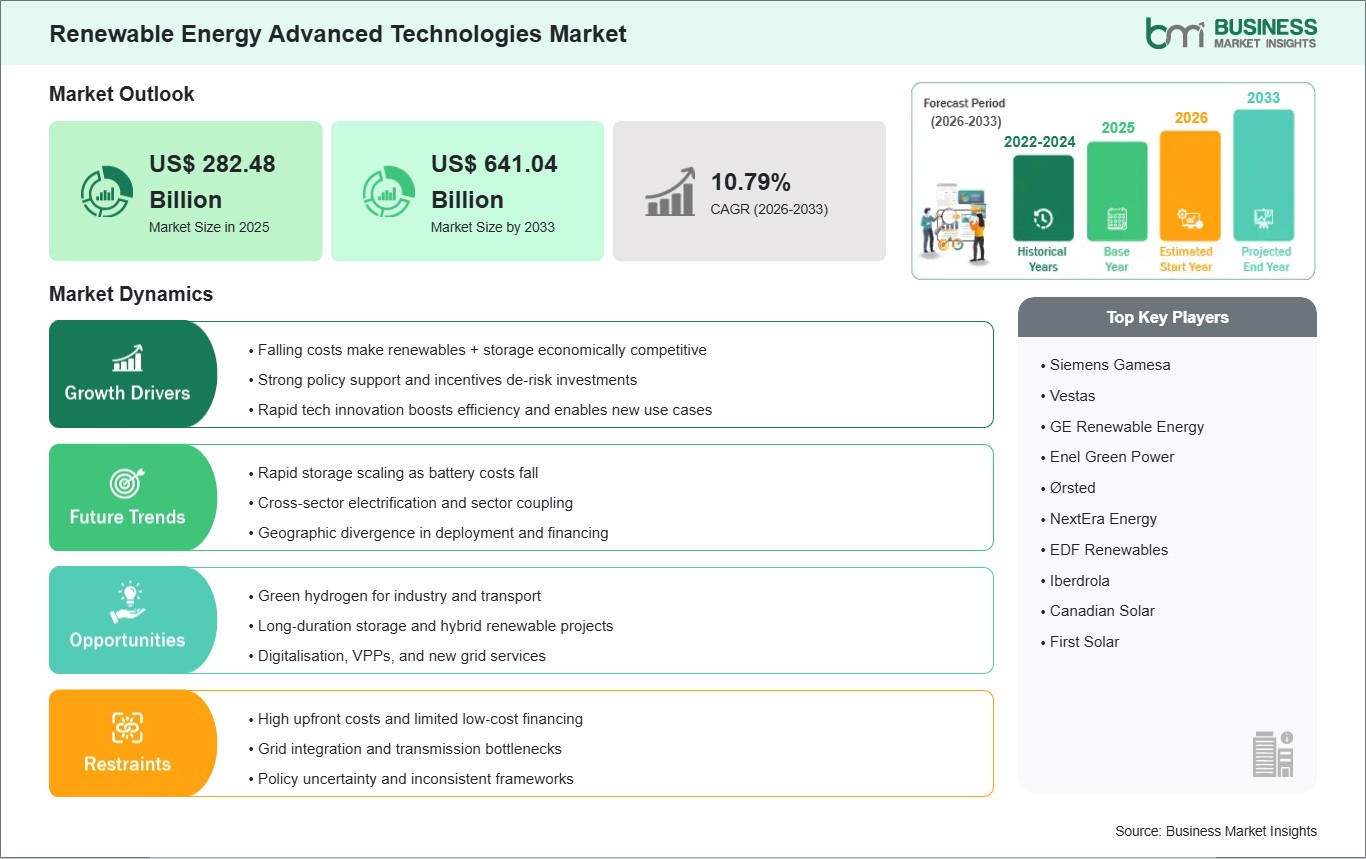
Renewable energy technologies cover integrated systems, digital tools, storage solutions, and advanced platforms that improve clean energy efficiency and reliability. These systems use solar, wind, hydropower, geothermal, and bioenergy sources, helping to make energy operations more flexible. Upgrading power systems is speeding up the move to decentralized and smart renewable networks. Goals like energy security and cutting carbon emissions are leading to more investment in infrastructure worldwide. Utilities and industries are turning to renewables to keep supply steady and rely less on traditional fuels. Efforts to electrify, modernize grids, and use distributed generation are increasing adoption in both commercial and residential areas.
The market is divided by technology, with solar and wind seeing the most growth because they are easy to install and integrate. Large systems are common in utility projects, while medium-sized solutions are being used more in industry and institutions. Most of the market is for grid-connected systems, supported by better transmission and digital monitoring. New advances include energy storage, predictive maintenance software, smart inverters, and hybrid setups. Artificial intelligence and data analytics help manage assets and forecast operations. Better links between renewables and smart grids make energy distribution more efficient. The market is competitive, with ongoing innovation, partnerships, and infrastructure projects. Companies focus on making systems efficient, optimizing their lifespan, and managing energy in an integrated way. Building resilient and scalable renewable systems remains a key industry goal.
Segment Analysis
Renewable Energy Advanced Technologies Market Segmentation
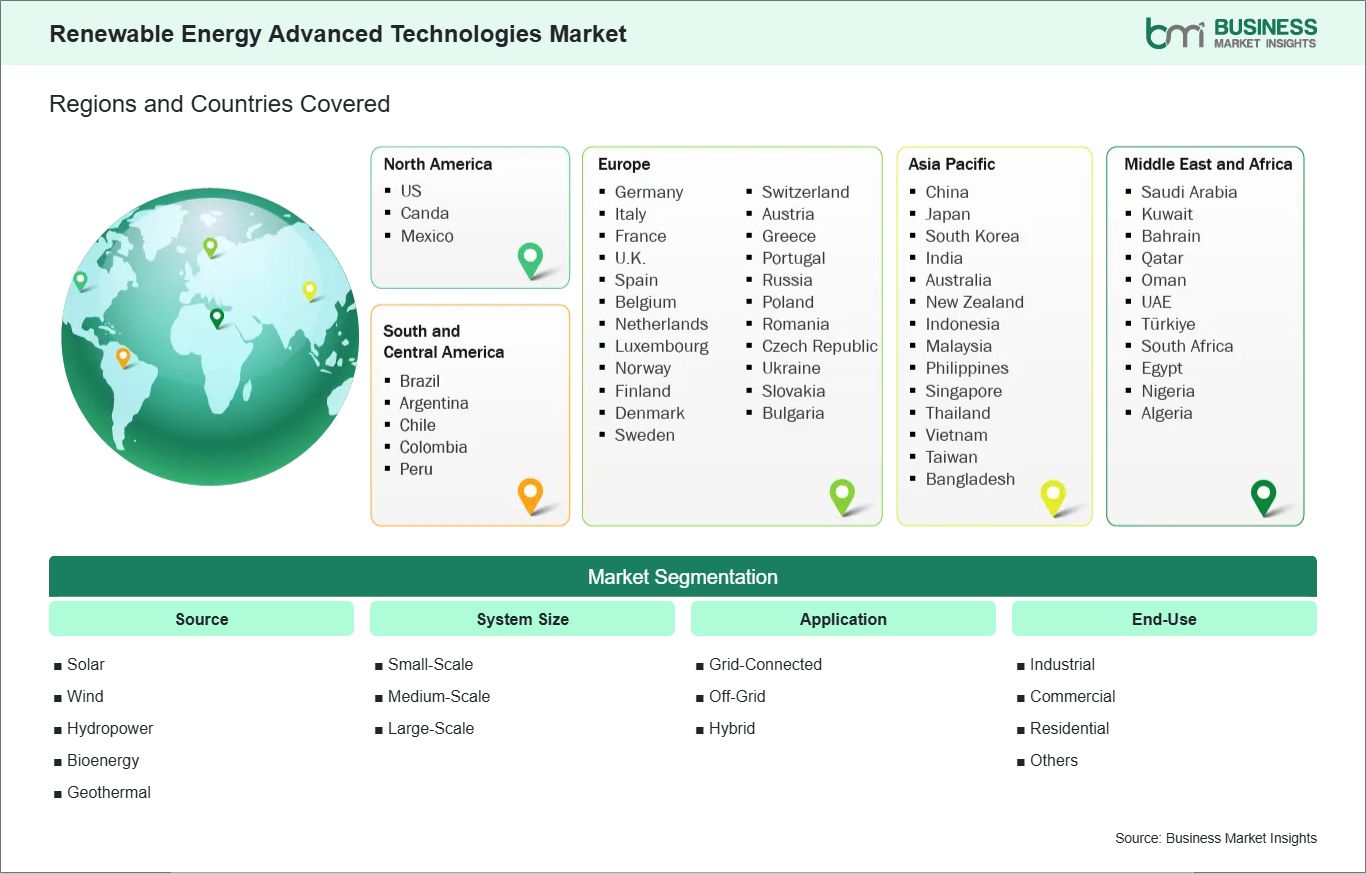
The Renewable Energy Advanced Technologies market is segmented based on Source, System Size, Application, and End-Use, reflecting diversified deployment patterns shaped by energy infrastructure modernization and application-specific operational requirements.
By Source
- Solar – Supports scalable deployment across distributed and utility-scale renewable installations.
- Wind – Enables high-capacity electricity generation with improved turbine efficiency technologies.
- Hydropower – Maintains stable renewable output for continuous grid balancing operations.
- Bioenergy – Converts organic resources into dispatchable and flexible energy solutions.
- Geothermal – Delivers long-duration energy generation with minimal climatic dependency.
By System Size
- Small-Scale – Expands decentralized energy access for localized consumption environments.
- Medium-Scale – Serves institutional and commercial facilities requiring balanced energy capacity.
- Large-Scale – Powers utility infrastructure through centralized renewable generation networks.
By Application
- Grid-Connected – Integrates renewable assets into the national transmission infrastructure efficiently.
- Off-Grid – Supports remote electrification and independent power generation requirements.
- Hybrid – Combines multiple energy systems for enhanced operational continuity.
By End-Use
- Industrial – Utilizes renewable systems for process optimization and energy cost management.
- Commercial – Encourages sustainable building operations and power reliability improvements.
- Residential – Promotes household energy independence through distributed renewable installations.
- Others – Addresses specialized infrastructure and community-level renewable applications.
Market Forces
Renewable Energy Advanced Technologies Market Drivers and Opportunities
Expansion of Smart Renewable Infrastructure
Governments and utilities are improving electricity infrastructure to make it more reliable and efficient. They are adding renewable technologies along with digital monitoring, predictive analytics, and automated grid management. As energy generation becomes more decentralized, there is a growing need for smart renewable systems that can balance changing power needs and keep operations running smoothly. These upgrades are leading to more investment in industrial, commercial, and public utility sectors.
Energy operators are choosing technologies that help them use assets more efficiently and make maintenance easier at renewable facilities. Adding more smart grids and storage boosts the value of clean energy in today's electricity networks.
Hybrid Renewable Energy Ecosystems
Hybrid renewable systems are becoming more popular because they combine different energy sources with storage. This helps make energy supply more consistent and solves problems with variability that single-source renewables face. Off-grid communities, industries, and remote projects are starting to use these systems, creating good opportunities for hybrid solutions. The market is expected to grow as more multi-source platforms use smart energy management software.
Hybrid systems provide flexibility for regions aiming to diversify renewable resources and pursue decentralized electrification. They enhance power generation, storage utilization, and load balancing, making them valuable for long-term renewable infrastructure growth.
Size and Share Analysis
Renewable Energy Advanced Technologies Market Size and Share Analysis
The Renewable Energy Advanced Technologies Market is projected to grow from US$ 282.48 Billion in 2025 to US$ 641.04 Billion by 2033 , registering a CAGR of 10.79% from 2026 to 2033. Continued investment in modern infrastructure and smart energy systems is fueling this growth. More use of storage and digital grid solutions is also helping these technologies reach more energy-intensive industries.
Solar technologies play a major role because they are easy to set up and work well with current systems. Large-scale solar projects are getting a lot of investment as utilities look to grow their renewable capacity. More industrial users are adopting these technologies through energy-saving and sustainability programs.
Grid-connected systems make up a large part of the market, thanks to the use of smart grids and updated transmission systems. Both commercial and residential sectors are using more renewables, helped by decentralized generation. Hybrid systems are also becoming more popular to improve energy reliability in areas where the electricity supply is less stable.
Report Coverage
Renewable Energy Advanced Technologies Market Report Coverage and Deliverables
The " Renewable Energy Advanced Technologies Market Size and Forecast (2022-2033)" report provides a detailed analysis of the market covering below areas:
- Market size and forecast at global, regional, and country levels for all market segments covered under the scope
- Market trends, as well as drivers, restraints, and opportunities
- Market analysis covering key trends, global and regional framework, major players, regulations, and recent developments
- Industry landscape and competition analysis covering market concentration, heat map analysis, prominent players, and recent developments for the Renewable Energy Advanced Technologies market
- Detailed company profiles, including SWOT analysis
Geographic Insights
Renewable Energy Advanced Technologies Market Geographic Insights
The Renewable Energy Advanced Technologies market shows different adoption patterns across regions, depending on how developed their infrastructure is, their regulations, energy mix, and grid upgrades. Countries that focus on energy independence are adding more renewables using advanced systems and smart management. How quickly these technologies are adopted depends on investment, electricity needs, and long-term sustainability plans.
North America is seeing strong growth in this industry because of improved utility infrastructure and more use of smart renewable systems. Industrial and commercial users are adopting new technologies to boost efficiency and make energy supplies more reliable. The region is also advancing in storage, digital grid improvements, and smart energy forecasting.
Asia Pacific is becoming a major area for renewable energy because of urban growth, higher industrial electricity needs, and new infrastructure projects. Governments in the region are helping to add more renewables to cut down on traditional fuel use and improve energy access. Growth in manufacturing and large clean energy projects is keeping the market strong in both developing and developed countries.
Europe continues to use renewable technologies at a high rate, thanks to policies focused on climate and sustainability. The region is focusing on hybrid systems, flexible grids, and low-emission infrastructure. In the Middle East, Africa, and South and Central America, growing investments are helping improve energy access and build stronger infrastructure for the future.
Report Guidance
Renewable Energy Advanced Technologies Market Report Guidance
The report includes qualitative and quantitative data for the Renewable Energy Advanced Technologies market across technology, application, fuel type, and geography.
- The report starts with the key takeaways (chapter 2), highlighting the key trends and outlook of the Renewable Energy Advanced Technologies market.
- Chapter 3 includes the research methodology of the study.
- Chapter 4 further includes ecosystem analysis.
- Chapter 5 highlights the major industry dynamics in the Renewable Energy Advanced Technologies market, including factors that are driving the market, prevailing deterrents, potential opportunities, as well as future trends. Impact analysis of these drivers and restraints is also covered in this section.
- Chapter 6 discusses the Renewable Energy Advanced Technologies market scenario in terms of historical market revenues and forecast till the year 2033.
- Chapters 7 to 10 cover the Renewable Energy Advanced Technologies market segments by technology, application, fuel type, and geography across North America, Europe, Asia Pacific, Middle East and Africa, and South and Central America. They cover the market revenue, forecast, and factors driving the market.
- Chapter 11 describes the competitive analysis along with the heat map analysis for the key players operating in the market.
- Chapter 12 describes the industry landscape analysis. It provides detailed descriptions of business activities such as market initiatives, new developments, mergers, and joint ventures globally, along with a competitive landscape.
- Chapter 13 provides detailed profiles of the major companies operating in the Renewable Energy Advanced Technologies market. Companies have been profiled on the basis of their key facts, business descriptions, products and services, financial overview, SWOT analysis, and key developments.
- Chapter 14, i.e., the appendix, is inclusive of a brief overview of the company, a list of abbreviations, and a disclaimer.
Industry Activity
Recent Developments
The Renewable Energy Advanced Technologies market is evaluated by gathering qualitative and quantitative data post-primary and secondary research, which includes important corporate publications, association data, and databases. A few of the key developments in the Renewable Energy Advanced Technologies market are:
- In April 2026, Power Factors introduced a new technology named Renewable Energy Management Intelligence (REMI), aimed at optimizing renewable energy portfolios using artificial intelligence. Built on operational data from 310 GW of renewable assets, REMI offers asset owners the capability to optimize performance and maximize returns by acting on real-time signals. Its agentic intelligence engine serves as a force multiplier for management teams, delivering transparent and traceable insights tailored for the renewables industry.
- In December 2025, Dubai Electricity and Water Authority (DEWA) Managing Director and CEO HE Saeed Mohammed Al Tayer engaged with a senior delegation from Dell Technologies to explore deeper collaboration aimed at enhancing digital transformation and smart infrastructure in Dubai's utility sector. This meeting is focused on strengthening renewable energy integration, modernizing the grid, and advancing AI-driven utility transformation initiatives.
Trust & Transparency
Research Methodology
The market analysis combines proprietary research with secondary data from government agencies, company disclosures, regulatory filings, industry databases and expert interviews. Market estimates are validated through data triangulation, cross-market benchmarking and analyst
review.
View Full Research Methodology
Key Sources Referred:
European Commission
US Department of Energy
International Energy Agency
Company Websites
Company Annual Reports
Company Investor Presentations