
Thermal Energy Storage Market Outlook: Size, Share, Trends, Growth Analysis, Competitive Landscape & Forecast, 2026-2033

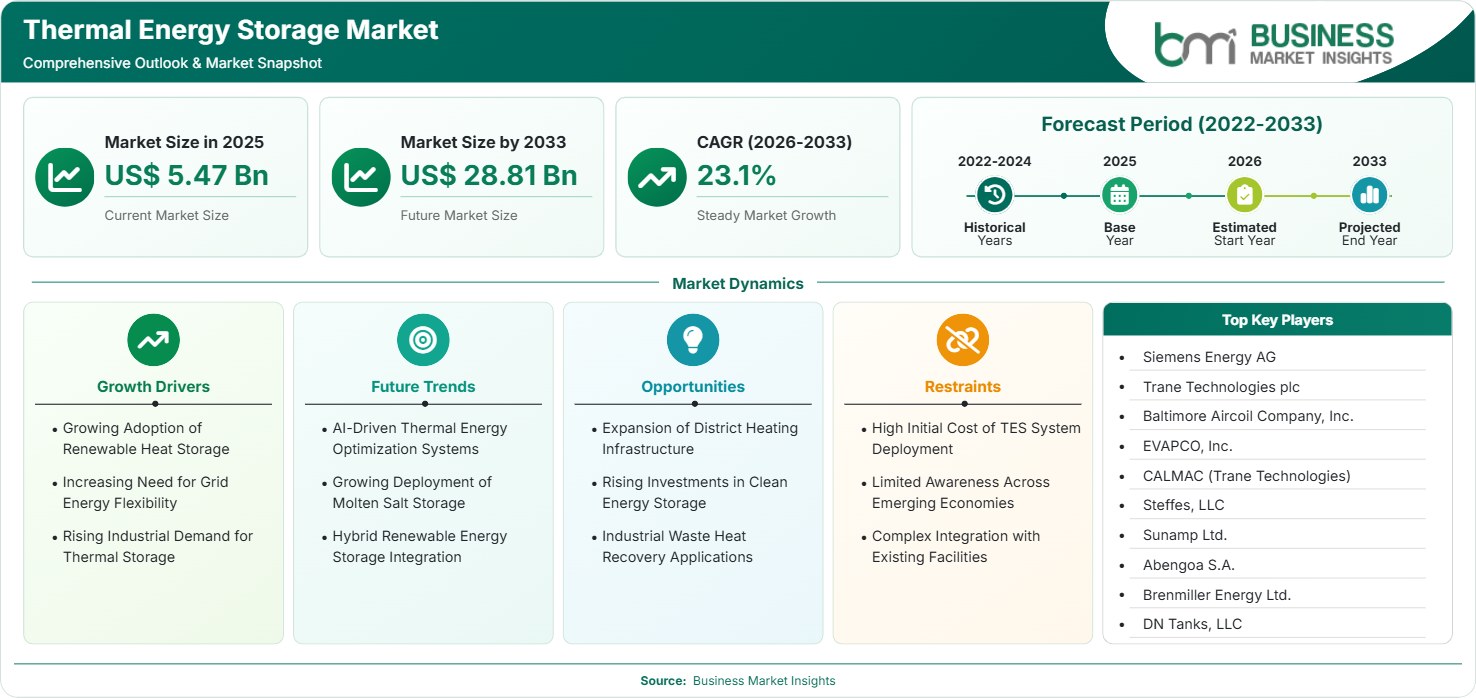
The Thermal Energy Storage Market size was valued at US$ 5.47 billion in 2025 and is projected to reach US$ 28.81 billion by 2033, growing at a CAGR of 23.1% from 2026 to 2033, driven by increasing renewable energy integration, rising demand for grid flexibility, industrial decarbonization initiatives, district heating expansion, and growing deployment of energy-efficient thermal storage technologies.

Report Coverage
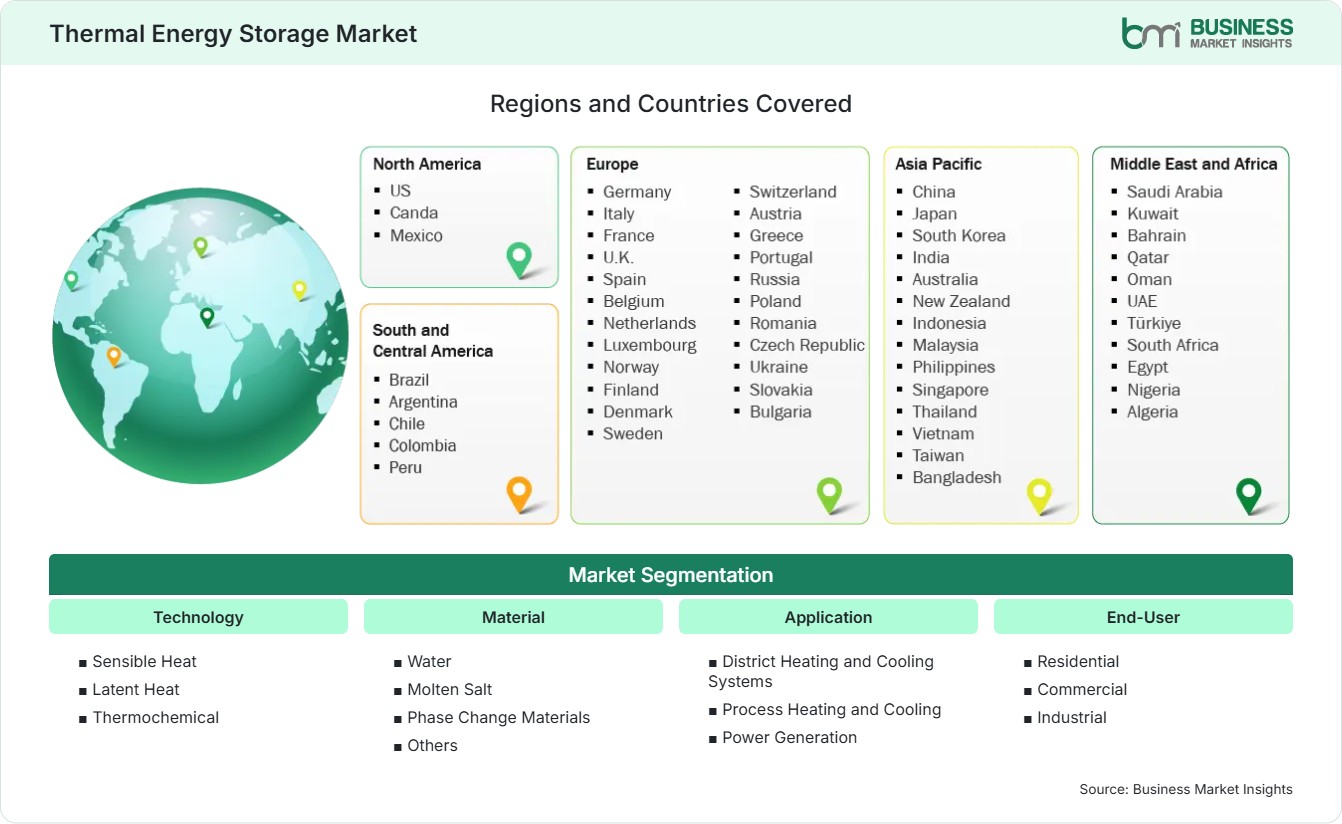
  • Technology: Sensible Heat, Latent Heat, Thermochemical
  • Material: Water, Molten Salt, Phase Change Materials, Others
  • Application: District Heating and Cooling Systems, Process Heating and Cooling, Power Generation
  • End-User: Residential, Commercial, and Industrial
US$ 5.47 Bn Market size in 2025
US$ 28.81 Bn Market Size by 2033
23.1% CAGR, 2026 - 2033
2026-2033 Forecast Period

01 AI Overview

Thermal Energy Storage Market Summary

  • North America Region: North America holds 30%–33% share in 2025, growing with a CAGR of 22.1%–22.8% influenced by renewable energy integration, grid modernization investments, commercial HVAC adoption, and industrial decarbonization initiatives. The US market analysis is projected to expand at a CAGR of 22.4%–23.0% from 2026–2033, supported by federal clean energy incentives, utility-scale storage deployment, and advanced building energy management systems.
  • Fastest Growing Region: Asia Pacific holds 27%–30% share in 2025, expanding with a CAGR of 24.5%–25.3% due to rapid urbanization, renewable power expansion, district cooling projects, industrial electrification, and increasing investments in energy storage infrastructure.
  • Leading Segment: Sensible Heat holds 48%–52% share in 2025, growing with a CAGR of 22.4%–23.0% owing to mature technology, lower installation costs, large-scale district heating applications, and widespread deployment in concentrated solar power facilities.
  • High Growth Segment: Phase Change Materials (PCM) hold 16%–19% share in 2025, expanding with a CAGR of 25.2%–26.0% due to superior energy density, compact storage capability, smart building integration, and increasing adoption across commercial HVAC applications.
  • Key Market Opportunity: Increasing investment in renewable energy storage, industrial waste heat recovery, and district heating modernization is creating long-term opportunities for advanced thermal energy storage technologies across utilities and industrial facilities.
  • Major Market Players: Siemens Energy AG, Trane Technologies plc, Baltimore Aircoil Company, Inc., EVAPCO, Inc., CALMAC (Trane Technologies), Steffes, LLC, Sunamp Ltd., Abengoa S.A., Brenmiller Energy Ltd., and DN Tanks, LLC.
02 Strategic Insights

Thermal Energy Storage Market: Strategic Insights

thermal-energy-storage-market-market-strategic-framework
FREE PDF
Request your free sample
Request free sample
03 Stakeholder View

Key Takeaways

  • The market value chain comprises material suppliers, storage system manufacturers, engineering companies, EPC contractors, utilities, industrial users, and district energy operators working together to improve energy efficiency and renewable integration.
  • The strongest growth opportunities are emerging in district heating, industrial waste heat recovery, renewable power integration, and commercial HVAC systems requiring long-duration thermal storage solutions.
  • Technology innovation is focused on advanced phase change materials, thermochemical storage systems, intelligent energy management software, and modular thermal storage units capable of improving efficiency and operational flexibility.
  • Asia Pacific represents the most attractive long-term investment destination due to accelerating renewable energy deployment, industrial expansion, urban infrastructure projects, and supportive government clean energy policies.
  • Companies are expanding through technology partnerships, demonstration projects, utility collaborations, and investments in next-generation storage materials to strengthen their competitive positioning.
  • Future market leadership will depend on storage efficiency, lifecycle economics, digital system integration, and scalable deployment across industrial, commercial, and utility-scale applications.
04 Geographic Outlook

Thermal Energy Storage Market Regional Highlights

North America Thermal Energy Storage Market

North America accounted for 30%–33% of the Thermal Energy Storage Market share in 2025 and is projected to grow at a CAGR of 22.1%–22.8% from 2026–2033. Strong renewable energy deployment, modernization of electric grids, commercial building decarbonization, and increasing industrial energy efficiency programs continue supporting market expansion. The United States dominates regional demand through utility-scale storage projects, district energy systems, and widespread investment in sustainable infrastructure.

  • The United States continues investing in renewable integration projects requiring thermal storage technologies to improve grid flexibility and optimize electricity consumption.
  • Commercial buildings are increasingly adopting thermal energy storage systems to reduce peak electricity demand and improve HVAC operational efficiency.
  • Industrial facilities are deploying thermal storage technologies to recover waste heat and lower operating costs while supporting sustainability targets.
  • Government incentives for clean energy, energy efficiency, and decarbonization continue accelerating deployment across utilities and commercial sectors.

US Thermal Energy Storage Market

The US accounted for 26%–29% of the market in 2025 and is expected to expand at a CAGR of 22.4%–23.0%, according to Thermal Energy Storage Market Forecasts. Market growth is supported by large-scale renewable energy integration, district cooling developments, industrial decarbonization, and commercial building modernization. Federal incentive programs, utility investments, and private-sector sustainability initiatives continue encouraging adoption of advanced thermal energy storage systems across multiple industries.

  • Utility companies are integrating thermal storage into renewable generation projects to improve grid stability and energy management capabilities.
  • Commercial real estate developers are deploying advanced thermal storage technologies to reduce energy costs and improve building sustainability.
  • Industrial manufacturers are increasing investments in waste heat recovery and thermal storage systems to enhance operational efficiency.
  • Advanced building automation and smart energy management platforms are driving higher adoption of integrated thermal storage solutions.

Europe Thermal Energy Storage Market

Europe accounted for 28%–31% of the Thermal Energy Storage Market share in 2025 and is projected to grow at a CAGR of 22.8%–23.6% from 2026–2033. Strong climate policies, district heating expansion, renewable energy integration, and industrial decarbonization initiatives continue driving market adoption. Germany, Denmark, Sweden, and the Netherlands remain key contributors through investments in seasonal heat storage, smart energy infrastructure, and sustainable heating technologies.

  • Germany is expanding thermal storage deployment through renewable heating projects, industrial decarbonization strategies, and large-scale district energy investments.
  • Denmark continues strengthening seasonal heat storage infrastructure supporting district heating networks integrated with renewable electricity generation.
  • Sweden is increasing adoption of thermal energy storage technologies to improve energy efficiency across residential, commercial, and industrial facilities.
  • The Netherlands is investing in sustainable district heating projects and industrial waste heat recovery systems to reduce carbon emissions.
  • European energy transition policies continue supporting commercialization of advanced thermal storage technologies and long-duration energy storage solutions.

Asia Pacific Thermal Energy Storage Market

Asia Pacific represented 27%–30% share in 2025 and is forecast to register a CAGR of 24.5%–25.3% from 2026–2033, making it the fastest-growing regional Thermal Energy Storage Market. Rapid industrialization, renewable energy expansion, urban infrastructure development, and increasing electricity demand are accelerating deployment of thermal storage technologies. China, India, Japan, South Korea, and Australia remain major investment markets for thermal energy storage systems.

  • China is leading regional deployment through concentrated solar power projects, industrial heat storage, and renewable energy integration initiatives.
  • India is increasing investments in district cooling, industrial energy efficiency, and renewable energy projects requiring thermal storage technologies.
  • Japan is strengthening adoption through smart buildings, energy-efficient infrastructure, and advanced thermal management solutions.
  • South Korea is supporting the Thermal Energy Storage Market expansion through industrial decarbonization programs and next-generation energy storage technology development.
  • Australia is investing in renewable power integration and long-duration thermal storage projects supporting grid reliability improvements.

Rest of World Thermal Energy Storage Market

Rest of World accounted for 10%–13% share in 2025 and is expected to grow at a CAGR of 23.0%–23.8% from 2026–2033. Latin America, the Middle East, and Africa are witnessing increasing adoption due to renewable energy investments, district cooling expansion, and industrial modernization. Countries with strong solar energy resources are actively deploying thermal storage technologies to improve renewable energy utilization.

The Middle East is investing in district cooling infrastructure and concentrated solar power projects, while Latin America is strengthening renewable electricity integration through thermal storage deployment. African markets are gradually adopting thermal storage solutions to improve energy access and industrial efficiency.

  • Saudi Arabia is investing in large-scale renewable energy projects integrating thermal storage technologies to improve grid flexibility.
  • United Arab Emirates is expanding district cooling infrastructure supported by advanced thermal energy storage systems.
  • Brazil is adopting thermal storage for industrial energy optimization and renewable energy integration across utility projects.
  • South Africa is exploring thermal storage technologies to improve grid resilience and support industrial decarbonization initiatives.
  • Regional governments are introducing clean energy programs encouraging deployment of sustainable heating and cooling technologies.
global-market-geography
FREE PDF
Request your free sample
Request free sample
05 Segment Analysis

Thermal Energy Storage Market Segmentation

Technology

Technology segmentation represents the foundation of the Thermal Energy Storage Market, with adoption influenced by storage efficiency, application suitability, and lifecycle economics. The segment accounted for 100% share in 2025 and is projected to grow at a CAGR of 23.1% from 2026–2033. Increasing renewable energy deployment and demand for long-duration energy storage continue driving technological innovation across thermal storage systems.

  • Sensible Heat: Sensible heat technology remains the dominant segment due to proven reliability, cost-effectiveness, simple system architecture, and extensive deployment across district heating and concentrated solar power facilities.
  • Latent Heat: Latent heat storage is gaining adoption through higher energy density, improved storage efficiency, and increasing utilization of advanced phase change materials in commercial buildings.
  • Thermochemical: Thermochemical storage technologies are emerging for long-duration applications requiring high energy density, minimal storage losses, and efficient industrial heat management.

Material

Material segmentation reflects the diversity of storage media used to improve thermal efficiency across heating, cooling, and industrial energy systems. The segment accounted for 100% share in 2025 and is expected to grow at a CAGR of 23.1% from 2026–2033. Material selection depends on storage capacity, operating temperature, energy density, and application-specific performance requirements.

  • Water: Water remains the most widely utilized storage medium due to low cost, high specific heat capacity, operational simplicity, and widespread use in district heating and cooling systems.
  • Molten Salt: Molten salt is extensively used in concentrated solar power plants because of its excellent thermal stability and ability to store high-temperature energy efficiently.
  • Phase Change Materials (PCM): Phase Change Materials improve storage density, reduce system size, and enhance energy efficiency in commercial buildings, industrial facilities, and renewable energy applications.
  • Others: Other storage materials include advanced ceramics, graphite composites, and engineered materials designed for specialized high-temperature and industrial thermal storage applications.

Application

Application segmentation reflects the growing use of thermal energy storage systems across heating, cooling, and power infrastructure. The segment accounted for 100% share in 2025 and is projected to grow at a CAGR of 23.1% from 2026 to 2033. Emerging Thermal Energy Storage Market Trends, such as rising investments in renewable energy integration, industrial energy optimization, and sustainable district energy networks, continue expanding the adoption of thermal storage technologies across multiple end-use applications.

  • District Heating and Cooling Systems: District energy systems represent a major application due to increasing urbanization, smart city development, renewable heat integration, and demand for energy-efficient centralized heating and cooling infrastructure.
  • Process Heating and Cooling: Industrial facilities are deploying thermal energy storage to improve process efficiency, reduce energy consumption, recover waste heat, and optimize production operations across manufacturing industries.
  • Power Generation: Thermal storage supports power generation by improving renewable energy utilization, enhancing grid reliability, reducing curtailment, and enabling dispatchable electricity production from concentrated solar power facilities.

End-User

End-user segmentation demonstrates increasing deployment across residential, commercial, and industrial sectors as organizations prioritize energy efficiency and carbon reduction. The segment accounted for 100% share in 2025 and is expected to register a CAGR of 23.1% from 2026–2033. Rising electrification, decarbonization initiatives, and energy cost optimization continue accelerating investments across all major end-user categories.

  • Residential: Residential adoption is increasing through smart homes, district heating networks, and energy-efficient buildings seeking lower electricity costs and improved renewable energy utilization.
  • Commercial: Commercial buildings are integrating thermal storage with HVAC systems to reduce peak electricity demand, optimize cooling operations, and achieve sustainability objectives.
  • Industrial: Industrial facilities remain major adopters by utilizing thermal storage for waste heat recovery, continuous process optimization, renewable energy integration, and improved operational efficiency.
06 Market Forces

Thermal Energy Storage Market Dynamics

Key Market Drivers

Growing Adoption of Renewable Heat Storage

The rapid deployment of renewable electricity generation is creating greater demand for renewable heat storage technologies capable of balancing intermittent energy production. The storage of thermal energy allows for the ability to store surplus renewable energy and heat for future use, making the process more efficient and decreasing reliance on fossil fuels. European, North American, and Asia-Pacific governments continue to support renewable heating technologies through incentive schemes, carbon reduction targets, and clean energy policies. With utilities now in search of new long-duration energy storage methods, the significance of thermal energy storage is only increasing.

Increasing Need for Grid Energy Flexibility

Increased use of renewable energy sources calls for the development of flexible grid systems that can efficiently deal with the fluctuating energy production. Energy storage via heat offers an economically efficient way to increase demand-side flexibility by shifting heating and cooling loads away from peak periods. The implementation of thermal energy storage is being done in district energy systems and renewable energy plants. Digital energy management platforms and smart grid technologies further enhance operational efficiency, enabling utilities and industries to optimize electricity consumption while reducing operational costs and improving overall system resilience.

Rising Industrial Demand for Thermal Storage

Industrial facilities are increasingly adopting thermal energy storage systems to improve process efficiency, recover waste heat, and reduce energy expenses. Energy-intensive industries such as chemical, food, cement, steel, and manufacturing industries require energy-efficient thermal management systems to support uninterrupted production. Through thermal energy storage, industries can harness surplus energy from processes and utilize it during production cycles, thus reducing their carbon footprints. The increased focus on sustainable practices and decarbonization is prompting companies to invest in advanced thermal energy storage technology.

Key Market Opportunities

Expansion of District Heating Infrastructure

District heating infrastructure is expanding rapidly across developed and emerging economies as governments pursue low-carbon heating solutions. Thermal energy storage improves the efficiency of district heating systems by storing excess thermal energy during low-demand periods and supplying it during peak consumption. Large-scale seasonal storage facilities further enhance renewable heat utilization while reducing fuel consumption and operational costs. Increasing investments in urban infrastructure, smart cities, and sustainable energy systems are expected to generate substantial long-term opportunities for thermal energy storage solution providers.

Rising Investments in Clean Energy Storage

Public and private investments in clean energy storage continue accelerating as countries strengthen renewable energy deployment and grid modernization initiatives. Thermal energy storage complements battery technologies by providing cost-effective long-duration storage for heating and cooling applications. Utilities, industrial operators, and commercial developers are increasingly investing in integrated storage solutions that improve renewable energy utilization and reduce carbon emissions. Continuous technological innovation and supportive government policies are expected to create attractive opportunities for system manufacturers and technology providers throughout the forecast period.

Industrial Waste Heat Recovery Applications

Industrial waste heat recovery is emerging as one of the most promising applications for thermal energy storage technologies. Manufacturing industries generate substantial quantities of unused thermal energy that can be captured, stored, and reused to improve production efficiency. Thermal storage systems enable facilities to reduce fuel consumption, lower operating costs, and minimize greenhouse gas emissions. Growing emphasis on circular economy practices, industrial sustainability, and energy efficiency regulations is expected to drive increased investment in waste heat recovery projects worldwide.

Market Restraints and Challenges

High Initial Cost of TES System Deployment

Factor: Thermal energy storage systems require significant upfront investment for storage materials, engineering design, installation, integration, and supporting infrastructure, particularly in large-scale industrial and utility projects.

Impact: High capital expenditure can delay project implementation and discourage adoption among small and medium-sized enterprises despite attractive long-term operational savings.

Limited Awareness Across Emerging Economies

Factor: Many industrial users, commercial developers, and utilities in emerging economies remain unfamiliar with the long-term operational and economic benefits offered by thermal energy storage technologies.

Impact: Limited technical knowledge and insufficient demonstration projects reduce market penetration and delay investment decisions.

07 Company Analysis

Competitive Landscape

The Thermal Energy Storage Market analysis reflects a competitive environment characterized by global energy technology providers, HVAC solution manufacturers, thermal storage specialists, and engineering companies. Market participants are investing in advanced storage materials, digital energy management platforms, modular thermal storage systems, and integrated renewable energy solutions.

Company Name

Overview

Products and Services relevant to this market

Siemens Energy AG

Global energy technology company providing integrated power generation and energy storage solutions.

Thermal energy storage systems, grid integration solutions, power plant technologies, and energy management services.

Trane Technologies plc

Global climate solutions provider specializing in sustainable heating and cooling technologies.

Thermal storage systems, HVAC solutions, district cooling technologies, and energy optimization services.

Baltimore Aircoil Company, Inc.

Manufacturer of heat transfer and thermal management equipment for industrial and commercial applications.

Thermal storage equipment, cooling towers, heat exchangers, and energy-efficient cooling solutions.

EVAPCO, Inc.

Global supplier of evaporative cooling and thermal management technologies.

Cooling towers, thermal storage equipment, condensers, and industrial heat rejection systems.

CALMAC (Trane Technologies)

Developer of advanced ice-based thermal energy storage technologies.

Ice thermal storage systems, energy storage solutions, building load management, and district cooling applications.

Steffes, LLC

Manufacturer specializing in electric thermal storage and energy management products.

Electric thermal storage systems, residential heating solutions, and commercial energy storage technologies.

Sunamp Ltd.

Clean energy company focused on compact thermal battery technologies.

Phase change material storage systems, thermal batteries, hot water storage, and renewable heat solutions.

Abengoa S.A.

Engineering company with expertise in concentrated solar power and thermal storage technologies.

Molten salt thermal storage systems, CSP solutions, renewable energy engineering, and infrastructure services.

Brenmiller Energy Ltd.

Energy storage technology company developing high-temperature thermal storage systems.

Thermal energy storage solutions, industrial heat storage, renewable integration, and energy optimization technologies.

DN Tanks, LLC

Engineering company specializing in large-scale liquid storage infrastructure.

Thermal water storage tanks, district energy storage infrastructure, and industrial storage solutions.

08 Industry Activity

Recent Developments

November 2025

Rondo Energy & SCG Cleanergy commissioned Southeast Asia's first industrial heat battery at SCG's cement plant in Thailand, enabling continuous clean steam and electricity generation for cement production.

May 2024

Aramco & Rondo Energy signed a Memorandum of Understanding (MoU) to explore gigawatt-scale deployment of thermal energy storage, hydrogen production, and carbon capture technologies across Aramco's global operations.

May 2024

SCG Cleanergy & Rondo Energy began construction of the commercial heat battery at a cement manufacturing plant in Thailand, demonstrating large-scale industrial thermal energy storage.

March 2024

EDP & Rondo Energy formed a strategic partnership to decarbonize industrial heat by integrating renewable power with Rondo Heat Battery systems across Europe.

10 Trust & Transparency

Research Methodology

The market analysis combines proprietary research with secondary data from government agencies, company disclosures, regulatory filings, industry databases and expert interviews. Market estimates are validated through data triangulation, cross-market benchmarking and analyst review.

View Full Research Methodology

11 Questions Answered

Frequently Asked Questions

What does the Thermal Energy Storage Market Report cover?

The Thermal Energy Storage Report provides comprehensive analysis of market size, regional trends, segmentation, competitive landscape, technological developments, investment opportunities, growth drivers, restraints, and future outlook through 2033.

4Which industries are the major end users of thermal energy storage systems?

Industrial facilities, commercial buildings, district energy operators, utilities, and residential developments increasingly utilize thermal energy storage to improve efficiency, reduce operating costs, and lower carbon emissions.

Why is Asia Pacific the fastest-growing regional market?

Asia Pacific is witnessing rapid growth because of expanding renewable energy capacity, industrialization, urban infrastructure development, district cooling projects, and increasing investments in sustainable energy systems.

Which technology segment holds the largest market share?

Sensible Heat remains the leading technology due to its commercial maturity, lower installation cost, operational reliability, and widespread deployment across district heating and concentrated solar power applications.

What is driving the Thermal Energy Storage Market growth?

The market is primarily driven by renewable energy integration, increasing demand for grid flexibility, industrial waste heat recovery, district heating expansion, and growing investments in energy-efficient heating and cooling technologies.

Access the Full Thermal Energy Storage Market Report

Get segment-level forecasts, regional estimates, competitive benchmarking, company profiles and downloadable Excel datasets.

Access the full Thermal Energy Storage Market Report
350 pages PDF & Excel | 2026-08-04