
Solar Energy Storage Battery Market Outlook: Size, Share, Trends, Growth Analysis, Competitive Landscape & Forecast, 2026-2033

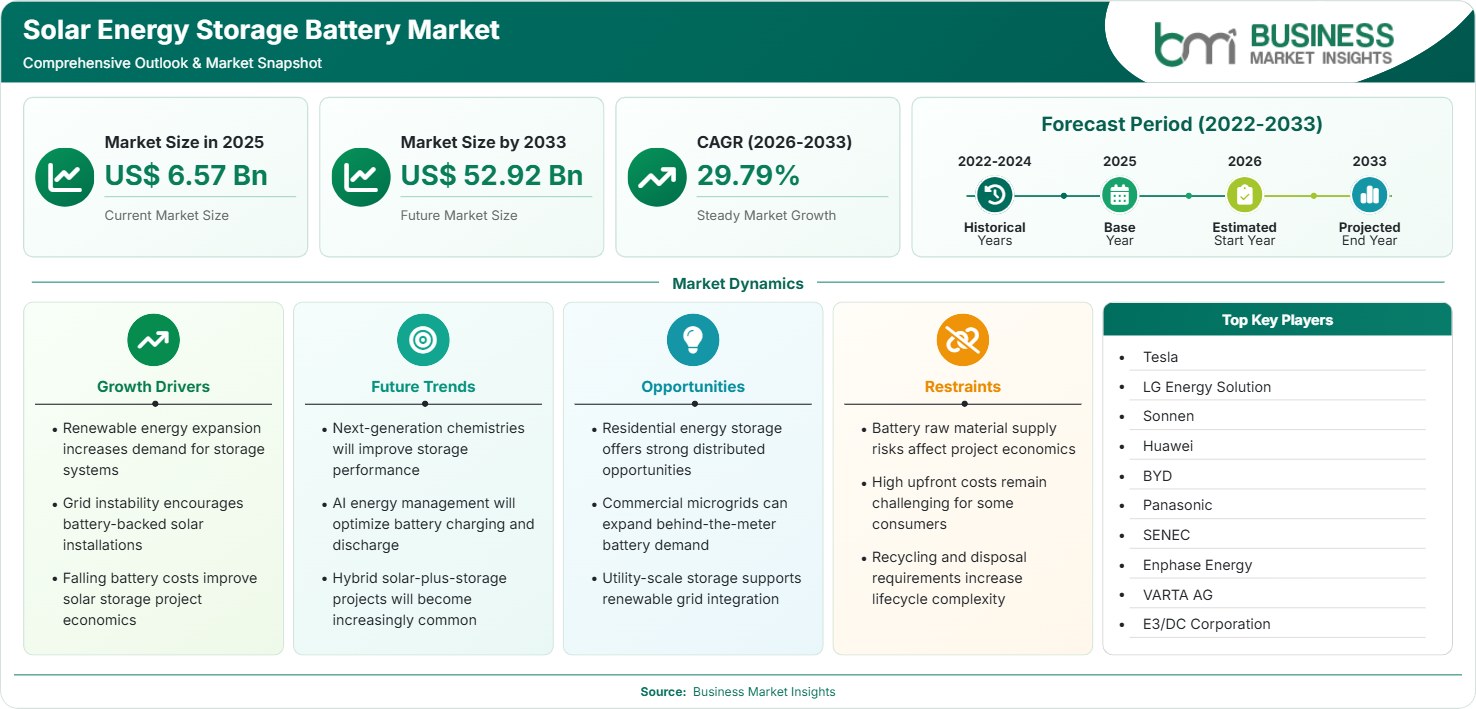
The Solar Energy Storage Battery Market size was valued at USD 6.57 Billion in 2025 and is projected to reach USD 52.92 Billion by 2033, growing at a CAGR of 29.79% during 2026–2033. Rising solar power installations, increasing grid reliability concerns, falling battery costs, and supportive clean energy policies are accelerating adoption. Opportunities are expanding through residential energy independence, commercial microgrids, and utility-scale renewable integration projects.

Report Coverage
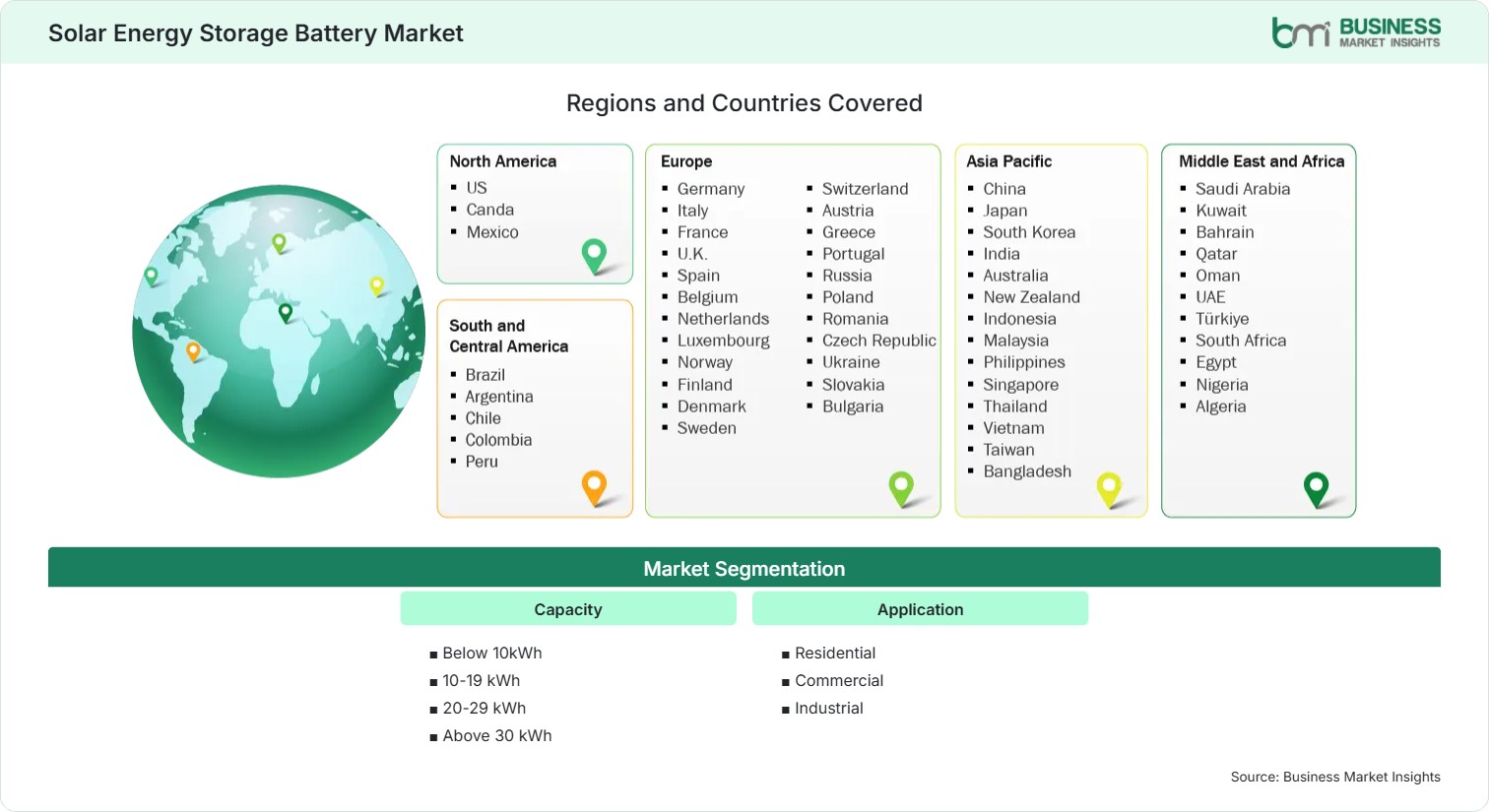
  • Capacity: Below 10kWh, 10-19 kWh, 20-29 kWh, Above 30 kWh
  • Application: Residential, Commercial, Industrial
US$ 6.57 Bn Market size in 2025
US$ 52.92 Bn Market Size by 2033
29.79% CAGR, 2026 - 2033
2026-2033 Forecast Period

01 AI Overview

Solar Energy Storage Battery Market Summary

  • North America Region: North America holds 28%–32% share in 2025, growing with a CAGR of 27.5%–29.2% during 2026–2033. Federal incentives, rising rooftop solar deployment, grid modernization programs, and energy resilience requirements support adoption. The U.S. leads regional demand through advanced residential storage penetration and utility investments, expanding at 27.8%–29.6% CAGR.
  • Fastest Growing Region: Asia Pacific holds 38%–42% share in 2025, growing with a CAGR of 31.5%–33.2% during 2026–2033. Rapid solar capacity additions, urbanization, supportive policy frameworks, and expanding battery manufacturing ecosystems continue driving deployment.
  • Leading Segment: Residential accounts for 46%–50% share in 2025 and is expected to grow at 30.2%–31.8% CAGR. Home energy independence, backup power demand, and rooftop solar adoption continue supporting growth.
  • High Growth Segment: Above 30kWh represents 18%–22% share in 2025 while expanding at 33.1%–35.0% CAGR. Commercial energy management, microgrid development, and large-scale renewable integration drive adoption.
  • Key Market Opportunity: Growing deployment of distributed energy resources and decentralized storage systems enables consumers and businesses to optimize energy consumption, reduce grid dependency, and improve resilience against power disruptions.
  • Major Market Players: Tesla, Inc., LG Energy Solution Ltd., sonnen GmbH, Huawei Technologies Co., Ltd., BYD Company Limited, Panasonic Corporation, SENEC GmbH, Enphase Energy, Inc., VARTA AG, E3/DC GmbH.
02 Strategic Insights

Solar Energy Storage Battery Market: Strategic Insights

Solar Energy Storage Battery Market Strategic Framework
FREE PDF
Request your free sample
Request free sample
03 Stakeholder View

Key Takeaways

  • The ecosystem increasingly connects battery manufacturers, inverter suppliers, solar developers, software providers, utilities, and energy service companies through integrated energy management platforms.
  • Large-capacity battery systems and residential installations present the strongest long-term opportunities due to expanding renewable adoption and reliability requirements.
  • Product innovation is focused on intelligent energy management software, longer-duration storage, advanced battery chemistries, and enhanced safety performance.
  • Asia Pacific remains the most attractive investment region due to large-scale solar deployment, government support, and extensive battery manufacturing capabilities.
  • Strategic partnerships among battery suppliers, solar installers, and utility operators are accelerating commercialization of integrated storage solutions.
  • Energy resilience and backup power capabilities are becoming increasingly important purchasing criteria across residential, commercial, and industrial applications.
04 Geographic Outlook

Solar Energy Storage Battery Market Regional Highlights

North America Solar Energy Storage Battery Market

North America accounted for 28%–32% Solar Energy Storage Battery Market share in 2025 and is projected to expand at 27.5%–29.2% CAGR through 2033. Strong policy support, incentives for clean energy deployment, and increasing concerns regarding power reliability continue driving market development. Residential homeowners, businesses, and utilities are increasingly adopting storage systems to improve energy resilience and reduce dependence on conventional grid infrastructure. Continued investments in renewable energy integration and grid modernization strengthen regional demand.

  • Federal tax incentives and state-level energy initiatives continue supporting battery deployment alongside residential and commercial solar installations.
  • Utilities increasingly deploy energy storage systems to improve grid stability, reduce peak demand pressures, and support renewable integration objectives.
  • Extreme weather events encourage adoption of backup power solutions capable of maintaining electricity availability during outages.
  • Rapid advancements in battery management software improve operational efficiency and overall storage system performance.
  • Growing consumer awareness regarding energy independence supports long-term residential storage demand.

US Solar Energy Storage Battery Market

The United States represents 81%–85% of North American demand and is expected to grow at 27.8%–29.6% CAGR through the forecast period. Strong solar penetration, supportive policy frameworks, and widespread interest in energy resilience continue supporting deployment.

  • Residential solar-plus-storage systems continue gaining popularity among homeowners seeking greater energy autonomy.
  • Utility-scale renewable projects increasingly include battery storage components designed to enhance grid flexibility.
  • Commercial facilities adopt storage systems to manage electricity costs and reduce exposure to peak pricing.
  • Advanced software platforms improve energy management and operational optimization across storage deployments.

Europe Solar Energy Storage Battery Market

Europe held 24%–28% share in 2025 and is projected to grow at 28.4%–30.1% CAGR through 2033. Rising electricity prices, sustainability initiatives, and renewable energy targets continue supporting market expansion. Germany remains the leading regional market, while Poland demonstrates accelerated growth potential due to increasing clean energy investments.

  • Germany leads regional deployment through extensive rooftop solar adoption and strong residential battery penetration.
  • Poland is projected to achieve 30.7%–32.4% CAGR supported by renewable energy expansion and modernization initiatives.
  • Demand for residential energy independence encourages homeowners to invest in battery-backed solar systems.
  • Net-zero objectives continue driving solar and storage investments across residential and commercial sectors.
  • Energy security concerns support growing adoption of distributed energy resources throughout the region.

Asia Pacific Solar Energy Storage Battery Market

Asia Pacific accounted for 38%–42% share in 2025 and is projected to expand at 31.5%–33.2% CAGR, making it the fastest-growing regional market. The strongest Solar Energy Storage Battery Market growth momentum is observed across major economies investing heavily in renewable energy generation, battery manufacturing, and electricity infrastructure modernization. Rising urbanization and growing energy demand continue reinforcing deployment. Manufacturers benefit from strong domestic production capabilities and favorable policy support programs promoting storage adoption.

  • China remains the largest regional market due to significant investments in battery production and renewable energy infrastructure.
  • India is projected to achieve 32.8%–34.5% CAGR supported by expanding solar installations and energy access initiatives.
  • Large-scale renewable integration projects increasingly require battery storage systems to balance supply variability.
  • Growing industrial electricity consumption supports adoption of commercial and industrial storage solutions.
  • Strong battery manufacturing ecosystems improve regional competitiveness and deployment affordability.

Rest of World Solar Energy Storage Battery Market

Rest of World accounted for 6%–10% share in 2025 and is expected to expand at 28.8%–30.5% CAGR through 2033. Demand is supported by electrification initiatives, renewable energy development, and energy security objectives across Latin America, the Middle East, and Africa. Governments and private investors increasingly view battery storage as a critical enabler of renewable energy expansion and grid modernization efforts.

  • Brazil remains the leading Latin American market supported by renewable energy investments and distributed generation growth.
  • Saudi Arabia continues accelerating solar deployment through large-scale clean energy diversification initiatives.
  • Off-grid and hybrid energy projects create significant opportunities for storage deployment across underserved regions.
  • Rising demand for reliable electricity access encourages adoption of solar-plus-storage solutions.
  • Utility modernization programs increasingly integrate battery storage to improve network stability and operational flexibility.
Global Market Geography
FREE PDF
Request your free sample
Request free sample
05 Segment Analysis

Solar Energy Storage Battery Market Segmentation

Capacity

The capacity segment represents a critical factor influencing battery deployment economics, backup duration, and energy management performance. The 10-19kWh segment accounted for 34%–38% share in 2025 and is projected to expand at 30.0%–31.7% CAGR through 2034. The Solar Energy Storage Battery Market scope continues broadening as consumers and businesses seek optimized balance between storage capacity, installation costs, energy independence, and renewable energy utilization efficiency.

  • Below 10kWh: Primarily utilized in smaller residential installations where affordability, backup power support, and self-consumption optimization remain central purchasing considerations.
  • 10-19kWh: Widely adopted for residential energy storage applications requiring reliable backup power, load shifting capabilities, and effective integration with rooftop solar systems.
  • 20-29kWh: Increasingly deployed in larger residential properties and small commercial facilities requiring greater storage capacity and enhanced energy management flexibility.
  • Above 30kWh: Preferred for commercial, industrial, and microgrid applications where significant backup capabilities, energy optimization, and renewable integration requirements drive adoption.

Application 

Application demand continues expanding as end users seek energy resilience, cost optimization, and renewable integration benefits. Residential installations accounted for 46%–50% share in 2025 and are projected to register 30.2%–31.8% CAGR through 2034. Emerging Solar Energy Storage Battery Market trends indicate rising consumer interest in energy independence, backup power availability, and lower electricity dependence.

  • Residential: Homeowners increasingly deploy storage systems to enhance self-consumption, reduce electricity costs, improve energy security, and maximize rooftop solar generation benefits.
  • Commercial: Businesses utilize storage systems to lower peak demand charges, optimize energy usage, improve resilience, and support sustainability objectives.
  • Industrial: Industrial facilities deploy high-capacity battery systems to manage energy-intensive operations, stabilize power supply, and integrate renewable energy resources efficiently.
06 Market Forces

Solar Energy Storage Battery Market Dynamics

Key Market Drivers

Renewable energy expansion increases demand for storage systems

Continuous global expansion of solar generation capacity results in the increasing need for energy storage options which can help to compensate for the uneven production of renewable energy. It is increasingly evident to utilities, businesses, and consumers that storage is an integral part of any renewable energy system. Batteries allow for better solar usage due to storing excess generation and using it at some other time without reliance on traditional power supplies. The Solar Energy Storage Battery Market growth outlook remains strongly aligned with accelerating renewable energy investments, expanding solar generation capacity, and increasing efforts to modernize electricity systems while reducing carbon emissions.

Grid instability encourages battery-backed solar installations

Concerns regarding grid reliability, power outages, and extreme weather events are driving adoption of solar-plus-storage systems worldwide. The need for resilient energy sources that ensure the provision of electrical power even during grid interruptions is becoming more prominent among companies and private consumers. Batteries help provide backup power, improve continuity, and prevent monetary losses from power supply interruptions. Utility companies use batteries to increase grid flexibility and deal with peak loads. Growing awareness of the benefits of energy resilience continues to influence purchase decisions across markets.

Falling battery costs improve solar storage project economics

Declining battery prices continue improving the financial attractiveness of energy storage projects across multiple applications. Developments in technology, manufacturing scalability, and supply chain management have reduced costs and improved availability. The savings on capital investment allow for broader deployment in homes, businesses, and utilities. In addition, advances in battery efficiency and longevity create stronger value propositions throughout the product's life cycle. With the economics becoming more favorable, there is continued rapid deployment of battery storage. This will foster competitive advantages and further promote the use of batteries with renewable energy systems.

Key Market Opportunities

Residential energy storage offers strong distributed opportunities

Residential energy storage represents one of the most dynamic opportunities within the sector as homeowners seek greater control over electricity consumption and reliability. Solar homes are becoming more sophisticated by incorporating batteries into their design to reduce reliance on the grid and make better use of energy consumption patterns. There is increasing consumer awareness of energy independence, which is favorable for future demand. Solution providers that can deliver cost-effective, scalable, and efficient solutions are poised to benefit from market growth.

Commercial microgrids can expand behind-the-meter battery demand

Commercial microgrids offer attractive opportunities for battery suppliers seeking to address business resilience and energy management requirements. Storage systems enable facilities to optimize electricity consumption, manage demand peaks, and reduce operational interruptions. Commercial customers increasingly evaluate distributed energy assets as part of broader sustainability and operational efficiency strategies. Microgrid development across educational institutions, healthcare facilities, data centers, and commercial campuses is expected to support growing battery deployment. These applications create recurring opportunities for integrated storage providers and energy solution developers.

Utility-scale storage supports renewable grid integration

Large-scale renewable installations increasingly require energy storage to support stable electricity delivery and efficient grid balancing. Utility operators continue investing in storage projects capable of managing generation variability and supporting system reliability. Solar Energy Storage Battery Market Forecasts indicate growing investment in utility-scale projects as governments pursue renewable energy targets and modernization objectives. Battery suppliers that develop scalable, safe, and cost-effective storage technologies are expected to benefit from rising procurement activity. Utility demand is likely to remain a key contributor to long-term market development and deployment growth.

Market Restraints and Challenges

Battery raw material supply risks affect project economics

Factor: Battery manufacturing depends heavily on materials such as lithium, nickel, cobalt, and graphite, which can experience supply constraints and price volatility. Impact: Fluctuating material costs can increase battery pricing, affect project returns, and create uncertainty for developers planning long-term investments. Supply disruptions may also influence production schedules and deployment timelines. Manufacturers must therefore strengthen sourcing strategies, diversify supply chains, and improve recycling initiatives to mitigate risks. These challenges remain important considerations for industry participants seeking stable growth and profitability.

High upfront costs remain challenging for some consumers

Factor: Despite improving economics, battery storage installations still require significant initial capital investment, particularly for larger systems. Impact: Cost-sensitive consumers and small organizations may delay adoption despite potential long-term savings benefits. Financing limitations can further influence purchasing decisions in developing regions. Vendors are increasingly developing leasing, financing, and subscription-based models to improve affordability and accessibility. However, upfront expenditure requirements continue representing a challenge that can moderate adoption rates within certain customer segments and geographic markets.

07 Company Analysis

Competitive Landscape

The Solar Energy Storage Battery Market analysis reflects intense competition driven by battery performance, software-enabled energy management, safety standards, storage capacity expansion, and integration with residential and commercial solar systems. Leading participants continue investing in lithium-ion innovation, virtual power plant capabilities, and intelligent energy optimization platforms.

Company Name

Overview

Products and Services Relevant to This Market

Tesla, Inc.

Leading energy storage and electric mobility company with strong residential and utility-scale storage presence.

Powerwall, Megapack, energy management software, solar-plus-storage solutions.

LG Energy Solution Ltd.

Global battery manufacturer with extensive expertise in advanced lithium-ion technologies.

Residential storage batteries, commercial storage systems, lithium-ion battery solutions.

sonnen GmbH

Pioneer in residential energy storage and virtual power plant technologies.

Home energy storage systems, energy management platforms, virtual power plant solutions.

Huawei Technologies Co., Ltd.

Technology provider offering smart photovoltaic and storage integration systems.

Smart energy storage solutions, inverters, digital energy management platforms.

BYD Company Limited

Major battery and renewable energy company with global storage deployment capabilities.

Battery energy storage systems, residential storage products, commercial solutions.

Panasonic Corporation

Diversified technology company with long-standing expertise in battery manufacturing.

Lithium-ion batteries, residential storage solutions, renewable energy systems.

SENEC GmbH

Energy storage specialist focused on residential solar self-consumption solutions.

Home storage batteries, solar integration systems, smart energy management technologies.

Enphase Energy, Inc.

Renewable energy technology provider known for integrated solar and storage architectures.

Energy storage systems, microinverters, monitoring software, home energy solutions.

VARTA AG

European battery manufacturer serving residential and commercial energy storage markets.

Home storage batteries, commercial storage solutions, energy management products.

E3/DC GmbH

German energy storage company specializing in integrated solar and battery solutions.

Residential storage systems, smart home energy platforms, backup power solutions.

10 Trust & Transparency

Research Methodology

The market analysis combines proprietary research with secondary data from government agencies, company disclosures, regulatory filings, industry databases and expert interviews. Market estimates are validated through data triangulation, cross-market benchmarking and analyst review.

View Full Research Methodology

11 Questions Answered

Frequently Asked Questions

What does a Solar Energy Storage Battery Market Report include?

A Market Report typically includes market sizing, technology analysis, growth forecasts, regional assessments, competitive benchmarking, investment opportunities, and industry trends.

How do battery storage systems support renewable energy integration?

Storage systems balance intermittent solar generation by storing excess energy and releasing electricity when production declines or demand increases, improving grid stability.

Why are high-capacity battery systems growing rapidly?

Higher-capacity systems support commercial facilities, industrial operations, microgrids, and large renewable projects requiring extended backup power and advanced energy management capabilities.

Which application segment dominates the market?

Residential applications dominate due to increasing rooftop solar installations, rising electricity costs, demand for backup power solutions, and growing consumer interest in energy independence.

What is a solar energy storage battery?

A solar energy storage battery stores excess electricity generated by solar panels for later use, helping consumers increase self-consumption, improve energy reliability, and reduce dependence on grid electricity.

Access the Full Solar Energy Storage Battery Market Report

Get segment-level forecasts, regional estimates, competitive benchmarking, company profiles and downloadable Excel datasets.

Access the full Solar Energy Storage Battery Market Report
350 pages PDF & Excel | 2026-08-19