Market Summary
Executive Summary and Global Market Analysis
Containerized battery energy storage systems are modular units built in standardized shipping containers for easier deployment. These systems help balance power, integrate renewable energy, manage backup electricity, and stabilize the grid in utility, commercial, and industrial settings. Their compact design simplifies transportation, installation, and maintenance. It also allows for flexible use in remote and urban areas. Energy transition efforts and grid modernization programs are changing how storage infrastructure investments are made around the world. Utilities and industrial operators use containerized solutions to manage intermittent renewable generation and improve electricity reliability. The growing electrification in transportation, manufacturing, and distributed energy networks is also driving the need for large-scale storage systems that can respond quickly and operate flexibly. The choice of battery chemistry and container design impacts buyers' strategies. Lithium-ion systems are commonly selected because of their higher energy density and efficiency. Meanwhile, sodium-based options are becoming more popular due to better material availability and thermal durability. Mid-range and high-capacity systems attract renewable developers and utilities that require scalable energy balancing in limited project areas. Advances in battery management software, thermal control technologies, and integrated safety features are enhancing product capabilities. Smart monitoring platforms now allow for predictive maintenance, real-time diagnostics, and remote asset management. Manufacturers are focusing on standardized modular designs that simplify capacity expansion and lower engineering challenges when deploying in different operating conditions. Technological differences, system integration skills, and long-term service options shape the competitive landscape in the industry. Market players focus on energy efficiency, operational reliability, and lifecycle optimization to strengthen their positions. Collaborations between storage integrators, renewable developers, and infrastructure providers further promote the wider adoption of containerized energy storage solutions in global energy systems.
Segment Analysis
Containerized Battery Energy Storage System Market Segmentation
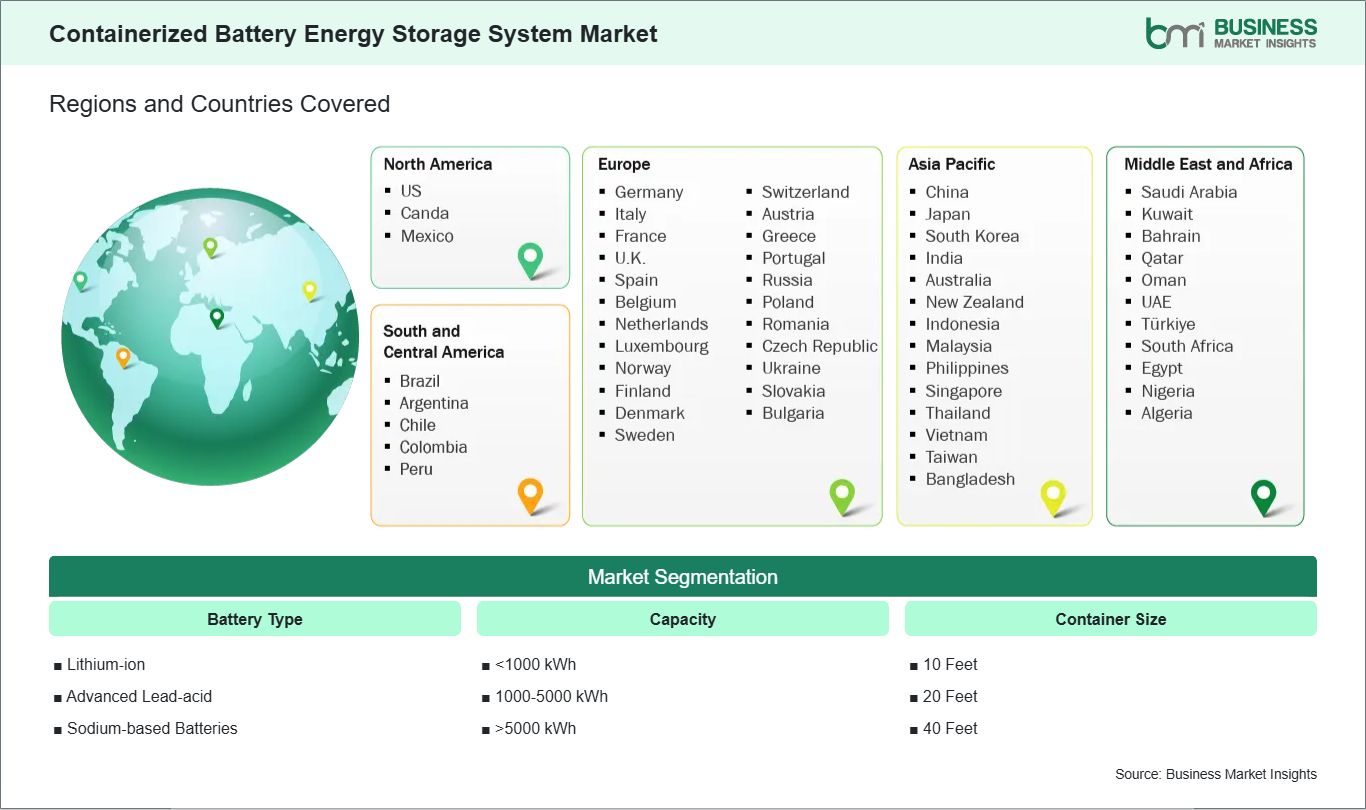
The containerized battery market is categorized by battery type, capacity, and container size, reflecting varied operational requirements across utility and commercial installations.
By Battery Type
- Lithium-ion – Delivers high energy density with advanced operational efficiency.
- Advanced Lead-acid – Supports cost-sensitive installations requiring established battery technologies.
- Sodium-based Batteries – Gains traction through enhanced thermal stability and material accessibility.
By Capacity
- <1,000 kWh – Suitable for localized backup power and smaller distributed applications.
- 1,000-5,000 kWh – Addresses medium-scale renewable integration and industrial balancing requirements.
- 5,000 kWh – Enables utility-scale storage operations supporting grid stabilization activities.
By Container Size
- 10 Feet – Preferred for compact installations with limited deployment space.
- 20 Feet – Balances storage capacity with transportation and installation flexibility.
- 40 Feet – Accommodates high-capacity systems for large-scale energy infrastructure projects.
Market Forces
Containerized Battery Energy Storage System Market Drivers and Opportunities
Expansion of Renewable Energy Integration
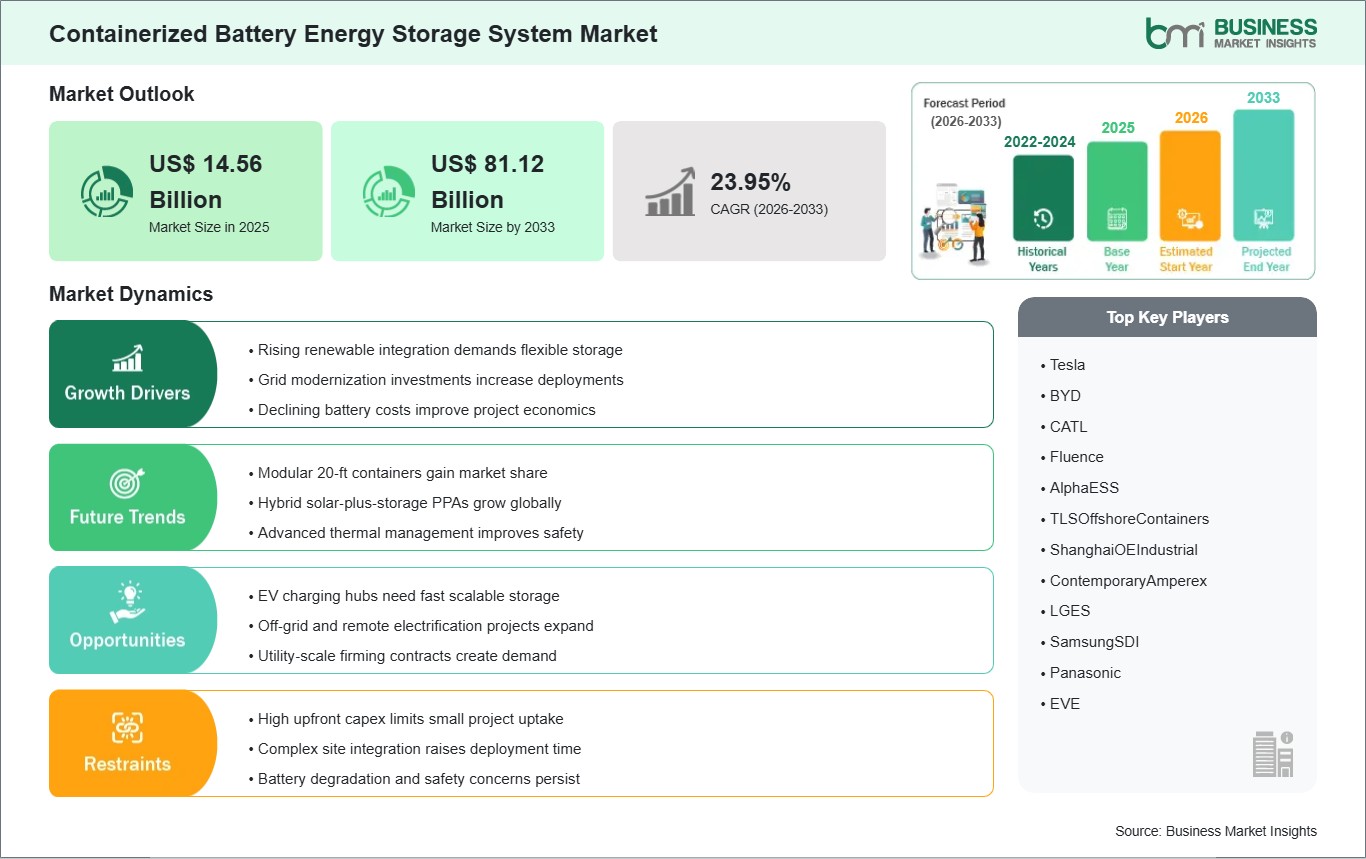
The growth of renewable electricity generation brings operational challenges related to changing power supply patterns. Solar and wind installations need storage systems that can quickly respond to balance energy output during both peak and off-peak times. Containerized battery systems meet these needs with modular deployment models. This allows utilities and industrial operators to improve energy continuity while aiding decentralized electricity networks. As the use of renewable energy increases in developed and emerging economies, storage systems become vital for keeping the grid steady. Containerized systems make it easier to integrate with renewable plants by cutting down on installation complexity and speeding up deployment. Their flexible design also helps upgrade infrastructure in remote areas where traditional grid improvements can be costly or hard to manage.
Deployment Across Microgrid and Off-Grid Infrastructure
Microgrid development is opening new opportunities for compact and transportable energy storage technologies. Industrial facilities, remote communities, and commercial campuses increasingly need localized energy resilience supported by integrated storage solutions. Containerized systems provide flexible scalability and support hybrid energy setups that include solar, wind, and backup generation technologies in isolated operational environments. Future deployment possibilities include critical infrastructure, mining operations, ports, and military facilities looking for stable electricity management systems. Improvements in digital monitoring and modular engineering enhance operational adaptability in different environmental conditions. Increased investment in resilient power networks will likely boost the adoption of containerized battery systems that support decentralized energy infrastructure strategies.
Size and Share Analysis
Containerized Battery Energy Storage System Market Size and Share Analysis
The Containerized Battery Energy Storage System Market is projected to grow from US$ 14.56 Billion in 2025 to US$ 81.12 Billion by 2033 , registering a CAGR of 23.95% from 2026 to 2033. The projected growth shows a rise in the use of renewable energy assets, a need for better grid flexibility, and more modular storage systems in industrial and utility-scale applications. Lithium-ion battery systems are popular because they work efficiently, fit into smaller spaces, and have dependable supply chains. Medium and large-capacity installations attract infrastructure developers seeking scalable storage solutions. These solutions help balance renewable energy, reduce peak demand, and manage backup power in commercial and utility environments. Integrating renewable energy on a large scale is a key focus in the industry. Industrial facilities, energy parks, and grid modernization projects are increasingly using containerized storage systems to enhance electricity reliability and operational efficiency. Larger container setups are also common in projects that require high-capacity storage within centralized energy infrastructure.
Report Coverage
Containerized Battery Energy Storage System Market Report Coverage and Deliverables
The "Containerized Battery Energy Storage System Market Size and Forecast (2022-2033)" report provides a detailed analysis of the market covering below areas:
- Market size and forecast at global, regional, and country levels for all market segments covered under the scope
- Market trends, as well as drivers, restraints, and opportunities
- Market analysis covering key trends, global and regional framework, major players, regulations, and recent developments
- Industry landscape and competition analysis covering market concentration, heat map analysis, prominent players, and recent developments for the Containerized Battery Energy Storage System market
- Detailed company profiles, including SWOT analysis
Geographic Insights
Containerized Battery Energy Storage System Market Geographic Insights
The containerized battery energy storage system market shows different regional patterns influenced by renewable energy goals, updates to electricity infrastructure, and plans for decentralized energy development. Demand changes based on needs for grid stability, industrial electrification efforts, and national energy transition plans. Market growth also reflects increasing interest in reliable power systems that support distributed generation and flexible electricity management. North America has significant deployment activity, driven by large renewable projects and efforts to ensure grid reliability. Energy storage installations are growing in commercial, industrial, and transmission applications. Supportive regulations and modernization efforts promote investments in scalable storage technologies that improve operational flexibility and energy continuity during fluctuating electricity demand. Asia Pacific is seeing strong growth due to extensive renewable energy additions and the development of industrial infrastructure. Countries in the region are improving storage integration to address electricity balancing issues linked to rising solar and wind capacity. Better manufacturing capabilities, developing battery supply chains, and investments in smart grid technologies support the broader use of containerized energy storage solutions. Europe continues to focus on transforming low-carbon infrastructure and stabilizing renewable energy programs. It promotes storage deployment in utility and commercial sectors. Emerging markets in the Middle East, Africa, and South and Central America are gradually adopting containerized storage systems to improve access to electricity and strengthen grid resilience. Efforts to modernize infrastructure and off-grid energy projects are creating long-term opportunities in developing regional markets.
Industry Activity
Recent Developments
The Containerized Battery Energy Storage System market is evaluated by gathering qualitative and quantitative data post primary and secondary research, which includes important corporate publications, association data, and databases. A few of the key developments in the Containerized Battery Energy Storage System market are:
- In September 2025, BYD unveils world’s largest 14.5 MWh DC energy storage system. China’s EV giant unveiled the “HaoHan” – a single-unit DC battery block with record-breaking capacity, aiming to disrupt the next generation of the energy storage market. The company also introduced its proprietary grid-forming inverter and advanced energy management system, designed to complement the HaoHan battery and optimize system performance.
- In June 2025, Tesla (TSLA stock) signed a $556.8 million (¥4 billion) deal with China Kangfu International Leasing and the Shanghai government to build its first grid‑scale Megapack energy storage station in Shanghai.
Trust & Transparency
Research Methodology
The market analysis combines proprietary research with secondary data from government agencies, company disclosures, regulatory filings, industry databases and expert interviews. Market estimates are validated through data triangulation, cross-market benchmarking and analyst
review.
View Full Research Methodology
Key Sources Referred:
World Bank – Global Trade Indicators World Trade Organization (WTO) International Monetary Fund (IMF) International Trade Administration (ITA) Company Websites Company Annual Reports Company Investor Presentations