
Electricity Transmission and Distribution Market Outlook: Size, Share, Trends, Growth Analysis, Competitive Landscape & Forecast, 2022-2033

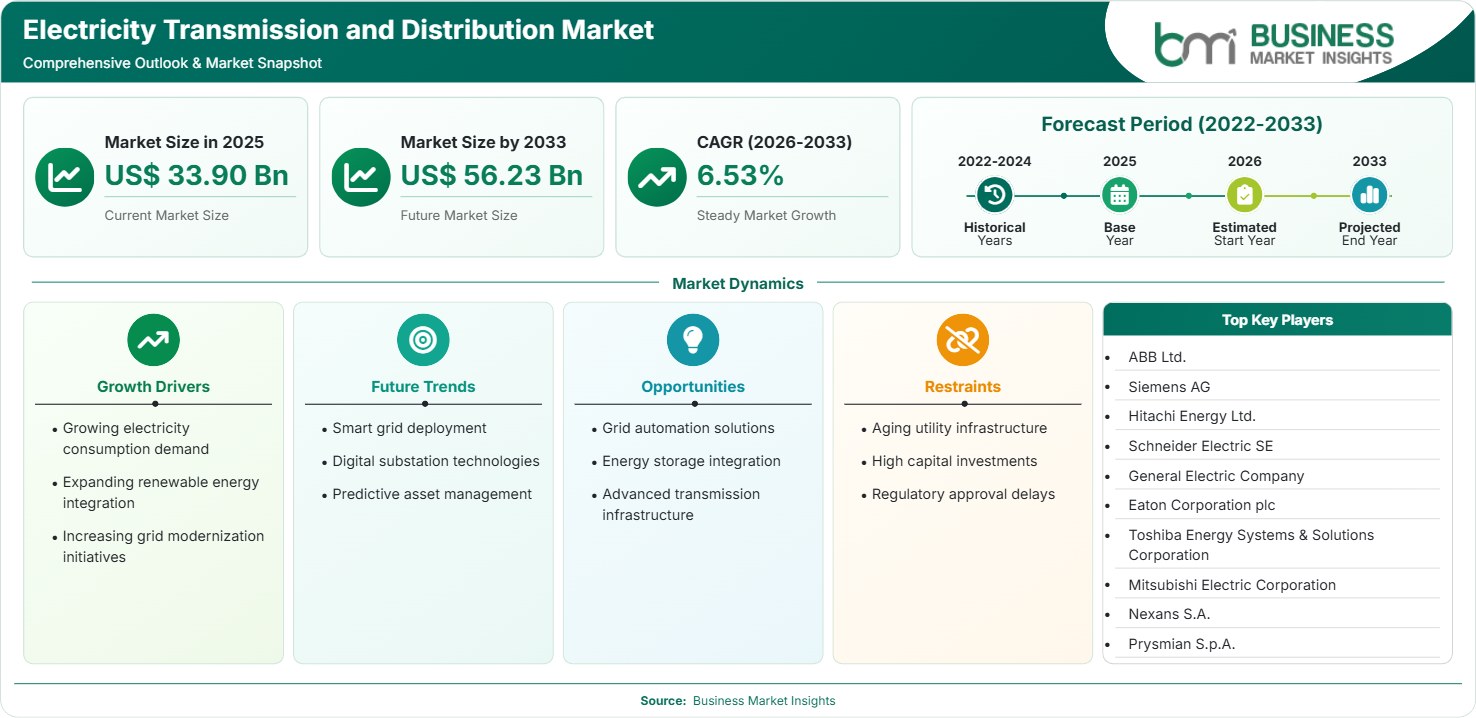
The Electricity Transmission and Distribution Market size was valued at US$ 33.90 billion in 2025 and is projected to reach US$ 56.23 billion by 2033, growing at a CAGR of 6.53% during 2026–2033. Growing electricity consumption demand, expanding renewable energy integration, and increasing grid modernization initiatives are accelerating market expansion, while grid automation solutions, energy storage integration, and advanced transmission infrastructure create long-term investment opportunities.

Report Coverage
  • Component: Equipment, Services
  • End-user: Electric Utility, Industrial, Renewables
US$ 33.90 Bn Market size in 2025
US$ 56.23 Bn Market Size by 2033
6.53% CAGR, 2026 - 2033
2026-2033 Forecast Period

AI Overview

Electricity Transmission and Distribution Market Summary

  • North America: North America holds 31%–34% electricity transmission and distribution market share in 2025 and is projected to grow at a CAGR of 6.1%–6.9% during 2026–2033. Ongoing transmission upgrades, smart grid deployment, and renewable energy integration continue strengthening regional demand. The U.S. market is expected to expand at a CAGR of 6.2%–7.0% through 2033.
  • Fastest Growing Region: Asia Pacific accounts for 34%–37% of the market in 2025 and is forecast to register the highest CAGR of 7.1%–7.9% during 2026–2033. Rapid urbanization, expanding electricity networks, and significant investments in transmission infrastructure continue driving regional growth.
  • Leading Segment: Equipment represents 68%–71% market share in 2025 and is anticipated to grow at a CAGR of 6.4%–7.2% during the forecast period. Increasing deployment of transformers, switchgear, substations, and transmission cables supports segment leadership.
  • High Growth Segment: Renewables accounts for 22%–25% market share in 2025 and is projected to register a CAGR of 7.6%–8.4% through 2033. Rising renewable energy capacity additions and expanding grid connectivity projects continue accelerating adoption.
  • Key Market Opportunity: Investments in digital substations, intelligent transmission networks, grid-scale energy storage, and advanced monitoring technologies are creating substantial opportunities for equipment manufacturers and utility solution providers.
  • Major Market Players: ABB Ltd., Siemens AG, Hitachi Energy Ltd., Schneider Electric SE, General Electric Company, Eaton Corporation plc, Toshiba Energy Systems & Solutions Corporation, Mitsubishi Electric Corporation, Nexans S.A., Prysmian S.p.A.
Strategic Insights

Electricity Transmission and Distribution Market: Strategic Insights

Electricity Transmission and Distribution Market Strategic Framework
FREE PDF
Request your free sample
Request free sample
Stakeholder View

Key Takeaways

  • The electricity transmission and distribution market value chain continues evolving through equipment manufacturing, engineering services, system integration, transmission and distribution infrastructure development, grid operation, digital monitoring, asset management, and lifecycle maintenance solutions, enabling greater efficiency, reliability, and long-term grid resilience.
  • Renewable energy integration presents the strongest long-term growth opportunity as utilities expand transmission capacity and modernize grid infrastructure to connect large-scale solar, wind, hydroelectric, and other renewable energy generation facilities while supporting decarbonization initiatives and increasing electricity demand.
  • Innovation in digital substations, intelligent sensors, AI-based grid analytics, predictive maintenance, IoT-enabled monitoring, and advanced automation technologies is significantly improving network reliability, operational efficiency, asset utilization, fault detection, and real-time grid management capabilities.
  • Asia Pacific offers the strongest investment potential due to extensive transmission and distribution expansion, rapid urbanization, accelerating electrification, increasing renewable energy deployment, and government-supported grid modernization programs aimed at strengthening energy security and supporting sustainable economic growth.
  • Strategic partnerships among utilities, transmission equipment manufacturers, engineering firms, technology providers, and digital solution vendors continue accelerating the deployment of next-generation power infrastructure, fostering innovation in smart grid technologies, enhancing operational performance, and supporting the transition toward resilient, efficient, and low-carbon electricity networks.
Geographic Outlook

Electricity Transmission and Distribution Market Regional Highlights

North America Electricity Transmission and Distribution Market

North America accounts for 31%–34% of the global market in 2025 and is projected to expand at a CAGR of 6.1%–6.9% through 2033. Modernization of aging transmission infrastructure, increasing renewable integration, and investments in smart grid technologies continue supporting regional growth. The Electricity Transmission and Distribution Market share remains strong because utilities continue investing in grid resilience and digital infrastructure.

  • Smart grid investments improve network efficiency and resilience.
  • Renewable energy integration increases transmission infrastructure demand.
  • Digital substations support real-time grid monitoring capabilities.
  • Government funding accelerates utility modernization initiatives.

US Electricity Transmission and Distribution Market

The United States dominates regional revenue and is expected to register a CAGR of 6.2%–7.0% during the forecast period. Federal infrastructure investments, growing electricity demand, expanding renewable generation, and replacement of aging transmission assets continue driving sustained Electricity Transmission and Distribution market growth.

  • Transmission expansion supports renewable energy deployment.
  • Utility digitalization strengthens operational efficiency.
  • Advanced monitoring technologies improve grid reliability.

Europe Electricity Transmission and Distribution Market

Europe represents 26%–29% of the global market in 2025 and is projected to grow at a CAGR of 6.0%–6.8% during 2026–2033. Germany leads regional investments, while Spain records the fastest growth supported by renewable energy expansion, cross-border transmission projects, and smart grid deployment.

  • Cross-border interconnections strengthen regional energy security.
  • Germany leads smart grid modernization investments.
  • Spain expands renewable transmission infrastructure rapidly.
  • Grid digitalization enhances operational flexibility.

Asia Pacific Electricity Transmission and Distribution Market

Asia Pacific accounts for 34%–37% of global revenue in 2025 and is expected to register the fastest CAGR of 7.1%–7.9% through 2033. China dominates regional demand, while India records the highest growth due to rapid urbanization, industrialization, renewable integration, and extensive power transmission investments.

  • Grid expansion supports rising electricity demand.
  • Renewable integration accelerates transmission upgrades.
  • Smart city development increases distribution investments.
  • High-voltage transmission projects strengthen grid capacity.

Rest of World Electricity Transmission and Distribution Market

The Rest of World region accounts for 8%–10% of the global market in 2025 and is projected to grow at a CAGR of 5.8%–6.6% during the forecast period. Brazil, Saudi Arabia, and South Africa continue investing in electricity infrastructure expansion, rural electrification, and renewable energy connectivity to improve long-term grid reliability.

  • Rural electrification projects expand distribution networks.
  • Utility modernization supports energy access improvements.
  • Renewable investments strengthen transmission connectivity.
  • Infrastructure development enhances long-term grid resilience.
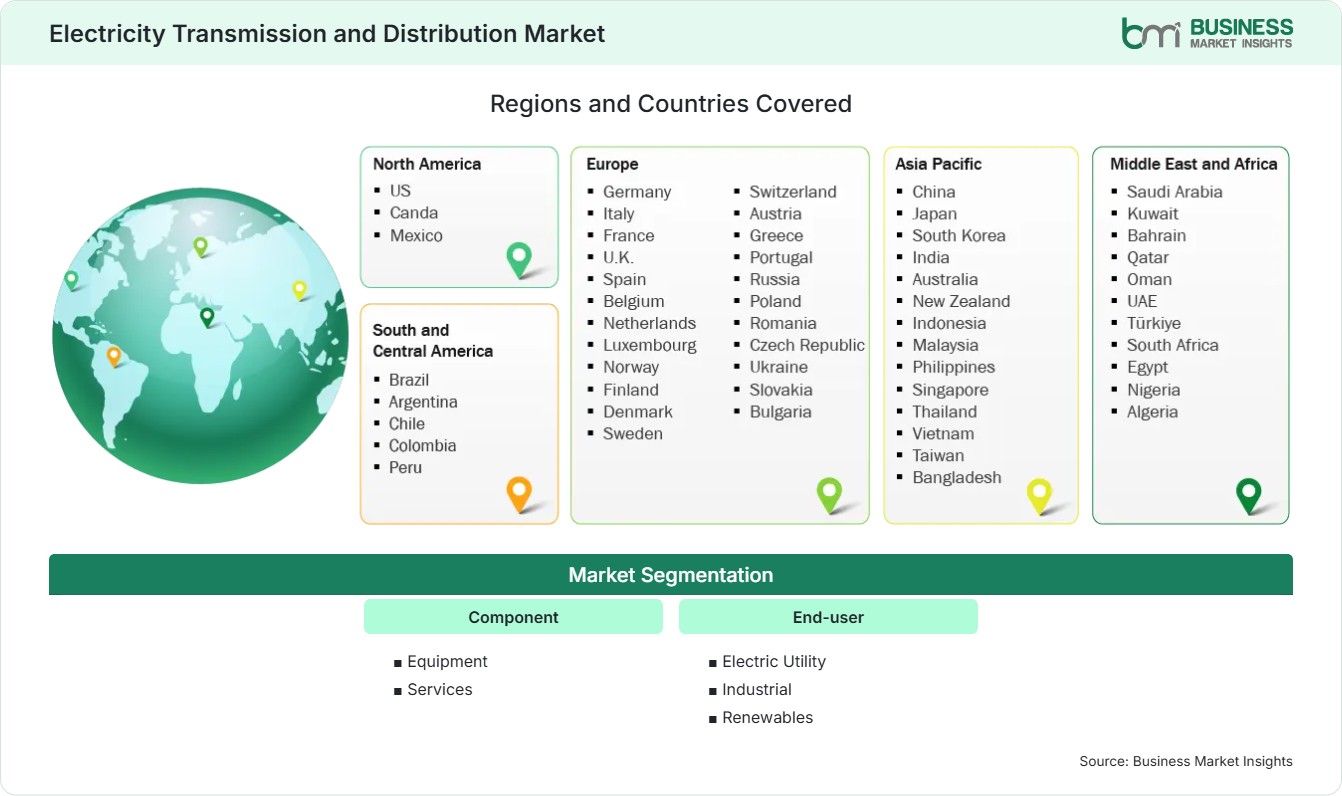
Global Market Geography
FREE PDF
Request your free sample
Request free sample
Segment Analysis

Electricity Transmission and Distribution Market Segmentation

Component

The Component segment accounted for 68%–71% of the overall market in 2025 and is projected to grow at a CAGR of 6.4%–7.2% during 2026–2033. Continuous investments in transmission expansion, distribution network modernization, and digital grid infrastructure are supporting sustained demand across developed and emerging economies. Utilities are deploying advanced transformers, switchgear, substations, transmission cables, protection systems, and intelligent monitoring equipment to improve grid reliability, reduce transmission losses, and strengthen network resilience. Increasing renewable energy integration and rising electricity demand are further encouraging utilities to upgrade aging infrastructure with digitally connected and highly efficient transmission and distribution assets.

  • Equipment: Equipment dominates the market owing to extensive deployment of transformers, switchgear, substations, transmission lines, protection relays, circuit breakers, and digital monitoring systems that support grid expansion, reliability enhancement, renewable energy integration, and efficient electricity transmission across utility networks.
  • Services: Services continue to witness strong demand through engineering, procurement, installation, commissioning, maintenance, asset management, system integration, consulting, and predictive monitoring solutions that enable utilities to maximize operational efficiency, improve asset performance, and extend infrastructure lifecycle.

End-user

End-users constituted 57%-60% share in the market in 2025 and are estimated to grow at a CAGR of 6.6%-7.4% from 2026 to 2033. Growing power consumption, industrial electrification, the growth of renewable energy generation, and the modernization of the grid through government-sponsored initiatives will continue to attract investment from various end-users. In the Electricity Transmission and Distribution Market Trends, it is evident that intelligent substations, grid automation, digital asset management software, and other advanced energy management solutions are increasingly adopted by various organizations.

  • Electric Utility: Electric utilities have continued to make major, ongoing investments in transmission line expansion, distribution system modernization, grid automation, digital substations, and infrastructure replacement aimed at improving and increasing efficiency, reliability, and future energy security.
  • Industrial: Industries have been investing heavily in electricity transmission and distribution infrastructure to ensure an uninterrupted energy supply, improve efficiency, minimize energy losses, enable large-capacity production processes, and support efficient energy management.
  • Renewables: Renewable energy firms continue to invest in transmission infrastructure for their energy projects, including high-voltage substations, transmission lines, grid integration technology, battery energy storage systems, and smart distribution systems.
Market Forces

Electricity Transmission and Distribution Market Dynamics

Key Market Drivers

Growing electricity consumption demand

Rapid urbanization, industrial expansion, population growth, increasing electrification of transportation, and rising deployment of digital infrastructure continue to drive global electricity consumption. Expansion of data centers, manufacturing plants, commercial buildings, and residential areas necessitates dependable electricity transmission and distribution infrastructure that can provide a continuous supply of electricity. This is why utilities are upgrading their transmission corridor technology, substations, and distribution networks to increase efficiency, reduce transmission losses, enhance grid stability, and meet growing electricity demand.

Expanding renewable energy integration

The rapid development of solar, wind, hydroelectric, and other renewable energy sources necessitates an upgrade to the transmission system to cope with the intermittent nature of energy production and ensure stable grid operation. Transmission systems are increasingly being developed to integrate new renewable energy sources into the current electrical power system through high-voltage transmission lines, digital substations, flexible distribution grids, and intelligent grid control.

Increasing grid modernization initiatives

There is an increase in investments by governments and utilities in technologies such as smart grids, digital substations, advanced metering infrastructure, artificial intelligence-based monitoring systems, and predictive maintenance systems. The upgrades have improved efficiency, increased grid visibility, reduced outages, enhanced cybersecurity, and enabled faster responses to changes in power demand. There is a consistent replacement of old power networks with digitally connected ones, thus providing steady demand for transmission and distribution systems.

Key Market Opportunities

Grid automation solutions

The rapid adoption of intelligent automation technologies presents major opportunities for equipment suppliers, software developers, and utility solutions providers, according to the Electricity Transmission and Distribution market forecasts. AI, Internet of Things, sensors, analytics, digital twins, and automated control systems enable utilities to streamline electricity flows, detect malfunctions, reduce maintenance costs, and improve network efficiency. The growing number of automated substations and grid monitoring technologies should further the digitalization of electricity transmission and distribution networks worldwide.

Energy storage integration

Growing investments in battery energy storage systems are transforming electricity transmission and distribution infrastructure by improving grid flexibility, balancing intermittent renewable power generation, and supporting peak demand management. The electricity grid has been made reliable through the application of large-scale battery storage technology, along with transmission and distribution systems, which will ensure that no curtailment of renewable energy production occurs, that voltage and frequency deviations are controlled, and that the resilience of the whole electricity grid system is increased. These latest battery technologies will ensure that the electricity grid is stabilized, loaded efficiently, and renewable energies are integrated. Declining battery prices, supportive government policies, and investment in smart grid technologies are creating many opportunities for equipment manufacturers and other players in the field.

Advanced transmission infrastructure

The increased investments in high-voltage direct current transmission systems, flexible AC transmission system technologies, smart substations, smart transformers, and robust power corridors continue to present significant opportunities within the electricity transmission infrastructure market segment. The focus of government entities and utilities on transmission infrastructure projects that will enhance long-distance power transmission, enable renewable integration, reduce transmission losses, and facilitate electricity trade is increasing.

Market Restraints and Challenges

Aging utility infrastructure

Factor: Many electricity transmission and distribution systems continue operating with aging transformers, substations, overhead transmission lines, underground cables, and distribution assets that require extensive modernization to meet evolving electricity demand and renewable integration requirements. Impact: Aging infrastructure increases maintenance costs, raises the likelihood of power outages, reduces operational efficiency, limits renewable energy connectivity, and forces utilities to undertake costly replacement and modernization programs that require long implementation timelines.

High capital investments

Factor: Construction of transmission corridors, digital substations, smart grid infrastructure, high-voltage equipment, and advanced monitoring systems requires significant financial investment, specialized engineering expertise, lengthy regulatory approvals, and complex project execution. Impact: High capital expenditure requirements may delay infrastructure expansion, limit modernization projects for financially constrained utilities, increase investment risks, and extend project completion timelines, particularly in developing economies facing budgetary and financing constraints.

Company Analysis

Competitive Landscape

The competitive Electricity Transmission and Distribution market analysis is characterized by continuous investments in smart grid technologies, digital substations, transmission automation, and innovative power transmission infrastructure. Top players are consolidating their positions in the industry by developing new products, establishing partnerships, modernizing utilities, and expanding high-voltage transmission solutions. Growth in renewable energy, digitalization of the grid, and asset management fuel competition among top equipment and technology providers worldwide.

Company Name

Overview

Products and Services Relevant to this Market

ABB Ltd.

Global technology leader providing electrification, automation, and digital energy infrastructure solutions.

High-voltage switchgear, transformers, substations, grid automation systems, digital monitoring solutions.

Siemens AG

Multinational engineering company offering advanced power transmission and smart grid technologies.

Digital substations, grid automation, transmission equipment, energy management software, protection systems.

Hitachi Energy Ltd.

Global provider of sustainable power technologies and electricity infrastructure solutions.

HVDC systems, transformers, substations, grid integration technologies, power quality solutions.

Schneider Electric SE

Energy management and automation company serving global utility and industrial sectors.

Smart grid platforms, distribution equipment, automation software, digital energy management solutions.

General Electric Company

Industrial technology company delivering advanced power transmission infrastructure worldwide.

Grid solutions, transmission equipment, digital substations, protection and control technologies.

Eaton Corporation plc

Power management company specializing in electrical infrastructure and grid reliability.

Circuit breakers, switchgear, power distribution equipment, electrical protection systems, utility solutions.

Toshiba Energy Systems & Solutions Corporation

Provider of integrated energy infrastructure and transmission technologies.

Transformers, transmission equipment, substations, power system engineering, grid modernization solutions.

Mitsubishi Electric Corporation

Global manufacturer of advanced electrical and energy management systems.

Power transformers, switchgear, transmission control systems, smart grid technologies.

Nexans S.A.

Global cable manufacturer serving utility and infrastructure markets.

High-voltage transmission cables, underground cable systems, grid connectivity solutions.

Prysmian S.p.A.

International supplier of cable and energy transmission solutions.

Power transmission cables, submarine cables, distribution networks, renewable grid connection solutions.

Industry Activity

Recent Developments

June 2025

Statnett, in collaboration with Energinet, Fingrid, and Svenska kraftnät, published the Nordic Grid Development Perspective 2025, outlining planned transmission network investments and strategic initiatives to strengthen cross-border electricity infrastructure and support regional electrification.

May 2025

Hitachi Energy announced contracts with Statnett to deliver Norway's first SF₆-free EconiQ transmission grid connection solution in the Greater Oslo area, supporting grid modernization and improving the reliability of electricity transmission infrastructure.

March 2025

Svenska kraftnät announced the postponement of its planned intraday electricity market trading initiative, which is being developed jointly with Fingrid and Energinet to reduce wear on the Fenno-Skan and Konti-Skan HVDC interconnectors and improve cross-border transmission operations.

March 2025

Statnett, together with Energinet, Fingrid, and Svenska kraftnät, confirmed the launch of the automated Nordic mFRR Energy Activation Market (mFRR EAM), introducing 15-minute automated balancing to enhance the efficiency and flexibility of the Nordic electricity transmission system.

Trust & Transparency

Research Methodology

The market analysis combines proprietary research with secondary data from government agencies, company disclosures, regulatory filings, industry databases and expert interviews. Market estimates are validated through data triangulation, cross-market benchmarking and analyst review.

View Full Research Methodology

Questions Answered

Frequently Asked Questions

What future opportunities are expected to support Electricity Transmission and Distribution market growth?

Major opportunities include grid automation solutions, battery energy storage integration, advanced transmission infrastructure, digital substations, intelligent asset management systems, and high-voltage transmission technologies supporting renewable energy integration.

Who are the leading companies operating in the market?

Key companies include ABB Ltd., Siemens AG, Hitachi Energy Ltd., Schneider Electric SE, General Electric Company, Eaton Corporation plc, Toshiba Energy Systems & Solutions Corporation, Mitsubishi Electric Corporation, Nexans S.A., and Prysmian S.p.A.

Which component dominates the market?

The Equipment segment leads the market with a 68%–71% share in 2025 owing to substantial demand for transformers, switchgear, substations, transmission lines, digital monitoring systems, and power distribution infrastructure.

Which region dominates the market?

Asia Pacific holds the largest regional share of 34%–37% in 2025, supported by extensive grid expansion projects, rapid urbanization, industrial growth, renewable energy investments, and government-backed electricity infrastructure modernization programs.

What factors are driving the Electricity Transmission and Distribution Market?

The market is driven by growing electricity consumption, increasing renewable energy integration, expanding smart grid deployment, modernization of aging utility infrastructure, and rising investments in digital transmission and distribution technologies.

Access the Full Electricity Transmission and Distribution Market Report

Get segment-level forecasts, regional estimates, competitive benchmarking, company profiles and downloadable Excel datasets.

Access the full Electricity Transmission and Distribution Market Report
350 pages PDF & Excel | 2026-07-29