Market Summary
Executive Summary and Global Market Analysis
Power distribution units are electrical devices that distribute, monitor, and manage power delivery from a primary source to multiple downstream loads within controlled environments. They are widely used where equipment density, uptime expectations, and power visibility require more structured distribution architecture than standard outlets or panels can provide. Their function now extends beyond basic delivery, especially in environments where monitoring, switching, and energy oversight influence operational reliability. This makes the category increasingly relevant across digital infrastructure and power-sensitive enterprise facilities.
Market progression is closely connected to the expansion of data-intensive environments and the need for more resilient internal power architecture. Telecom and IT sites, financial institutions, healthcare facilities, manufacturing operations, and public-sector installations are all increasing their attention to uninterrupted power distribution and better load management. As computing density rises and operational continuity becomes more critical, procurement is shifting toward PDUs that offer stronger visibility, control, and adaptability. This transition is reinforcing the value of both conventional and intelligent unit configurations.
Segmentation trends reveal a market shaped by installation format, monitoring capability, and load environment. Basic units continue to serve essential distribution needs, while metered and intelligent configurations are gaining stronger relevance where operators need granular power insight and remote management. Three-phase systems remain especially important in larger commercial and industrial settings because they suit higher-capacity electrical loads and scalable deployment requirements. Rack-mounted designs also occupy a prominent role due to their fit with data center and equipment room infrastructure.
Technology development is moving toward networked monitoring, compact high-density outlet design, and more flexible deployment options. Vendors are increasingly emphasizing remote visibility, environmental monitoring, outlet-level intelligence, and scalable form factors that support changing rack and facility layouts. These advances improve both operational control and energy management in complex installations. The sector is therefore evolving from passive distribution hardware into more connected infrastructure for digital power oversight.
Competitive dynamics are being shaped by intelligent product portfolios, energy-aware features, and solutions tailored to mission-critical environments. Suppliers are competing through outlet innovation, improved interoperability, and greater flexibility in how units are configured and expanded. The market consequently reflects a broader shift toward smarter, more adaptable power distribution ecosystems rather than standardized hardware-only offerings.
Segment Analysis
Power Distribution Unit Market Segmentation
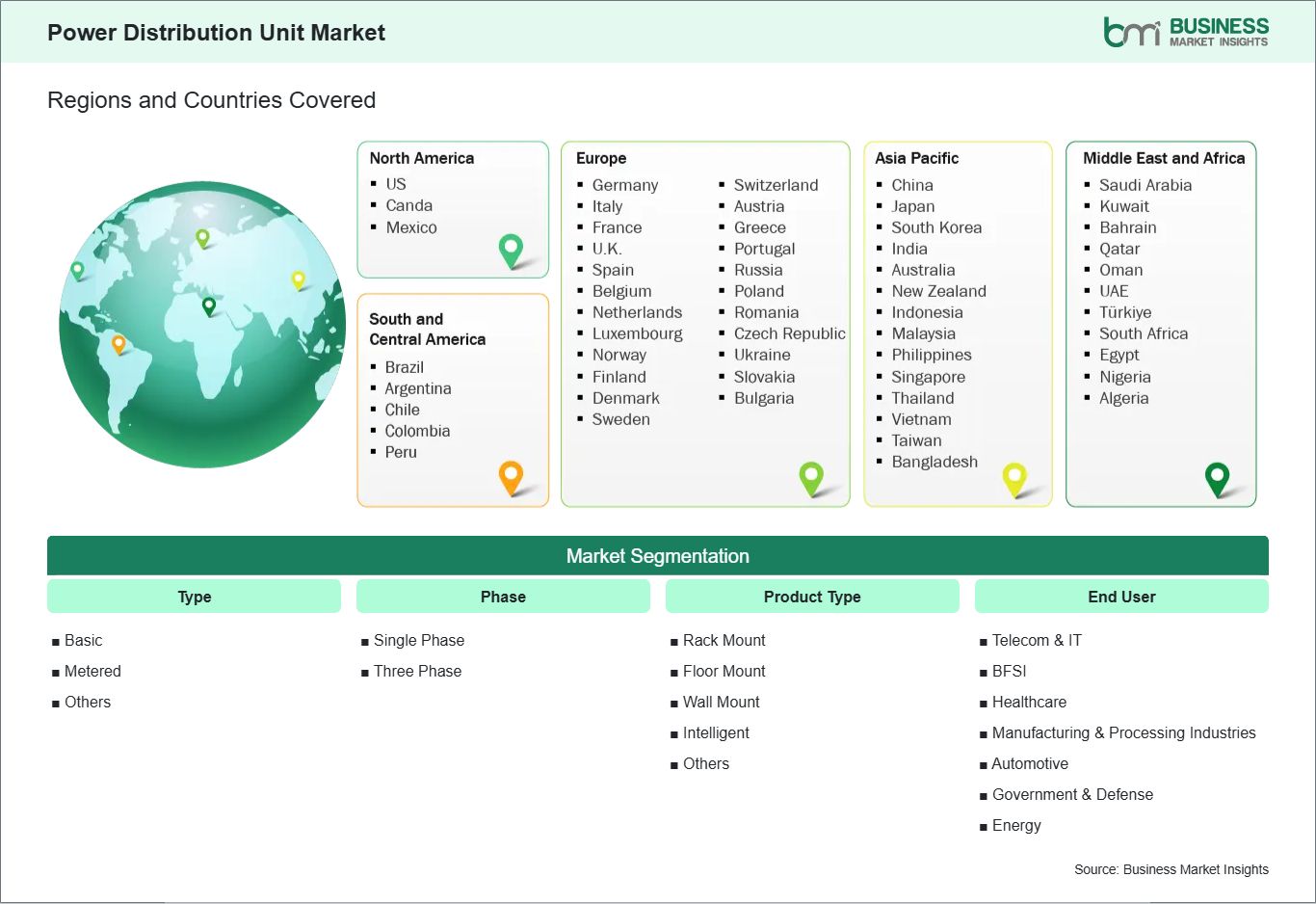
The Power Distribution Unit Market is segmented based on type, phase, product type, end user, highlighting distinct operational priorities and evolving deployment strategies across various end uses.
By Type
- Basic: Delivers straightforward power distribution for stable operational environments.
- Metered: Adds load visibility for better energy tracking and capacity planning.
- Others: Includes monitored, switched, and advanced configurable unit variants.
By Phase
- Single Phase: Fits lighter-duty installations with moderate power requirements.
- Three Phase: Supports dense infrastructure and higher-capacity load environments.
By Product Type
- Rack Mount: Aligns with server, network, and equipment rack deployments.
- Floor Mount: Serves larger installations requiring standalone power distribution placement.
- Wall Mount: Conserves floor space in constrained technical environments.
- Intelligent: Enables remote monitoring, switching, and operational insight.
- Others: Covers specialized product formats for site-specific deployment needs.
By End User
- Telecom & IT: Requires structured power distribution for uptime-sensitive digital infrastructure.
- BFSI: Prioritizes continuity and monitored power for critical transaction systems.
- Healthcare: Supports medical and facility equipment needing stable power access.
- Manufacturing & Processing Industries: Protects production systems through managed internal distribution.
- Automotive: Uses PDUs within automation-heavy industrial and testing environments.
- Government & Defense: Demands reliable and secure power management infrastructure.
- Energy: Applies PDUs in operational and control-intensive power environments.
Market Forces
Power Distribution Unit Market Drivers and Opportunities
Expansion of Power-Dense Digital and Enterprise Infrastructure
Organizations are operating more equipment within limited physical space while placing greater importance on uptime, visibility, and controlled power allocation. This is especially relevant in telecom, IT, BFSI, healthcare, and government environments where internal power distribution must support concentrated loads without compromising reliability. Traditional distribution approaches offer less insight into load balance and downstream consumption patterns, creating a stronger need for purpose-built PDU solutions. As facilities become more power-dense, structured and monitored distribution becomes a more important operational requirement.
The business impact of this shift is evident in procurement preferences across both new and upgraded sites. Operators are increasingly selecting units that improve load monitoring, reduce operational blind spots, and support more efficient infrastructure planning. Rack-mounted, metered, and intelligent PDUs are becoming more relevant because they help facilities manage complexity while maintaining continuity. This strengthens the market’s role in supporting resilient and measurable internal power architecture.
Intelligent and Networked PDUs for Remote Visibility and Flexible Deployment
A major opportunity is emerging through the transition from basic power delivery toward intelligent, connected distribution platforms. Enterprises increasingly want PDUs that provide outlet-level monitoring, remote management, flexible input options, and compatibility with broader environmental or infrastructure oversight systems. This need is especially pronounced in data centers and high-availability enterprise environments where operators must optimize capacity, energy use, and service response. Intelligent and interoperable PDUs therefore offer a stronger value proposition than fixed-function distribution hardware.
Future scope expands as distributed computing, edge deployments, and high-density racks reshape electrical requirements inside facilities. Networked PDUs that support scalable installation, remote diagnostics, and flexible outlet utilization are well-positioned to meet these demands. As organizations modernize digital infrastructure and seek tighter operational control, intelligent products can capture a larger share of spending across both centralized and distributed sites. This creates attractive opportunity across telecom, IT, BFSI, healthcare, and industrial control environments.
Size and Share Analysis
Power Distribution Unit Market Size and Share Analysis
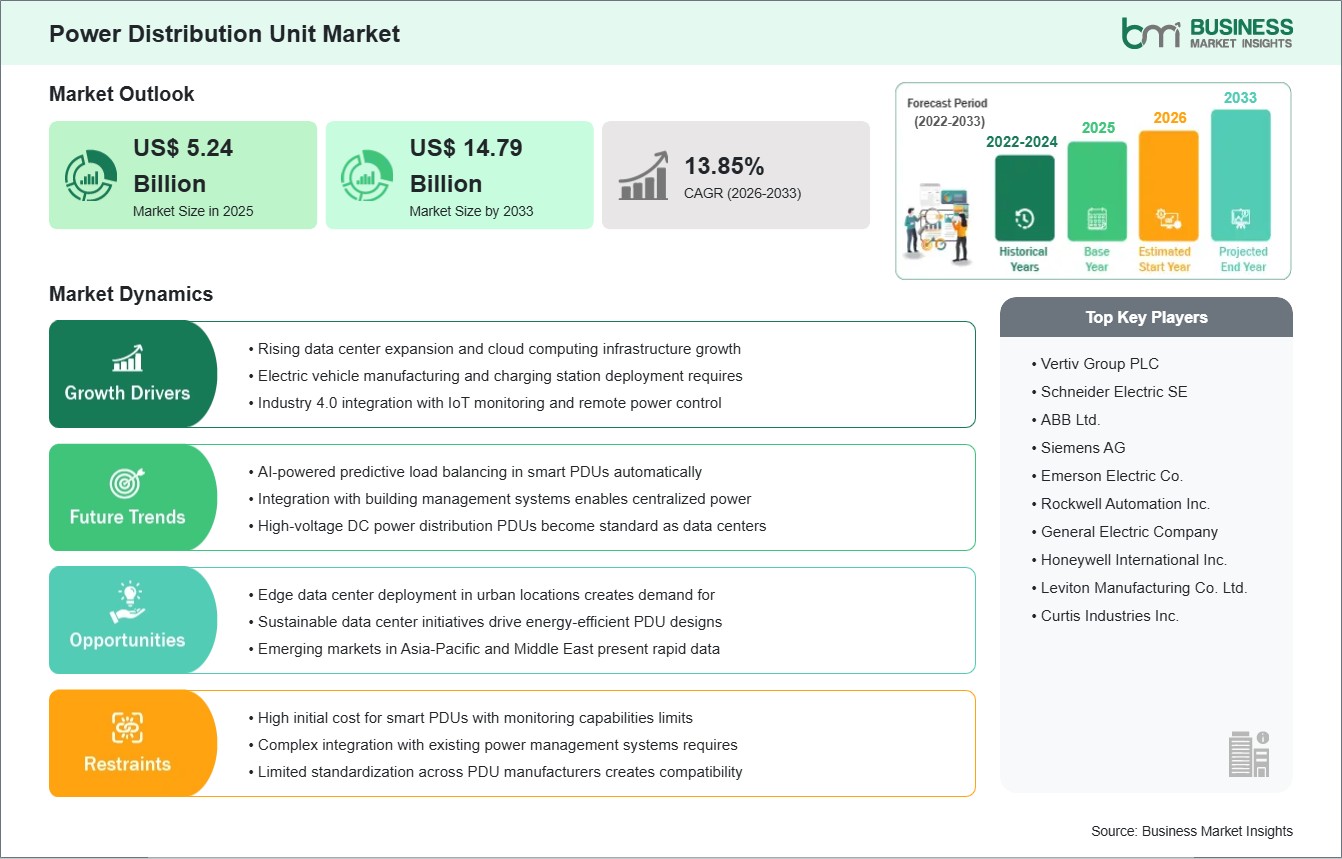
The Power Distribution Unit Market is projected to grow from US$ 5.24 billion in 2025 to US$ 14.79 billion by 2033. The market is estimated to record a CAGR of 13.85% from 2026 to 2033.
This growth path indicates a market supported by the spread of power-sensitive digital infrastructure, stronger interest in monitored distribution, and broader demand for resilient internal electrical architecture. It also reflects the shift toward more intelligent and adaptable unit configurations.
By type, phase, and product format, metered and intelligent solutions hold increasing strategic importance because operators want better visibility and control over distributed loads. Three-phase and rack-mount configurations also maintain strong commercial relevance in dense and technically demanding environments. Basic and single-phase units continue to serve practical needs where complexity and monitoring requirements are lower.
By end user, Telecom & IT represents the strongest demand center due to its concentration of uptime-sensitive and rack-based equipment. BFSI, healthcare, and government environments also maintain strong relevance because of their dependence on continuity and monitored electrical infrastructure. Manufacturing, automotive, and energy applications broaden the market through industrial and control-oriented use cases.
Report Coverage
Power Distribution Unit Market Report Coverage and Deliverables
The "Power Distribution Unit Market Size and Forecast (2022–2033)" report provides a detailed analysis of the market covering below areas:
- Market size and forecast at global, regional, and country levels for all the key market segments covered under the scope
- Market trends, as well as market dynamics such as drivers, restraints, and key opportunities
- Market analysis covering key market trends, global and regional framework, major players, regulations, and recent market developments
- Industry landscape and competition analysis covering market concentration, heat map analysis, prominent players, and recent developments for the market
- Detailed company profiles, including SWOT analysis
Geographic Insights
Power Distribution Unit Market Geographic Insights
The Power Distribution Unit market shows diverse regional adoption patterns influenced by data infrastructure density, power reliability needs, digital transformation, and enterprise facility modernization. Across the global landscape, market development is shaped by the need for safer and more controllable internal power distribution in rack-based, equipment-dense, and uptime-sensitive environments. Regional differences largely reflect digital infrastructure maturity and the pace of intelligent electrical system deployment.
North America remains a leading market because operators in the region continue upgrading data center, enterprise, and institutional infrastructure with monitored and intelligent distribution equipment. Strong demand is supported by the concentration of telecom, IT, BFSI, and healthcare environments that require reliable rack-level and facility-level power management. The region also shows stronger alignment with advanced PDUs that offer remote visibility and higher operational flexibility.
Asia Pacific presents a robust expansion environment as cloud adoption, digital services growth, and enterprise infrastructure investment continue to broaden. Demand is reinforced by data center development, telecom expansion, and industrial digitalization across major economies in the region. This creates strong relevance for scalable rack-mounted, three-phase, and intelligent PDU solutions across both centralized and distributed facilities.
Europe reflects a more efficiency- and compliance-led pattern, with emphasis on energy-aware infrastructure, operational resilience, and structured electrical management within advanced facilities. Enterprises in the region are increasingly attentive to intelligent distribution systems that support monitoring, optimization, and adaptable deployment. Beyond these major regions, emerging markets offer additional opportunity as digital infrastructure expands and organizations strengthen internal power management across critical sectors.
Industry Activity
Recent Developments
The Power Distribution Unit Market is evaluated by gathering qualitative and quantitative data post primary and secondary research, which includes important corporate publications, association data, and databases. Recent developments and news in the market include:
- In June 2026, Vision Marine has improved the manufacturability of its E-Motion Power Distribution Unit and engaged a contract manufacturer to support production planning for a key high-voltage component. The work strengthens E-Motion manufacturing readiness and supports the platform's roadmap toward future compatibility with fast-charging infrastructure for higher-use applications, including commercial operators, boat clubs, rental fleets and marina environments.
- In September 2025, Vertiv, a global leader in critical digital infrastructure, today announced the new Vertiv™ PowerIT rack power distribution units (PDU), an extension of the Vertiv PowerIT product line. These models are designed to address the rising power needs of data-intensive workloads, including AI and high-performance computing (HPC). They provide advanced power management, flexible configurations, and enhanced internal components for greater reliability, enabling data centres to seamlessly scale power in response to growing IT demands. Basic, monitored and switched models are available now in North America, Europe, the Middle East and Africa (EMEA).
Trust & Transparency
Research Methodology
The market analysis combines proprietary research with secondary data from government agencies, company disclosures, regulatory filings, industry databases and expert interviews. Market estimates are validated through data triangulation, cross-market benchmarking and analyst
review.
View Full Research Methodology
Key Sources Referred:
World Bank – Global Trade IndicatorsWorld Trade Organization (WTO)International Monetary Fund (IMF)International Energy Agency (IEA)International Trade Administration (ITA)Company WebsitesCompany Annual ReportsCompany Investor Presentations